
A normal YouTube-style video click-through rate falls between 2% and 10%, with 4% to 6% representing a healthy middle range. A strong CTR matters, but a high number alone doesn't prove that your video is attracting valuable viewers.
That distinction changes how experienced marketers read performance. CTR measures the decision made before the viewer commits to the video, so it reveals how effectively the title, thumbnail, placement, and audience intent work together. It doesn't tell you whether the viewer stayed, trusted the message, or converted.
A video can win the click and lose the audience. The sustainable target is qualified CTR, meaning a click earned by an accurate promise and followed by meaningful engagement.
What Video Click Through Rate Actually Means
For YouTube-style video, a typical video click through rate sits in the broad 2% to 10% range, while 4% to 6% is often treated as a healthy middle and 7% or higher as strong performance, according to industry video CTR benchmarks. Those figures aren't universal targets. They describe a reference range for interpreting how often an impression becomes a view.
YouTube defines impressions CTR as how often viewers watched a video after seeing a registered impression. The platform also explains that the metric includes only views that originate from counted impressions, so it won't always match a rough calculation using total views and total impressions. See YouTube's official explanation of impressions CTR for the measurement boundaries.
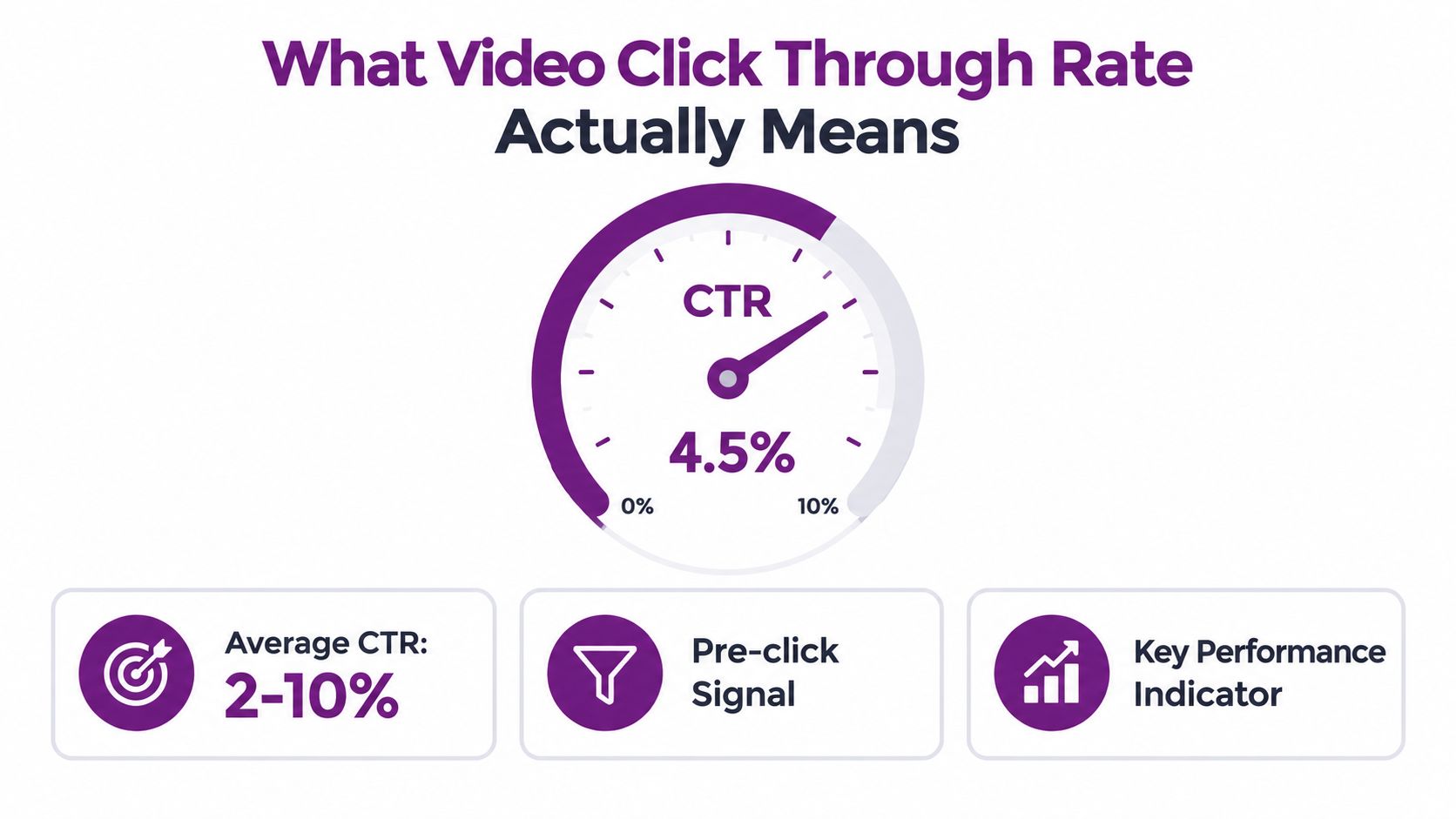
CTR is a packaging signal
CTR primarily evaluates what happens before the watch begins. A viewer sees a visual, reads a title, recognizes a topic, and decides whether the promised value feels relevant enough to justify attention.
That makes CTR a useful diagnostic for:
- Thumbnail clarity: Can someone understand the visual at a glance?
- Title relevance: Does the wording match the viewer's problem or curiosity?
- Audience intent: Is the video appearing in a context where viewers want this subject?
- Positioning: Does the package distinguish the video from competing options?
Production quality still matters, but it can't rescue packaging that fails to communicate. A beautifully filmed product demo may receive few clicks if the thumbnail is cluttered or the title doesn't state the benefit.
Teams using LunaBloom AI's company information can think about the metric in the same way: a thumbnail, title, and metadata create the pre-click promise, while the video must fulfill it. CTR tells you whether the promise earns attention, not whether the complete experience succeeds.
Practical rule: Treat CTR as a verdict on the impression package, not as a complete verdict on the video.
How to Calculate and Interpret CTR Correctly
The basic formula is straightforward:
CTR = clicks from counted impressions ÷ counted impressions × 100
If a platform records an impression and the viewer watches after seeing it, that action contributes to the reported impression CTR. The difficult part isn't the arithmetic. It's knowing which impressions and views belong in the calculation.
YouTube warns that dividing total views by total impressions can produce a different result because not every view comes from a registered impression. Views from sources or surfaces that don't qualify for the impression metric may still appear in total view counts, but they don't belong in the CTR denominator or numerator.
Use the dashboard metric first
Start with the platform's reported CTR rather than building a substitute from broad totals. Then check:
- The date range: Compare equivalent publishing or campaign periods.
- The asset type: Separate long-form video, ads, product demos, and other formats.
- The traffic source: Review browse, homepage, suggested, search, and campaign placements separately.
- The downstream behavior: Pair CTR with retention, watch time, or conversion quality.
Traffic source changes the meaning of the number. YouTube CTR guidance from Switcher Studio describes public benchmark ranges around 2% to 10%, while noting that browse or homepage impressions often sit around 3% to 5% and search traffic can be higher because the viewer has stronger intent.
A package that performs well in search may fail on the homepage because search viewers already expressed a need. Homepage viewers are evaluating your video against many alternatives without an explicit query. That doesn't mean one audience is better. It means the creative must do different work.
Separate discovery from demand capture
For search, make the title closely match the problem or query. For browse and suggested surfaces, make the thumbnail-title combination immediately understandable and differentiated.
Don't average these sources too early. A blended CTR can hide the actual diagnosis:
- Strong search CTR, weak browse CTR: The topic matches demand, but the package may lack broad curiosity or visual clarity.
- Strong browse CTR, weak search CTR: The visual attracts attention, but the title may not communicate query relevance.
- Weak CTR across sources: Investigate the promise, audience fit, and creative quality together.
This segmentation prevents a common mistake, changing a package that already works for one intent group in an attempt to improve an unhelpful overall average.
CTR Benchmarks by Platform and Format
A benchmark is useful only when the comparison is fair. Organic discovery, paid advertising, in-feed autoplay, and search-led viewing don't create the same click decision, so their CTRs shouldn't share one target.
A benchmark set covering Meta video ads, TikTok in-feed ads, and YouTube video ads reports the following platform-specific averages in 2026:
| Platform | Format | Avg CTR |
|---|---|---|
| Meta | Video ads | 1.93% |
| TikTok | In-feed video ads | 0.84% |
| YouTube | Video ads | 0.42% |
The same 2026 video advertising benchmark analysis reports that Meta results varied by industry from 1.37% to 2.36%, while monthly Meta performance moved from 2.03% in February to 1.65% in June. Those changes show why category, seasonality, placement, and campaign objective matter alongside creative quality.
Why the numbers diverge
A YouTube organic video often earns a click from a viewer actively choosing what to watch. A paid in-feed placement may interrupt scrolling, compete with autoplay behavior, or ask for a click that isn't central to the user's session. The denominator may look similar, but the psychological context isn't.
Organic video on high-intent surfaces can materially outperform paid placements, particularly when a viewer is searching for a specific answer or selecting a recommended video. That doesn't make paid CTR inferior. Paid campaigns may optimize for reach, conversions, or qualified traffic rather than a raw click.
For teams running campaigns through LunaBloom AI, the practical implication is to create separate baselines for:
- Social advertising: Judge the ad against its platform, placement, audience, and objective.
- Product demos: Compare similar products and intent stages, not broad channel averages.
- Localized campaigns: Evaluate each language or regional audience independently.
- Organic video: Segment search, browse, and suggested traffic.
A platform average can tell you where to start. It can't tell you whether your specific package is working.
Why High CTR Can Be a Trap Without Retention
The most dangerous CTR mistake is treating every click as a win. A title or thumbnail can create intense curiosity, but if the opening doesn't deliver the promised value, viewers leave quickly and the initial lift becomes a liability.
A 5% CTR with strong retention can outperform a 12% CTR with weak retention. The comparison is a practical reminder that qualified attention matters more than click volume. Recommendation systems can interpret rapid departures as evidence that the package and the experience don't match, while sustained viewing gives the click more value.
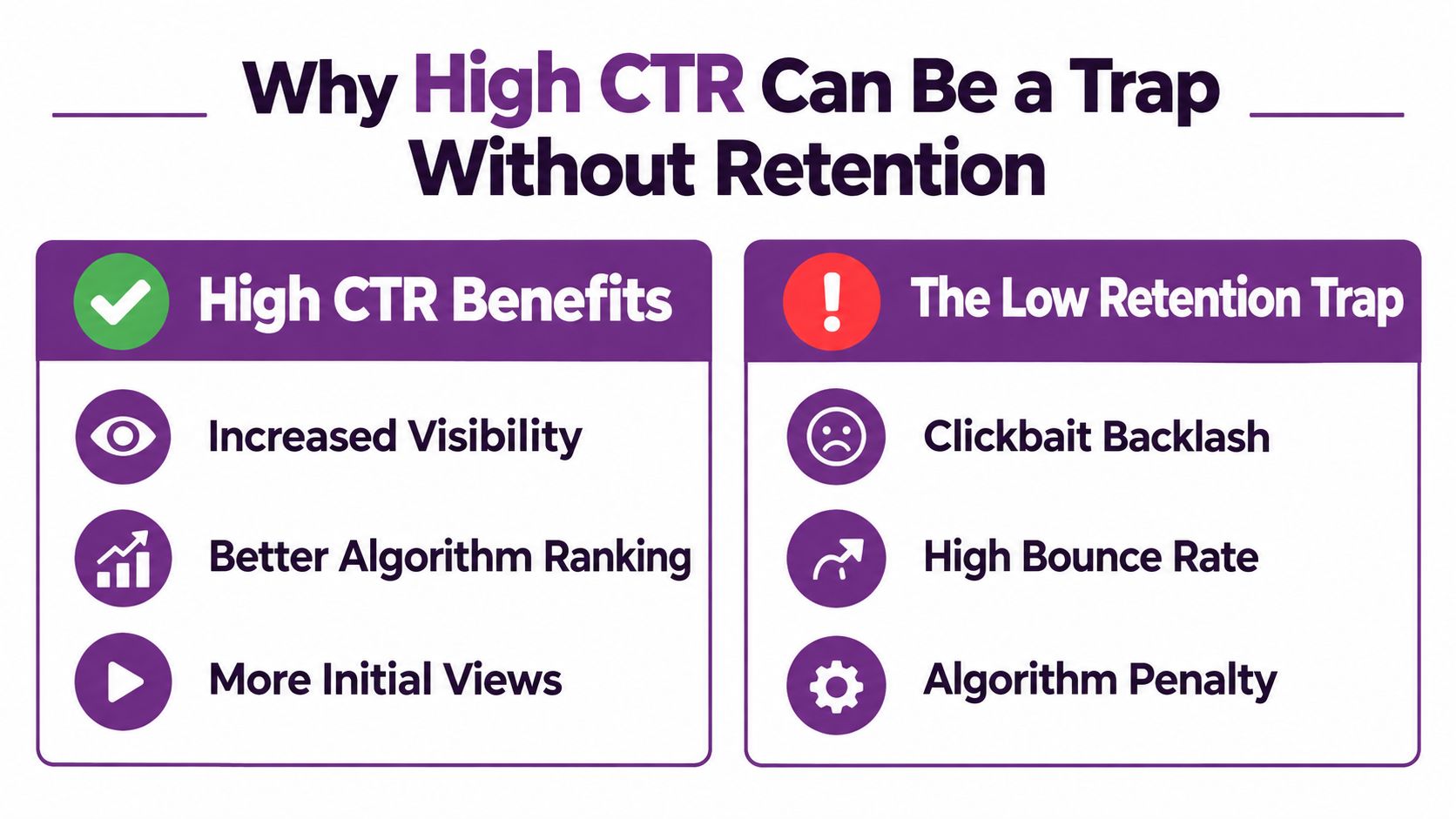
Optimize for the promise you can keep
Clickbait isn't only an ethical problem. It creates an inefficient acquisition path:
- The thumbnail or title generates a click.
- The opening fails to confirm the viewer's expectation.
- The viewer exits before the message develops.
- Retention and satisfaction weaken.
- Distribution or business outcomes suffer.
The trap also appears in paid campaigns. Benchmark reporting cited by TubeBuddy's discussion of YouTube algorithm myths describes a period in which hook rate improved while ROAS fell by about 10%. Early engagement rose, but that didn't guarantee better commercial performance.
This is why I review the first meaningful retention drop beside CTR. If a creative variation earns more clicks but loses viewers immediately, I don't call it a winner. I either revise the opening to fulfill the promise or reject the package.
Track qualified clicks
The better question isn't, “How do I increase CTR?” It's, “Which creative elements increase clicks from people who stay engaged?”
Useful quality checks include:
- Whether the opening confirms the title's promise quickly.
- Whether the viewer reaches the primary explanation or demonstration.
- Whether traffic from the click produces useful actions.
- Whether stronger CTR comes with stable or improving retention.
High CTR is valuable when it opens the right door. It becomes a trap when it persuades the wrong people to enter.
Creative Signals That Drive Video CTR
The strongest CTR improvements usually happen before the viewer sees the video itself. Thumbnail composition, title clarity, contrast, faces, and text density shape the decision at the impression stage.
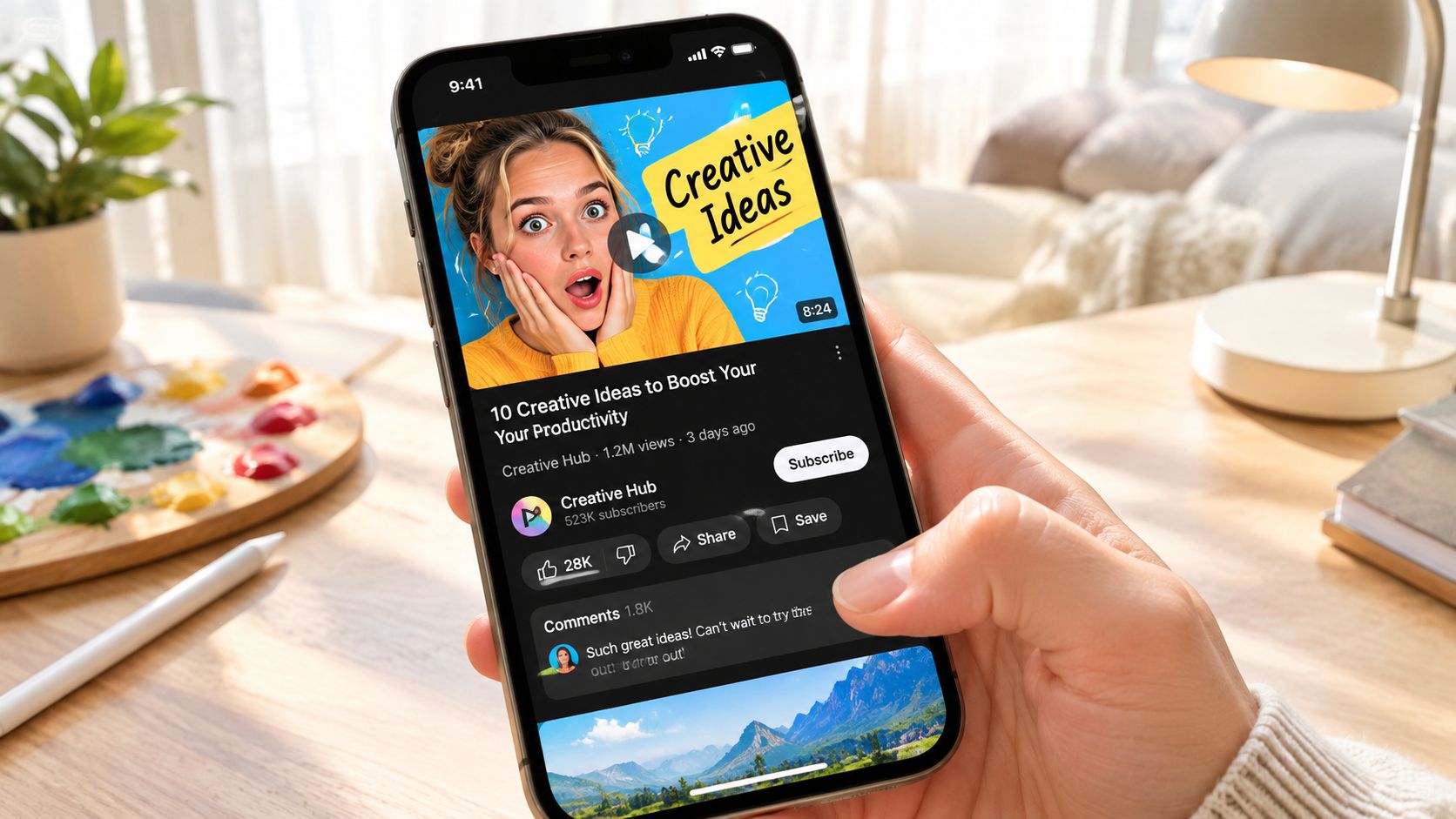
A thumbnail preference study found that brightness, color, visible faces, and low text density tend to support stronger CTR. It also reported that shorter titles around 30 characters produced about 60% more median views, while numeric title patterns underperformed by 11%, as detailed in the thumbnail preference study.
These findings don't mean every title must be short or every thumbnail must contain a face. They identify useful creative variables to test, not rigid formulas.
Build a clear visual hierarchy
A viewer should know what the thumbnail is about without zooming in. Use one dominant subject, strong separation between foreground and background, and text only when it adds information that the title doesn't already provide.
The common failure is trying to explain the entire video in the thumbnail. Small screens punish dense layouts. A single visual conflict, outcome, or recognizable subject usually communicates faster than several competing labels.
Titles should complete the thumbnail rather than duplicate it. If the visual shows the problem, the title can state the consequence or promised result. If the title names the topic, the thumbnail can show the tension or transformation.
Creative test: Remove every thumbnail word that merely repeats the title. Keep text only when it contributes a new piece of meaning.
Modeling work on online video ads also indicates that metadata substantially affects CTR, while the opening seconds and final scene contribute to CTR prediction and downstream ad performance. The practical lesson is that packaging and narrative aren't isolated. The package earns the opportunity, and the opening protects it.
For platform-specific execution, HiveHQ's TikTok Spark Ads guide is useful when adapting creator-led content to paid distribution. Spark-style creative still needs a clear first impression, but the native context changes how much credibility the creator, caption, and opening frame carry.
A disciplined review asks:
- Can the image be understood at mobile size?
- Does the title promise a specific outcome or question?
- Does the first scene deliver evidence of that promise?
- Would the same package make sense to the intended traffic source?
For teams producing multiple versions, LunaBloom AI's contact page is a relevant starting point for discussing workflows that combine generated video, captions, localization, and metadata. The tool choice matters less than maintaining control over the variables being tested.
Actionable Tactics to Diagnose and Fix Low CTR
Low CTR isn't a diagnosis. It's a symptom. The fix depends on whether the problem sits in the thumbnail, title, audience, placement, or the promise delivered after the click.
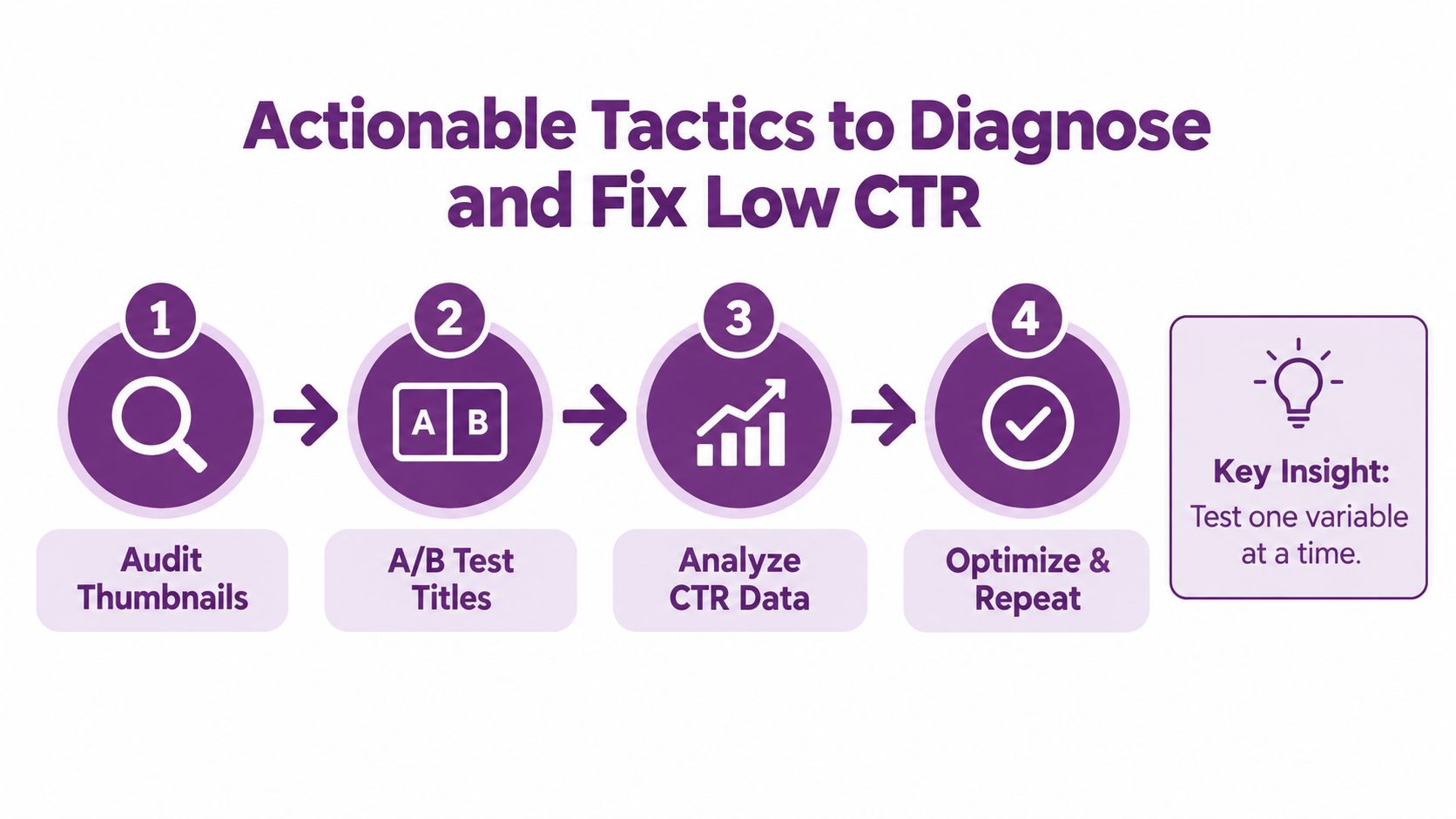
Start with source-level evidence
Pull CTR by traffic source before changing the creative. Compare search with browse, suggested, feed, and paid placements. A weak blended result may hide a strong search package and a weak discovery package, or the reverse.
Then inspect the retention curve. If impressions are high and clicks are low, test the package first. If CTR is healthy but viewers leave at the opening, fix the hook and promise alignment before producing another thumbnail.
Run cleaner creative tests
Use a controlled sequence rather than changing everything at once:
- Audit the thumbnail: Check contrast, face visibility, text density, focal point, and mobile readability.
- Test the title: Change the benefit, specificity, or query match while preserving the thumbnail.
- Compare by source: See whether the change helps search, discovery, or paid traffic.
- Review retention: Keep the variation only if the additional clicks remain qualified.
Testing one variable at a time makes the result interpretable. If the title, thumbnail, targeting, and opening all change together, you won't know what caused the movement.
Improve the distribution fit
A strong package can still produce weak CTR when it reaches the wrong audience. Align the creative with the viewer's stage:
- Problem-aware viewers: Lead with the pain point or question.
- Solution-aware viewers: Show the mechanism, outcome, or comparison.
- Ready-to-buy viewers: Make the product use case and next step clear.
- Localized audiences: Adapt examples, captions, voice, and visual references rather than translating words alone.
Subtitles and translations can expand access, but localization should preserve the original promise. A translated title that sounds unnatural or loses the search intent may reduce qualified clicks even when the video itself is understandable.
For broader measurement planning, XBurst's guide to measuring content effectively offers a useful framework for connecting attention metrics with content outcomes. That connection matters because CTR is an input to the journey, not the final business result.
LunaBloom AI can generate edited videos from prompts, scripts, and images, with voiceovers, captions, localized versions, and SEO-oriented thumbnails, titles, and metadata. Those capabilities can support teams producing variations across social ads, demos, and regional campaigns, but each version still needs source-level measurement and retention review. The platform is available through LunaBloom AI's app.
Use a repeatable review cycle
Every review should answer four questions:
- Where did the impression occur?
- What did the viewer see before clicking?
- Did the opening fulfill the promise?
- Did the click produce meaningful engagement?
That workflow replaces vague optimization with evidence. It also keeps teams from celebrating a cheap click that never becomes attention, trust, or action.
Real-World Example From Low CTR to Sustainable Growth
Consider a brand publishing product demos and social ads that consistently produce 2% CTR but struggle to convert. The number sits within the broad YouTube-style benchmark range, yet the business outcome remains weak, so the team shouldn't assume the package is healthy.
The team segments performance by source and discovers that search viewers respond more readily than feed viewers. Search titles clearly answer the product problem, while the feed thumbnails look generic beside competing creative. The team keeps the search package largely intact and develops a separate discovery version with stronger contrast, a single product use case, and a title focused on the outcome.
The testing loop
They then:
- Run a thumbnail test while holding the title constant.
- Test a shorter, more specific title against the original.
- Compare CTR by source rather than relying on the blended figure.
- Review the opening retention curve for every winning variation.
- Keep only versions that attract clicks without an immediate drop-off.
One version may generate more clicks but lose viewers quickly because the thumbnail implies a dramatic transformation that the demo doesn't show. The team rejects it. Another version earns a more modest click rate but keeps qualified viewers engaged and produces stronger downstream actions. That is the sustainable winner.
The team can use LunaBloom AI's starter app when creating localized or variant assets, while keeping the measurement discipline separate from the production workflow. Automation can make more tests practical, but it can't decide whether a promise is honest or whether an audience stayed for the right reason.
CTR is best understood as one part of a performance system. Packaging earns attention, the opening validates the click, retention confirms relevance, and conversion shows whether the attention mattered.
LunaBloom AI helps creators and marketing teams produce edited videos with voiceovers, captions, localized versions, and SEO-oriented thumbnails, titles, and metadata. Use it to create and test video variations more efficiently, then visit LunaBloom AI to explore a workflow built around qualified clicks and sustained engagement.