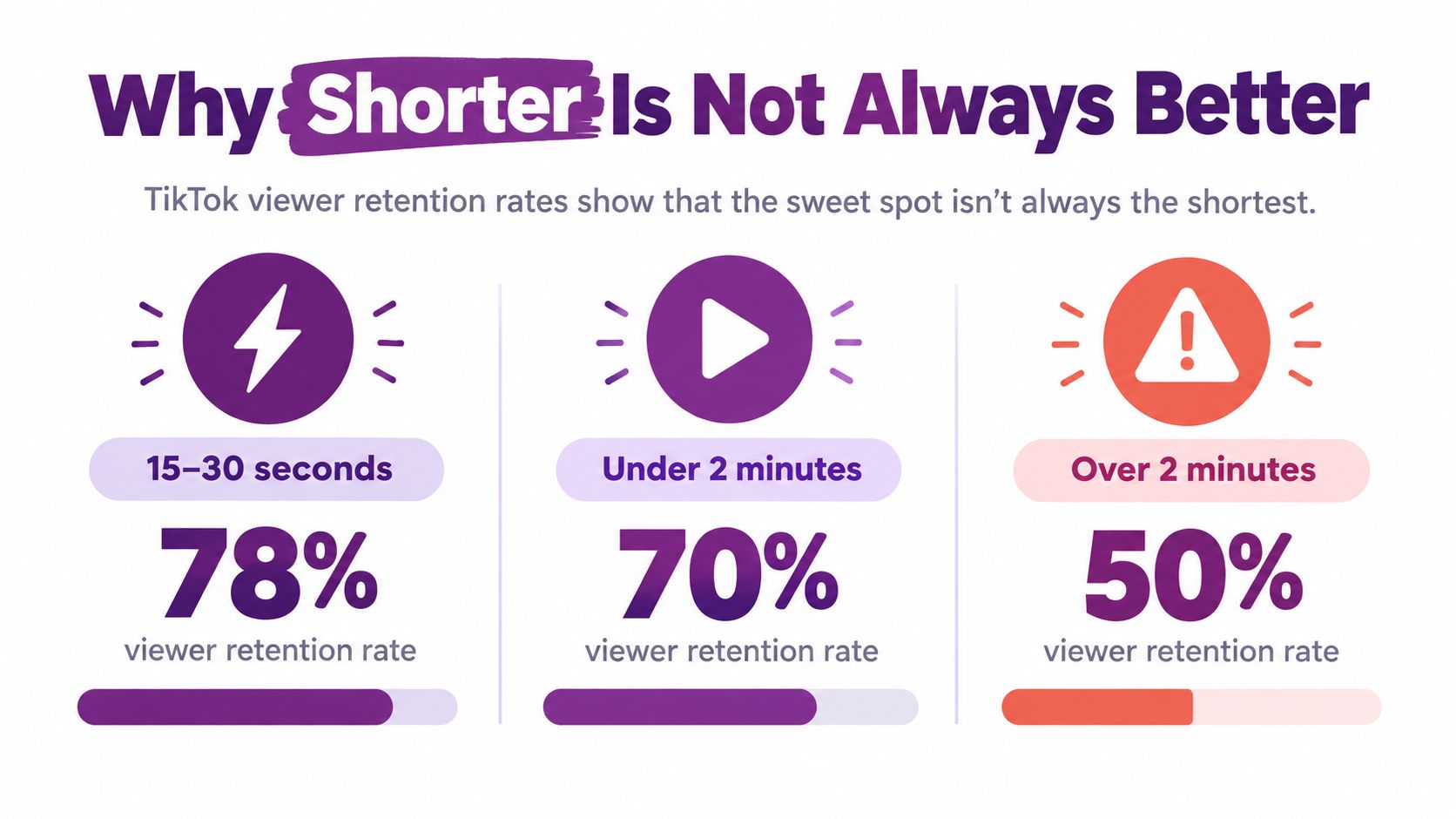
Most creators assume the safest social video is the shortest one. The data says that shortcut can cost you reach. TikTok clips between 15 and 30 seconds achieved the highest engagement rate at 6.00%, while videos between 120 and 180 seconds generated the highest median views, 11,136, roughly 11 times the median for the shortest clips, according to a 2026 short-form video benchmark analysis.
That contrast captures the core problem with social media video length best practices. The right runtime depends on whether you want viewers to interact, watch to completion, discover your brand, learn a process, or take a commercial action. A short clip can win engagement while a longer one earns more total exposure. Treat duration as a performance variable, not a formatting preference.
Why Shorter Is Not Always Better
Shorter videos often win the first interaction, while longer videos can earn more total viewing. A creator can publish the same idea as a fast, 20-second TikTok and as a two-minute explanation with examples. The short cut reduces the effort required to watch and react. The longer cut gives interested viewers more substance and creates more opportunities for recommendation.
The decision depends on the metric you are trying to improve. Optimize for comments, shares, completion, reach, or conversion before choosing the runtime.
Use paired edits rather than guessing. Test a compact version designed to prompt a quick response against a longer version designed to build watch time and explain the subject. Compare completion, shares, comments, and total views side by side. A longer video has not succeeded just because it accumulated more exposure, and a short video has not succeeded because it was easier to finish.
Choose the viewer action first
Define the intended behavior before production:
- Engagement: Present one compact idea that viewers can understand and react to quickly.
- Reach: Use a longer narrative only when curiosity and useful development can sustain viewing.
- Education: Allow enough time to explain the problem and demonstrate the solution.
- Conversion: Keep the proof, demonstration, or objection handling that supports a decision.
A short opinion and a longer tutorial are different products, not competing edits of the same product. Forcing both into one runtime can remove the context that makes a detailed idea useful or the focus that makes a quick idea shareable.
Teams producing longer videos can use ContentBuck YouTube video length tips to connect runtime with topic depth. The editorial rule is direct: remove material that does not serve the promise, while keeping the evidence that makes the promise credible.
Practical rule: Shorten the message until every second earns its place, not until the video reaches an arbitrary limit.
Audience, funnel stage, and subject should shape the final choice. Teams reviewing positioning can consult LunaBloom AI's company information when deciding which ideas warrant a quick clip and which need a fuller explanation.
Platform Length Benchmarks for 2026
Platform limits define what you can upload, not what viewers will finish. Set the first test range around the platform's viewing habits, the video's purpose, and the trade-off between total reach and engagement per viewer.
| Platform | Starting Test Range | Max Length |
|---|---|---|
| TikTok | 15 to 60 seconds | 10 minutes recorded in-app, 60 minutes uploaded from a device |
| Instagram Reels | 45 to 60 seconds | 3 minutes |
| YouTube Shorts | 15 to 60 seconds | 3 minutes |
| Around 2 minutes overall | Platform support varies by format |
TikTok allows videos recorded in the app to run up to 10 minutes, while device uploads can reach 60 minutes, according to this TikTok video-length guide. Those ceilings expand creative options, but they do not make long videos suitable for every audience. Short clips can spread quickly because the commitment is low. Longer stories and tutorials may earn more total reach when their development keeps viewers watching, even if engagement per viewer falls.
Instagram Reels can run up to 3 minutes, yet 45 to 60 seconds remains a practical starting range for testing. That window gives creators room to develop a useful point without demanding the commitment of a full tutorial. YouTube Shorts also deserves separate treatment from standard YouTube videos. A self-contained tip fits the Shorts workflow. Detailed instruction belongs in a longer format when the subject needs evidence, steps, or demonstrations.
Compare reach with engagement
TikTok makes the trade-off clear. A short clip can deliver the central idea quickly, support replays, and invite reactions. A longer investigation or tutorial can reach more people overall when curiosity carries viewers through the added context. Compare total views with completion and interaction rates rather than choosing a duration from the upload limit alone.
Facebook follows a different pattern. Independent analysis found that videos around 2 minutes tended to perform best overall, while videos longer than 3 minutes could generate more comments and views in specific contexts (Facebook video length analysis). Treat those findings as a testing direction, not a fixed rule. Audience intent and topic depth still determine whether extra runtime earns attention.
Track completion beside views before changing the editorial plan. Teams can use this guide on how to measure video completion rates to separate videos that attract plays from those that hold attention through the ending.
For production workflows, LunaBloom AI supports script and image inputs, voiceovers, captions, avatars, localization, and social publishing. Those features can help teams create platform-specific versions without treating every upload as a separate production.
The Critical Importance of Hook Timing
Hook timing determines whether a video earns the chance to be watched. A longer video can perform when its opening makes the value clear before attention drops. A short video can still fail if it spends its first seconds on greetings, branding, or unexplained setup.
Viewer retention is about 70% for videos under 2 minutes and falls below 50% for videos longer than 2 minutes, with a sharp decline between 2 and 3 minutes, according to Cloudinary's video retention guidance. These benchmarks show why reach alone is an incomplete measure. A longer cut may attract views, while a delayed hook reduces the number of people who stay long enough to engage.
Build the first seconds around a promise
Use the opening to answer one practical question:
- What problem will this solve? State the pain point in plain language.
- What will the viewer learn? Name the specific outcome rather than the broad subject.
- Why should the viewer care now? Lead with a surprising result, visible change, or meaningful tension.
“Welcome back to the channel” consumes opening space without offering a reason to continue. “This edit mistake is cutting your completion rate” creates immediate tension and gives the video a clear purpose.
Make the promise visible where possible. A product demo should show the product performing the relevant action. A tutorial can reveal the finished result or the step viewers usually find difficult. A thought-leadership clip should state its position before explaining the reasoning.
Pace the middle around one narrative unit
After the hook earns attention, deliver one connected sequence. Remove repeated context, decorative pauses, and side points that belong in another clip. Captions and visual changes should clarify the message, not add movement without meaning.
Longer runtime earns its place when each segment answers the question raised at the start. If a two-minute explanation introduces an unrelated topic halfway through, viewers receive a natural exit point. That weakens completion and can reduce the engagement that made the extra reach valuable.
This video resource offers another way to think about the relationship between opening structure and mobile viewing:
Finish with one action that matches the viewer's stage. Ask for a comment when the idea invites debate, a save when the information will help later, or a click when the video leads to a deeper resource. Place that action before attention fades, rather than adding a second conclusion after it.
Matching Content Type to Duration
Duration should reflect the viewer's intent and the engagement trade-off each platform creates. Fast entertainment can reach more casual viewers, while a longer explanation may generate stronger retention among people actively seeking an answer. Choose runtime by the value delivered, not by the category label.
- Entertainment and reactions: Start around 15 to 30 seconds. Keep the premise, payoff, and ending in one movement so reach does not come at the cost of weak completion.
- Educational clips: Test up to 60 seconds, extending toward 90 seconds when every added section answers a clear question.
- Product demonstrations: Show the problem, the product action, and the result. Cutting any of these can leave viewers with more uncertainty, even if the video earns broader distribution.
- Tutorials: Split complex processes into focused episodes when a single clip would need padding to cover every step.
- Case-study content: Keep the context, evidence, and outcome together when viewers have enough intent to evaluate the details.
The same platform can serve different jobs
An entertaining Instagram Reel may perform best as a quick visual payoff. An educational Reel for a business account may perform better between 60 and 90 seconds, according to the 2026 short-form video strategy analysis. Treat that range as a test direction, not a default. More time can improve engagement per qualified viewer when the subject requires useful detail, while a casual concept may lose reach and completion if stretched.
Instagram's product information says creators can record and edit one or multiple clips adding up to a maximum of 3 minutes in a Reel (Instagram Reels features). That limit defines available space, not an effective runtime. Use the extra length only when the next section adds evidence, explanation, or a meaningful step.
Match the cut to the viewer's commitment:
- Casual viewers need an immediate payoff.
- Curious viewers will tolerate a short explanation.
- High-intent viewers may stay for a tutorial, demo, or detailed comparison.
If the idea needs more time than the feed context supports, publish a concise entry point and send interested viewers to a fuller destination. The short video must still provide a complete takeaway. Withholding all value makes it feel like an advertisement and can weaken engagement.
For teams producing educational assets quickly, LunaBloom AI's starter app can turn scripts and visual inputs into edited videos with voiceovers and captions. Automation can create alternate cuts, but the editorial decision remains human: give each point 20 seconds or 90 only when the viewer receives proportionate value.
Testing, Measuring, and Refining
No benchmark can identify your audience's exact stopping point. The reliable method is controlled comparison. Keep the core idea similar, vary the runtime, and watch what happens to completion, shares, comments, and meaningful clicks.
A 2026 industry synthesis reported that about 65% of viewers finish videos under one minute, compared with 20% for videos longer than 20 minutes (social video length guidance). That comparison isn't a prescription for every format. It shows why runtime should be tested against the viewer's willingness to commit.
Design a clean length test
Change one major variable at a time:
- Choose one content premise. Use the same lesson, offer, or argument.
- Create different cuts. Compare a concise version with a fuller version that preserves the same promise.
- Keep the hook strong in each cut. Don't make the shorter edit the only version with a clear opening.
- Track several outcomes. Review completion, average watch behavior, shares, comments, saves, and the action that matters to the campaign.
- Inspect the drop-off point. A sharp exit after the hook may indicate weak delivery. A late decline may indicate that the video has reached its natural endpoint.
A video with more views isn't automatically the winner. If the campaign needs qualified clicks or conversations, the version that earns fewer casual plays may still create more useful action. Define success before you compare results.
Use retention curves as editorial feedback
Retention data can reveal problems that editing alone won't. If viewers leave when the speaker starts explaining background, move the result earlier. If they remain through a demonstration but leave during the call to action, shorten the ending and make the next step clearer.
A scholarly paper found a statistically significant inverted U-shaped relationship between video length and engagement, with an optimal length of 34.69 seconds (scholarly video engagement paper). Treat that figure as a useful reference point, not a universal target. Your subject, platform, audience familiarity, and opening quality can shift the useful range.
Measurement principle: Don't ask whether a video is short enough. Ask where viewers stop receiving value.
Once a pattern appears across comparable posts, update the brief for future scripts. Teams that want help translating those findings into a repeatable workflow can contact LunaBloom AI about their production needs. The important practice is the testing loop, not the specific software.
Repurposing and Maximizing Reach
A strong source video shouldn't produce only one upload. Build a central version around the complete idea, then cut platform-specific edits that preserve one narrative unit per clip.
A 60-second tutorial, for example, can become three 20-second tips, each with its own hook and payoff. The complete version can remain available for viewers who want the full process. This approach tests different lengths against the same underlying message without forcing every audience into the same viewing experience.
Repurpose by audience intent
- TikTok: Extract the most immediately useful or surprising step.
- Instagram Reels: Shape a self-contained explanation around the visual payoff.
- YouTube Shorts: Give the viewer a complete answer, then point to the longer resource only when it adds genuine depth.
- Facebook: Preserve more context when the story or explanation benefits from a broader setup.
The edit should be native to the destination. Don't just crop a long video and assume the result works everywhere. Rewrite the opening, adjust captions, remove references to another platform, and make the final action relevant to the audience in front of you.
Guidance on short-form content strategy for streamers is useful here because repurposing works best when each cut has a defined role rather than being a random excerpt. A clip should answer a question, demonstrate a step, or create a clear reason to continue.
LunaBloom AI can support this workflow through its video creation app, which turns scripts, prompts, and images into edited videos with captions, voiceovers, avatars, and publishing features. Use automation to create and localize variations, then use analytics to decide which runtimes deserve more production attention.
Length is a variable to test, not a rule to follow. Start with a platform-appropriate window, place the value in the opening, measure the action you need, and keep the version that earns meaningful attention.
LunaBloom AI helps creators and marketing teams turn scripts, prompts, and images into edited social videos with natural voiceovers, captions, avatars, localization, and one-click publishing. Visit LunaBloom AI to create platform-specific video versions and test duration without rebuilding every asset from scratch.