The most popular advice about voice cloning models is also the least reliable: provide a short recording, press generate, and expect a perfect copy of someone's voice. Modern systems can produce remarkably natural speech from limited audio, but naturalness isn't the same as identity. A voice may resemble the target while drifting in emotion, cadence, pronunciation, or vocal character. For teams building products with synthetic speech, that distinction matters more than a polished demo.
The Reality of Voice Identity Replication
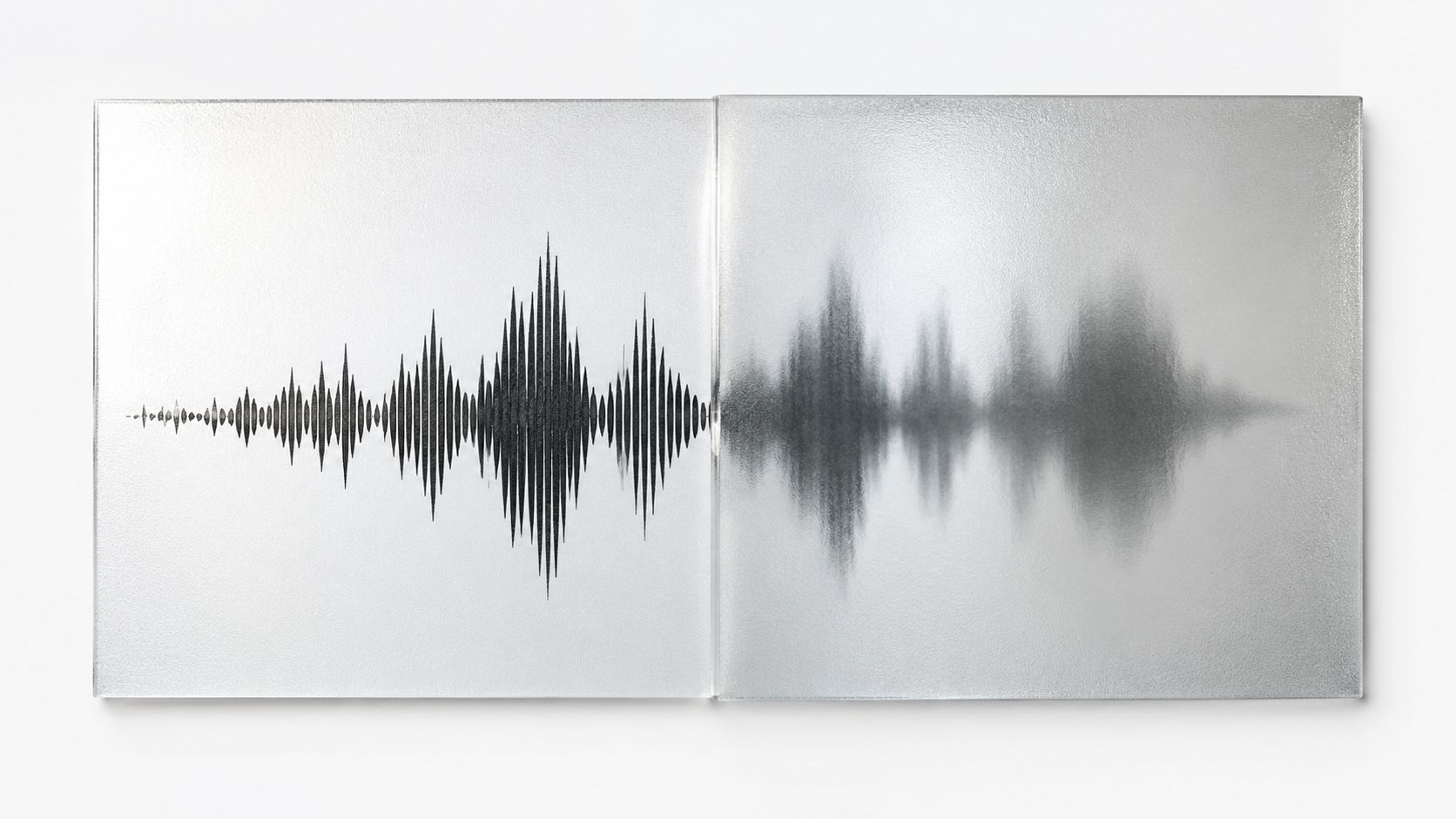
A common assumption is that a voice cloning model creates a one-to-one acoustic duplicate. In practice, many systems produce something closer to style transfer. They learn patterns associated with a speaker, then combine those patterns with the model's existing representation of tone, rhythm, emotion, and delivery.
That's why a generated voice can sound familiar without being a faithful copy. It may preserve a recognizable pitch range or vocal texture, yet change how the speaker expresses confidence, warmth, hesitation, or authority. A voice created for a short marketing sentence might sound convincing, then feel noticeably different when it reads a long explanation or an emotionally difficult line.
Similarity is not identity
A 2026 arXiv study found that widely used voice-cloning models systematically apply style transfer rather than perfect identity replication. Human raters perceived the cloned voices as more authoritative, warm, customer-service-like, and human-like than the source voices, according to the study on style transfer in voice cloning.
That finding changes how product teams should evaluate output. A model may not be reproducing the speaker's identity as much as it's generating a socially optimized interpretation of that identity. The result can sound more polished, more confident, or more suitable for a customer-facing context than the original recording.
Practical rule: Treat “sounds like the speaker” and “is acoustically faithful to the speaker” as separate acceptance criteria.
For creators, the difference affects audience trust. If a familiar presenter suddenly sounds unusually authoritative or cheerful, listeners may notice even when they can't explain why. For businesses, the distinction affects consent, brand consistency, and disclosure. A model that transfers style rather than identity still uses characteristics associated with a real person, so teams should document whose voice was used, what permissions apply, and where synthetic output will appear. A clear vocabulary for voice-related terms and concepts can help teams avoid treating every resemblance as a perfect clone.
Tracing the Evolution of Speech Synthesis Architectures
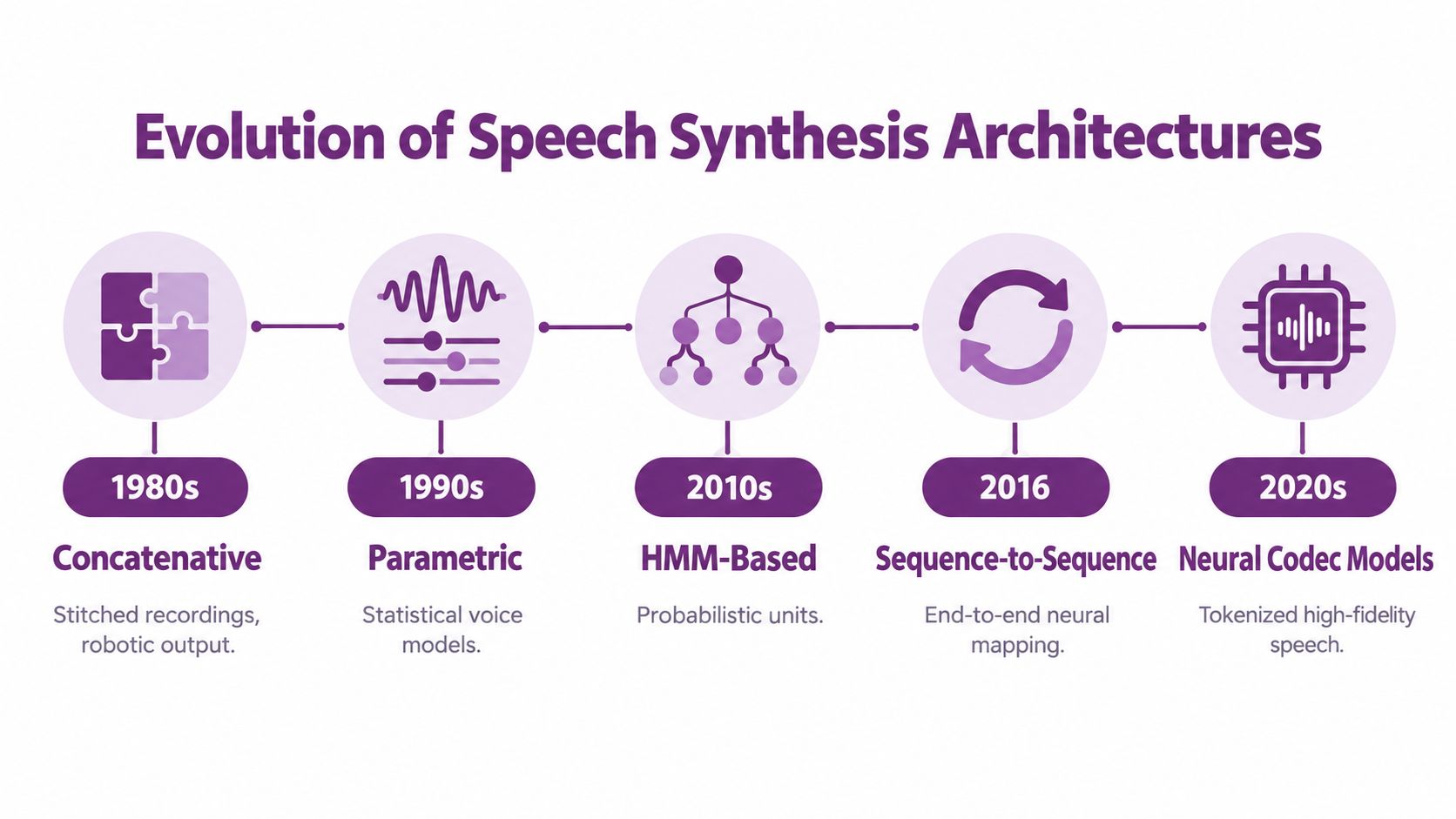
Voice cloning models didn't appear as a single invention. They grew out of several generations of speech synthesis, each solving a different limitation.
Early concatenative systems assembled speech from recorded fragments. Developers recorded a voice saying many sound units, then stitched those units together to form new words and sentences. The approach could sound clear when the requested phrasing matched the available recordings, but transitions often felt mechanical. The system had little ability to express a new emotion or adapt naturally to unfamiliar text.
Statistical and parametric systems in the 1990s and 2000s modeled speech characteristics rather than directly replaying stored fragments. They offered more flexibility, but their output often had a constrained, synthetic quality. The model represented a voice through statistical parameters, which made generation easier to control but limited the richness of the resulting waveform.
The neural shift
Neural systems changed the problem from selecting and manipulating predefined speech units to learning a mapping between language and audio. A major milestone arrived in 2016, when DeepMind's WaveNet helped establish neural text-to-speech as a breakthrough approach. Instead of producing speech through heavily engineered rules, WaveNet modeled the audio waveform directly, allowing much richer timing, texture, and pronunciation.
The important change wasn't just that speech sounded more natural. Neural architectures could learn reusable representations across speakers. A multi-speaker model could separate content from characteristics such as pitch, timbre, and delivery, then apply those characteristics to new text.
Why less reference audio became possible
Between 2017 and 2020, multi-speaker and transfer-learning systems reduced the target-speaker audio needed for adaptation. Earlier approaches could require tens of hours or minutes of recordings, while later systems could work with roughly 30 minutes for some adaptation workflows or even a few seconds in zero-shot setups, as described in this overview of voice cloning's technical evolution.
The product implication is straightforward. Modern systems don't need to learn speech from scratch for every person. They start with broad knowledge learned from many voices, then use a reference recording to steer generation toward a target speaker.
That efficiency also creates risk. A model that needs very little audio lowers the barrier for legitimate creators, but it can lower the barrier for impersonation too. Architecture determines not only quality and speed, but also how much consent-sensitive material a system requires before it can produce persuasive speech.
Comparing Zero-Shot and Fine-Tuning Approaches
The choice between zero-shot generation and fine-tuning is a decision about speed, control, and consistency.
A zero-shot voice cloning model receives a short reference clip and generates a speaker embedding on the fly. The embedding is a compact representation of vocal characteristics that guides the model during synthesis. The model's weights stay unchanged, so the process is fast and convenient for testing different voices or producing one-off content.
Fine-tuning takes a different path. The system updates model weights using a larger dataset from the target speaker. That extra adaptation can improve consistency across pronunciation, rhythm, and longer passages, but it requires cleaner data, more processing, and a stronger consent process.
| Method | Audio Required | Best Use Case |
|---|---|---|
| Zero-shot | About 3 to 20 seconds for a reference clip | Fast experiments, short content, temporary voice matching |
| Light fine-tuning | Roughly 30 minutes of audio | Repeated production with a more consistent voice |
| Deeper adaptation | About 15 minutes to more than 3 hours, depending on the workflow | Long-term voice use where stability and adaptation matter |
These ranges are summarized in an independent lesson on zero-shot cloning and fine-tuning.
Choose zero-shot for speed
Zero-shot is useful when the team needs to answer an early product question: Can this voice work for the concept at all? A short, clean recording may be enough to test a narrator for a prototype, generate a draft localization, or compare several delivery styles.
The trade-off is that the output may shift between sentences. Background noise, unusual pronunciation, emotional changes, and long-form structure can expose weaknesses. A voice that performs well in a short sample may not hold its identity through a complete training module or a series of product videos.
Choose fine-tuning for repeatability
Fine-tuning makes more sense when the same voice will appear repeatedly across a library of content. It gives the system more target-specific material to learn, which can reduce variation and support a more stable production workflow.
More data doesn't automatically guarantee a faithful identity. Recording quality, script coverage, speaking style, and the model architecture still matter. A dataset full of inconsistent microphones, background noise, or radically different delivery styles can teach the system conflicting signals.
A practical decision sequence looks like this:
- Prototype with zero-shot output. Test pronunciation, tone, and the intended audience response.
- Measure repeatability across varied scripts. Include names, numbers, questions, long sentences, and emotionally different lines.
- Fine-tune only when the workflow justifies it. Use a controlled dataset and document the speaker's authorization.
- Revalidate after adaptation. Fine-tuning can improve one behavior while introducing another, so compare before and after across the same test set.
Evaluating Model Performance and Resilience
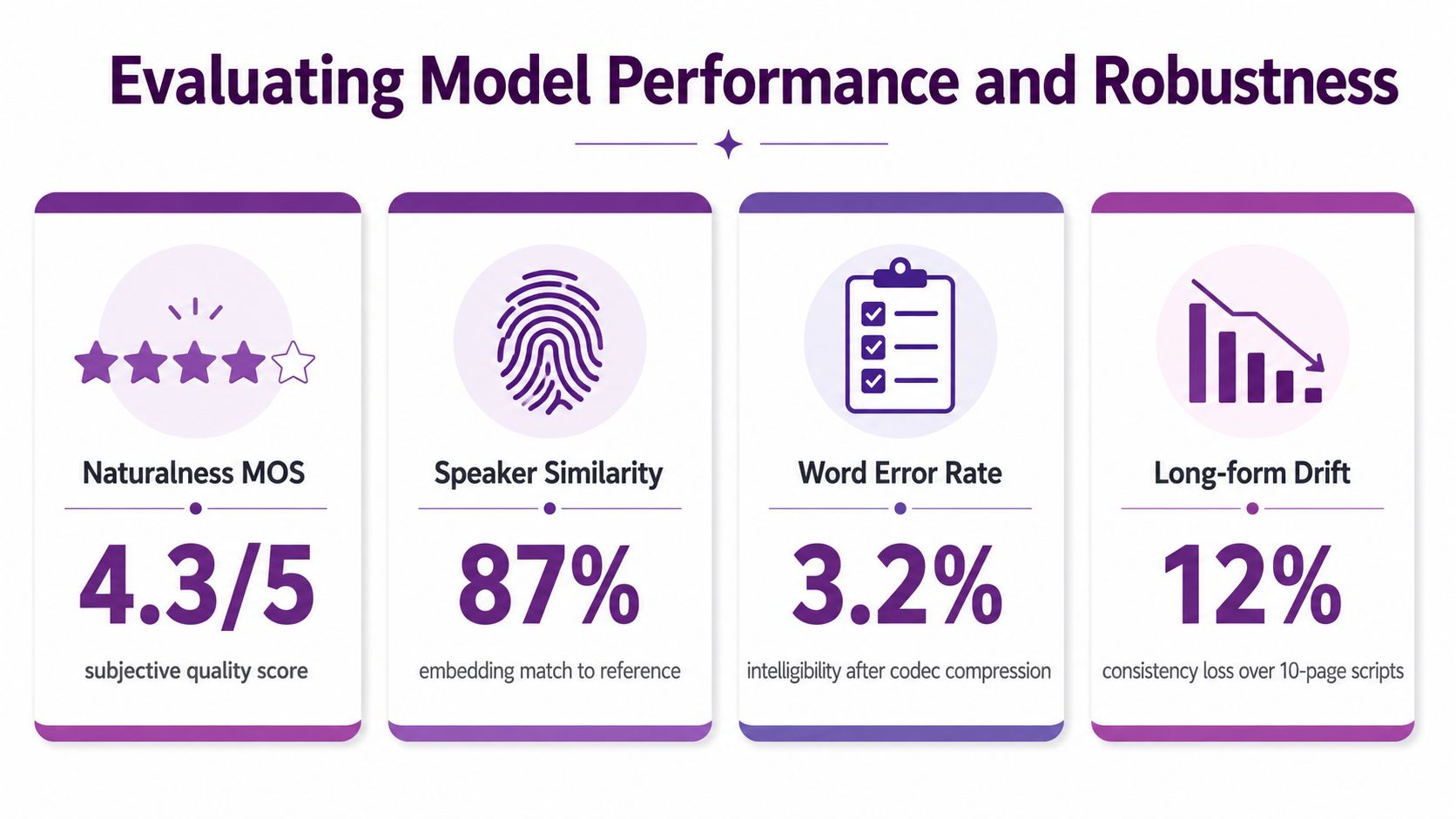
A voice cloning model can sound convincing in a controlled demo and still fail in production. The demo may use a short sentence, a clean recording path, favorable text, and no downstream processing. Real deployments add long scripts, resampling, compression, edits, background music, and unfamiliar language patterns.
That is why reliability deserves equal or greater attention than naturalness. Naturalness asks whether the speech sounds human. Reliability asks whether the system keeps content, identity, and timing intact when conditions change.
What serious evaluation tests
RVCBench examines 18 stress-test dimensions across 204 speakers and 14,370 utterance-level items, according to the RVCBench research paper. That kind of matrix helps surface failures that a polished demo can hide.
The main checks are straightforward:
- Content consistency: Does the generated speech still match the script?
- Speaker similarity: Are the target voice traits still recognizable after more than a short sample?
- Long-form stability: Do identity, rhythm, and vocal quality stay steady across extended speech?
- Post-processing resilience: Do resampling and downstream audio steps damage the result?
- Adversarial resistance: Can deliberate manipulation expose weaknesses?
- Detector-facing separability: Does the output behave differently in systems designed to distinguish synthetic audio?
Test the deployment path
A model should not be approved only from files exported directly from its own interface. Test the audio after the same transformations it will face in the product.
For a video workflow, that may include editing, loudness normalization, music mixing, subtitle generation, platform encoding, and social publishing. For a customer-support workflow, it may include telephony compression and noisy playback. Each transformation can affect perceived identity and intelligibility.
Use a test matrix that covers:
- Short and long scripts.
- Neutral, excited, apologetic, and instructional delivery.
- Names, abbreviations, numbers, and uncommon words.
- Different sample rates and output formats.
- Multiple speakers and languages, where relevant.
- Human review plus automated checks for transcription accuracy and consistency.
A product team can use a starter workflow such as this practical app resource to organize experiments, but the acceptance criteria should come from the actual deployment environment. Resilience is not a model-card adjective. It is a release requirement.
Real-World Applications for Creators and Enterprises
Voice cloning models add the most value when they reduce repeat recording work without taking editorial control away from people. A creator can approve one narration style, then adapt scripts for new campaigns without rebuilding the voice from scratch. A training team can update a module without pulling the original presenter back into the studio.
For content creators, the main uses are straightforward:
- Localization: Produce versions of a video for different languages and regional accents while keeping a familiar presentation style.
- Content updates: Change a product detail without rerecording an entire explanation.
- Short-form production: Create narrated social ads, explainers, and product demonstrations from approved scripts.
- Accessibility: Offer an audio version of written content in a consistent, recognizable voice.
Enterprises use synthetic speech in onboarding, internal communications, customer education, and training. A company might pair a custom avatar with a cloned voice, then automate lip synchronization, captions, translations, and editing. That shortens the path from a reviewed script to a finished training asset, but only if voice approval stays inside the content workflow.
The production model matters as much as the use case. Teams need a human checkpoint for pronunciation, tone, factual accuracy, and disclosure. They also need a way to revoke a voice, replace an outdated version, and identify which assets were generated from it.
The following video shows how voice-driven video production can fit into a broader creative workflow:
A platform such as LunaBloom AI can generate edited videos from scripts, prompts, and images, with voiceovers, captions, avatars, localization, and social publishing features included in the workflow. The key question is whether the team can keep review, consent, version control, and brand standards attached to every generated asset.
Production insight: Automating narration is easy. Automating accountability is not.
Navigating Security Risks and Ethical Boundaries
Voice authentication systems often assume that a voice signal is difficult to reproduce. That assumption no longer holds reliably. A cloned recording can resemble the enrolled speaker closely enough to challenge systems that perform well on genuine human speech.
A large evaluation found that open-source cloning models trained from only a few minutes of target speech and a single V100 GPU achieved high spoofing success against a state-of-the-art speaker-verification model. Reported bypass rates were 56.2% for GPT-SoVITS, 82.7% for Bert-VITS2, and 43.1% for RVC, as detailed in the speaker-verification security study.
The same research reported that the verifier maintained a 0.01% false acceptance rate for genuine users, yet still failed to distinguish some high-quality synthetic speech. The lesson is important: strong biometric performance on real voices doesn't prove resistance to generated audio.
Why detection isn't enough
People often ask how they can spot a clone by listening. That's the wrong control for a high-risk workflow. Recent reporting says the FBI recorded over 22,000 AI-attributed complaints in 2025, while reported losses from AI voice and video scams approached $893 million. Research summarized in the same voice-cloning fraud analysis also notes that no reliable, precise mechanism currently detects all modern neural voice cloning.
A listener may notice an unnatural pause, odd pronunciation, or emotional mismatch. But a convincing sample can pass casual inspection, especially when the recipient expects an urgent call or familiar voice. Financial approval, password recovery, and executive authorization therefore need a second channel.
Consent and regulation
Ethical use starts before generation. A person's voice is not just an audio file. It can function as an identifier, a representation of personality, and a source of authority in a relationship with an audience.
In the United States, the Federal Trade Commission launched its Voice Cloning Challenge in 2024 and selected four winners focused on harms from AI-enabled voice cloning, as described in the FTC's consumer-protection initiative. China's deep-synthesis rules, which took effect on August 15, 2023, require relevant providers to implement content labeling and obtain appropriate authorizations for training data involving personal information, according to this independent regulation review.
For teams handling recordings, a clear privacy framework should cover consent scope, retention, permitted channels, revocation, disclosure, and access controls. Legal compliance varies by jurisdiction, but responsible product design should assume that permission must be specific, documented, and easy to audit.
Building a Responsible Voice AI Strategy
A responsible voice AI program treats synthetic speech as a controlled production capability, not as a novelty feature. The goal isn't to identify every fake by ear. The goal is to reduce the damage when audio is copied, transformed, or misused.
Start with a written voice register. Record:
- Ownership and consent: Who supplied the voice, what use was authorized, and whether commercial, internal, or public distribution is allowed.
- Technical lineage: Which reference files, model, adaptation method, and generation settings produced each approved voice.
- Release boundaries: Which channels can publish the output and which uses require additional review.
- Revocation rules: How the team disables a voice and updates published assets if consent changes.
Next, separate low-risk creation from high-risk decisions. Synthetic narration for an approved product tutorial can follow a normal editorial review. A request to approve a payment, reset access, or share confidential information should never rely on voice similarity alone.
Use layered verification:
- Confirm the request through a separate channel. Call a known number, use an established workspace, or require an authenticated application action.
- Use challenge-response carefully. A changing prompt is stronger than replaying a fixed phrase, but it shouldn't be treated as a complete defense against advanced synthesis.
- Require human approval for sensitive actions. Establish thresholds for money movement, account recovery, legal commitments, and access to private data.
- Preserve provenance. Store generation records and apply clear labeling where synthetic media may affect audience interpretation.
- Monitor published assets. Search for unauthorized reuse, review unusual requests, and keep an incident process ready.
Operational rule: If the consequence of being wrong is serious, voice similarity must be evidence, never the final authorization.
Teams should also evaluate vendors against their own threat model. Ask how they handle consent, deletion, access, model training, audit logs, output labeling, and account recovery. The LunaBloom AI overview can help prospective users understand the platform context, but every organization still needs its own approval policy and risk controls.
The most durable strategy combines technical testing with governance. Validate long-form output, test post-processing, document every approved voice, and teach staff that a familiar voice can still be an untrusted signal.
LunaBloom AI helps creators and businesses turn scripts, images, and prompts into edited videos with custom voices, avatars, captions, localization, and social publishing workflows. If you're planning voice-enabled content, visit LunaBloom AI to explore a production workflow that keeps creation, review, and publishing in one place.