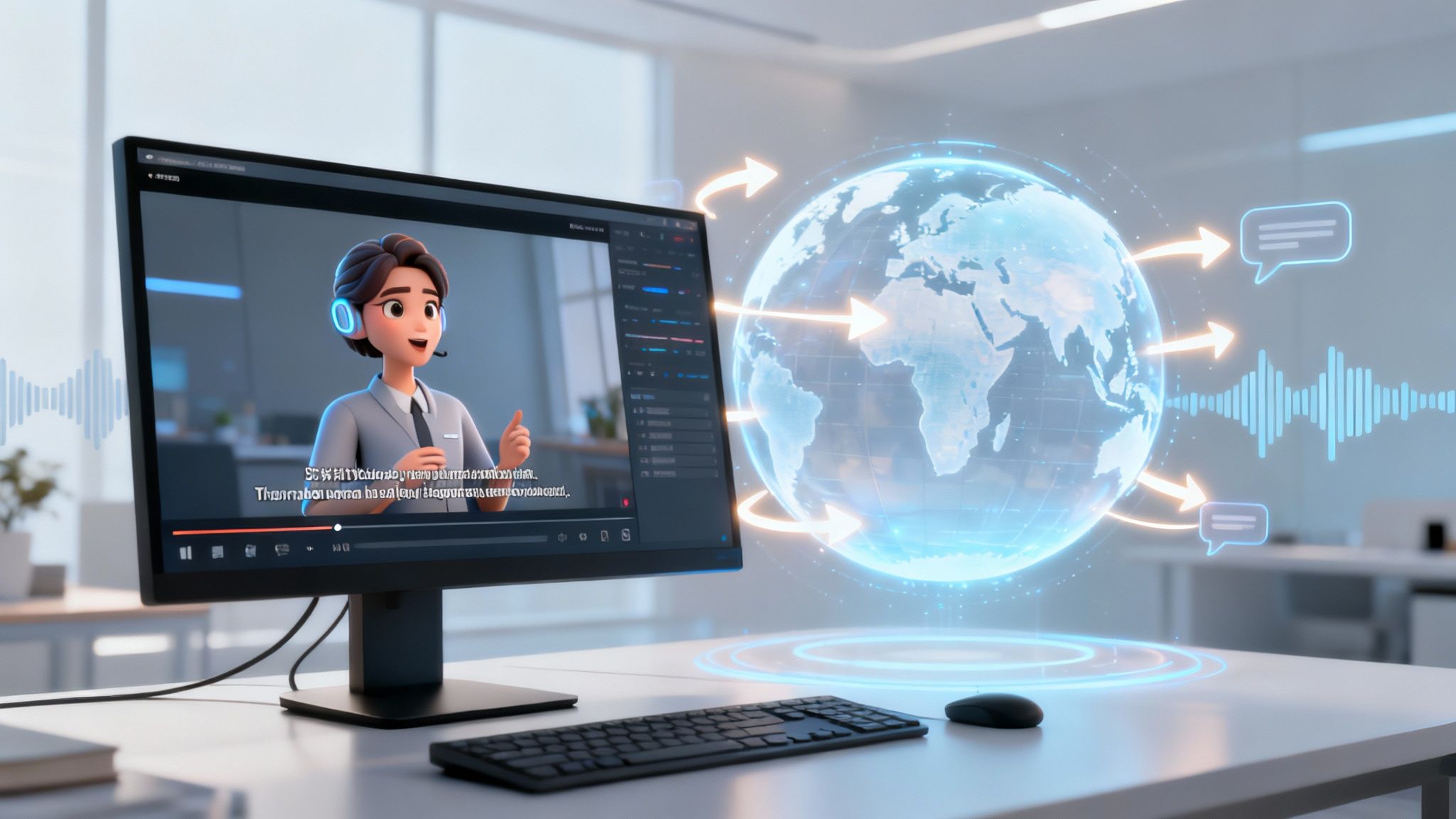
A video translation service adapts your video content for audiences who speak different languages. It’s much more than just swapping out words; it involves a detailed process of subtitling, dubbing, and localizing on-screen text and cultural references to ensure your message truly connects on a global scale.
Think of it less like a dictionary and more like a cultural interpreter for your brand. This guide will walk you through everything you need to know.
Why Do You Need a Video Translation Service?
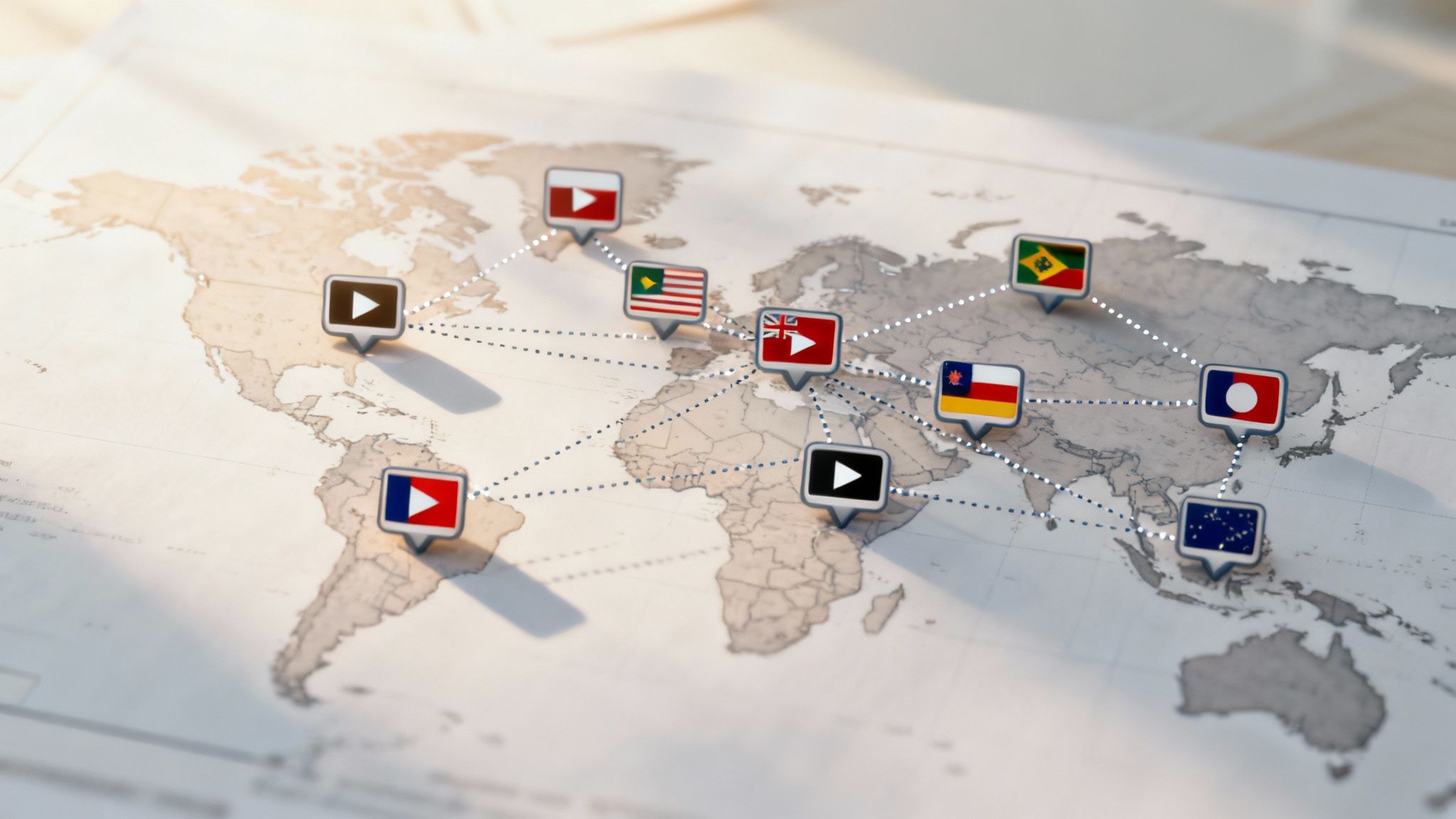
We live in a world where video is the primary way people learn, shop, and connect. If your content is stuck in a single language, you’re missing out on a massive global audience. A professional video translation service acts as a bridge, turning a language barrier into a significant growth opportunity.
The goal is to make your content accessible and feel natural to viewers, no matter where they are. This isn’t about slapping on automated, word-for-word translations. It’s a careful process that preserves your original intent, tone, and impact.
Expand Your Global Reach
The demand for multilingual video isn’t a fleeting trend—it’s a fundamental shift in business strategy. This is reflected in the market itself, which was valued at $1.7 billion and is projected to explode to $4.5 billion by 2033. This growth highlights how vital translation has become. You can explore more insights on Verified Market Reports.
To tap into this potential, a good video translation service bundles several key components.
Here’s a quick overview of what these core services are and what they’re used for.
Core Components of a Video Translation Service
|
Service Component |
Description |
Best For |
|---|---|---|
|
Subtitling |
Adding text captions in the target language, usually at the bottom of the screen. |
Social media videos (where many watch with sound off), accessibility, and SEO. |
|
Dubbing & Voice-overs |
Replacing the original audio with a new voice track recorded in a different language. |
Immersive experiences like training modules, e-learning courses, and feature films. |
|
On-Screen Text Localization |
Adapting any text appearing directly in the video (graphics, titles, calls-to-action). |
Ensuring a seamless, native feel for graphics-heavy marketing or instructional videos. |
These elements work together to create a completely localized experience for the viewer.
A great translation service ensures your message is not just understood, but truly felt. It captures the cultural idioms, humor, and regional nuances that automated tools miss, making your content feel like it was made just for them.
Key Benefits for Your Brand
Investing in a video translation service brings tangible benefits that extend beyond simply reaching a larger audience. It directly impacts how people in new markets perceive your brand.
By speaking your audience’s language, you show respect for their culture, which is a fast track to building trust and credibility.
This approach leads to higher engagement, better message comprehension, and a potential boost in conversion rates. Whether you’re a marketer launching a global campaign, an educator sharing knowledge, or a company training an international team, professional translation ensures your video assets perform optimally everywhere.
Subtitling vs. Dubbing vs. Localization: What’s the Difference?

When you decide to take your video content global, you’ll encounter three core methods in any professional video translation service. Think of them as different tools—each designed for a specific job. The right choice depends on your audience, budget, and goals.
Let’s start with subtitling. This involves adding text to video translations at the bottom of the screen. It’s fast, cost-effective, and excellent for accessibility.
Plus, subtitles provide search engines with a text-based version of your video to crawl, which can give your SEO a nice boost. They are especially critical on social media, where up to 85% of videos are watched with the sound off.
Open vs. Closed Captions
When it comes to subtitles, you have two main options:
-
Open Captions: These are burned directly into the video file. Viewers can’t turn them off, which guarantees they are seen but offers no flexibility.
-
Closed Captions (CC): These are delivered as a separate file, so viewers can toggle them on or off. This is the modern standard for platforms like YouTube and gives users control over their experience.
Next is dubbing, a more immersive and complex process. Instead of adding text, dubbing replaces the original speaker’s voice with a new audio track in the target language.
Dubbing isn’t just about replacing words; it’s about creating a seamless experience where the audience feels the content was made just for them. It closes cultural gaps in a way subtitles sometimes can’t.
The Nuances of Dubbing
Not all dubbing is the same. A good video translation service will use two primary techniques:
-
Lip-Sync Dubbing: This is the gold standard. The translated script is meticulously timed to match the on-screen speaker’s lip movements. It’s the go-to for films, dramas, and high-production marketing videos where realism is paramount.
-
Voice-Over Narration: This simpler style lays a new voice track over the original audio, which is often still faintly audible in the background. It works perfectly for documentaries, interviews, and corporate training videos where matching lip movements isn’t the main goal.
Finally, we have localization. This goes beyond words to adapt your entire message to feel natural and resonate culturally with a new audience. This could mean changing on-screen graphics, adjusting colors to avoid negative connotations, or tweaking calls-to-action to fit local customs.
For example, a thumbs-up gesture might be a sign of approval in one country but deeply offensive in another. A top-notch video translation service understands these critical details. The broader translation services market, which includes this deep cultural adaptation, is a massive sector valued at $956.81 billion. With platforms like YouTube seeing 5 billion daily video views, the need for truly localized content has never been greater. You can find more market insights on Research Nester.
How AI Is Revolutionizing Video Translation
Not long ago, video translation was a slow, manual, and expensive process involving multiple specialists.
That’s all changing. Artificial intelligence has completely shaken up how we approach global content, making it faster and easier than ever to connect with audiences everywhere. AI acts as a powerful assistant, streamlining workflows without sacrificing quality.
Tasks that used to take days can now be completed in hours, sometimes minutes. This isn’t a future concept; it’s the new reality for any modern video translation service.
This technology is advancing rapidly. We now have AI tools for near-instant transcription, translation, and subtitling in dozens of languages. It’s this explosion in capability that has the machine translation market on track to jump from $650 million to $3 billion by 2027.
The AI-Powered Toolkit
Think of AI as a collection of smart tools, each designed to handle tedious parts of video translation. The capabilities in modern platforms today would have seemed like science fiction just a few years ago.
Here are a few powerful features in the new toolkit:
-
Automatic Subtitle Generation: AI listens to your audio, transcribes it with high accuracy, and then translates the text into multiple languages almost instantly.
-
AI Voice Cloning and Dubbing: The technology can analyze a speaker’s voice and create a synthetic version that speaks another language while keeping the original tone and emotion for a natural-sounding dub.
-
AI Avatars: Need to create a video without a presenter? Feed a script to a realistic AI avatar, and it will deliver the lines for you—no cameras, actors, or studio time needed.
These tools don’t just speed things up; they bring a level of consistency and scale to the process that wasn’t possible before.
From Days to Hours: The New Workflow
The real magic of AI is how it has transformed the translation project timeline. What was once a complicated chain of handoffs is now a cleaner, more direct process.
Let’s compare the traditional method with the new AI-powered approach.
Traditional vs. AI-Powered Video Translation Workflow
|
Process Stage |
Traditional Method |
AI-Powered Method |
|---|---|---|
|
Transcription |
A human transcriber manually types all spoken dialogue, a process that can take hours. |
AI generates a full transcript in minutes with high accuracy. |
|
Translation |
A linguist translates the entire script from scratch, requiring significant time and effort. |
AI produces an instant first-draft translation, which a human expert then refines. |
|
Subtitling/Dubbing |
Subtitles are manually timed. Dubbing requires voice actors, studio time, and audio engineers. |
AI automatically generates and syncs subtitles. Voice cloning creates dubs in a fraction of the time. |
|
Review & QA |
Multiple rounds of review are needed to check for errors in timing, translation, and audio. |
Human experts focus on high-level quality checks, like cultural nuances and context. |
As you can see, AI handles the heavy lifting, freeing up human professionals to focus on what they do best.
The goal of AI in video translation is not to replace human experts but to empower them. It handles the grunt work so linguists can focus on the critical nuances of cultural adaptation and quality control.
This hybrid approach gives you the best of both worlds: the speed of machine learning combined with the cultural understanding of a human professional. The result is a high-quality, culturally sharp video delivered in record time.
The world of content creation is filled with amazing AI content creation tools that can help with everything from scriptwriting to video editing. For any business, this means you can finally produce and launch multilingual content at a speed that turns global ambitions into reality.
Understanding the Video Translation Workflow: A Step-by-Step Guide
Understanding how a video translation project works can save you a lot of headaches. While every video translation service has its own unique process, most follow a similar path. Think of it less as a black box and more as a well-oiled assembly line for taking your content global.
This step-by-step process ensures every detail gets the attention it deserves. Each stage builds on the last, leading to a final video that feels right to your new audience.
The Standard Project Journey
Most professional projects start with a deep dive into your goals. This initial planning session is crucial for getting everyone on the same page about the scope, tone, and technical needs.
Here are the typical steps you can expect:
-
Project Scoping and Asset Collection: This is ground zero. You’ll provide your video files, scripts, and brand guidelines. The service provider will then confirm the target languages, your desired services (subtitles or dubbing), and deadlines.
-
Transcription and Time-Coding: Before translation can begin, the audio is converted into an accurate text script. For subtitles and dubbing to align perfectly, you need a high-quality transcription with timecode.
-
Translation and Cultural Adaptation: This is where the magic happens. Expert linguists translate the words and adapt idioms, jokes, and cultural references to resonate with the target audience. It’s an art form.
-
Technical Integration: The translated script is integrated back into the video. This involves either generating and syncing subtitles or recording the new voice-over and mixing it into the audio track.
The infographic below illustrates these key stages, showing how a project moves from planning to delivery.
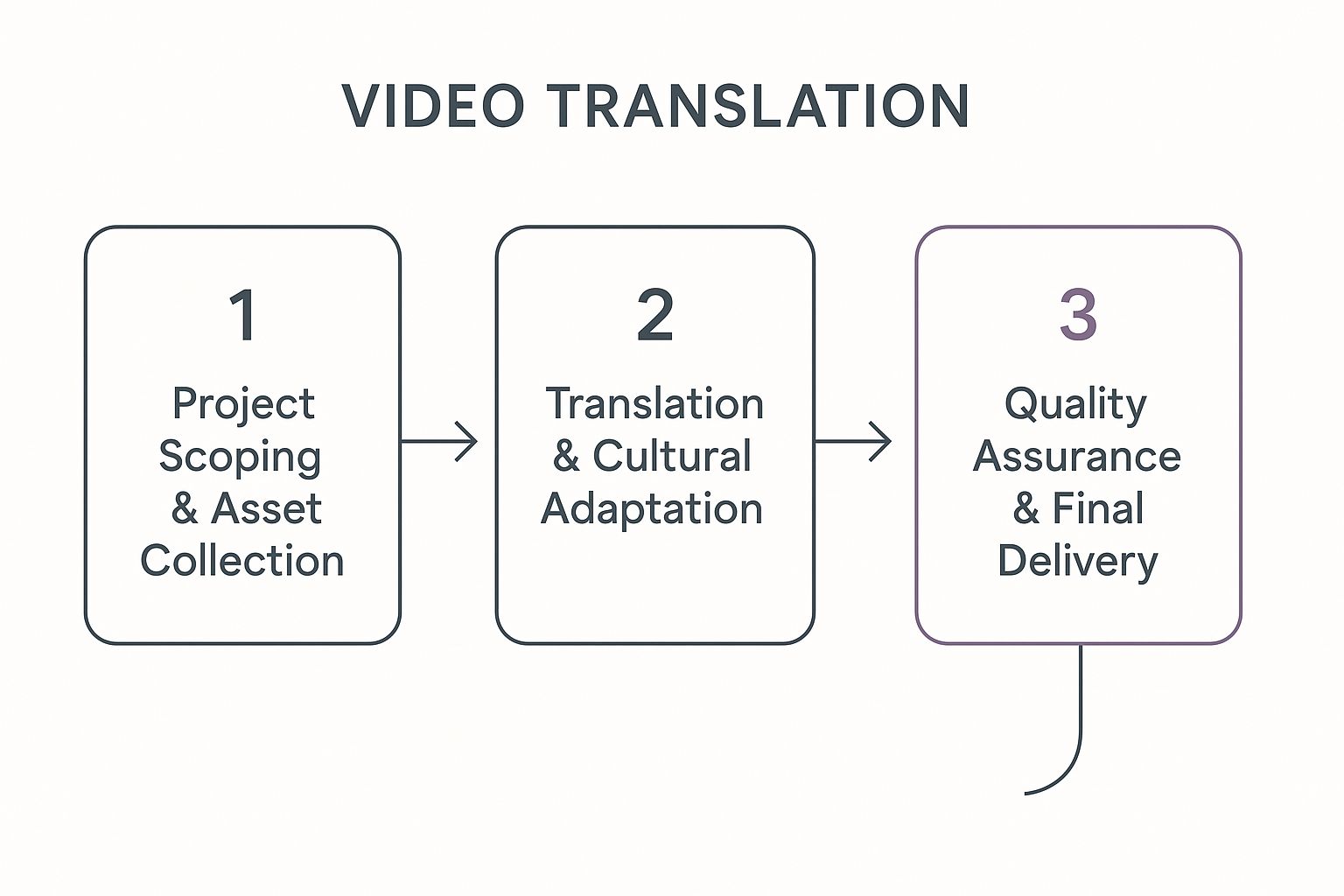
As you can see, each phase flows logically into the next, which is why a structured approach is so important.
The Final Polish
The last steps are all about quality control. This is where human eyes and ears are still essential, even when AI has sped up the earlier stages.
Quality Assurance (QA) is the safety net of video translation. Native speakers review the final video for linguistic accuracy, cultural appropriateness, and technical glitches, ensuring nothing gets lost in translation.
Once all checks are passed, you receive the finished files. This usually includes the final translated video, subtitle files (like .SRT), or separate audio tracks, all ready for you to share with your new global audience.
How to Choose the Right Video Translation Service
Picking the right video translation service is a critical decision for your global strategy. It’s not about finding the cheapest option; it’s about finding a partner who understands your brand’s voice and is committed to quality.
Get this choice right, and you’ll connect with new markets authentically. Get it wrong, and you risk costly and embarrassing brand missteps.
To make the right choice, you need a simple framework. The best partners blend smart technology with human expertise to deliver translations that are accurate and feel natural to local audiences.
Key Factors to Evaluate in a Partner
When vetting potential partners, look past the sales pitch and focus on these core areas.
-
Quality Assurance (QA) Process: How do they guarantee accuracy? A solid QA process should be central, not an afterthought. It should involve native-speaking linguists who check for grammar, context, and cultural nuances. Ask if human review is standard or an expensive add-on.
-
Technology and Human Expertise: What’s under the hood? Look for a service that uses AI for speed (like first-draft transcriptions) but relies on human experts for the crucial final polish. This hybrid model offers the perfect balance of efficiency and quality.
-
Industry Specialization: Do they understand your niche? A provider with experience in your industry—whether it’s tech, healthcare, or e-learning—will already know the specific jargon. This prevents cringe-worthy mistakes that can damage your credibility.
-
Scalability and Support: Can they grow with you? Consider your future needs. Will they be able to handle more videos or more languages down the road? And don’t forget customer support. You need a responsive team that can solve problems quickly.
The ideal video translation partner should feel like an extension of your team. They need to be as committed as you are to protecting your brand and ensuring your message resonates, no matter the language.
Asking the Right Questions
To truly understand a provider’s capabilities, ask sharp questions that go beyond their marketing materials.
Come to the conversation prepared with questions like these:
-
Can you show me work samples or case studies from my industry?
-
Who are the linguists that will work on my project? Are they native speakers?
-
What is your typical turnaround time for a project of my size?
-
How do you handle feedback and revisions if we need changes?
By digging into these details, you can confidently choose a partner who delivers translations that are accurate and culturally on point. Modern platforms like LunaBloom AI are designed to solve this problem, offering a seamless solution that combines smart AI features with an easy-to-manage workflow.
Choosing the right partner ensures your content doesn’t just get translated—it gets results.
Lunabloom: AI-Powered Platform for Effortless Video Translation
When it comes to translating videos professionally and efficiently, Lunabloom stands out as an all-in-one AI-powered platform designed for creators, educators, and global brands. It simplifies the entire video translation process—from transcription and dubbing to localization—so your content connects with audiences worldwide, effortlessly.
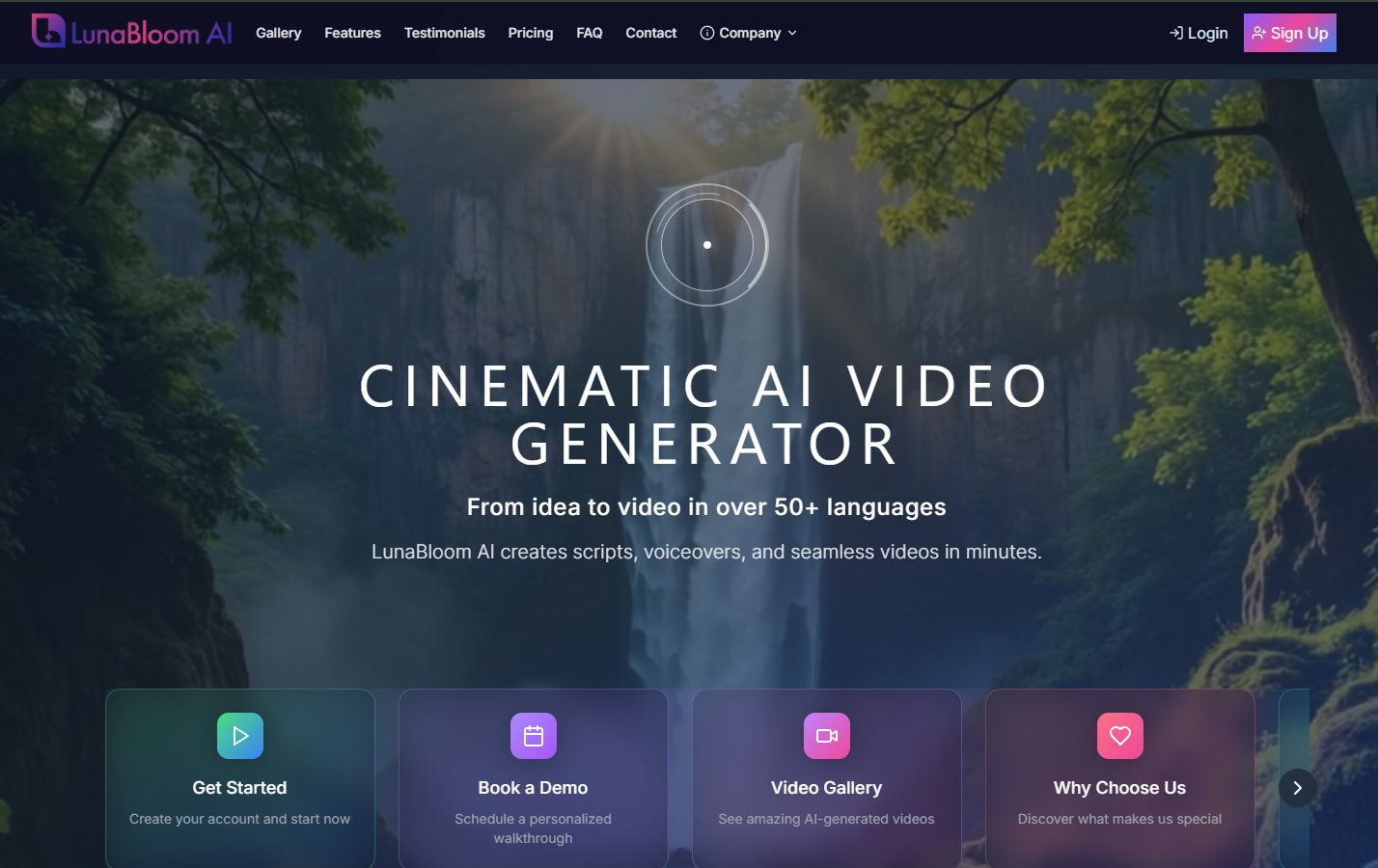
Lunabloom uses advanced AI voice technology and machine translation to help you translate videos into multiple languages while preserving tone, pacing, and emotional depth. Its intuitive dashboard allows users to manage large-scale projects without needing professional editing expertise. Whether you’re creating training videos, marketing campaigns, or online courses, Lunabloom ensures every message feels authentic and culturally relevant.
Key Features
-
AI Voice Dubbing & Translation: Instantly translate and dub videos into 75+ languages while maintaining natural speech rhythm and emotional tone.
-
Accurate Transcriptions: Generate and edit transcripts with near-perfect accuracy, saving hours of manual effort.
-
Multi-Language Subtitling: Auto-generate and sync subtitles across multiple languages with one click.
-
Voice Cloning Technology: Reproduce your original speaker’s voice in another language for brand consistency.
-
Real-Time Collaboration: Work with your team on translations, revisions, and approvals within a shared workspace.
-
Cloud-Based Project Management: Upload, translate, and export videos directly from your browser—no additional software required.
-
Customizable Localization Tools: Adapt on-screen text, visuals, and tone for different cultural audiences.
-
Seamless Integrations: Connect with popular video hosting and learning platforms like YouTube, Vimeo, and LMS systems.
Lunabloom bridges creativity and technology, helping businesses and creators scale their multilingual video content strategy with ease. It’s not just a translation tool—it’s your complete AI studio for global storytelling.
Frequently Asked Questions About Video Translation Services
Even with a solid plan, you might still have questions. Let’s tackle the most common ones to help you make informed decisions for your global content strategy.
How much does a video translation service cost?
There’s no single price tag. The cost depends on several factors: the video’s length, the target languages, and the type of service you choose. Simple subtitling will always be more affordable than full lip-sync dubbing.
While AI-powered services have made translation more accessible, the best approach is to get a custom quote. This is the only way to know the true cost for your specific project.
Can I use free online tools for video translation?
While it’s tempting to use free automated tools for a quick translation, it’s a huge risk for professional content. These tools often miss cultural nuances, produce awkward grammar, and can damage your brand’s credibility.
For marketing videos, training materials, or any public-facing content, protecting your message is paramount. A professional service that combines AI’s speed with human quality control is the only way to go.
How long does it take to translate a video?
Like cost, the timeline depends on the project’s complexity. A straightforward five-minute video that only needs AI-generated subtitles can often be turned around in a few hours.
On the other hand, a feature-length film requiring high-quality lip-sync dubbing and localization of on-screen text could easily take several weeks. Always discuss timelines with your provider upfront to ensure everyone is on the same page.
The good news is that AI-driven workflows have significantly reduced delivery times for most standard projects, making it faster than ever to get your content to a global audience.
Ready to take your videos global? A video translation service is your key to unlocking new markets and connecting with audiences worldwide. By choosing the right partner and the right approach—whether subtitling, dubbing, or full localization—you can ensure your message is heard and felt, no matter the language. The combination of powerful AI and human expertise makes this more achievable than ever before.
LunaBloom AI provides all the tools you need—from AI avatars to voice cloning and automatic subtitles—to connect with audiences worldwide. Start creating your multilingual videos today.