A generated clip can sound like a familiar speaker without listeners recognizing it as synthetic. That distinction matters: a voice can carry someone's identity even when its artificial origin is hard to hear. Naturalness therefore raises the compliance bar. Get consent for the chosen voice mode before production, and plan how to disclose its use before publishing. In January 2024, a robocall imitating President Joe Biden reached New Hampshire voters, showing how voice imitation can shape a message beyond the recording itself.
What AI Voice Generation Actually Does
AI voice generation is software that turns a script, or a short reference clip, into spoken audio without a live booth session. You pick a job first. The science only matters after you can name whose voice the audience will think they hear.
| Mode | What you supply | Whose voice | Best fit | Consent bar |
|---|---|---|---|---|
| Stock text to speech | Script and a preset library voice | Generic licensed speaker | Explainers, UI prompts, drafts | Use only voices the vendor licenses |
| Zero-shot voice cloning | Script plus a few seconds of one speaker | That person, new words | Consistent creator or brand narration | Written permission scoped to uses |
| Fine-tuned custom voice | Longer approved recordings | Stable branded voice | Series, training, ads | Contract covering training and new lines |
| Voice conversion | Existing audio plus a target voice | New timbre, original words | Changing speaker on a finished take | Rights from both the source and the target |
| Multilingual narration | Script, a voice, and target languages | Same identity, new language | Localization | Extra scope for each language and market |
Five jobs, five bars
Stock text to speech reads your script in a library voice the vendor already licensed. It fits interface prompts, rough cuts, and explainers where no real colleague is implied. If the license says non-commercial or "demo only," that voice stays off the ad.
Zero-shot voice cloning takes a brief sample of one person and speaks new lines in that identity. It is the mode people mean when they say a tool "sounds like me." A few seconds can be enough to be recognizable, which is exactly why a scoped written yes comes before the upload.
Fine-tuned custom voice needs longer approved recordings. You pay that cost when a series, a training catalog, or a run of ads has to hold the same timbre for months. The contract should cover both the training audio and every new line the model may later speak.
Voice conversion keeps the words already recorded and swaps the speaker. The original performance and the target identity both need clearance. A finished take you own is not a free pass to wear someone else's voice.
Multilingual narration keeps one identity and switches language. A yes for English product demos is not a yes for the same face and voice in a new market, with new claims, humor, and legal lines.
Practical rule: A library voice for generic lines, cloning only with a scoped yes, and conversion only when both performances are cleared.
The listener study shows why that column is part of choosing a mode. People often hear the person and miss the machine. Skill, model quality, and how clean the recording was all change detection, so you cannot treat "it sounds a bit off" as a safety check. Match the consent bar to the identity you are about to publish, then stop if you cannot name who allowed it.
How a Short Sample Becomes a Voice
A voice-cloning system turns a short recording into a reference for generating new speech. It extracts features such as pitch, timbre, and rhythm into a speaker representation, then uses that representation to read new text. The result is newly generated speech, not old syllables rearranged into a sentence.
Earlier text-to-speech systems often relied on large scripted datasets and engineering for a fixed speaker. Reference-based cloning can adapt from a sample without retraining a full model. The trade-off is that a usable voice identity can be created from audio that was never recorded for that purpose.
A 2023 McAfee Labs test reported that about three seconds of recorded speech produced a clone at an 85% voice match, with more audio raising the match to about 95%. A separate speaker-controlled study paired 12,376 real utterances with 12,376 synthetic utterances and measured average x-vector cosine similarity of 0.776 ± 0.063. That score describes identity similarity, not naturalness, prosody, or permission, according to an APSIPA 2025 speaker-cloning paper.
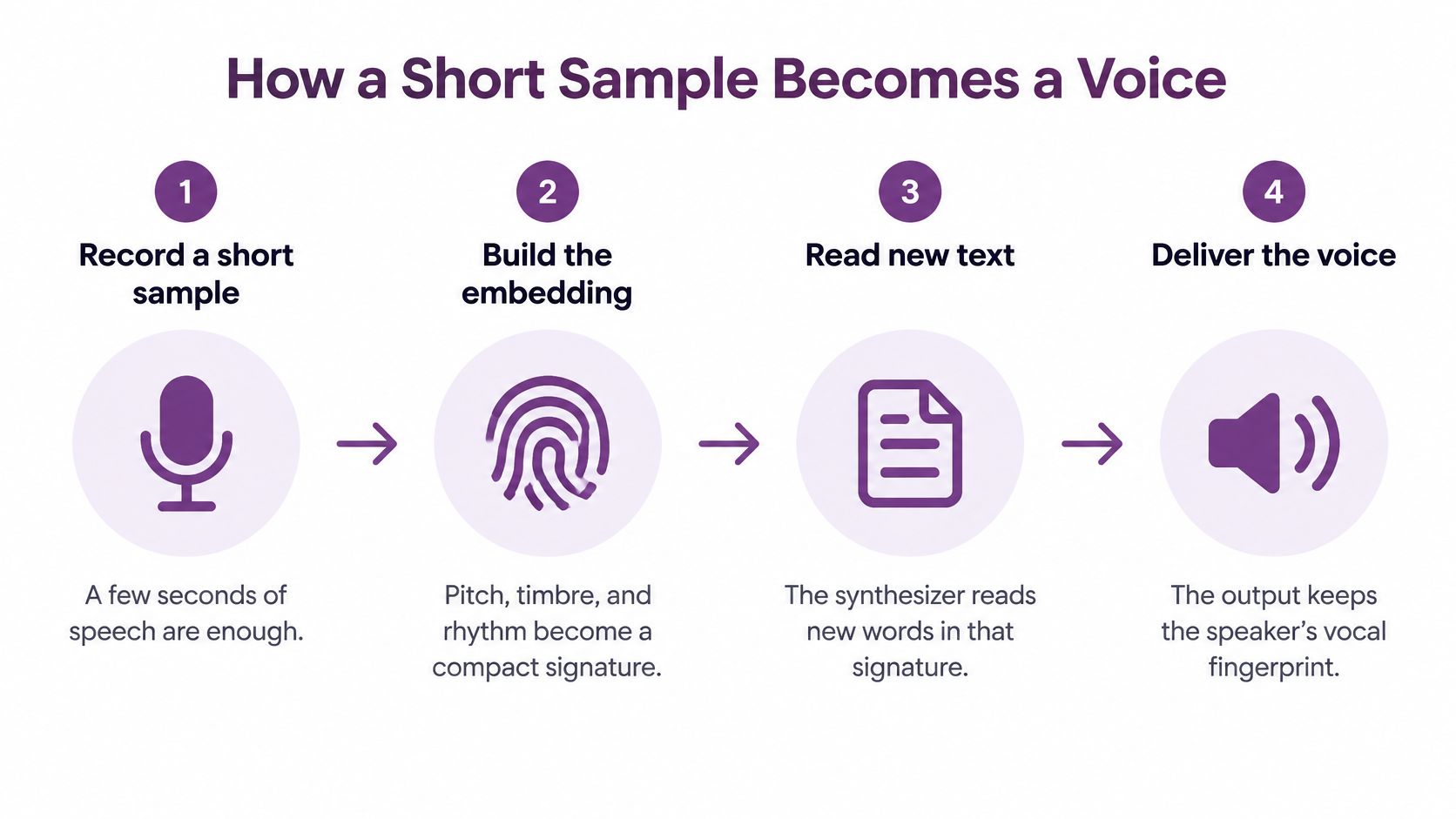
The path from clip to waveform
- Clean reference: Record with little noise, music, or room echo. Background sounds can become part of what the system learns.
- Speaker representation: The system compresses vocal features such as pitch, timbre, and rhythm into a reusable identity.
- Script preparation: Mark names, pauses, and intended emotion. Clear direction helps the generated delivery match the message.
- Waveform generation: The model speaks the new lines in the reference voice.
- Separate checks: Review speaker similarity, word accuracy, accent clarity, and the human listening experience. A match score cannot confirm natural timing or consent.
A founder's 10-second voicemail could provide a reference for a product demo containing sentences they never recorded. That can make updates easier, but it also shows why access to the recording and generated voice must be controlled.
A McAfee survey of 7,054 adults across seven countries found that one in four had experienced an AI voice-cloning scam, or knew someone who had; 77% of those who lost money reported a financial loss. A separate 2023 McAfee survey of more than 7,000 adults in seven countries found that 53% shared their voice online at least once a week, according to Voxbooster's summary of the survey. Restrict access to both the sample and the generated voice, and record the speaker's permission before creating a reusable identity. Review LunaBloom AI's privacy practices for handling reference audio before uploading a sample.
Watch the short walkthrough, then use the same sequence to prepare and review a voice sample.
Where Creators and Teams Use Generated Voices
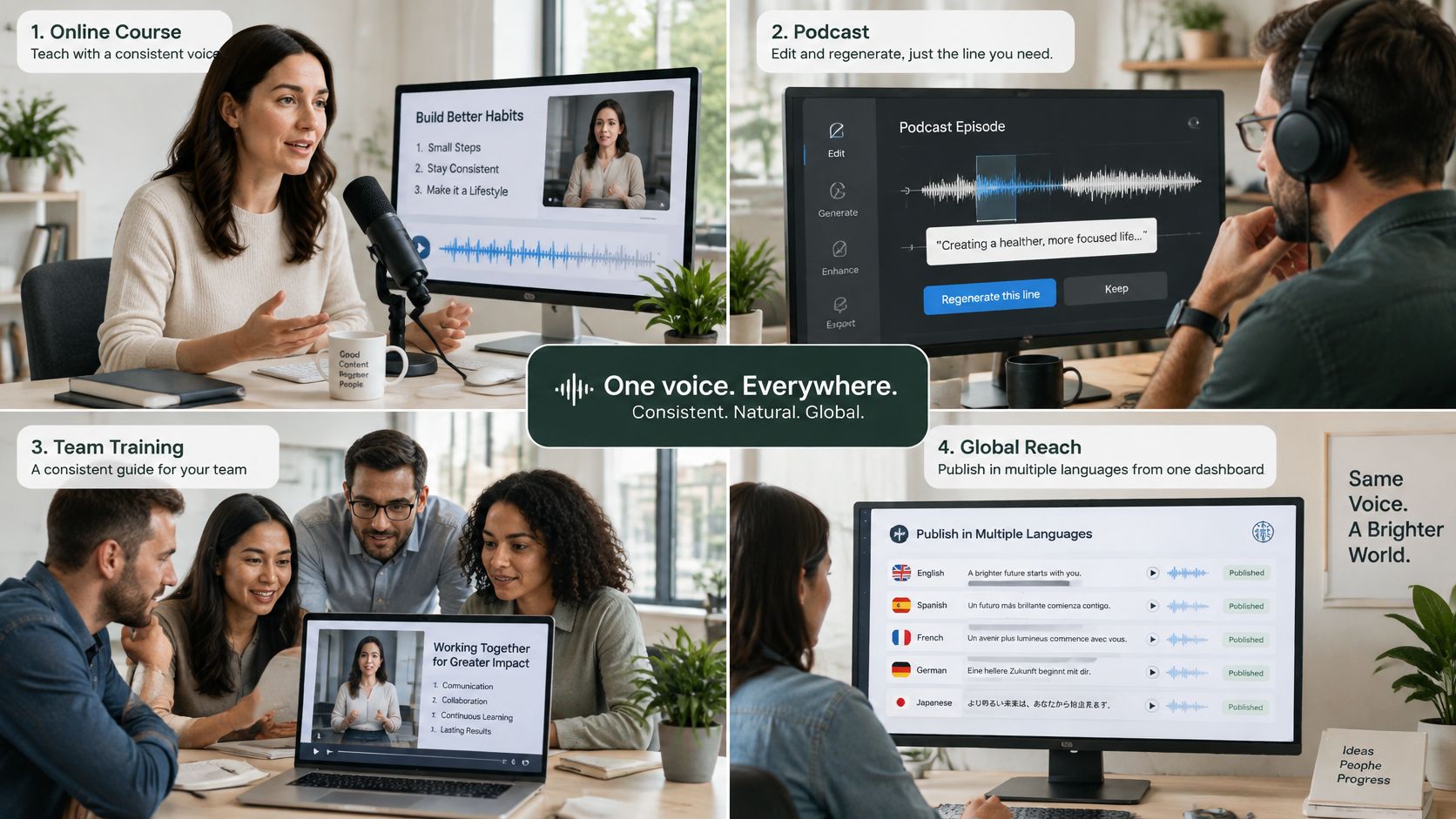
Picture an educator with a twelve-module course. She writes the lesson, generates one steady narrator, and stays off camera. When a date or a definition changes, she regenerates that module instead of rebooking a booth. Library speech is enough here if students are not meant to think a particular colleague is speaking.
A small brand records one approved read and reuses that identity on product demos and short social ads. The point is recognition across cuts, not a new performance every Friday. Cloning earns its keep only when the audience should know that creator or spokesperson. If the brand voice is a licensed library speaker, stay on stock speech and skip the sample entirely.
An agency keeps one presenter while it localizes an explainer. Names, units, and jokes that do not survive a literal translation get rewritten before anyone hits generate. The English yes does not automatically cover the new market. Teams that also need picture, captions, and a finished cut often pair the voice decision with corporate video production services so the spoken line and the on-screen text tell the same story.
A company uses one voice for onboarding and internal updates. New hires hear a single guide instead of a patchwork of contractors. That is still an everyday job when the audio explains a process. It stops being casual the moment the same voice asks someone to move money, gives medical or legal instructions, speaks for a public figure, or calls a customer.
The one-sentence speaker test
After you sketch the scene, write one sentence: "The audience will think they are hearing ___."
- A role, not a person: "A neutral course narrator." Library speech can carry it.
- A named creator or spokesperson: Cloning or a custom voice, and only with that person's scope.
- Someone who never agreed: Stop. Similarity to a coworker, a customer, or a celebrity is not a draft.
If that sentence names a real person, treat permission, disclosure, and a way to pull the file as part of the job, not as paperwork for later.
You can browse how a studio-style project is organized on the LunaBloom AI site once you know which speaker you are shipping.
What Listeners Can and Cannot Tell
Listeners hear the finished voice, not the edits behind it. A corrected date or a revised closing line can be regenerated without bringing the speaker back to a recording booth.
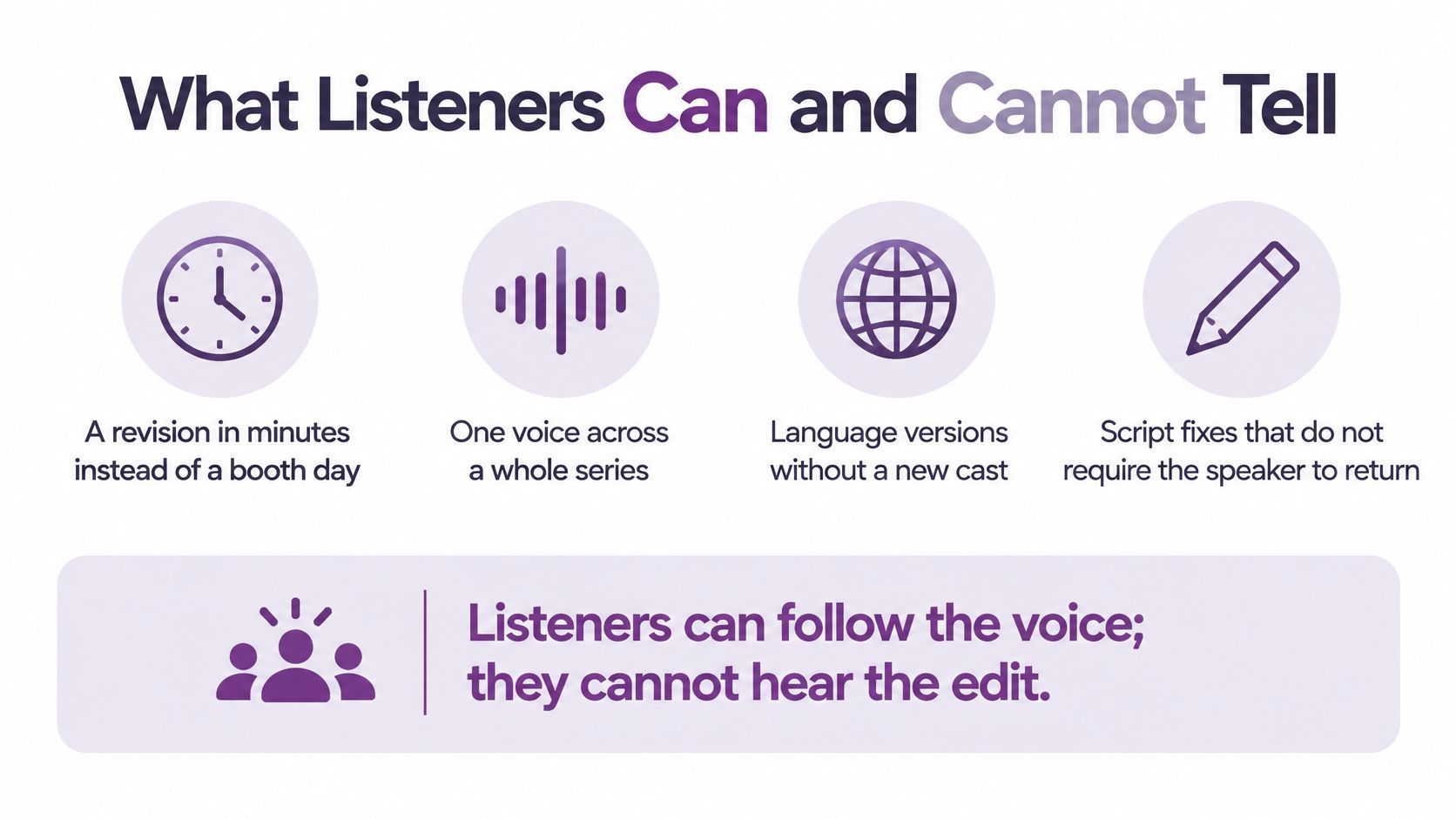
For a series, a consistent voice can help connect modules, ads, and updates. A script can also be adapted into another language, provided that language and use are within the voice owner's permission. These conveniences make production easier, but they do not guarantee a natural performance.
Long passages can expose weaknesses: emotion may sound flat, names may be mispronounced, and an accent may shift. A voice can also sound convincing enough that a listener trusts it without checking who is speaking.
Pressure, not a marketing blame line
Voice-cloning scams have drawn public attention, but ordinary explainers are not fraud. The practical concern is that realistic audio can be mistaken for an authentic request, especially when money, health, politics, emergencies, or identity are involved.
For entertainment and routine explainers, use a visible label and an audio disclosure. For higher-stakes messages, pair disclosure with another way to verify the claim, such as a known link, a callback to a number the listener already has, or confirmation from a person.
A spoken disclaimer alone can be missed, misunderstood in translation, or removed when a clip is reposted. If someone could act on the audio alone, provide a separate verification path.
Consent Disclosure and the Rights Ledger
The more a synthetic voice sounds like a person, the less acceptable a silent publish becomes. Quality raises the compliance bar. It does not lower it.
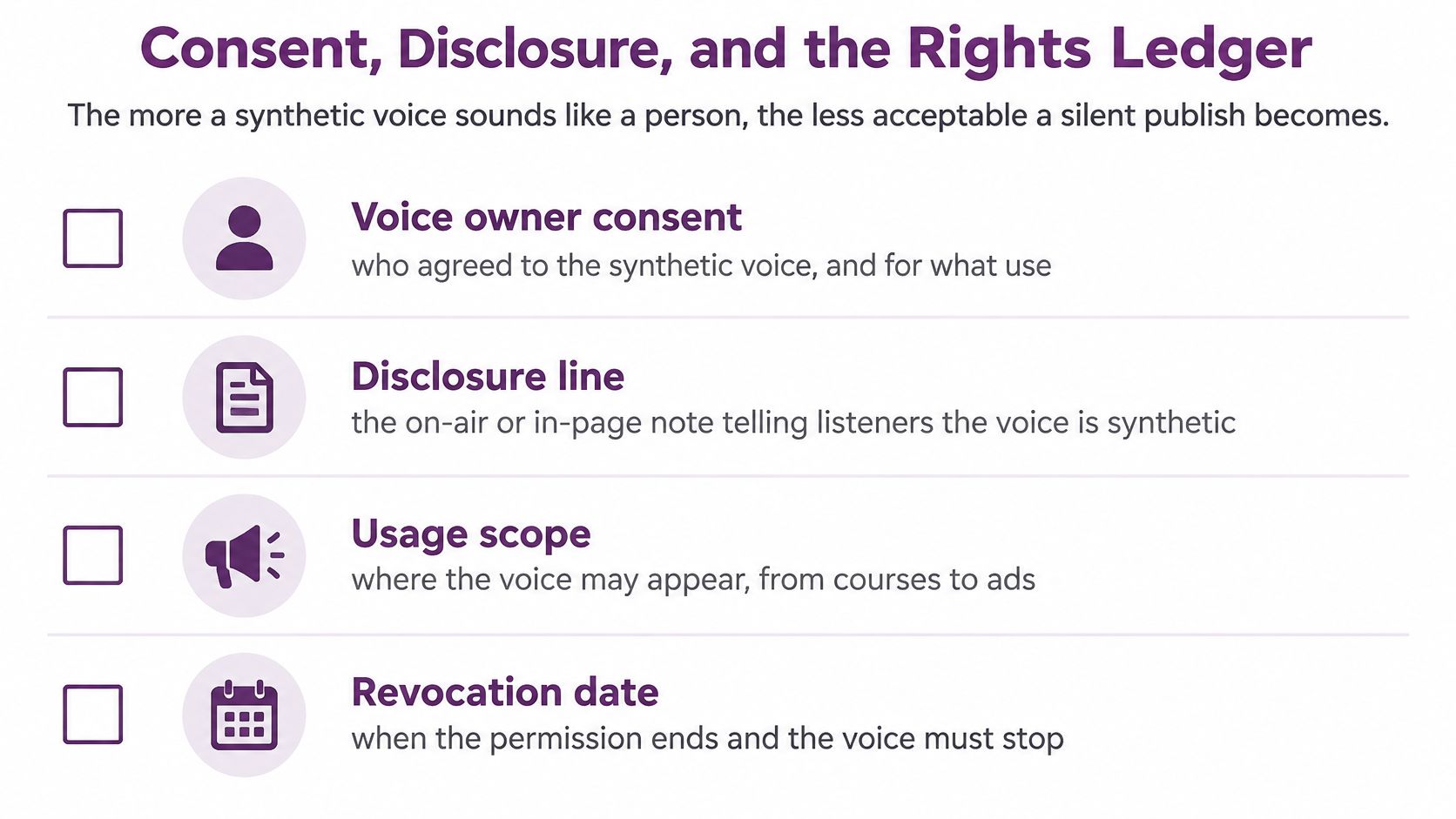
Build a rights ledger before the first export. These fields are the working tool, not a legal essay.
- Voice owner: The person, not "the brand," unless a contract says the brand holds the replica right.
- Recordings or model: Which takes, and which model version, are allowed.
- Content categories: Courses, ads, support, internal training. Unlisted categories stay off.
- Territory and term: Where it may play, and the date it stops.
- Pay: What the owner receives, including reuse.
- Training versus new lines: May the sample train a model, and may new lines be generated from text?
- Sublicensing: Who else may ship the voice.
- Revocation: How the owner pulls permission, and how fast you take files down.
- Audit log: Who keeps the record of approval, export, and withdrawal.
Attach each rule to a field
The U.S. Copyright Office's July 2024 Digital Replicas report treats a realistic AI voice as a digital replica. The Copyright Act does not preempt laws that restrict unauthorized voice replicas, and a recording can be unlawful even when it copies no song or script, as the USPTO note on that report makes clear. The Office said people licensing these rights should have adequate knowledge and full disclosure of intended uses, spelled out in the Copyright Office Digital Replicas report. That is your owner, use, channel, duration, and commercial-scope fields. A vague yes to "use the voice" does not fill them.
In the European Union, providers of systems that generate synthetic audio must mark the output in a machine-readable format so it can be detected as artificially generated or manipulated, under Article 50 of the EU AI Act. That mark is separate from telling a person the content is AI. Keep the metadata on export even when you also speak a disclosure.
For phone outreach, the FCC has treated AI-generated voices as "artificial or prerecorded" under the Telephone Consumer Protection Act, so outbound calls can trigger consent, identification, and opt-out duties, as explained in Plura's TCPA compliance overview. Block impersonation of public figures, employees, customers, and family unless that person is the documented owner.
| Rule | Who it binds | Duty before publish |
|---|---|---|
| US Copyright Office Digital Replicas report, July 2024 | People licensing a realistic voice replica | Name the voice owner and disclose uses, channels, duration, and commercial scope; copyright in a script or song is not the limit |
| EU AI Act synthetic-audio rule | Providers of systems that generate synthetic audio | Mark the output in a machine-readable format so it can be detected as artificial, separate from telling the listener |
| FCC Telephone Consumer Protection Act | Callers using an AI-generated voice | Treat the voice as artificial or prerecorded and meet consent, identification, and opt-out duties |
If you cannot show who approved this voice for this channel, do not ship it. The terms you accept on a platform do not replace the owner's ledger.
How to Add a Voice to a Production Workflow
Ship in one order. Each step exists because the previous one can be faked by a clean-sounding file.
- Label the job. Low risk covers entertainment and an internal draft. High risk covers money, health, politics, emergencies, or identity. High risk gets a second proof path, not only a nicer read.
- File consent before the upload. No sample enters the tool until the ledger names the owner, the uses, and the term.
- Write the script for the ear. Add pronunciations, and write a disclosure line that still makes sense after translation. A joke that dies in the new language gets rewritten, not dubbed blindly.
- Generate, then review on purpose. Check similarity, word errors, pacing, and a human listen on both speakers and headphones. A pass on studio monitors can hide a harsh name on a phone.
- Do not stop at one detector. In a benchmark of 257,440 samples from 206 public figures, 22 recent detectors lost 43% of performance on perturbed, realistic tests that mixed seven text-to-speech systems, three voice-conversion methods, identity-consistent transcripts, and noise, according to an arXiv audio-deepfake benchmark. Treat a detector hit as a risk signal. False alarms rise on compressed, accented, or reverberant speech, and a strong clone can still pass.
- Attach both labels. Put a listener-facing line on the asset, and keep a machine-readable origin mark in the export.
- Export the bundle. Waveform, model and version, script, language, and localization settings travel together.
- Store the dispute set. Keep the original reference, the generated file, and the prompt so you can audit or pull the clip. Restrict who can open the voice model.
The workflow is done when a colleague can answer who spoke, who allowed it, and which file is the source of truth.
Start With One Approved Voice
Decide what you are handing over. A one-off audio clip only has to sound right once. A repeatable voice has to be explainable to a client or a teammate six weeks later, including who approved it and where it may play.
If the deliverable is only a raw file, go back to the mode table and stop at the consent bar for that row. If the deliverable is a video, a single path that already joins script, picture, voice, and captions avoids a messy handoff between tools.
LunaBloom AI is a registered digital service for AI video creation. Creators bring the idea and move through eight steps: Idea, Script, Visuals, Voice, Video, Music and sound effects, Captions, and Publish, without a complicated editing workflow. Voice Cloning keeps a familiar voice consistent across pieces. The same project can carry multilingual voiceovers, background music, and customizable visuals without advanced editing skills. Business plans include commercial use rights and AI voice and narration, along with text and image to video, dialogue videos, and avatar videos. Plan details sit on LunaBloom AI pricing.
Start smaller than the catalog you imagine. One approved speaker. One language. One disclosure line on screen and in the audio. Ledger fields filled before a second market or a second voice. When consent matches the channel, the eight-step path is the place to put that voice on picture. Until then, another language is just a wider way to publish a voice you cannot explain.
LunaBloom AI turns an approved script into video with voice, music, captions, and a path to publish, so the narrator you cleared is the narrator on screen. If you are pairing a consented voice with a real cut, visit LunaBloom AI and start with one speaker, one language, and the disclosure already written. Bring the ledger with you, and add a second market only after that first voice is still the one you can defend.