Forget the advice to copy a viral Short, stuff in hashtags, and post more often. That approach treats How to Go Viral on YouTube Shorts as a lottery ticket. It's a testing problem instead.
You're not trying to guess one perfect upload. You're trying to learn, one variable at a time, what makes your viewers stay, react, and come back. The audience is large enough to reward that discipline. The YouTube Shorts revenue sharing update reported that Shorts averaged more than 70 billion daily views by March 2024, after launching in 2021.
Scale doesn't make breakout reach automatic. A weak opening still loses its first small audience, and a high completion rate can still hide a video nobody liked. I'd build three honest variants over one polished guess every time.
The Signals YouTube Uses to Judge a Short
YouTube doesn't push a Short because of hashtags or a magic view count. It shows the Short to viewers first, then reads what those viewers do.
The YouTube Support guidance on search and discovery tips for Shorts says YouTube evaluates whether viewers choose to watch, ignore it, or mark it as not interesting, then uses average view duration and average percentage viewed as ranking signals. It also says likes and post-watch survey results help indicate whether viewers enjoyed the content.
That sequence matters. First you earn a choice to watch. Then you earn continued attention. Then you earn a sign that the payoff was worth it. A Short can fail at any one of those points for a completely different reason.
What to Pull From Analytics
| Signal | What it tells you |
|---|---|
| Viewed vs. swiped away | Whether the opening earned a choice to watch |
| Average percentage viewed | Share of the Short people actually watched |
| Average view duration | Seconds watched per viewer on average |
| Likes and post-watch survey | Whether viewers enjoyed the result |
| Not interested marks | Whether the topic fits the audience |
Don't look for a universal pass mark in that table. Recommendations are personalized to each viewer's interests and prior viewing behavior, so a like rate that works in comedy may tell you nothing about tutorials.
Views tell you how far a Short traveled. The five signals tell you why it stopped.
Export your last ten Shorts into a spreadsheet with one column per signal. That's your baseline. Every test you run from here either beats that baseline on a specific signal or it doesn't, and you'll know which part to fix next.
How to Build and Publish a Short in Seven Steps
A Short is easier to learn from when each upload tests one clear decision. Set the promise, format, and review point before publishing, then change one variable at a time. Otherwise, a strong result won't tell you which choice worked.
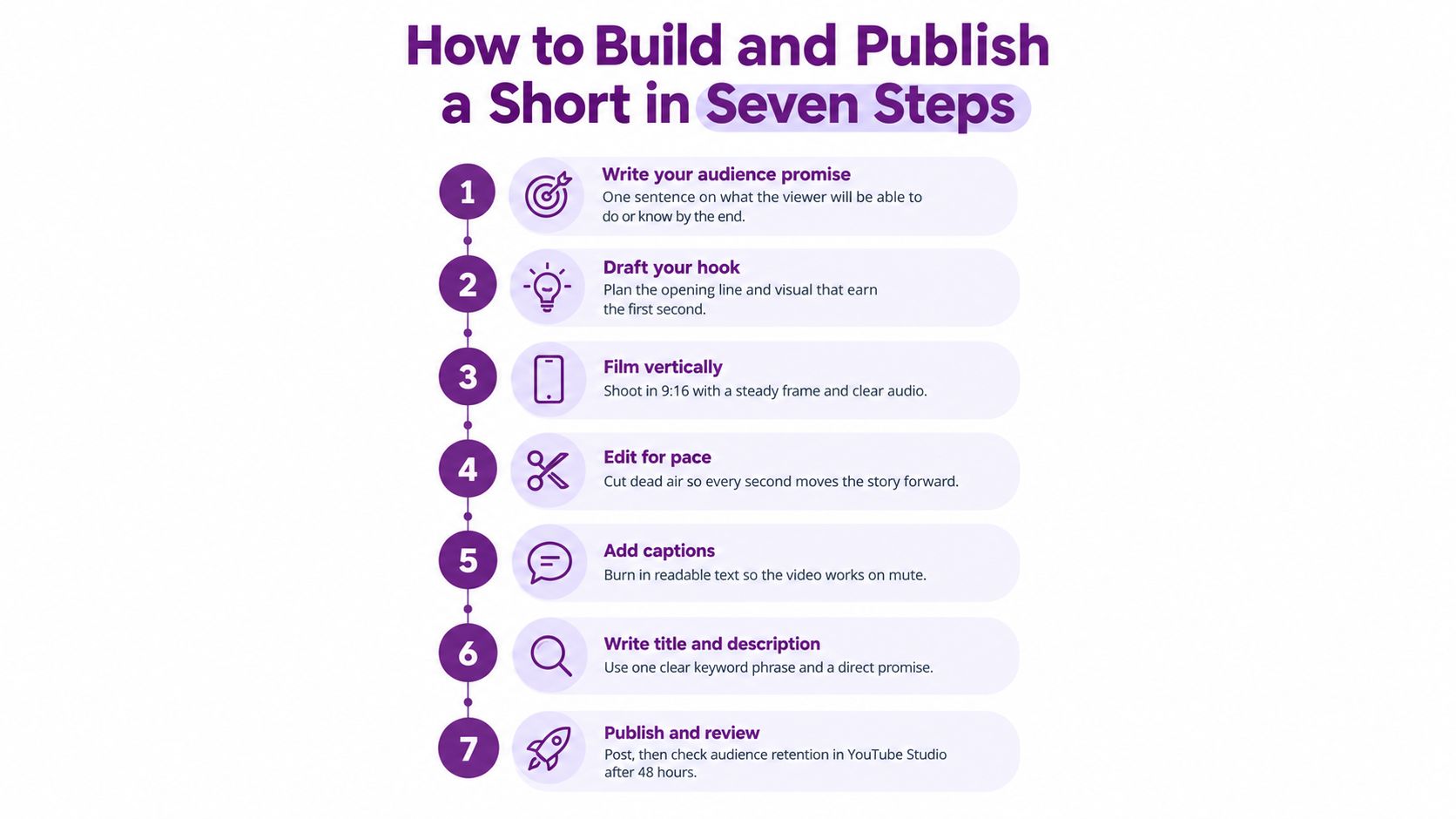
- Write one audience promise. In a sentence, say what viewers will know or be able to do by the end.
- Pick a format and length. Use the table to choose before scripting, not after editing.
- Write three hook variants. Start with the payoff, a visible conflict, or a specific claim.
- Edit to spec. Use a vertical frame and burned-in captions. Skip a branded intro, and make the ending resolve or loop cleanly.
- Build controlled variants. Change one element per version, such as the opening line, first frame, duration, or ending.
- Publish on different days. Avoid posting identical copies back to back, so each result is easier to interpret.
- Review at a fixed checkpoint. Around 48 hours, examine whether viewers chose to watch or ignored the Short, then review retention and distribution.
Choosing a Length to Test
| Format | Target length | Best for | Main risk |
|---|---|---|---|
| Single fact | 15-20 seconds | One claim with one visual | Filler that adds no information |
| Compact tutorial | 25-40 seconds | One technique or step | A skipped step that confuses viewers |
| Story or demonstration | 45-60 seconds | A before-and-after or narrative arc | Losing tension in the middle |
The YouTube Support page on Shorts ranking signals describes whether viewers choose to watch or ignore a recommendation, along with average view duration, average percentage viewed, likes, and post-watch satisfaction signals. Use those measures to diagnose the next edit. If viewers swipe away, change the first second. If they start watching but leave early, compress the setup. If retention is strong but distribution stalls, consider whether the topic or packaging fits the audience.
Don't treat a view count as proof the video worked; compare each Short's likes, comments, and retention against your own last ten uploads instead of an external benchmark. A large audience can produce many views without showing that the structure held attention, while high completion alone does not prove the topic reached the right viewers.
Practical rule: Change one thing per round. Rewrite the hook, shorten the edit, or change the ending, but don't alter all three at once. Otherwise, the result won't show which change mattered.
Hooks That Earn the First Second
A polished opening can still lose a viewer. The first second has one job: make the subject and its payoff clear enough that someone chooses to keep watching. Treat that opening as a testable choice, not a guarantee of reach.
A still like this works because the problem is already visible.
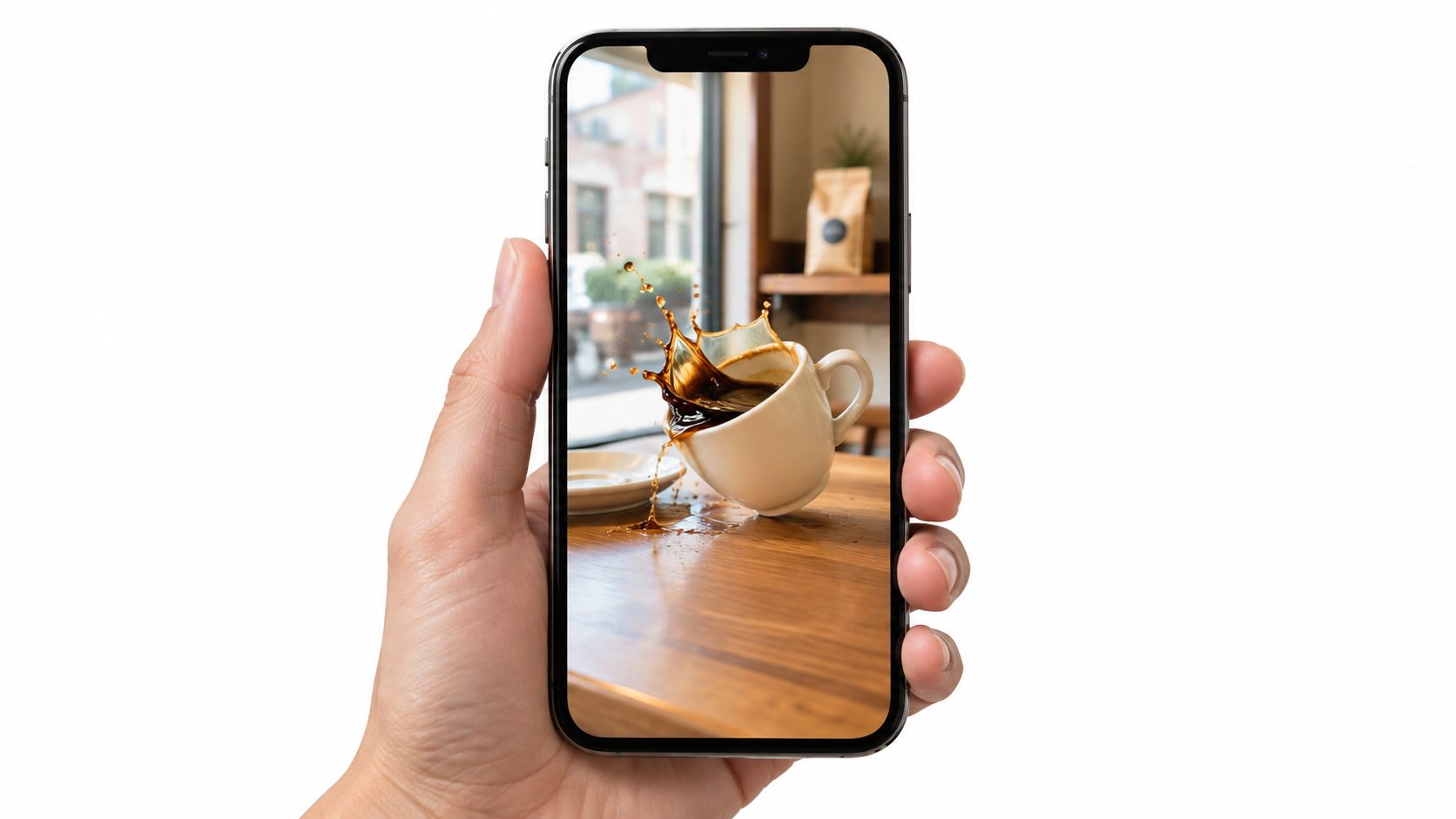
YouTube evaluates whether viewers choose to watch or ignore a Short, so the first frame needs to earn attention before the viewer swipes away. That signal is not thumbnail click-through rate. A strong opening may help people stay, but it cannot prove that the full video satisfies them or that YouTube will distribute it widely.
Five Hook Types Worth Testing
- Result first: Show the finished outcome, then explain how you got there.
- Visible conflict: Put the mistake on screen immediately, such as a spilled drink or a blurry photo.
- Open question: Set up a question the video answers later.
- Specific number: Use a time or cost to make the promise concrete.
- Pattern break: Change the visual within the first second so the frame does not feel static.
For a 30-second clip about cleaning a smudged phone lens, open on the blurry before image and add text saying it took two minutes to fix. The viewer can identify the problem and expected payoff before hearing an explanation. The trade-off is that text must stay quick to read; a specific promise loses force if the opening is crowded.
This breakdown shows one way an opening choice can play out.
Test one variable at a time. Keep the footage and edit identical, then change only the opening line or first frame across separate uploads. Comparing three versions on separate days can show which opening earns more viewers, but differences in results do not prove that the hook alone caused a change. A repeatable approach to build an audience with viral videos depends on learning from tests, not treating one spike as a formula.
Logo animations, slow fades, spoken greetings, and text that takes more than a second to read delay the point. Put the topic in the first frame so it makes sense with the sound off.
Editing for Retention Without Losing the Point
Start with a production spec and edit to it every time. That consistency is what makes your tests readable.
The Master Spec
- Frame: Shoot and export a 9:16 vertical master, with the central claim or visual conflict in the opening beat.
- Cuts: Remove pauses, filler words, and any sentence that repeats what the viewer can already see.
- Captions: Burn them in, sized for a phone screen, a few words at a time.
- Ending: Resolve the question, or loop back to the opening so a replay feels natural rather than abrupt.
Captions aren't decoration. Many viewers watch without sound, and readable text keeps them oriented when the audio is off. Dense captions do the opposite. If a viewer needs to pause to read your text, you've edited for yourself, not for them.
Length deserves the same discipline. The Virvid guide to Shorts length and retention notes that very short videos are commonly associated with higher completion, while longer Shorts can earn greater reach when the narrative sustains attention. That means you shouldn't assume one ideal length. Compare a tight cut against a fuller explanation using average percentage viewed and average view duration, and let your own audience decide.
A longer cut isn't automatically weaker. A demonstration that builds to a visible result can hold attention for its full run, while a short clip with no payoff loses people in half the time. I'd rather watch both numbers move together than defend a favorite duration.
A loop that tricks viewers into a second play inflates completion. It doesn't prove anyone was satisfied.
Avoid slow branded intros, generic stock looking visuals, unsupported claims, and templates that make every video look identical. Viewers recognize a template quickly, and recognition without novelty gives them a reason to swipe.
If you use AI avatars, cloned voices, or automated translations, check every output by hand before publishing. Listen for mispronounced names and numbers, read translations for cultural nuance, verify factual claims, and watch for visual continuity breaks between shots. Speed is the benefit of automation. Skipping review is where that speed costs you credibility.
Formats, Trends and Packaging That Travel
A repeatable format beats a string of unrelated ideas. A weekly series with the same title pattern, cover style, and structure gives returning viewers something to recognize and gives you comparable data across uploads.
Say you publish three keyboard shortcuts every Tuesday. The format stays fixed. The shortcuts change. After a month you can see which topics earn a choice to watch and which ones don't, without wondering whether the format itself caused the difference.
Trends, Length, and Packaging
Join a trend only when your angle adds something the original didn't. A trending sound under an unrelated clip borrows attention without earning it, and viewers can tell. Drop the trend when your own numbers stop responding, not when everyone else does.
You also have more room than the old one minute limit. The YouTube Support page on longer Shorts eligibility states that since October 15, 2024, YouTube categorizes square or vertical videos up to three minutes long as Shorts when uploaded after that date. The same page warns that a Short longer than one minute with an active copyright claim of any type can be blocked globally, making it unplayable, unrecommended, and ineligible for monetization.
That extra time suits a demonstration or explanation that genuinely needs it. It doesn't excuse filler, because unnecessary pauses still drag down the share of the video people watch.
Packaging carries the format between uploads:
- Cover frame: Pick a frame that shows the topic with short, readable text, such as the finished dish instead of an empty counter.
- Title and caption: Put your keyword phrase where it reads naturally, once, close to the promise.
- Related long video: When a Short teases a longer tutorial, link that video in the description so interested viewers have a next step.
Keep a steady rhythm. One test batch a week gives each Short its own read and gives you time to act on the result. Ten uploads in one day blur together, and you end up guessing again.
Reading Analytics and Iterating Without Chasing Views
A single metric can make a weak Short look successful. High completion may come from a loop, while a large view count alone says little about whether viewers liked the video or wanted more.
Fixed targets circulate widely, including 70% retention, 73% average retention, and 60–70% completion. The NetInfluencer report on short-form content performance notes that these benchmarks come from marketing-content aggregations rather than transparent YouTube datasets. It also reports that Shorts generated 88% of views and 85% of engagements among U.S. creator uploads in 2025, while representing 57% of uploads. Treat those figures as context, not a target for your own channel.
Diagnose Before You Recut
| Symptom | Likely cause | Fix |
|---|---|---|
| Many swipe-aways in the first second | Weak opening or unclear premise | Lead with the result or conflict, and cut any intro |
| Viewers leave before the payoff | Setup runs too long | Move the payoff earlier and remove context viewers do not need |
| Strong retention, weak distribution | Topic or packaging mismatch | Retest the title, caption, and cover frame before changing the edit |
| High completion, few likes or comments | Replay loop inflating completion | Make the payoff clearer or add a question viewers want to answer |
| Good likes, weak retention | Right idea, slow delivery | Recut a shorter version with the same content |
| One spike, then flat | One-off trend with no repeat audience | Turn the format into a recurring series |
Set a stop rule before each batch. If viewers leave immediately, test a different first second. If swipe-away is high, make the premise clearer. Comments asking what you meant are useful evidence that the message needs work.
Change one variable at a time, such as the opening, title, or cover frame. Keep the rest steady so you can see what changed the response. Scale a format when retention, engagement, and subscriptions improve together. If completion rises while likes and subscriptions stay flat, the edit may encourage replays without building an audience.
Virality is not the same as retention. A short, loopable clip can reach high completion and still bring few subscribers or customers.
Compare several uploads rather than drawing a conclusion from one result. A Short with lower retention may serve you better if it earns comments, shares, and channel visits that your high-completion clips do not. Views show reach; they do not, by themselves, explain why people watched or whether the video gave them a reason to return.
Confirm Your Test Batch Before Posting This Week
Pick one recurring topic your audience already responds to. Write a single compact tutorial script, then make three versions that differ only in the opening line or first frame. Keep the footage, captions, and ending identical across all three.
Publish them on separate days so each gets its own read. At 48 hours, check swipe away and early exits. At seven days, check average percentage viewed, average view duration, likes, and survey signals.
Write down which variable changed and what the numbers did. That one page of notes is worth more than another week of guessing.
If you produce with LunaBloom AI, one script can become several avatar led or localized versions with captions and translations, which makes a three variant batch realistic in a single session. Review each version for pronunciation, accuracy, and visual continuity before it goes live.
Start with one hook this week. Compare it against your own last ten Shorts, not against someone else's viral screenshot.
Turn one script into three testable Shorts this week, with voiceovers, burned in captions, translations, and social ready exports handled in minutes. Visit LunaBloom AI to build your first batch, publish the variants, and let your own Analytics pick the winner.