You've got a melody, a mood, and perhaps a chorus stuck in your head, but the lyrics won't arrive. An AI song generator can produce a draft in moments, yet the first version often rhymes without meaning, scans awkwardly, or sounds like a collection of familiar songwriting phrases. The useful question isn't whether AI can write words. It's whether you can turn those words into a singable, coherent, original, and commercially defensible song.
AI song generator lyrics work best as creative material, not automatic finished songs. The strongest workflow combines specific prompts, human editing, vocal testing, provenance records, and a careful transition from lyrics to audio and video.
Why AI Song Generator Lyrics Matter for Modern Creators
A songwriter opens a blank document after hearing a promising chord progression. The emotional idea is clear, but the second verse keeps circling the same image. An AI lyric generator can offer alternate angles, internal rhymes, chorus variations, or a bridge that changes the perspective. That makes it useful at the exact point where many projects stall, before a creator has enough material to judge the song properly.
The technology is moving from novelty toward a practical production aid. The AI-generated song lyric market was valued at $152.3 million in 2025 and is projected to reach $847.9 million by 2034, representing a 21.4% compound annual growth rate over 2026 to 2034, according to DataIntelo's AI-generated song lyric market report. The same report gives cloud-based deployment a 72.5% share and Asia Pacific a 38.2% revenue share, signs that lyric generation is being commercialized across major markets.
What generators handle well
AI is particularly useful for:
- Idea expansion: turning a theme such as homesickness or creative burnout into several narrative directions.
- Structural drafting: laying out verses, pre-choruses, choruses, bridges, and outros.
- Rhyme exploration: suggesting less obvious end words and approximate rhyme families.
- Style translation: adapting a concept to broad genre conventions, such as a pop hook or a reflective folk verse.
- Rapid comparison: giving you several chorus options before you commit to one.
That speed matters to musicians, marketers, educators, and video creators. A teacher may need an original song for a lesson. A brand team may need a short musical concept for a campaign. A filmmaker may need lyrics that support a character arc rather than describe a product.
The weaknesses are just as important. Generators can imitate surface vocabulary while missing the emotional logic between lines. They may repeat an image, change tense without reason, overload a melody with syllables, or force a rhyme that makes the speaker sound unnatural. Human judgment still decides what the song means, which details belong to the creator, and whether a line sounds convincing when sung.
Practical rule: Use AI to widen the set of possibilities, then use your own taste to narrow it.
A helpful overview of how AI can support broader creative workflows is this AI content guide from Taja AI. For song projects that will become visual assets, LunaBloom AI fits later in the workflow by connecting creative concepts with video production.
The rest of the process is straightforward in principle: choose a generator that matches the job, prompt for musical constraints, edit every useful draft, document your contribution, and only then build the finished song and video.
Choosing the Right AI Lyric Generator for Your Style
Tool selection affects the quality of the draft before you write a single prompt. A text-only lyric writer gives you the most control over language, while an integrated music generator lets you hear how words behave against a melody. A video-oriented platform becomes relevant when the song is meant to support a finished visual rather than remain a text document.
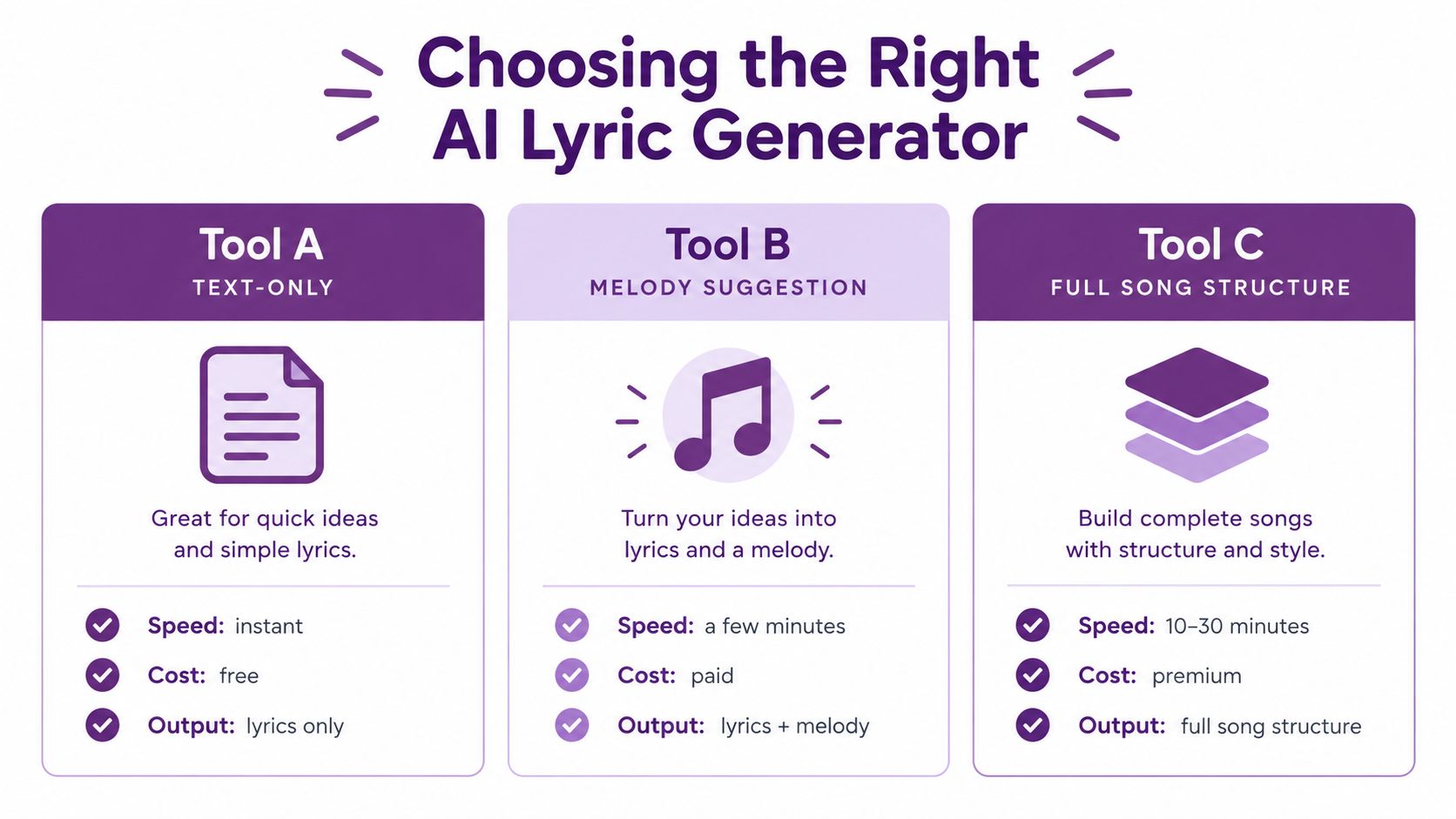
Which AI Lyric Generator Fits Your Goal
| Tool Type | Best For | Lyric Control | Output Beyond Lyrics |
|---|---|---|---|
| Text-only lyric writer | Hooks, verse ideas, rewrites, and concept development | Highest control over wording, structure, and revision | Usually text or exportable drafts |
| Integrated song and vocal generator | Testing lyrics against melody, arrangement, and vocal delivery | Moderate control, with stronger audio feedback | Music, vocals, and song demos |
| Video-ready creative platform | Music videos, social assets, ads, tutorials, and branded storytelling | Control depends on the lyric and video workflow | Edited video, voiceovers, captions, avatars, and publishing assets |
Choose a text-only tool when the lyric itself is the main creative product. It's easier to rewrite one line at a time, preserve a personal voice, or test a tightly controlled rhyme pattern. The trade-off is that you won't know whether the words sing naturally until you place them over music.
An integrated song generator is better for rapid demos. You can hear whether a chorus feels too dense, whether a vowel lands on a sustained note, and whether a verse has enough contrast. The output may sound convincing while hiding weak writing, so audio polish shouldn't replace a lyric review.
A platform such as the LunaBloom AI app belongs in a different category when the goal includes a finished video. Its broader workflow supports text, scripts, images, voiceovers, captions, avatars, and music-oriented video creation. That convenience is useful for creators making an ad, tutorial, social post, or music video, but it isn't a reason to skip lyric editing.
Selection criteria that matter
Before committing to a tool, check:
- Genre control: Can you specify the emotional and musical character without asking for a living artist's exact style?
- Structure controls: Can you request distinct sections and control repetition?
- Meter awareness: Does the system respond to syllable counts, line length, or singability instructions?
- Revision depth: Can you regenerate one section while keeping a chorus intact?
- Output options: Will you receive usable text, audio, stems, or video layers?
- Collaboration: Can you preserve versions and share drafts with a producer or client?
- Usage terms: Do the platform's terms address commercial use, ownership, and generated content?
The right choice depends on where the bottleneck is. If you're blocked at the first line, start with text. If you're unsure whether the lyric works musically, use audio feedback. If the final deliverable is a visual campaign, choose a workflow that keeps lyrics, sound, and video connected without treating the raw generation as finished work.
How to Prompt AI to Generate Lyrics That Actually Sing
A strong prompt describes a song as a performance, not as a topic. “Write a song about heartbreak” leaves the generator with too many generic choices. “Write a restrained pop ballad from the perspective of someone deleting a former partner's number, with a four-line chorus, conversational language, and short lines that leave room for held notes” gives it a usable creative boundary.
Build the prompt in layers
Define the emotional center. Name the event, conflict, and emotional movement. “Missing someone” is broad. “Wanting to reconnect but being afraid the relationship has changed” creates tension.
Specify the speaker. Identify who is singing, to whom, and from what point of view. A first-person confession will produce different language from an observer describing two people in conflict.
Set the structure. Request the sections you need, such as Verse 1, Pre-Chorus, Chorus, Verse 2, Bridge, and Final Chorus. State which section should carry the central phrase.
Add performance constraints. Ask for short lines, a consistent approximate syllable count, open vowel sounds in sustained positions, and a chorus that can be repeated without losing clarity.
Control the rhyme. Specify an approach such as ABAB, AABB, slant rhyme, or mostly unrhymed verses with a tighter chorus. Don't demand perfect rhyme everywhere, because forced rhyme often damages natural speech.
State what to avoid. Ban phrases and images that feel overused for the concept. Ask for concrete sensory details instead of abstract declarations.
A practical template looks like this:
Write original lyrics for a modern alternative-pop song about leaving a familiar city after a difficult year. The speaker is hopeful but unsettled. Use Verse 1, Pre-Chorus, Chorus, Verse 2, Bridge, and Final Chorus. Keep the verses conversational, use an ABAB pattern where it sounds natural, and make each chorus line short enough to sing clearly. Include one recurring image involving a train platform. Avoid generic phrases about spreading wings, burning bridges, or finding yourself.
For a rap verse, change the constraints:
Write a sixteen-line rap verse from the perspective of a creator building a career without outside approval. Use internal rhyme, concrete workday details, varied line lengths, and a confident but not boastful tone. Keep the meaning clear when spoken aloud. Avoid luxury clichés and motivational-poster language.
The Stanford project on lyric generation offers a useful technical insight. Its workflow uses GPT-2 with tuning-free prompting, or in-context learning, on lyrics from successful songs rather than full fine-tuning. The authors report that this approach can perform comparably to, and sometimes better than, heavily fine-tuned lyric-generation models while reducing training and fine-tuning overhead, as described in the Stanford lyric-generation project. The practical lesson is to use carefully selected exemplars and clear instructions, not to assume that more training automatically creates better songwriting.
When using examples, don't paste copyrighted lyrics and ask for a close imitation. Describe high-level qualities such as clipped phrasing, conversational delivery, dense internal rhyme, or image-heavy verses. The MyMentions AI prompt strategy is useful for thinking about specificity, context, constraints, and iterative refinement.
Generate sections separately once you have a promising direction. Ask for three choruses, keep the strongest two lines, and regenerate around them. Then place the selected chorus into a full structure. This preserves creative control and prevents one weak generation from determining the entire song.
You can test the resulting lyric in a music workflow through the LunaBloom AI starter app, but treat the audio result as feedback. Listen for crowded phrases, awkward stresses, and vowels that collapse when the vocal holds a note.
Editing and Polishing AI Lyrics for Flow and Originality
The raw draft is where songwriting begins. AI often produces lines with attractive vocabulary, but attractive words don't guarantee a story, a believable speaker, or a phrase a vocalist can deliver comfortably.
A comparative study found that only 30.90% of AI-generated songs closely resembled human-written songs, while human-authored songs were identified with 90.05% precision, according to the OpenReview study on AI and human songwriting. Those results support a practical conclusion: surface fluency isn't enough. Review the lyric for cohesion, thematic development, meaning, and singability.
Start with the voice
Read every line aloud without music. If you wouldn't say the sentence in the character's situation, replace it. Specificity usually comes from small physical details, not more dramatic adjectives.
For example:
- Draft: “I'm lost in the shadows of the night.”
- Revision: “Your blue mug waits beside the sink.”
The second line creates a place, an object, and an absence. It gives a vocalist something concrete to inhabit.
Run the lyric through five passes
Rhyme: Mark the end words and listen for accidental patterns. A rhyme should support the emotional tone, not announce that the writer needed a matching sound.
Meter: Count syllables loosely, then clap or tap the intended rhythm. Perfect equality isn't required, but major variation needs a musical reason. A line that reads well can still feel cramped when sung.
Story: Ask what changes from the first verse to the second. The bridge should introduce a new realization, image, or angle rather than repeat the chorus in different words.
Clichés: Search for stock images, especially in heartbreak, ambition, and romance songs. Keep a familiar phrase only when you've given it a fresh context.
Vocal fit: Sing the lyric on a simple melody. Notice consonant clusters on quick notes, closed vowels on sustained notes, and words that become unclear when repeated.
Listen for the mouth, not just the page. A lyric can be grammatically correct and still be physically awkward to sing.
Keep the human center
A practical augmentation workflow starts with your own material. Write a few anchor lines, a personal image, or the emotional turn you want in the bridge. Ask the generator for alternatives around those anchors, then rewrite the selected version until the diction belongs to the same person.
Use a revision checklist before exporting:
- Meaning: Can a listener explain what the speaker wants?
- Continuity: Do the images belong to the same world?
- Contrast: Does each section do a different job?
- Repetition: Is the repeated hook easy to remember?
- Originality: Have you removed borrowed or overly familiar phrasing?
- Singability: Does the lyric remain clear at the intended tempo?
- Human contribution: Have you recorded which lines, edits, melodies, and arrangements came from you?
A platform used for the final visual production may also provide context about its creative workflow. LunaBloom AI describes tools for music videos and related storytelling formats on its about page, but no platform can decide whether a lyric expresses your voice. That decision remains part of the creative work.
Legal and Ethical Guardrails for AI Generated Lyrics
The safest way to think about AI lyric ownership is to separate human authorship, machine-generated material, input content, output similarity, and platform terms. A song can contain all of these at once, and a simple yes-or-no answer about whether it is “owned” misses the practical issue.
In the United States, human-authored lyrics remain eligible for copyright protection, while lyrics generated without sufficient human authorship generally aren't protected on their own. For mixed works, protection can apply to the human-authored portions, and creators may need to disclose AI-generated elements under the applicable Copyright Office framework. Commercial publication, monetization, and registration therefore require a record of what you wrote, selected, transformed, performed, or arranged.
Why training disputes matter to users
In October 2023, Universal Music, ABKCO, and Concord sued Anthropic in U.S. federal court, alleging that Claude was trained using an “innumerable” amount of copyrighted song lyrics. Reuters reported that in 2026, the dispute expanded through a separate suit involving more than 20,000 songs and seeking over $3 billion in damages, as covered in Reuters' report on the Anthropic lyrics litigation.
That dispute concerns training and platform conduct, but it doesn't answer whether your individual output is safe. Your exposure depends heavily on the final lyric. If it reproduces or closely tracks a protected song, the output may create infringement risk even if you didn't know what source material influenced the system.
Never paste lyrics you don't control into a generator to “continue,” “rewrite,” or “make more like this.” Lyrics are protected literary expression, and copying them can implicate reproduction and derivative-work rights, as explained in legal research on copyright and generative music.
A defensible publishing workflow
Before releasing a track, keep:
- Prompt records: Save the prompts and dates used to create substantial drafts.
- Source records: Note which words, melodies, recordings, and references you supplied.
- Revision history: Preserve your original lines and the edits that shaped the final lyric.
- Similarity checks: Review distinctive phrases against known songs before distribution.
- Terms records: Save the relevant platform terms at the time of creation.
- Contributor records: Document human co-writers, performers, producers, and arrangers.
Don't treat a platform's permission to generate audio as a guarantee that every output is legally clear. Read the service terms, especially where they address commercial use, training, indemnity, attribution, and ownership. A general intellectual-property overview from Coto & Waddington's asset guide can help organize the documentation side, but a lawyer should handle a material dispute or high-value release.
LunaBloom AI's terms page should be reviewed alongside any other service terms before you publish work created through its tools. The practical standard is simple: use material you have rights to use, avoid prompts that request imitation of protected lyrics, inspect the output for recognizable copying, and preserve evidence of your human contribution.
From Lyrics to Finished Song and Video With LunaBloom AI
A polished lyric still needs a production plan. Decide whether the words will support a vocal demo, a lyric video, a character performance, a social advertisement, or a longer narrative. Each format changes what matters. A lyric video needs readable timing and clear typography, while a character-led music video needs visual continuity, believable lip sync, and room for the vocal phrasing.
Start with the approved lyric and create a clean production sheet:
- Lock the sections: Label verses, chorus, bridge, and outro.
- Mark the hook: Identify the phrase that should receive visual emphasis.
- Choose the visual premise: Match the emotional movement rather than illustrating every noun.
- Prepare the audio: Keep the vocal, and lyric versions organized.
- Build the first cut: Use captions and scene changes that follow the song's structure.
- Review the mouth movements: Check difficult consonants, sustained vowels, and repeated phrases.
- Export platform versions: Adjust framing, captions, and metadata for each destination.
LunaBloom AI can turn prompts, scripts, and images into edited videos with voiceovers, captions, avatars, localization, and social publishing features. Its music-focused capabilities also support AI-generated songs, sing-and-dance videos, and lip-synced visuals for uploaded tracks. That makes it suitable for connecting a finished lyric to a promotional video, product concept, tutorial, or music-first social asset.
Keep the rights review active at this stage. If a user supplies copyrighted lyrics and the generated result reproduces or closely tracks those words, the song can infringe the underlying musical composition because lyrics are protected literary expression. Audio generation and video generation don't remove that risk.
The best workflow is therefore not “prompt, download, publish.” It's prompt, test, rewrite, document, produce, and review. When the lyric scans naturally and the visual treatment reinforces its emotional center, AI becomes a practical production partner rather than a shortcut that leaves the hard decisions unresolved.
Use LunaBloom AI to turn your original, reviewed lyrics into music videos, lip-synced visuals, captioned social content, and polished creator assets from one workflow. Visit LunaBloom AI to test how your finished song concept can move from words to a publishable video.