Think of a video sales letter as your best salesperson—one who works 24/7, never sleeps, and tirelessly turns curious viewers into loyal customers. It’s the modern evolution of old-school direct-response copywriting, perfectly redesigned for an audience that prefers watching over reading.
What Is a Video Sales Letter and Why It Works
Imagine a long, text-heavy sales page. Now, picture transforming all that static text into a dynamic, engaging video that tells a compelling story. That, in a nutshell, is a video sales letter (VSL).
A VSL is a AI video creation with a single, focused purpose: to persuade a viewer to take one specific action. This action could be anything from buying a product or booking a demo to simply signing up for a newsletter.
Unlike a flashy brand advertisement, a VSL is a pure direct-response machine. It follows a proven formula: hook the viewer, dive deep into their biggest pain point, introduce your product as the ultimate solution, and close with a powerful call-to-action. It’s a meticulously crafted journey designed to guide a prospect from “What’s this?” to “I need this now.”
The Psychology Behind Its Effectiveness
The true magic of a VSL lies in its ability to blend sight and sound, forging a genuine emotional connection with the viewer. This multi-sensory experience makes your message stick in a way plain text simply can’t. To fully grasp this, it helps to understand what a conversion truly means in marketing.
A VSL isn’t just about listing features; it’s about telling a powerful story. It allows you to:
Grab and Hold Attention: In our fast-scrolling digital world, video reigns supreme. A well-crafted VSL snags a viewer’s attention immediately and holds it using smart pacing, supportive visuals, and a compelling narrative.
Convey Real Emotion: Your tone of voice, the background music, and the visuals all work in harmony to communicate excitement, trust, and urgency. Text can tell someone a deal is urgent; video makes them feel it.
Simplify Complex Ideas: Have a complicated product? A VSL can break it down into easily digestible concepts using animations, screen recordings, or simple on-screen text, making your solution feel both obvious and essential.
A Video Sales Letter is a digital bridge. On one side, you have your prospect’s biggest problem. On the other, your perfect solution. The VSL connects the two with a persuasive, personal story, transforming a passive reading experience into an active, emotional decision.
And the data doesn’t lie. Studies show that viewers retain an incredible 95% of a message when they watch it in a video, compared to just 10% when they read it in text. This power extends to email marketing, where simply including a video can boost click-through rates by up to 300%.
Why It Outperforms Traditional Sales Pages
So, what makes a video sales letter so much more effective than the old-school sales pages it often replaces? Let’s break it down.
VSL vs. Traditional Sales Page Performance
|
Attribute |
Video Sales Letter (VSL) |
Traditional Sales Page |
|---|---|---|
|
Engagement |
High. Combines audio and visual cues to keep viewers hooked. |
Low. Relies on skim-reading; easy for visitors to bounce. |
|
Emotional Connection |
Strong. Tone of voice and music build trust and empathy. |
Weak. Difficult to convey emotion through text alone. |
|
Information Retention |
Excellent. Viewers retain up to 95% of the message. |
Poor. Viewers retain only about 10% of what they read. |
|
Conversion Rates |
Consistently higher due to a more personal and persuasive format. |
Generally lower; feels more transactional and less personal. |
|
Complexity Explained |
Simple. Breaks down complex ideas with visuals and narration. |
Difficult. Can become dense and overwhelming for the reader. |
Ultimately, a VSL works because it mimics a real, one-on-one sales conversation. It anticipates objections, showcases testimonials, and builds a sense of urgency that motivates people to act now. It makes the entire sales process feel more human, direct, and incredibly compelling.
LunaBloom and VSLs: An Innovative Approach
Creating a high-converting video sales letter can feel daunting, but platforms like LunaBloom AI are revolutionizing the process. LunaBloom AI allows you to generate professional, high-converting VSLs without technical headaches. From writing the script to producing the video, LunaBloom AI simplifies the process, enabling anyone to craft persuasive sales videos in minutes.
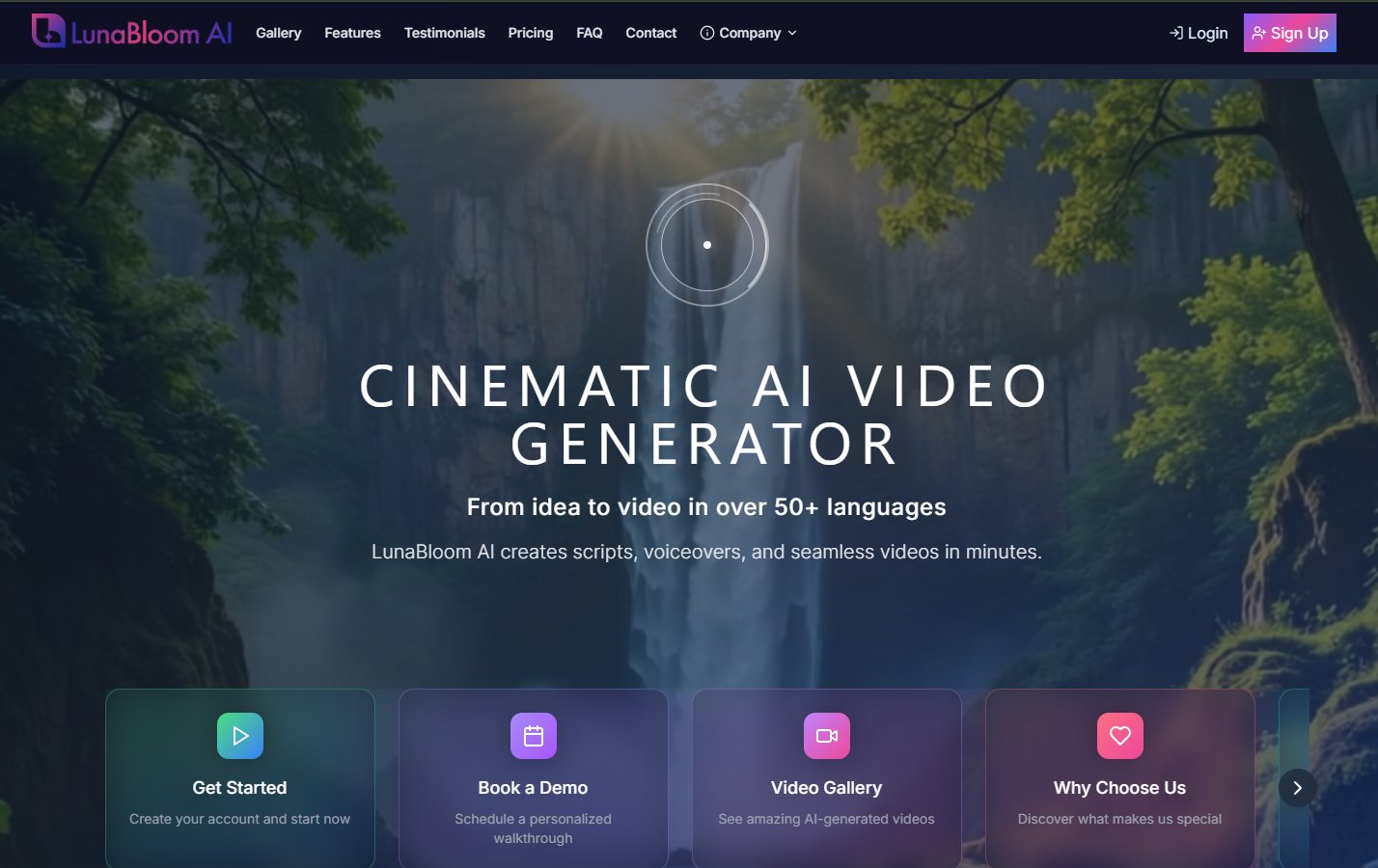
Advanced Features for Maximum Impact:
Create Hyper-Realistic Custom AI Avatars:
Transform your photos into custom-branded avatars.
Choose from photo-realistic, animated, or 3D avatar styles.
Customize expressions and attire to match your brand, maintaining a consistent presence across all videos.
50+ Multilingual Voices for Global Reach:
Create content in 50+ languages with natural AI voices.
Access diverse regional accents for authentic localization.
Clone your voice for a consistent brand presence globally.
Auto-generate subtitles and translations instantly, making your videos accessible worldwide.
Lightning-Fast Text-to-Video Creation:
Input your script and get professional videos in minutes.
No technical skills or video editing experience required.
AI handles animation, voice sync, and editing automatically.
Perfect for creating tutorials, marketing videos, and social content instantly.
Flexible Pricing Plans for EVERYONE:
Start free with access to core AI Video Generator features.
Plans available for individuals, businesses, and enterprise teams.
Scale video production as your business grows while keeping costs affordable.
Studio-quality results at a fraction of traditional production costs.
With LunaBloom AI, you can create the perfect VSL tailored to your audience, all while saving time and resources. Start building your high-converting VSL now at LunaBloom AI.
Crafting Your High-Converting VSL Script
Your script is the soul of your video sales letter. It’s the narrative that guides a viewer from being a curious browser to a confident buyer. You can have the slickest production in the world, but without a killer script, your VSL is dead in the water.
Think of your script as a blueprint for persuasion. Every word, every pause, and every story beat must be laser-focused on one goal: conversion. This isn’t about being a pushy salesperson; it’s about building such a powerful, logical, and emotional case that your solution becomes the only one that makes sense.
The Unskippable Hook
Let’s be realistic: you have about 8 seconds to grab someone’s attention before they click away. Your opening, or “hook,” is your one chance to make them stop scrolling and listen. A great hook doesn’t just get attention—it instantly qualifies your ideal customer by speaking directly to their biggest problem or deepest desire.
Here are a few proven ways to pull them in:
The Question Hook: “Are you a small business owner who’s sick of pouring money into ads that just don’t work?” This immediately grabs the right person’s attention.
The Shocking Statement Hook: “You’re probably just one simple mistake away from doubling your monthly revenue. In the next few minutes, I’ll show you exactly what it is.” Curiosity is a powerful motivator.
The Story Hook: “Just six months ago, I was exactly where you are now—overwhelmed, overworked, and on the brink of giving up on my online store.” This creates instant relatability and trust.
The key is to jump straight into the conversation already happening inside their head. Skip the long, boring introductions and hit them with what matters most to them.
Agitate the Problem, Then Introduce the Solution
You’ve captured their attention. Now what? Your next job is to make them feel deeply understood. This is where you dive into their pain points. But don’t just mention the problem—agitate it. Paint a vivid, painful picture of the frustration, wasted time, and missed opportunities their problem is causing.
For example, if you sell time-management software, don’t just say, “You’re disorganized.” Instead, say, “You start each day with a clear plan, but by noon, you’re buried under a mountain of emails, surprise meetings, and a to-do list that’s grown three times as long. You end the day feeling defeated, knowing you were busy but not one bit productive.” See the difference?
Only after the viewer feels the full weight of their problem will they be truly open to a solution. This is where you pivot and introduce your product not as a nice-to-have, but as the essential key to their relief.
This transition is crucial. You’re framing your product as the bridge from their current state of frustration to the future they’ve been dreaming of. It becomes the tool that finally solves the very problem you just described in agonizing detail.
Build Trust with Social Proof
At this stage, your viewer is interested but still skeptical. They’re thinking, “This sounds great, but does it actually work?” Now is your chance to demolish that doubt with overwhelming social proof. This is where you weave in testimonials, case studies, and hard data to back up your claims.
Showing real results is infinitely more powerful than making more promises. Here’s how to do it effectively:
Direct Testimonials: Feature short clips or quotes from happy customers explaining, in their own words, how your product changed their life or business.
Case Studies: Quickly walk through a specific customer’s journey, highlighting the “before” and the incredible “after.”
Data and Statistics: Use concrete numbers. “Our users report an average 45% increase in productivity within the first 30 days.”
This is where your promises transform into proven facts, making the decision to buy feel safe and intelligent. The data backs this up: 87% of marketers report that video has directly increased their sales, showing the power of combining a persuasive script with tangible proof.
This infographic illustrates the typical viewer journey, showing common drop-off points.
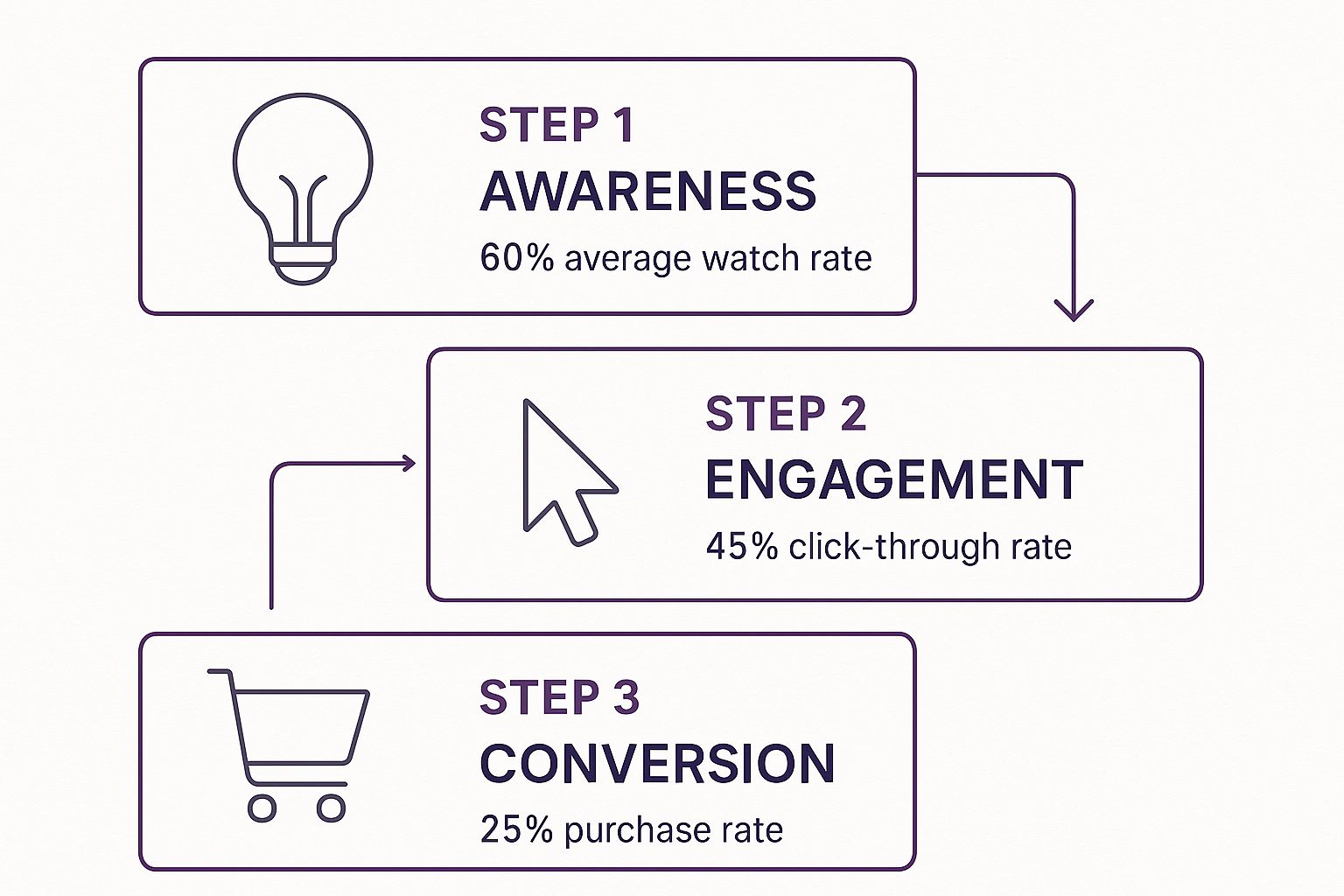
As you can see, keeping viewers engaged through the middle phase is the whole ballgame. If you lose them there, you lose the sale.
Structure the Irresistible Offer and Call to Action
Finally, it’s time to present your offer and tell them exactly what to do next. Your offer needs to be so compelling it feels like a no-brainer. This is where you “stack the value” by piling on bonuses, offering a limited-time discount, or including a money-back guarantee to eliminate any last-minute hesitation.
Your call to action (CTA) must be crystal clear, direct, and urgent. Avoid vague phrases like “learn more.” Instead, use a commanding statement like, “Click the button below to get instant access.” If possible, create scarcity or urgency by mentioning a limited number of spots or a price that’s about to increase. This encourages people to act now instead of later. To accelerate the writing process, consider exploring some of the best AI script generators.
Essential VSL Production and Design Principles

If a great script is the engine of your video sales letter, then production and design are the vehicle that delivers the message. This is where your persuasive words come to life. But don’t worry—you don’t need a Hollywood budget to create a video that sells.
The goal isn’t cinematic perfection; it’s clarity and persuasion. In fact, a simple slide-based VSL, often called an “ugly” VSL, can easily outperform a slick, high-budget production if it nails the core elements. The key is to remove distractions and focus the viewer’s attention squarely on your message.
Prioritizing Audio Quality Above All Else
Let’s be crystal clear: if your audience has to strain to hear you, you’ve already lost. Poor audio is the fastest way to make someone click away. It signals unprofessionalism and makes your message impossible to follow. Crisp, clear sound is not a luxury—it’s non-negotiable.
Investing in a decent microphone is one of the smartest decisions you can make. Even an affordable USB mic or a simple lavalier you clip to your shirt will be a massive upgrade from your computer’s built-in microphone.
Before you record, always perform a quick soundcheck in a quiet room. Listen for echoes, background noise, or muffled words. Viewers will forgive grainy video, but they will never tolerate bad audio.
Mastering Pacing and Visual Simplicity
The rhythm of your VSL is critical. Talk too fast, and you’ll overwhelm your audience. Too slow, and they’ll get bored. Aim for a conversational but deliberate pace, using well-placed pauses to let your key ideas sink in.
This same principle applies to your visuals. Whether you’re using simple text slides or appearing on camera, the visuals should support your script, not compete with it.
Slide-Based VSLs: Keep it clean and high-contrast, like white text on a black background. Use minimal text on each slide—just a few words to emphasize what you’re saying. This encourages listening over reading.
On-Camera VSLs: Ensure your background is tidy and free of clutter. The focus should be on you and your message, not the messy bookshelf behind you. Good lighting is also essential; it builds trust and enhances professionalism.
The most effective video sales letter design isn’t about flashy graphics or complex animations. It’s about creating a frictionless viewing experience where the only thing the prospect needs to focus on is the story you’re telling and the solution you’re offering.
Using Visuals to Emphasize Key Points
While simplicity is your ally, you can strategically use subtle visual elements to make your most important points stand out. Think of these as signposts that grab the viewer’s attention and highlight the takeaways you want them to remember.
These visuals act as a highlighter for your spoken words.
Text Overlays: Use bold or colored text to emphasize a specific statistic, benefit, or guarantee.
Simple Graphics: A basic chart or graph can make data much easier to digest at a glance.
Subtle Animations: A simple animation can be effective for revealing a price or drawing attention to your call-to-action button.
The golden rule is to use these tools sparingly and with a clear purpose. Every visual element should serve a function—clarify a point, build credibility, or guide the viewer toward the final call to action. When you combine a killer script with clean, intentional design, you create a persuasive machine that converts viewers into customers.
Deconstructing Successful VSL Examples
Understanding the theory behind a great video sales letter is one thing, but seeing it in action is where the real learning happens. By deconstructing successful VSLs, you can see how the core principles—hook, problem, solution, and close—are adapted to fit different products and audiences. It’s like getting a look under the hood of a high-performance engine.
The beauty of the VSL format is its flexibility. Whether you’re selling a complex software subscription, a high-end coaching program, or a simple physical product, the fundamental structure works. The magic lies in how you customize each component to address the specific fears, desires, and doubts of your ideal customer.
Example 1: The Coaching and Personal Development VSL
Beau Norton’s “Practitioner of Peace” is a prime example of a VSL for the personal development space. It masterfully sells an intangible product—personal transformation—by tapping into deep emotional triggers.
The Hook: It avoids a sales pitch, instead opening with profound questions like, “What is the one thing that all successful people have in common?” This sparks curiosity and encourages self-reflection, instantly lowering the viewer’s guard.
The Problem: Norton excels at agitating the pain points of feeling stuck, unfulfilled, and out of control. He uses relatable stories to build powerful empathy, making the viewer feel understood.
The Solution & Offer: The book is positioned not just as a book, but as the “key” to unlocking a better version of oneself. The offer is simple but framed as the first step toward peace and success, making it feel incredibly valuable.
The Call-to-Action: The CTA is encouraging and direct, urging viewers to take that crucial first step. The inspirational tone is perfectly suited for the personal development market.
Example 2: The SaaS and Technology VSL
Next, let’s analyze HubSpot’s announcement video for their Breeze AI technology. This VSL is a masterclass in making a complex, feature-heavy product feel simple, essential, and even exciting. While a personal development VSL sells a feeling, a great SaaS VSL sells efficiency and measurable results.
The video uses clean visuals, slick product demos, and a clear, confident voiceover to communicate its value. It feels professional while staying focused on solving the user’s biggest business challenges—a critical approach in the B2B world where buyers are focused on ROI.
A successful SaaS VSL doesn’t just list features; it demonstrates a better future. It shows the viewer a world where tedious tasks are automated, goals are achieved faster, and their work life is significantly easier.
The video brilliantly translates technical specifications into tangible benefits like saving time and working smarter, which are the outcomes that motivate business audiences to invest.
Example 3: The ‘Ugly’ E-commerce VSL
Finally, Michelle Cornish’s VSL for her bookkeeping guide is a classic “ugly” VSL, consisting of simple slides and a voiceover. Its power comes from its raw, unfiltered focus on the message, proving you don’t need a big budget to drive sales.
Direct Problem Focus: The video gets straight to the point, addressing the primary pain point for its audience: small business owners overwhelmed by their finances.
Simplicity Builds Trust: The minimalist design makes the message feel more authentic, like receiving advice from a trusted expert rather than a slick marketing team.
Clear Value Proposition: The VSL clearly explains what you’ll learn and how it will help you save money and reduce stress. It’s direct and powerful.
This no-frills style works because it prioritizes clarity, which often converts best for information products. This makes sense, as 92% of internet users watch videos online, and a clear message will always outperform flashy production. You can learn more about how VSLs convey complex messages in this comprehensive guide on cincopa.com.
Each of these examples, though stylistically different, uses the same core formula to guide the viewer on a journey from problem to solution.
VSL Deconstruction Checklist
When analyzing a VSL, use this checklist to identify the techniques that make it effective.
|
Element |
What to Look For |
Impact on Viewer |
|---|---|---|
|
The Hook |
How quickly does it grab attention? Does it use a question, a bold statement, or a shocking statistic? |
Creates immediate curiosity and stops them from scrolling. |
|
Problem Agitation |
Does it describe the viewer’s pain points in vivid detail? Does it use emotional language? |
Makes the viewer feel understood and validates their struggles. |
|
The Story |
Is there a personal or relatable story? How does it connect the problem to the solution? |
Builds trust, creates an emotional connection, and makes the solution memorable. |
|
Solution Intro |
How is the product/service introduced? Is it framed as a unique discovery or a “secret”? |
Positions the offer as the perfect answer to the agitated problem. |
|
Credibility |
Are there testimonials, case studies, social proof, or expert endorsements? |
Overcomes skepticism and proves the solution actually works. |
|
The Offer |
How is the offer structured? Does it include bonuses, a guarantee, or scarcity (limited time/spots)? |
Makes the offer feel irresistible and increases its perceived value. |
|
Call-to-Action |
Is it clear, direct, and easy to follow? Does it tell the viewer exactly what to do next? |
Removes friction and confusion, guiding the viewer to take the desired action. |
By using this checklist, you can shift from being a passive viewer to an active analyst, spotting the hidden psychology at play and borrowing the best techniques for your own video sales letters.
How to Avoid Common VSL Conversion Killers

Creating a successful video sales letter isn’t just about following a formula; it’s also about avoiding the common pitfalls that sabotage countless videos. Many businesses invest significant time and resources into a VSL only to see it fail due to a few simple, preventable mistakes.
Think of your VSL as a bridge connecting a customer’s problem to your solution. A single weak plank can make the entire structure feel unstable, causing viewers to lose trust and click away. Let’s make sure that doesn’t happen to you.
Focusing on Features Instead of Benefits
This is arguably the most common VSL mistake. Entrepreneurs get so excited about their product that they list all its features. But here’s the truth: your audience doesn’t care that your software uses a proprietary algorithm. They care that it saves them 10 hours a week.
You have to sell the outcome, not the specifications.
Always translate your product’s features into tangible, emotional benefits for the viewer. This requires getting inside your customer’s head to understand what truly matters to them.
Feature: Our product has a 10-hour battery life.
Benefit: You can get through your entire workday without ever worrying about finding an outlet.
Feature: This course includes 20 downloadable worksheets.
Benefit: You get a complete, step-by-step toolkit to eliminate guesswork and achieve results faster.
This shift from “what it is” to “what it does for you” is everything. Benefits connect with people’s emotions and aspirations, and that’s what drives purchasing decisions.
Overlooking the Power of Audio
In the world of VSLs, bad audio is a cardinal sin. It instantly screams “amateur” and makes your message a chore to follow. People will forgive grainy video long before they’ll tolerate scratchy, muffled, or inconsistent sound.
A VSL with crystal-clear audio and simple text on screen will always outperform a beautifully shot video with terrible sound. Your voice is your primary tool for building trust and conveying emotion, so make sure it’s heard perfectly.
Invest in a decent microphone. It’s a small expenditure that pays for itself many times over by ensuring your message lands with the clarity and authority it deserves.
A Weak or Confusing Call to Action
You’ve built an airtight case for your product, and the viewer is convinced. Don’t fumble the ball now. A vague or weak call to action (CTA) will kill the momentum you’ve worked so hard to build.
Your audience should never have to guess what to do next.
Your CTA must be direct, clear, and urgent. Don’t say “learn more” when you mean “buy now.” Use punchy, action-oriented language that spells out exactly what they should do and what they will get. A phrase like, “Click the button below to get instant access to the complete system” is far more effective than a passive “Check out our product.”
Tell them precisely what you want them to do. You’ll be amazed at how many will follow your lead.
Using AI Tools to Build Your VSL Faster
Not long ago, creating a high-quality video sales letter required significant resources, including writers, voice actors, and video editors. Today, that process is being revolutionized. AI tools provide a massive advantage, allowing you to bypass technical hurdles and creative blocks to produce a powerful VSL in a fraction of the time.
This isn’t about replacing creativity; it’s about amplifying it. Think of these tools as an expert assistant that handles the tedious tasks, freeing you up to focus on your core message. You can now go from a blank page to a finished VSL without ever needing a camera or microphone.
Conquer Writer’s Block with AI Scripting
The script is the foundation of your VSL. However, staring at a blank page can be the most daunting part of the process. AI script generators are designed to shatter that writer’s block by providing a solid, persuasive starting point based on proven direct-response formulas.
Simply input the basics: your product, your target audience, and their primary pain points. The AI will generate a complete script framework that typically includes:
A powerful hook to grab attention immediately.
Problem agitation sections to resonate with your viewer’s frustrations.
A solution pivot that seamlessly introduces your product.
Benefit-driven language that sells the outcome, not just the features.
A compelling call-to-action that drives action.
You receive a strong first draft that you can then refine with your unique voice and personality. It’s like having an expert copywriter on demand.
Create Professional Voiceovers Without a Microphone
A VSL with poor audio is doomed from the start. But not everyone has a professional-grade voice or a soundproof studio. AI text-to-speech technology eliminates this barrier, transforming your written script into a surprisingly natural, human-sounding voiceover.
Modern AI voices are no longer robotic. They offer a wide range of tones, accents, and emotional styles, allowing you to find a voice that perfectly matches your brand, whether you need to sound authoritative, warm, or energetic.
This is what truly levels the playing field. You no longer need expensive recording equipment or the confidence of a keynote speaker. A great script is all you need—the AI can handle the entire audio production.
This technology enables you to produce VSLs with crystal-clear audio from anywhere, empowering solo entrepreneurs and small teams to compete with larger companies.
Automate Video Assembly and Production
This is where AI truly shines. The latest AI video generators can now build the entire VSL for you, combining the script, voiceover, and visuals into a polished final product. Best of all, you need zero video editing skills.
The process is remarkably simple:
Input Your Script: Write it yourself or use an AI-generated version.
Select a Voice and Style: Choose an AI voiceover and a visual theme that aligns with your brand.
Generate the Video: The AI analyzes your script, sources relevant stock footage and images, and synchronizes everything with text overlays and smooth transitions.
The result is a fully produced, slide-based video sales letter ready for publication. Platforms are making this technology more accessible than ever. For instance, tools like LunaBloom AI are designed to turn your ideas into compelling videos with minimal effort. This automated workflow dramatically reduces production time, allowing you to test different hooks, offers, and angles faster than ever before.
Frequently Asked Questions About VSLs
Even with a clear roadmap, you might still have a few questions about creating a video sales letter. Let’s address them now so you can move forward with confidence.
What’s the Ideal Length for a VSL?
The honest answer is: it depends. The optimal length is directly tied to the price and complexity of your offer. For lower-priced products targeting a warm audience, a concise 5-12 minute VSL can be highly effective.
However, if you’re selling a high-ticket offer or a complex solution to a cold audience, you’ll need more time to build trust and present your case. These VSLs can often run from 20 to 45 minutes or even longer.
The golden rule is this: your VSL should be as long as necessary to close the deal, but as short as possible to maintain engagement. The focus should always be on delivering value, not on hitting a specific time mark.
Do I Really Need to Be on Camera?
Absolutely not. In fact, many of the most successful VSLs are “ugly” VSLs—simple slides paired with a compelling voiceover. This format is a classic for a reason.
By removing the on-screen personality, you force the viewer to focus entirely on your message and the story you’re telling. It strips away potential distractions, making your VSL accessible to anyone, regardless of their comfort level on camera or their budget.
How Do I Know if My VSL Is Actually Working?
The most important metric is your conversion rate—the percentage of viewers who took your desired action (e.g., clicking “buy now”). That’s your ultimate scoreboard. But to understand the “why” behind that number, you need to track a few other key performance indicators.
Monitor these metrics closely:
View-Through Rate (VTR): Shows you exactly where people are dropping off, helping you identify weak spots in your script.
Click-Through Rate (CTR): Measures how many people click your call-to-action when it appears.
Average Watch Time: Provides a general sense of how engaging your video is overall.
If you’re running paid ads, the ultimate metric is your Return on Ad Spend (ROAS). This tells you if your VSL is not just converting, but also generating a profit.
Ready to create a high-impact video sales letter without the technical headaches? LunaBloom AI can transform your ideas into a professional, persuasive video in minutes. Let it generate your script, create the voiceover, and produce a finished VSL automatically.