You publish a polished English video, promote it in several new markets, and then watch engagement flatten. The script is clear, the visuals are strong, and the offer makes sense. Yet viewers leave because the content feels imported rather than made for them.
That gap is where multilingual content localization matters. It goes beyond translating dialogue. It adapts language, locale, voice, captions, visuals, metadata, accessibility, and the buying journey so people can understand and trust the same message in their own context.
The Localization Problem Most Teams Discover Too Late
A video can be technically available in a market without being useful there. An English upload with automatic subtitles may load correctly, but it can still contain unfamiliar idioms, the wrong currency format, awkward pronunciation, or a call to action that does not match local expectations.
Translation changes words. Localization changes the experience around those words. That distinction becomes especially important in video because meaning is distributed across several layers at once:
- Spoken narration
- On-screen text
- Captions and subtitles
- Thumbnails and titles
- Visual references and examples
- Voice, accent, pacing, and pronunciation
- Landing pages and follow-up messages
CSA Research surveyed 8,709 online consumers across 29 countries in 2020. The research found that 76% preferred buying when product information was available in their native language, while 40% said they would never purchase from websites written in other languages. The same research found that 65% preferred content in their own language even when it was poorly written, which shows how strongly language access affects trust and market entry. Read the CSA Research findings on consumer language preferences for the full context.

Availability is not usefulness
The silent cost of skipped localization appears in places teams often overlook:
- A viewer understands the broad topic but misses the product benefit because the phrasing sounds unnatural.
- A caption translates an idiom word-for-word, making the speaker appear careless.
- A voiceover pronounces a brand name or place incorrectly.
- A thumbnail remains in English, so the local audience never understands the promise before clicking.
- The video sends viewers to a landing page that still uses unfamiliar terms or formats.
The problem isn't always that the audience rejects the product. Often, the audience never receives enough local context to evaluate it confidently.
Practical rule: Treat every visible, spoken, and searchable part of a video as a localized asset, not as a side effect of translation.
For a publisher building international campaigns, this changes the first planning question. Don't ask only, “How do we translate this video?” Ask, “What must this audience understand, feel, and do at each point in the journey?” A useful starting point is to document the audience, channel, desired action, terminology, and market-specific risks before production begins. LunaBloom's company overview provides an example of how a video platform can fit into a broader content workflow, but the underlying principle applies to any production stack.
What Multilingual Content Localization Actually Means
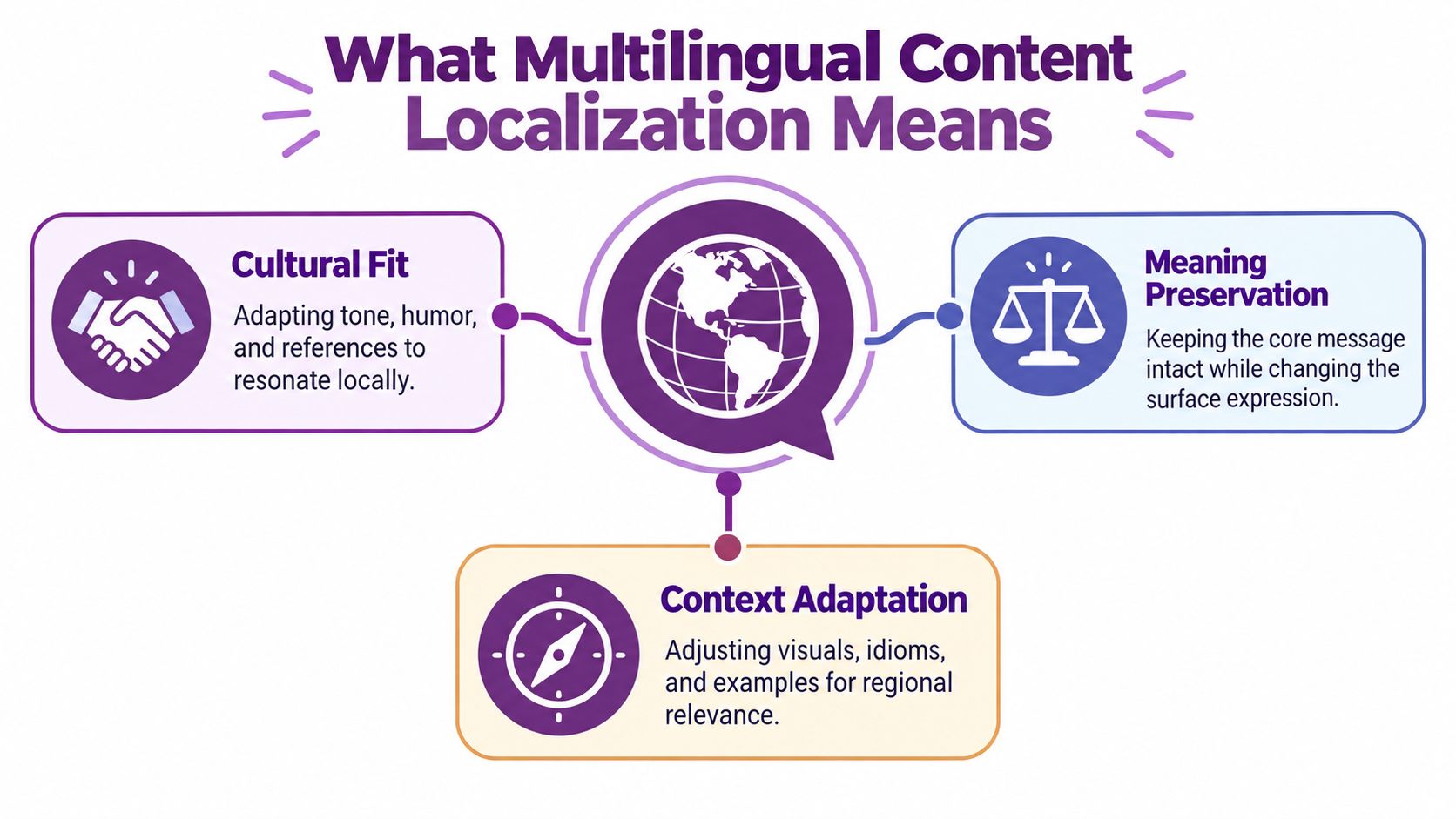
Localization is like moving the same conversation into a different room. The message remains recognizable, but the lighting, furniture, etiquette, and wayfinding need to fit the people who use that room.
Translation transfers meaning from one language to another. Transcreation reshapes creative language, such as slogans, humor, metaphors, and emotional appeals, while protecting the intended effect. Full localization includes those language decisions plus cultural references, formats, imagery, voice, accessibility, search intent, and customer journey details.
Language is not the same as locale
A language label alone is too broad for reliable production. English for the United States and English for the United Kingdom may share grammar, yet differ in spelling, vocabulary, date conventions, units, pronunciation, and commercial expectations. Brazilian Portuguese and European Portuguese also need separate treatment.
Use locale identifiers such as:
en-USen-GBpt-BRpt-PTzh-Hanszh-Hant
The W3C Internationalization Tag Set requirements explain why language and locale information must travel with content, not sit only in a project name. BCP 47 language tags distinguish regional variants, while Unicode CLDR locale data supports regional formatting for dates, numbers, currencies, calendars, and related conventions.
Store locale metadata beside every meaningful content object:
- Script segments
- Caption cues
- Voice tracks
- Thumbnail text layers
- SEO titles and descriptions
- Calls to action
- Product names and protected terms
This prevents a production system from treating “Portuguese” or “English” as a single undifferentiated field. It also helps teams route the right strings to the right reviewers, preserve placeholders, select suitable pronunciation models, and test text direction for right-to-left scripts.
How the concept changes a video pipeline
Suppose an English product demo says, “Get started today.” Localization may require more than a translated sentence. The voice track might need a regional speaker profile, the subtitle may need different line breaks, the thumbnail may need shorter text, the landing page may need local currency formatting, and the SEO title may need a different search phrase.
That's why useful multilingual SEO guidance, such as LLMrefs' best practices for multilingual SEO, treats localized pages as complete search experiences rather than translated keyword containers. A localized video works the same way. Preserve the core promise, then adapt the surrounding signals that help people understand and act.
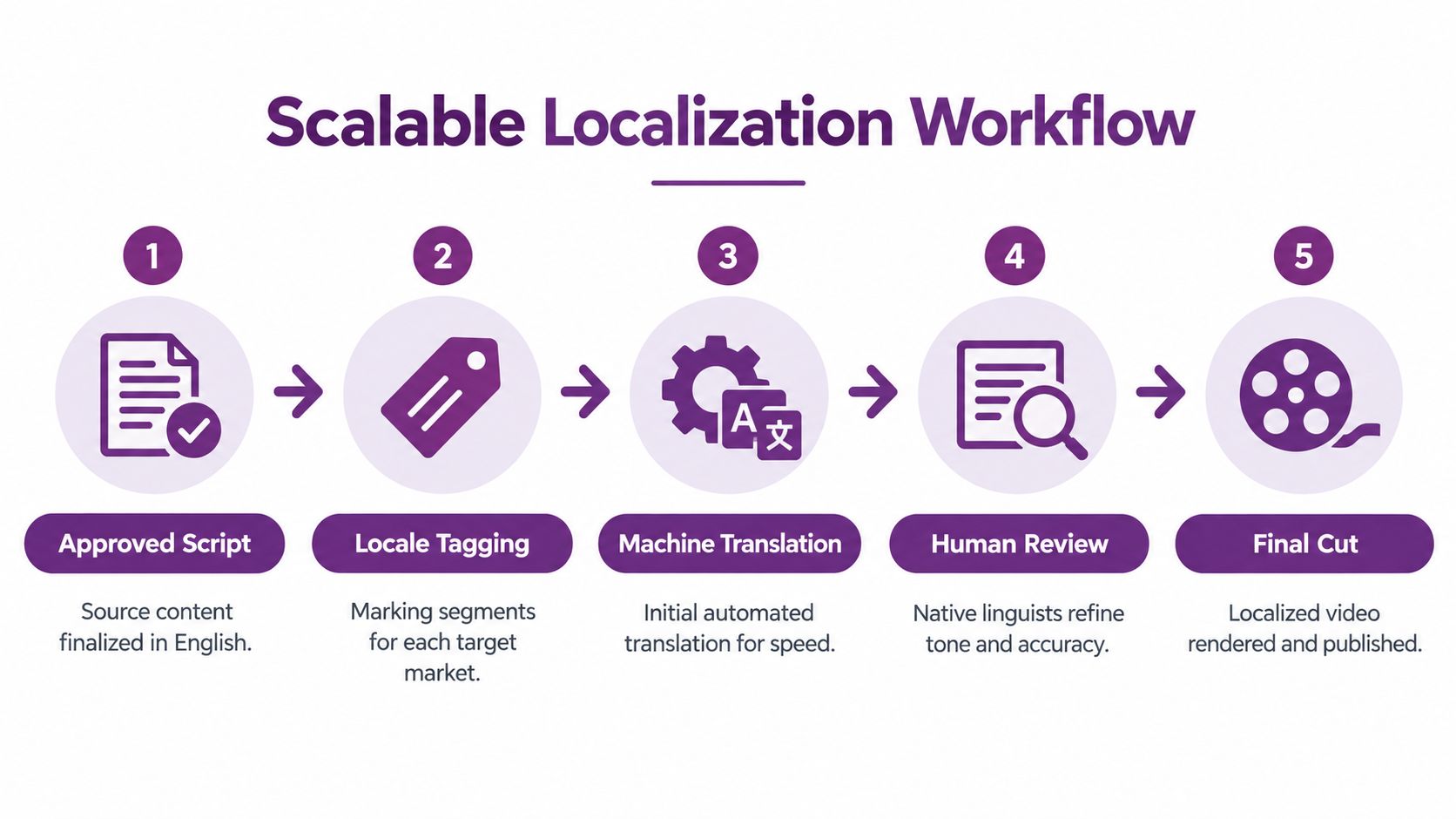
A Scalable Workflow from Script to Final Cut
A scalable workflow doesn't remove human judgment. It places human judgment at the points where errors become expensive or damaging.
1. Approve the source script
Start with one controlled source script. Mark brand names, legal phrases, product terminology, jokes, placeholders, pronunciation notes, and lines that can be rewritten by market.
The source owner approves the meaning and claims. A language or localization lead then identifies segments that require transcreation rather than direct translation. This prevents reviewers in different markets from making incompatible creative decisions.
2. Tag every segment by locale
Attach metadata before translation begins. Each segment should identify its target locale, content type, translation status, reviewer, and any constraints such as maximum caption length or protected terminology.
The result is a structured handoff, not a pile of copied documents. Teams working with web data or content intelligence can also use a web data API from Context.dev to enrich research and organize market-specific inputs, provided the resulting claims and references receive editorial review.
3. Generate a first translation
Machine translation can create a useful draft quickly, particularly for repetitive instructional language. It shouldn't make the final decision on cultural tone, sensitive wording, claims, humor, or ambiguous terminology.
The first output should preserve placeholders and identify uncertainty. A human reviewer then checks whether the translated sentence means what the source intended, not merely whether individual words look correct.
4. Select or create the regional voice
Choose between a curated native voice, a professionally recorded voiceover, partial re-voicing, or voice cloning where the speaker has appropriate permission. Reviewers should test names, acronyms, numbers, technical terms, emotional emphasis, and pacing.
A familiar voice can preserve continuity across markets, but a regional voice can sound more natural when accent and cultural expectations strongly influence trust. The right choice depends on the audience and the role of the video.
5. Align captions, visuals, and metadata
Captions must match the localized audio and remain readable at the intended playback speed. Rebuild on-screen text and thumbnails instead of leaving English layers embedded in the video.
Then review:
- Localized title and description
- Search terms and intent
- Thumbnail wording
- Calls to action
- Landing-page language
- Accessibility text
- Platform-specific metadata
Watch the production relationship between script, narration, captions, and final edit in this video workflow example:
6. Run market-level QA
The final reviewer should watch the rendered asset, not only inspect a translation file. They need to hear pronunciation, compare captions with speech, check text overflow, test reading order, and confirm that the call to action leads to the correct localized destination.
A platform such as LunaBloom AI can support multilingual voiceovers, voice cloning, subtitles, translations, and localized video production across more than one language. Whatever tools you use, keep approval responsibility with people who understand the target audience and the content's commercial or educational purpose.
Choosing Between Subtitles, Dubbing, and Regional Voice Cloning
The best delivery mode depends on the viewer, channel, video length, and consequence of misunderstanding. A short social clip may benefit from fast, readable subtitles. A product demo or training lesson may justify a complete regional voice track because viewers need to follow the explanation without dividing attention between audio and text.
| Mode | Cost | Turnaround | Best fit | Watch-through risk |
|---|---|---|---|---|
| Subtitles | Lower | Faster | Short clips, multilingual reach, audiences comfortable reading | Viewers may skip if captions are dense, late, or culturally awkward |
| Full dubbing | Higher | Longer | Tutorials, product demos, training, audiences with limited English proficiency | Poor lip timing or unnatural delivery can break trust |
| Regional voice cloning | Variable | Faster after setup | Consistent creator or brand voice across markets | Incorrect pronunciation or unsuitable accent can feel artificial |
| Partial re-voicing | Moderate | Moderate | Key introductions, calls to action, or selected campaign sections | Mixed languages can feel inconsistent if transitions are unclear |
| In-screen text rewrites | Moderate | Moderate | Visual-first social posts and thumbnail-led campaigns | Text expansion can damage layouts or hide the main message |
Subtitles are efficient, but they place more work on the viewer. Keep sentence segmentation natural, align cues with speech, and rewrite idioms rather than translating them word for word. A subtitle that is technically accurate can still fail if it arrives after the visual event or disappears before the reader finishes.
Dubbing creates a more immersive experience, particularly when the video teaches a process. It also introduces more production dependencies, including voice direction, timing, lip movement, music balance, and synchronization with on-screen text.
Regional voice cloning occupies a useful middle ground. It can preserve a recognizable speaker while adapting language and accent, but teams need explicit consent, a pronunciation dictionary, and a human listening pass. Cloned voice quality doesn't guarantee cultural fit.
Match the mode to the viewing context
Ask four questions before selecting a format:
- Does the viewer need to read detailed information while watching?
- Is the audience likely to have limited proficiency in the source language?
- Does the speaker's identity carry trust or recognition?
- Can the channel support multiple audio tracks, captions, and localized thumbnails?
A short social clip may use concise subtitles and rewritten text overlays. An onboarding lesson may need dubbing, captions, a transcript, and localized help content. A campaign aimed at professional buyers may prioritize precise terminology over expressive voice performance.
For creators testing formats, LunaBloom's starter app is one possible production environment for creating localized video variants. The decision should still be based on audience behavior and comprehension requirements, not on the novelty of a particular format.
Measuring What Localization Is Actually Worth
Localization becomes easier to defend when teams connect it to commercial outcomes instead of counting translated assets. Set a market objective before production, then measure the behavior that indicates whether the localized experience helped.
CSA Research found that 75% of consumers were more likely to buy again when customer care was provided in their own language. Even among respondents highly confident in reading English, 60% still preferred customer support in their native language. These findings connect localization to retention, not only first-time discovery. See the CSA Research analysis of the online buying experience.
For business audiences, CSA Research reported that 66% of business users would pay up to 30% more for a localized product, compared with 34% of consumers who expressed the same willingness. The CSA Research research on B2B localization value gives the commercial context for that comparison.
Choose metrics that reflect the journey
Track results separately by market and content version. Useful measures include:
- Conversion rate: Compare the localized page or video path with a suitable source-language baseline.
- Qualified leads: Check whether localized campaigns attract prospects that fit the target market.
- Retention: Measure repeat use, renewals, or repeat purchases after localized support and education.
- Willingness to pay: Test whether local terminology, proof points, and service information support premium positioning.
- Expansion revenue: Connect localized content to upgrades, additional markets, or broader account adoption.
Avoid treating language count as the outcome. Publishing more versions can increase coverage while producing no commercial improvement if the content remains difficult to understand or the sales journey stays in the source language.
B2B and B2C need different proof
B2B localization depends heavily on precision. Product terminology, units, legal language, security explanations, implementation details, and proof points must match the buyer's working context. A translated demo that uses familiar words but unclear technical concepts can create doubt during evaluation.
B2C localization often puts more weight on emotional fit, idioms, cultural references, and visual recognition. A slogan may need transcreation, while a tutorial may need direct translation with careful terminology control.
Set a baseline before publishing the localized version. If possible, compare similar audiences or campaigns and isolate one meaningful change at a time. Then use the results to decide whether to expand, revise, or pause a market. A pricing or planning workspace, such as LunaBloom's pricing page, can help teams evaluate production options, but the business case still depends on measured market behavior.
Where Localization Quietly Fails Across Languages
Adding languages can create the appearance of inclusion while leaving users blocked. The most overlooked failures often sit outside the translated sentence.
A 2025 LangCrUX study examined 120,000 popular websites across 12 primarily non-Latin-script languages and found that, in Bangladesh, 79% of informative accessibility text remained in English. The result is a familiar pattern: captions and interface labels appear translated, while alt text, error messages, screen-reader semantics, reading order, or contrast guidance remain inaccessible. Review the LangCrUX study on multilingual web accessibility for its detailed findings.
Accessibility must follow the script
A localized video landing page should be tested in the language and script users encounter. Check whether:
- Screen readers pronounce labels and headings sensibly.
- Keyboard navigation follows the correct reading order.
- Right-to-left layouts behave correctly in Arabic and other applicable interfaces.
- Captions remain readable after text expansion.
- Visual instructions don't rely only on color or untranslated symbols.
- Error messages explain what the user should do next.
A video can have excellent localized audio and still fail the user who cannot operate the surrounding page. Accessibility is part of localization because the task, not the translation file, defines whether the experience works.
Low-resource languages need stronger evidence
Language coverage also hides quality differences. English represents about half of web content even though roughly 5% of the world's population speaks it as a first language. Danish, Finnish, Swedish, and Greek each account for less than 0.6% of web content, while Maltese, Irish, Estonian, Latvian, and Slovenian have very limited online visibility. These figures and the broader language-equity discussion appear in Microsoft's European digital language initiative.
Sparse digital data can contribute to unnatural phrasing, weak speech recognition, incorrect names, and culturally misleading output. A language should count as supported only when people can complete the intended task comfortably.
Use these quality signals:
- Native-speaker evaluation
- Accent and dialect testing
- Terminology governance
- Confidence thresholds
- Human escalation paths
- Market-segmented performance measurement
For teams operating across markets, guidance on DSA compliance at global scale also illustrates why multilingual review needs governance, not just automated generation. Quality, safety, and accessibility should be checked per locale.
A Pre-Publish Quality Checklist You Can Run Today
Run the following checks on the rendered video, its metadata, and its destination page:
- Language accuracy: Confirm meaning, tone, idioms, names, and protected terms with a qualified reviewer.
- Locale formatting: Verify dates, numbers, currencies, units, and decimal conventions. A U.S.-style
$1,999.00may be wrong for a German audience. - Typography: Check text expansion, truncation, line breaks, font support, and right-to-left behavior.
- Caption timing: Make sure cues don't race past the spoken words or disappear before viewers can read them.
- Voice pronunciation: Test brand names, place names, acronyms, numbers, and technical vocabulary.
- Channel assets: Localize the thumbnail, title, description, captions, and call to action for each publishing channel.
- Accessibility: Test screen-reader labels, keyboard navigation, reading order, contrast, alt text, and caption comprehension.
- Final approval: Require native-speaker or trained reviewer sign-off for priority markets.
Keep the asset history and approval rules clear, especially when several people edit scripts, voice tracks, or metadata. Your privacy information should also match the language and market expectations of the product experience.
Localization becomes scalable when every artifact has an owner, a locale, a quality status, and a clear definition of done. That's how a promising English video becomes a useful local experience rather than a translated file that happens to publish.
LunaBloom AI helps creators, marketers, educators, and teams turn scripts and assets into videos with multilingual voiceovers, voice cloning, subtitles, translations, captions, and localized SEO metadata. Visit LunaBloom AI to explore a workflow for producing and managing localized video content across markets.