The FBI's 2025 Internet Crime Report counted 22,364 complaints that referenced artificial intelligence, with about $893 million in reported losses inside a total of 1,008,597 complaints and $20.9 billion in losses, as summarized in this policy brief on fraud and voice cloning. AI-referenced cases were roughly 2.2% of complaints and 4.3% of reported losses. None of that is specific to cloned speech, but a synthetic voice is now the cheapest way to make an impersonation call sound like a colleague, a bank or a grandchild.
Search for AI voice cloning online free and you'll find lists ranked by free minutes and character quotas. Minutes are the least useful number on the page. What decides whether a free clone is usable is what happens to your sample after you upload it, whether the export carries a watermark and whether the service ever asked the speaker for permission.
So take it in that order. Compare the access models first, test your shortlist against the same script and the same two scores, then judge each option on consent capture, verification and usage rights rather than on how good the demo sounded.
Free AI Voice Cloning Options Compared
Almost no voice tool charges for the first minute. The access model tells you more about a service than its demo reel, because the model decides what you can export, what you must disclose and where your reference recording ends up.
Free tiers are the front door to a paid market. The global AI voice-generator market was valued at $4.16 billion in 2025, according to VoxBooster's compilation of MarketsandMarkets data, and most of that revenue starts as someone testing a free allowance and then needing a longer clip or a more stable clone.
The four free access models and their catches
| Free access model | What you typically get | Main catch |
|---|---|---|
| Free trial with credits | A few generations or short clips | Expires quickly; cloning may need a paid plan |
| Free tier with cloning limits | Basic voice cloning from a short sample | Watermarks, export caps or lower sample rates |
| Free custom voice creation | Upload a sample and clone without a paid plan | Consent often rests on a checkbox, not verification |
| Open-source demo space | Test models in a browser | Quality, uptime and data retention vary and are often unstated |
Free trials flatter every tool. Five generations is enough to hear one good sentence and not enough to hear how the model handles your client's surname, a phone number or a price. Capped free tiers are the most readable model, because the limits are published and the output usually carries a watermark you can plan around.
Free custom voice creation is the tempting one. It asks for a sample, produces something recognizably human and skips the payment step entirely, which is exactly why the permission question deserves a hard look before you upload anyone's voice. Open-source demo spaces let you hear a model without registering anywhere, and they come with no retention statement, no uptime guarantee and no support route.
The test that matters: a free clone is judged on intelligibility, identity match and usage rights together, never on one convincing demo.
Shortlist two or three services from different rows, not three variants of the same trial. Pick one capped tier and one trial at minimum, so you can see the difference between an allowance that renews and a dead end that expires mid-project.
If you already work inside a DAW and want a clone that lands in a session rather than a browser tab, this roundup of voice cloning tools for bedroom producers covers the low-budget end of the market. When a free allowance runs out, read how the next tier counts before you upgrade: a plan and credit comparison is easier to reconcile than a pricing page that quotes minutes and characters in the same breath.
Match the model to the job. A ten-minute experiment suits a trial. A single narrated slide deck suits a capped tier. A voice you'll reuse for a year needs exportable files and retention terms in writing.
Testing Free Voice Clones Step by Step
A clone can be instantly recognizable and still be wrong. In a controlled zero-shot voice-conversion benchmark on 100 LibriTTS test-clean utterances, Seed-VC reached a speaker-embedding cosine similarity of 0.8676 while posting a word error rate of 11.99% and a character error rate of 2.92%, as reported in the Seed-VC technical report. The voice matched. Roughly one word in eight did not.
That gap is why a demo proves so little. Two scores decide whether a free tool is worth keeping: how closely the clone resembles the speaker, and how accurately it reads the words you typed.
A clone that fools you in ten seconds can still mangle your product name six times in a minute of narration.
Why published scores won't rank tools for you
A multilingual technical report on an approximately 0.8-billion-parameter system reported an average WER of 6.75 and a speaker-similarity score of 73.18, improving after reinforcement-learning fine-tuning to WER 6.00 and similarity 73.63, per that system's technical report. Set those beside the Seed-VC figures and you might conclude one model is far more accurate. You can't know that, because the language, reference length, text, codec and scoring model all differ.
Results only compare when everything else is held constant, which in practice means you compare tools on your own recording and your own script.
What to measure and how to measure it
| Criterion | What it measures | How to test it |
|---|---|---|
| Word error rate (WER) | Whether the words are intelligible and correct | Run the same script through speech recognition and compare the transcript |
| Speaker similarity | How closely the clone matches the target voice | Compare speaker embeddings with a verifier such as ECAPA-TDNN |
| Character error rate (CER) | Character-level accuracy, used for Chinese text | Report CER alongside WER for non-alphabetic scripts |
| Naturalness | Whether prosody and pauses sound human | Listen to difficult sentences, not only a short demo |
| Accent similarity | Whether the accent stays consistent | Test with the speaker's accent and with a neutral sentence |
| Output format and sample rate | Whether the file is usable for editing | Check export settings and listen after compression |
| Generation latency | Time from text to finished audio | Time three runs of the same script and average them |
Alongside the scores, note what the free tier permits before you test: whether it accepts only short reference clips, whether it does zero-shot cloning, the output sample rate and file format, language and accent coverage, and whether commercial use is allowed. A tool that produces a beautiful clone you're not licensed to publish has failed.
Failure modes show up in the same places every time. Identity drifts between paragraphs, emphasis lands on the wrong word, pauses appear where no speaker would breathe, the accent slides toward the model's default, and compression flattens the high end so the clone sounds thinner than the reference.
The seven-step test I'd run on every shortlisted service
- Record a clean reference clip of a speaker who has given you written permission. Quiet room, no music bed, no room reverb, at the length the tool asks for.
- Write one script that contains a number, a proper noun, a long sentence and one emotional line. Use the same script everywhere.
- Generate each clone and save the settings, output format and sample rate next to the file.
- Transcribe every output with speech recognition and calculate WER against the script. For Chinese text, report CER as well.
- Compare each clone with the reference using a speaker-embedding verifier such as ECAPA-TDNN, then listen to the emotional line on both speakers and headphones.
- Compress one output to the format you publish in, then listen again for identity drift.
- Log the practical stuff: generation time per run, export limits, watermarking and what the service says about deleting your sample.
The pass rule: keep only the service that clears your thresholds on the difficult lines. The opening sentence flatters everything.
Set thresholds before you listen, or the best-sounding demo will set them for you. Marketing narration needs a low WER and a stable identity. Character dialogue needs prosody and emotional range that a free tier often can't sustain past a few lines.
Consent, Disclosure and Permission Records
The uncomfortable part: a free price says nothing about whether the person you're cloning agreed to it.
The gap is measurable. A Consumer Reports assessment of six publicly available services found that four allowed researchers to create a clone from publicly available audio without a technical mechanism confirming the speaker's consent, relying largely on a checkbox or self-attestation, and four of the six offered free custom voice cloning, as NBC News reported on the assessment. A checkbox records that you claimed permission. It does not record that permission exists.
Treat permission, generation and disclosure as three separate acts. You obtain permission from a person, you generate the synthetic recording, and you label the result for whoever hears it. A free trial, a short upload or a limited-duration sample settles none of those steps.
What to keep on file is boring and specific: a signed release or written message, the date, the exact uses approved, the languages and formats covered, and the name of the tool used to build the model. Then answer the follow-up questions in writing too. Does the permission cover paid ads, training material, translations and future model improvements? Most releases don't say, and a creator who assumes yes is the one who gets the takedown notice.
Special cases each need their own path. A client's voice needs the client's signature, not the agency's. An employee's voice needs a scope that survives them leaving the job. A deceased person's voice needs the estate. A child needs a parent or guardian. A hired actor needs a rate and a term that state what happens to the model after the contract ends.
Choose tools on these features rather than on voice quality: consent capture, deletion controls, retention policy, export restrictions, disclosure options and a visible abuse-reporting route. It's worth reading the privacy and data retention terms on any service before you upload a client's recording, because that document tells you what the checkbox authorizes.
Before you publish anything, confirm five things in one place: written permission on file, approved uses listed, disclosure chosen, deletion route known, export rights checked. If any of the five is missing, the clone isn't ready.
Matching a Free Tool to Your Use Case
Say a bakery wants a narrated ad for a weekend promotion and a phone script for its loyalty program. The first is a five-sentence job for almost any free tier with a licensed voice. The second is a regulated communication that needs consent records before a single second is generated. Same tool, different answer.
| Use case | What matters most | Fit for a free tool |
|---|---|---|
| Marketing narration | Low word error rate and consistent identity | Good fit for short clips that a person reviews |
| Character dialogue | Prosody and emotional range | Often weak for long or emotional scenes |
| Internal training | Consistent pronunciation and written consent | Good fit when the file stays inside the organization |
| Phone calls or outbound messages | Prior consent, caller identification and disclosure | Needs a stricter route and legal review |
| Customer support or authentication | Identity assurance | Not suitable; use independent verification |
Outbound calls are the case where free access causes the most damage. The Federal Communications Commission confirmed in February 2024 that AI-generated voices fall within the Telephone Consumer Protection Act's meaning of an "artificial or prerecorded voice", so a business or individual generally needs the called party's prior express consent before initiating covered calls, and applicable messages must identify the entity responsible and disclose, per the FCC's declaratory ruling. A free tool makes the call sound human. It removes none of the obligations.
Short, personal projects sit at the other end. A message built for a birthday video has a small, known audience and a speaker who is usually in the room when it plays, which is about as low-risk as cloning gets.
Between those extremes, the rule of thumb is simple: the higher the stakes for the person hearing the voice, the more verification the workflow needs before you even pick a tool.
Where a Cloned Voice Cannot Be Trusted
A convincing clone proves nothing about identity, and that conclusion should shape every high-stakes use you're planning.
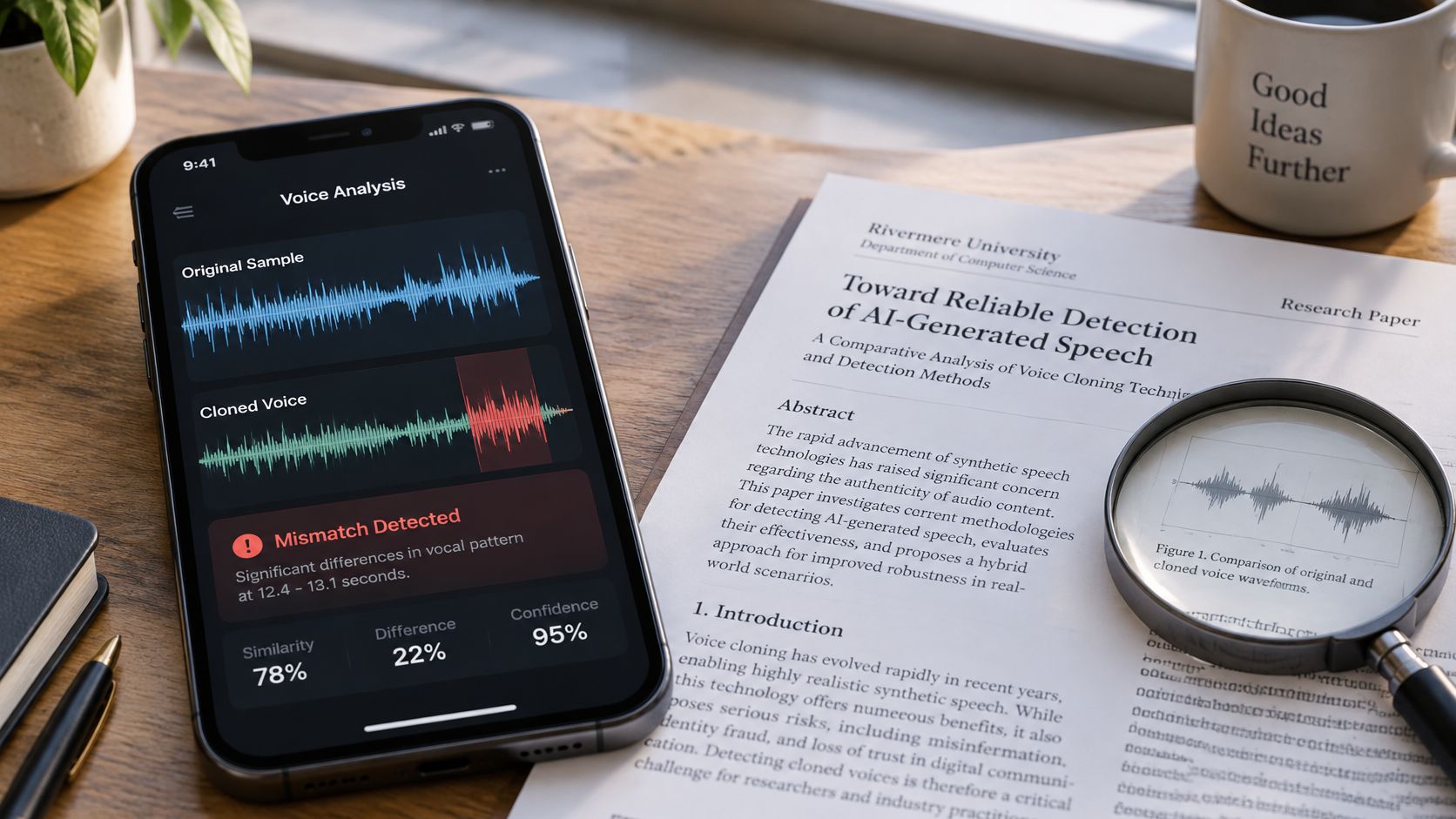
Zhejiang University researchers reported that attackers could use a single short voice sample to generate speech capable of deceiving listeners, and that more than 80% of tested cloned voices succeeded in bypassing voice-authentication systems, according to the university's summary of the research. That doesn't mean every free tool defeats every banking system. It means voice alone is weak evidence, and any process that accepts it as proof is already broken.
Replace voice-only approval with controls that use a second channel:
- A known callback number: hang up and call the number you already have on file, never the one in the message.
- A transaction confirmation: approve payment changes in writing through the finance system, not over the phone.
- Multifactor authentication: protect password resets with a device or token, not a spoken passphrase.
- A pre-agreed phrase: agree a family or team verification phrase out loud, in person, before you ever need it.
Never approve payment-detail changes, password resets or sensitive employee instructions on voice alone, however familiar the caller sounds.
For a sense of how easily a synthetic voice passes as a person in conversation, this short demonstration is worth two minutes.
Disclosure is the other half. Under the EU AI Act's transparency rules, AI-generated or manipulated audio that resembles an existing person and could falsely appear authentic must be disclosed clearly and distinguishably no later than the audience's first exposure, in a form that's understandable without special software, while providers must mark outputs in a machine-readable format, as the European Commission's Article 50 explainer sets out. Listeners can't be your detection system either: in a 2025 study, people classified AI voice clones as human about 70% of the time, compared with 72% for real recordings, according to VoxBooster's summary of the perception research.
If you publish on a platform whose terms of use require synthetic media to be labeled, that duty sits alongside the legal one rather than behind it, so check the terms before the file goes live.
The useful question isn't whether you can clone a voice for free. It's where cloned audio belongs, what you must disclose, and what stops it from being mistaken for an authenticated human instruction.
Choose Your Free Workflow and Start Testing
Start with the free access model that lets you export a usable MP3 or WAV at a sample rate your editor accepts. Not the one with the most monthly minutes. Everything downstream depends on getting a clean, unwatermarked file you're licensed to publish.
Then run the seven-step routine on one short script with two services before you commit to either. Two services, one script, one reference clip, and a written record of the scores. That's an afternoon of work that saves you a wasted subscription and tells you which tool fails on the lines that matter.
The publishing gate comes next, and it's essential. Written permission on file. Approved uses recorded. Disclosure label chosen. Output checked line by line against the script. Speaker-similarity check passed. If a client's voice is in the file, add their sign-off to the record before anything ships.
Where a cloned voice is one part of a video pipeline rather than a standalone audio job, LunaBloom AI is worth adding to the shortlist, since voice cloning here creates content with a familiar and consistent voice inside the same studio that handles script, captions and export. The Starter plan is free to start and includes 2 free videos of up to 10 seconds each, with no monthly commitment, which is enough to hear whether a clone holds up on your own script. Read our terms on consent, export and retention directly before you rely on a clone for anything published.
If you'd rather generate voiceovers from your own scripts at volume instead of one file at a time, check whether a service offers an API for programmatic generation before you build a workflow around its dashboard.
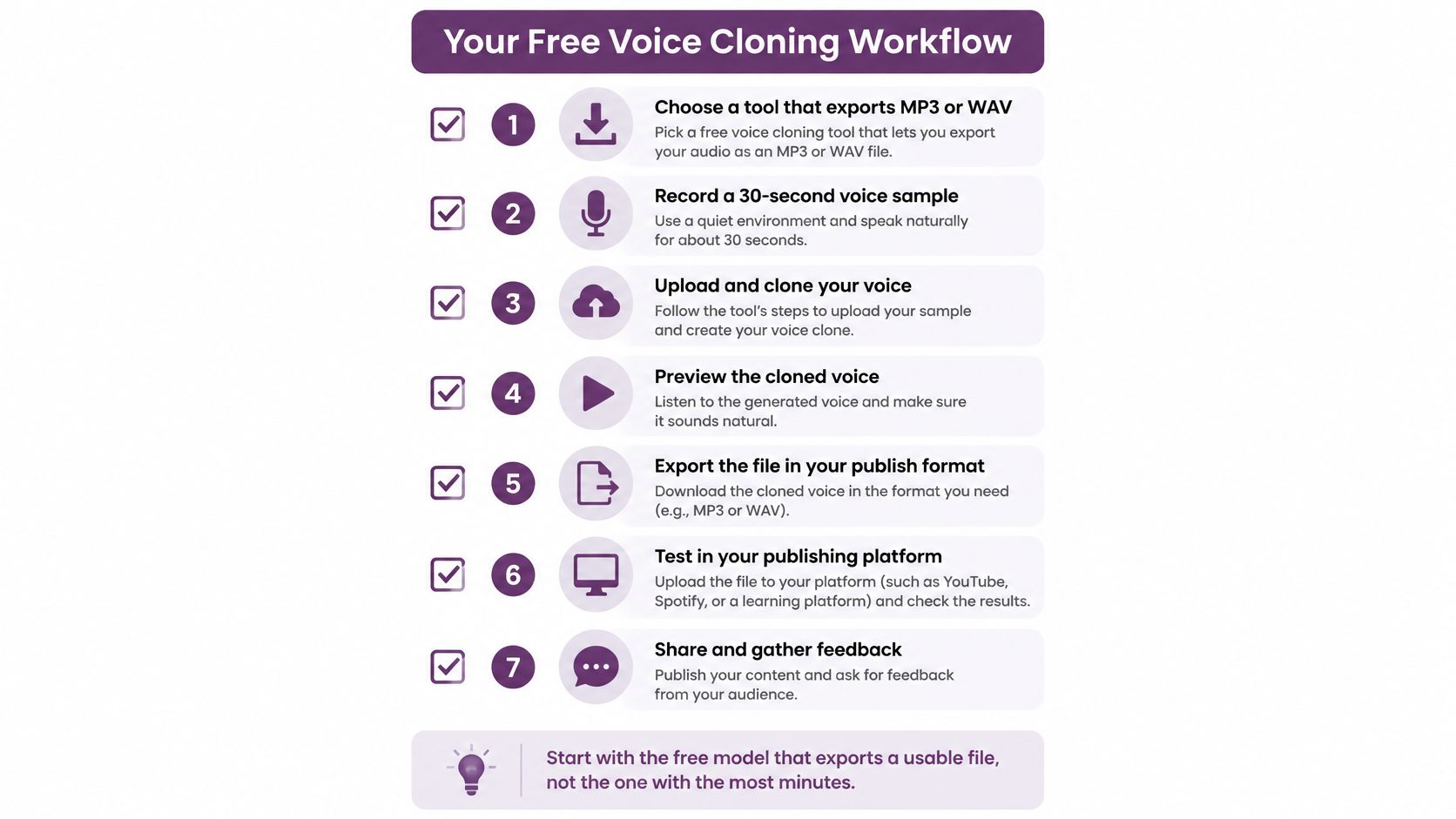
The decision for today is smaller than the whole project. Pick one short script, run the seven-step test on two free services this week, and open the permission record with the first recording you make.
Free voice cloning is the part that gets you started, and the rest of the pipeline is where LunaBloom AI earns its place: clone a voice you have permission to use, write the script, and let the studio handle narration, captions and export in one place, without a separate audio tool for every step. You can begin on the free Starter plan and see how a consistent cloned voice holds together across a finished video rather than a single test line. Visit LunaBloom AI to run your first clip and hear the difference for yourself.