So, what is digital storytelling? At its core, it's the timeless art of telling stories, rebooted for our digital age. It combines classic narrative principles with modern digital tools—like video, audio, images, and interactive elements—to create immersive and shareable experiences.
Think of it as the evolution of storytelling, moving from the campfire to the computer screen.
The Evolution from Campfire to Screen

Imagine a storyteller captivating an audience around a campfire, using only their voice and dramatic pauses. Now, give that storyteller a digital toolkit: video clips to show a spooky location, sound effects to make a door creak, and interactive polls to let the audience choose what happens next. That's digital storytelling in a nutshell.
It isn't just about adding technology to a story. It's about using technology to deepen the narrative's impact and broaden its reach. This multimedia approach creates an experience that can be instantly shared across websites, social media, and online courses, connecting with a global audience.
Why It Matters More Than Ever
In today's flood of information, a compelling story is what cuts through the noise. Digital stories create an emotional connection that raw data or a standard advertisement simply can't.
They make complex ideas understandable and add a human element to brands, abstract concepts, and personal journeys. This is why digital storytelling has become an essential skill for marketers, educators, and content creators. The goal is to craft a narrative that feels both personal and universal.
Digital storytelling isn't about capturing everything; it’s about conveying one tight idea that allows the audience to imagine the broader world of your story. Instead of trying to cover everything, cover almost nothing, but do it well.
This focus on a single, powerful message is what makes a digital story so effective.
The Building Blocks of a Digital Story
Every digital story is a blend of different media types working together to tell a single, cohesive tale. The tools may change, but the core ingredients remain consistent.
Here’s a quick look at the fundamental components that make up a good digital story.
Digital Storytelling At a Glance
| Component | Description | Example |
|---|---|---|
| A Compelling Narrative | The heart of the story. It includes the plot, characters, and conflict that drive the message. | A short film about a startup's journey, focusing on the founder's struggles and triumphs. |
| Multimedia Elements | The visuals and sounds—images, video, music, sound effects—that set the emotional tone. | An animated explainer using upbeat music and bright graphics to simplify a complex topic. |
| A Personal Voice | The unique perspective or narrator's voice that guides the audience and adds authenticity. | A documentary-style video where an employee shares their personal experience in their own words. |
| An Emotional Core | The feeling the story is meant to evoke, whether it's joy, empathy, or curiosity. | A charity's campaign video that uses powerful imagery and a moving score to inspire donations. |
When these elements work in harmony, they create something far more memorable than any single piece of media could achieve on its own.
The Seven Core Elements of a Great Digital Story

What separates a digital story that connects from one that just adds to the online noise? While the technology is new, the key ingredients are as old as storytelling itself. Pioneers like the StoryCenter defined a framework of seven core elements that provides a reliable roadmap for crafting narratives that stick.
Think of these as fundamental building blocks, not rigid rules. Getting them right helps you move from simply sharing information to telling a story that people truly feel and remember.
1. Point of View and a Dramatic Question
Every great story is told through a specific lens. Whose story is it, and why should the audience care? Establishing a clear point of view gives your narrative personality and a pulse.
This perspective fuels the central conflict, or the dramatic question. This is the hook that keeps your audience engaged. Will the hero succeed? Can the problem be solved? This underlying tension makes viewers want to see what happens next.
2. Emotional Content and the Gift of Your Voice
Facts inform, but feelings connect. A powerful digital story taps into universal human emotions like joy, fear, or hope. This emotional content is the heart of your narrative, making the message relatable on a deeper level.
You deliver that emotion through the gift of your voice. This can be a literal voiceover, but it also refers to the overall tone of your writing and visuals. Your unique voice adds a layer of authenticity that can't be faked, making the story feel real and immediate.
A good story allows the reader to find the universal truth in the most specific detail. It isn't about capturing everything, but rather conveying one tight idea that allows the audience to imagine the broader world of your story.
This sharp focus is crucial for making a lasting impact.
3. Soundtrack, Economy, and Pacing
Never underestimate the power of sound. The right soundtrack can instantly set a mood, build tension, or highlight a triumphant moment, doing emotional work that words or images alone cannot.
Next is economy—using just enough content to tell your story effectively, and nothing more. In a world of short attention spans, every word, image, and second of video must earn its place. This discipline forces you to cut the fluff and focus on what drives the narrative forward.
Finally, there's pacing. This is the rhythm of your story. It’s about knowing when to slow down to let an emotional moment sink in and when to speed up to build excitement. Proper pacing keeps your audience engaged from start to finish.
Putting Digital Storytelling to Work
Understanding the theory is one thing, but seeing digital storytelling in action is where its power becomes clear. This is where we move from ideas to impact, exploring how various industries use stories to achieve real-world goals.
In marketing, for example, stories have become a primary currency. Brands no longer just sell products; they sell feelings, values, and a sense of belonging. Digital storytelling is their tool, turning a customer review into a heartfelt video testimonial or a company's origin into an engaging animated short.
This narrative approach is what cuts through the advertising clutter. Global digital ad spend is projected to exceed USD 740 billion by 2026, a significant increase from USD 626 billion in 2023. Retail advertising, which heavily relies on narrative campaigns and short-form video, accounts for nearly 23.7% of that spending. The data is clear: stories are central to how brands communicate today.
Beyond Marketing: The Broader Impact
But digital storytelling's influence extends far beyond advertising. It's a versatile tool used in various fields to solve unique challenges.
- Education and Training: Instead of dry textbooks, educators use interactive stories to make complex subjects engaging. Imagine a history lesson taught through a virtual tour or a safety drill explained with a relatable video scenario.
- Non-Profit and Advocacy: Charities use raw, emotional video stories to connect donors directly to their cause. A short film showing the real-world impact of a single donation builds empathy and inspires action far more effectively than statistics alone.
- Internal Communications: Companies use stories to onboard new hires, share their culture, and celebrate team achievements. A personal video from a leader can build a more connected and motivated team than a formal email ever could.
From Consumption to Creation
The ability to tell a great digital story is no longer limited to large marketing teams. It's becoming a crucial skill for entrepreneurs, creators, and anyone looking to build an audience or a business. These skills are particularly powerful if you want to create and sell digital products, as a compelling narrative can clearly explain the value of an online course, an e-book, or a new software tool.
The goal is to turn a passive audience into an active one. A good story doesn't just give you information; it invites you to feel, think, and ultimately, do something.
When you achieve this, you’re not just creating content. You’re building a loyal community of followers, customers, and advocates.
Choosing the Right Format for Your Narrative
Digital storytelling is not a one-size-fits-all medium. The format you choose is just as important as the message itself. This strategic decision determines who your story reaches and how they experience it, based on your goals and your audience's online behavior.
A story designed for a quick scroll on TikTok will look completely different from an immersive website or a long-form podcast. Each format has its own strengths. Short-form video excels at grabbing attention and delivering a quick emotional punch, while a podcast can build a deep, personal connection over time.
To help you decide, this decision tree illustrates how your primary goal—to sell, teach, or entertain—can guide you to the most effective format.
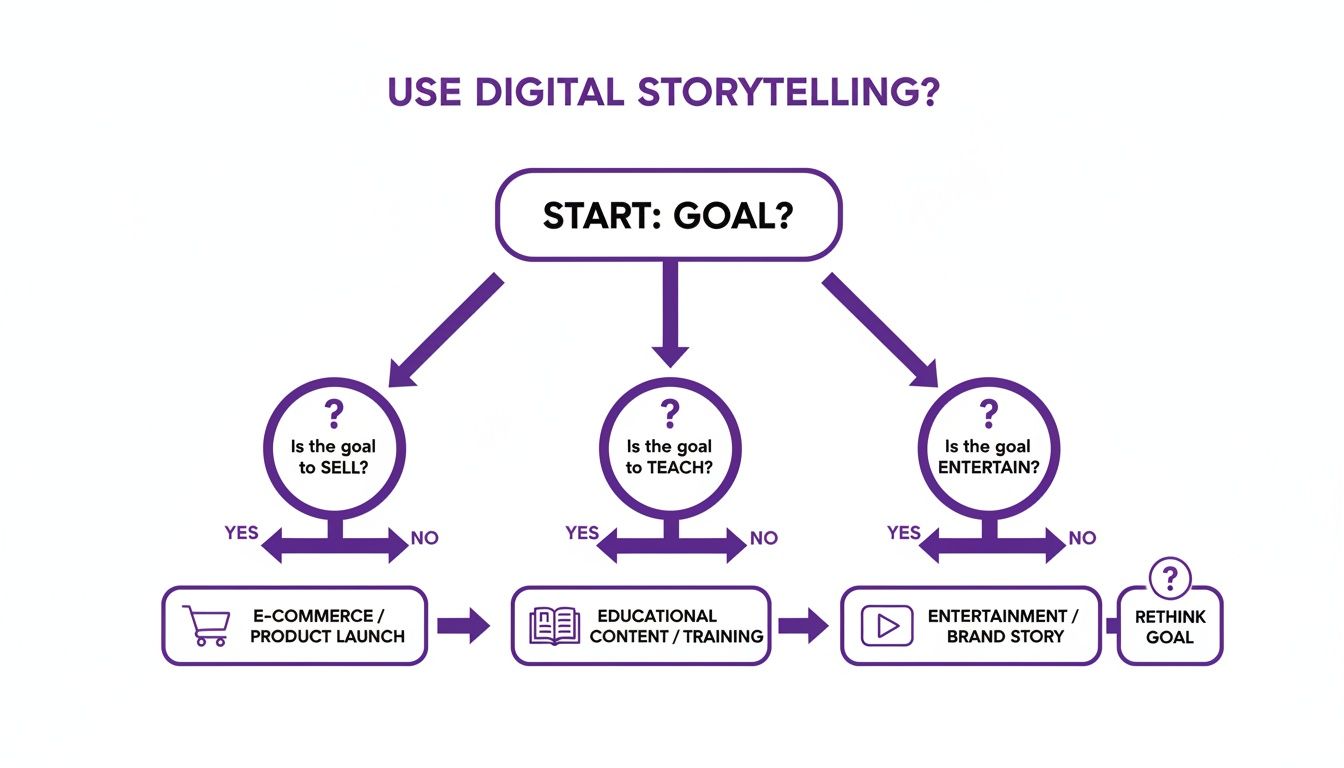
As you can see, your "why" is the starting point that guides your entire creative process. Aligning your goal with the right format ensures your story feels natural and engaging on its chosen platform.
Choosing Your Digital Storytelling Format
This table breaks down some of the most popular formats, comparing their strengths to help you align your creative vision with the right platform and audience.
| Format Type | Best For | Key Platforms | Primary Audience |
|---|---|---|---|
| Short-Form Video | High-impact, viral content; quick tutorials; brand personality clips. | TikTok, Instagram Reels, YouTube Shorts | Younger demographics (Gen Z, Millennials); mobile-first users. |
| Long-Form Video | In-depth explainers; mini-documentaries; customer testimonials. | YouTube, Vimeo | Viewers seeking detailed information or entertainment. |
| Interactive Web | Complex data visualization; immersive brand histories; educational modules. | Custom Websites, Microsites | Users who enjoy exploration and self-paced learning. |
| Narrative Podcast | Serialized stories; deep-dive interviews; branded content series. | Spotify, Apple Podcasts | Commuters, multitaskers, and loyal followers. |
| Social Media Stories | Behind-the-scenes content; polls and Q&As; daily updates. | Instagram, Facebook, Snapchat | Existing followers seeking authentic, timely engagement. |
The best choice always aligns your message with your audience's expectations and the conventions of the platform.
The Power of Audio Storytelling
Don't overlook the power of audio. Narrative podcasts are booming because they create an incredibly intimate bond with the listener. They are perfect for serialized stories, in-depth interviews, and branded series that can cultivate a dedicated following.
Ultimately, the ideal format for your digital story is the one that best serves your message and connects authentically with your audience. Ask yourself: where does my audience spend their time online, and what content do they already enjoy? Meeting them where they are is the secret to making a real impact.
How AI Is Kicking the Door Open for Digital Storytellers

For a long time, creating a polished digital story required expensive equipment, complex software, and significant technical skill. But artificial intelligence is changing the game, acting as a powerful creative partner that removes these barriers.
AI isn't here to replace the storyteller. Instead, think of it as the ultimate production assistant. It automates the tedious, technical tasks, transforming a once slow and costly process into something fast, affordable, and scalable. This shift empowers anyone—from a solo creator to a global marketing team—to become a capable digital storyteller.
The growth in this area is undeniable. The market for AI-powered creation tools is expected to grow from USD 0.35 billion in 2025 to nearly USD 0.90 billion by 2033, with AI features driving this surge.
Taking the Technical Headaches Out of Production
One of the biggest advantages of AI is its ability to close the technical skill gap. Instead of spending weeks learning complicated video editing software, you can now use tools that generate a complete video from a simple text script. This puts the focus back where it belongs: on the idea, not the gear.
This technology frees you to concentrate on the narrative. You write the script and define the vision, while AI assembles the visuals, voiceovers, and subtitles. Suddenly, producing a professional-quality video is as straightforward as writing an email.
Shattering Creative and Language Barriers
AI also opens up new creative possibilities and dissolves old limitations, especially for reaching a global audience.
- AI Avatars and Voice Cloning: Not comfortable on camera? AI avatars can deliver your message with realistic expressions and gestures. You can even clone your voice to narrate your stories, ensuring brand consistency without recording new audio for every project.
- Automated Multilingual Translation: This is a game-changer for brands with global ambitions. Platforms like LunaBloom AI can take a single story and instantly translate and dub it into dozens of languages. A narrative created for one market can now connect emotionally with audiences worldwide, without the high cost of traditional localization.
AI is the great equalizer. It gives everyone access to a virtual production studio, so a story's quality is measured by the strength of the idea, not the size of the budget.
By handling the technical heavy lifting, AI empowers human creators to do what they do best: craft authentic, memorable stories that connect with people. To learn more about how AI is transforming the content landscape, check out these insights on AI for Content Creation.
Common Questions About Digital Storytelling
As you explore digital storytelling, a few common questions often arise. Let's tackle them directly to help you move from understanding the concept to creating something great.
Here are clear, concise answers to the most frequent inquiries.
How Is Digital Storytelling Different from Traditional Marketing?
Traditional marketing often focuses on features and benefits—it tells you what a product does. Digital storytelling, in contrast, shows you why that matters by wrapping the message in a narrative that evokes emotion. It's the difference between a technical spec sheet and a compelling story about a problem being solved.
Instead of just presenting facts, a digital story introduces characters, conflicts, and resolutions to make a brand’s message feel human and memorable. It's less about selling a product and more about sharing an experience.
What Are the First Steps to Creating a Digital Story?
Getting started is simpler than it seems. Don't aim for perfection on your first try; focus on making a connection. Follow this straightforward plan:
- Start with Your 'Why': Define the single core message you want to convey or the primary emotion you want your audience to feel.
- Outline the Narrative: Sketch a basic story structure with a clear beginning, middle, and end.
- Gather Your Assets: Collect simple materials like relevant photos, a short video clip, or background music that fits the mood.
- Assemble with a Tool: Use an intuitive platform to combine your script and assets into a cohesive story.
Can AI Really Create Authentic and Emotional Stories?
Think of AI as a skilled co-pilot, not the pilot. The authenticity and emotion—the heart of your story—still come from your unique human idea and script.
AI platforms handle the tedious, heavy-lifting parts of production. They can generate a video from your text or create a professional voiceover in minutes, freeing you up to focus on what really matters: the story itself. It takes the technical headaches out of the equation so your genuine message can shine through.
Ready to bring your own digital stories to life without getting bogged down by technical stuff? With LunaBloom AI, you can turn your ideas into incredible videos in minutes. Transform your scripts into captivating narratives with AI avatars, voice cloning, and instant translation in over 50 languages. Start creating for free today!