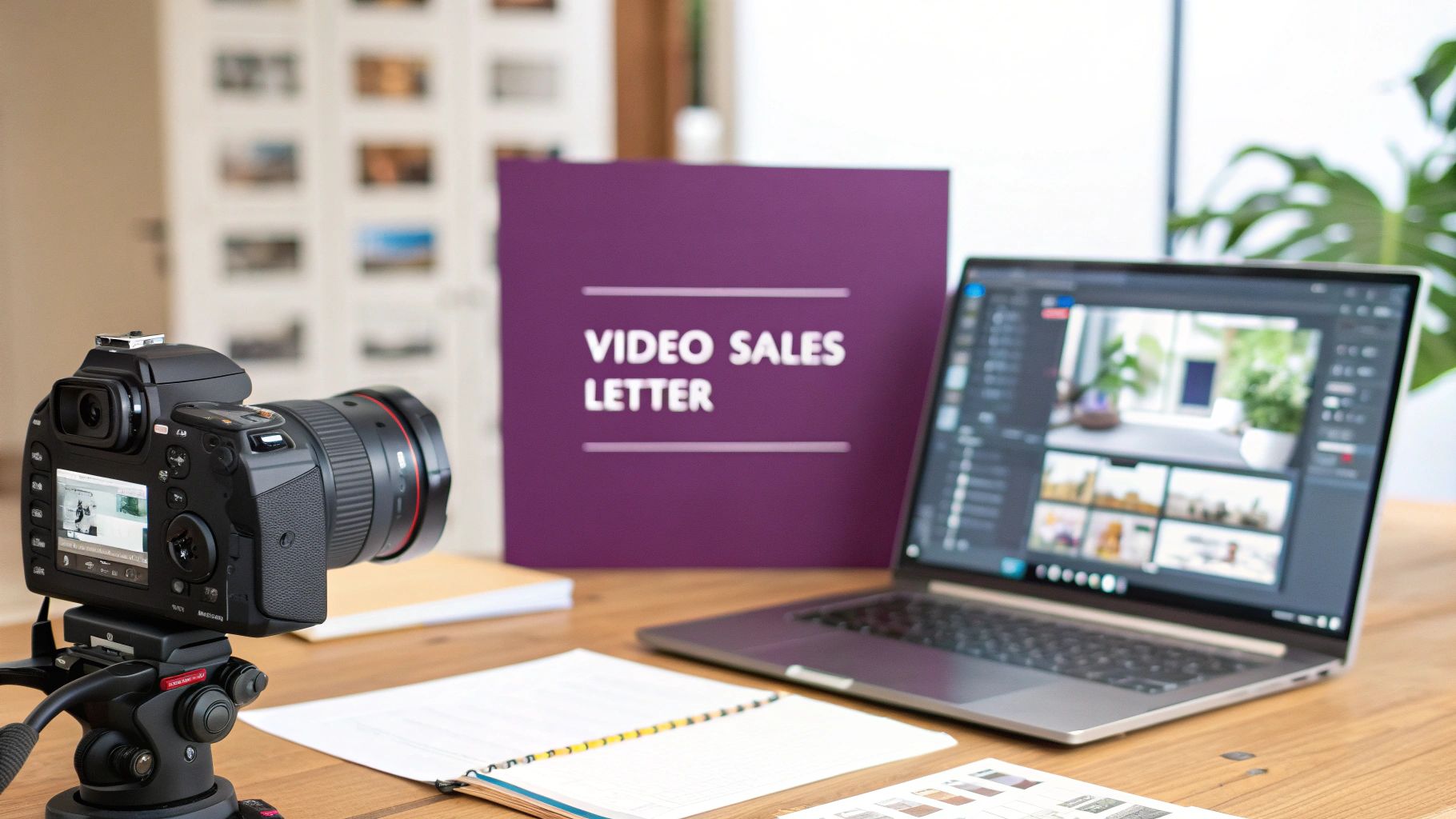
A video sales letter, or VSL, is a powerful marketing tool designed to do one thing: persuade a viewer to take a specific action, usually to buy a product. Think of it as your best salesperson, working tirelessly for you 24/7. It combines the proven, direct-response principles of traditional sales letters with the engaging, emotional power of video.
What Are Video Sales Letters and Why Do They Work?
A VSL isn’t just another marketing video. While a standard video ad builds brand awareness, a VSL has a single, laser-focused mission: to sell. It guides a potential customer from initial curiosity to a confident purchase by addressing their specific problems and positioning your product as the ultimate solution.
The real magic is in the connection it creates. Instead of forcing someone to read long blocks of text on a sales page, a VSL lets them hear your voice, feel your conviction, and get lost in the story. This multi-sensory experience makes your message more memorable and emotionally resonant than text ever could be.
Text Sales Letter vs. Video Sales Letter: The Key Differences
So, what really separates a classic text sales letter (TSL) from a modern VSL? While both aim to sell, their delivery and impact are worlds apart. Here’s a quick comparison.
| Feature | Text Sales Letter (TSL) | Video Sales Letter (VSL) |
|---|---|---|
| Engagement | Passive; requires active reading and concentration. | Active; grabs attention with both audio and visuals. |
| Emotional Impact | Relies solely on powerful copywriting. | Amplifies emotion with tone of voice, music, and imagery. |
| Information Retention | Lower; readers often skim or skip sections. | Higher; viewers retain more from combined audio-visual content. |
| Connection | Can feel impersonal and one-sided. | Builds a more personal, human connection with the viewer. |
| Pacing | The reader controls the pace, which can lead to drop-offs. | You control the narrative flow and the pace of the sale. |
As you can see, video adds persuasive layers that are simply impossible to achieve with text alone.
The Psychological Power of VSLs
There’s a good reason VSLs are so effective—they tap directly into human psychology. Video engages our sight and hearing simultaneously, forcing our brains to process information more deeply. This makes it a fantastic tool for explaining complex ideas or demonstrating your product’s value in a way that truly sticks.
A great VSL leverages three key psychological triggers:
- Problem Agitation: It doesn’t just identify a problem; it twists the knife. By vividly describing a pain point the viewer feels, it makes them desperate for a solution.
- Emotional Connection: Through authentic storytelling and a genuine vocal tone, it builds trust. The pitch feels less like a hard sell and more like a friend giving valuable advice.
- Urgency and Scarcity: It almost always concludes with a clear call to action and a compelling reason to act now, such as a limited-time offer or an exclusive bonus.
This powerful formula is why businesses are embracing video. It’s not just a trend; it’s a fundamental shift in online sales. In fact, 87% of marketers report that video has directly increased their sales. For a deeper look at how video works on landing pages, check out this guide on creating a High-Converting Landing Page Video.
The 5 Building Blocks of a Persuasive VSL
A high-converting video sales letter isn’t thrown together; it’s carefully engineered. Think of it like building a house—every piece must be in the right place for the structure to stand strong. An effective VSL follows a proven formula that guides your viewer from skepticism to action.
This journey is built on five critical stages that form the backbone of any VSL that converts. Mastering these elements is what separates a video that gets views from one that drives sales.
Stage 1: The Irresistible Hook
You have only a few seconds to grab someone’s attention before they click away. The hook is your opening gambit, designed to stop them in their tracks and make them curious enough to keep watching.
A powerful hook often starts with a provocative question, a shocking statistic, or a bold promise that taps into a deep desire or fear. The goal is simple: make the viewer immediately think, “This is for me.”
- Question Hook Example: “What if you could double your productivity in half the time, starting tomorrow?”
- Bold Promise Example: “In the next three minutes, I’ll reveal the single mistake preventing your business from hitting six figures.”
Stage 2: The Problem and Agitation
Once you have their attention, it’s time to connect with their pain. This stage isn’t just about stating a problem; it’s about making them feel it. Paint a vivid picture of their struggle, highlighting the frustration and real-world consequences of not solving it.
When you dig into the emotional side of their challenge, you build empathy and prove you genuinely understand their world. This makes them far more receptive to your solution because they feel heard.
“People don’t buy products; they buy better versions of themselves. The problem-agitation phase is where you show them the gap between who they are and who they want to be.”
Stage 3: The Perfect Solution
After making the problem feel real and urgent, you introduce your product or service as the hero of the story. This is the crucial pivot from pain to relief.
But here’s the key: don’t just list features. You must translate every feature into a clear benefit that directly solves the pain you just agitated. If the problem was wasted time, the benefit is freedom. If the problem was financial stress, the benefit is peace of mind.
Stage 4: The Power of Social Proof
By this point, your viewer is interested but likely still skeptical. They’re thinking, “This sounds great, but does it actually work?” This is where you demolish that doubt with compelling social proof.
Showcasing testimonials, case studies, impressive data, or user reviews provides essential third-party validation. It proves you’re not just making empty promises—you’ve delivered real results for people just like them.
Stage 5: The Clear Call to Action
Finally, you must tell your viewer exactly what to do next. A weak or confusing call to action (CTA) will kill your conversion rate. You need to be direct, clear, and confident.
To motivate immediate action, create urgency with a limited-time offer, a special bonus, or a discount. Your CTA is the final push that turns a passive viewer into an active customer.
Proven VSL Frameworks That Get Results
You don’t need to reinvent the wheel to create a powerful video sales letter. Smart marketers rely on battle-tested formulas that tap into human psychology to guide viewers toward a decision. Using a proven framework provides a roadmap for building a persuasive narrative that feels natural and, most importantly, converts.
These frameworks ensure your message flows logically and hits all the right emotional beats. Let’s explore two of the most effective models.
The Classic Problem-Agitate-Solve (PAS) Framework
The Problem-Agitate-Solve (PAS) framework is the undisputed workhorse of direct-response marketing. It’s simple, direct, and incredibly effective because it connects with the viewer’s pain on an emotional level before ever mentioning a solution.
Here’s how the three stages work:
- Problem: Start by identifying a specific pain point your audience knows all too well. You want them to immediately think, “Yes, that’s me.”
- Agitate: This is where the magic happens. Don’t just state the problem—amplify it. Dig into the frustration, the consequences, and the emotional toll. Make the need for a solution feel urgent.
- Solve: After amplifying the pain, you introduce your product as the clear, obvious, and immediate fix to the struggle you just detailed.
PAS is perfect for VSLs where the problem is sharp and the solution is straightforward. Its power lies in making the viewer desperate for relief right before you offer it.
The Narrative Hero’s Journey Framework
What if your product is more complex, or you want to build a deeper brand connection? This is where the Hero’s Journey framework shines. This storytelling structure casts your customer as the hero, with your product serving as the wise guide or magical tool that ensures their success.
This approach is less direct than PAS but can forge a much stronger emotional bond. It’s no wonder that over 60% of account executives now use video in their sales outreach—storytelling makes messages stick. You can explore more sales video statistics to see why 64% of sales pros are happy with their video results.
The framework follows a classic story arc:
- The Hero’s World: We meet the hero (your customer) in their everyday life, but we see signs of an unresolved challenge or a nagging desire.
- The Call to Adventure: The hero faces a problem so significant they can no longer ignore it, forcing them to seek a change.
- The Mentor and the Tool: This is where you come in. Your brand or product appears as the mentor with crucial advice or the special tool that gives the hero a new advantage.
- The Ultimate Triumph: Armed with your help, the hero overcomes their obstacle. They return transformed, having achieved the success they desired.
Using the Hero’s Journey turns a simple pitch into an inspiring narrative. Your product is no longer just something they buy; it’s an essential part of their success story.
How to Create Your First Video Sales Letter: A Step-by-Step Guide
Ready to turn theory into action? You don’t need a Hollywood budget to create an effective video sales letter. This step-by-step process will guide you from initial idea to a polished video that turns viewers into customers.
Each step builds on the last, ensuring you end up with a professional video that delivers results.
1. Scripting and Storyboarding Your Message
Before you even think about recording, you need a script. Your script is the foundation of your VSL. Use a framework like PAS or the Hero’s Journey to structure your story. The key is to write in a conversational, genuine tone—as if you’re talking to a friend.
Once your script is ready, create a simple storyboard. This doesn’t need to be a work of art. You can use slides in PowerPoint or a two-column document: one for the script and the other for the on-screen visuals (e.g., “Text: ‘Feeling Stuck?'” or “Image: a frustrated person at a desk”). This plan ensures your visuals perfectly support your message.
2. Recording Clean, Compelling Audio
Audio quality is non-negotiable. If your sound is tinny, muffled, or full of background noise, people will leave. Poor audio screams unprofessionalism and destroys trust before you even make your pitch. You don’t need a professional studio, but investing in a decent USB microphone is one of the smartest moves you can make.
Record in a quiet room, away from echoes or ambient noise. Speak clearly and with energy. Your tone of voice is how you connect with the viewer, so let your passion for the solution shine through.
3. Sourcing or Creating Your Visuals
With your audio recorded, it’s time to bring your storyboard to life. Your visuals don’t have to be complex; many of the highest-converting video sales letters use simple text on a screen.
Here are a few popular visual options:
- Simple Slides: Use PowerPoint or Keynote to create clean slides with text that reinforces your key points. This classic “ugly VSL” style still converts incredibly well.
- Stock Footage: Sites like Pexels offer free video clips, while services like Storyblocks have vast libraries. Stock footage can add a dynamic, high-quality feel.
- Screencasts: If you’re selling software or a digital service, a screen recording showing your product in action is highly persuasive.
You can also leverage AI video generation tools like Sora 2 to create unique visuals without ever needing a camera.
4. Editing It All Together
Now it’s time to assemble the pieces. Using video editing software, you’ll sync your visuals with your audio recording. The goal is a smooth, seamless viewing experience.
Cut out any awkward pauses or mistakes from your audio track. Use simple transitions between slides or clips to maintain flow. You can also add quiet background music to set the mood, but ensure it never overpowers your voice.
5. Publishing and Testing Your VSL
Once you’re happy with the final edit, export the video and upload it to a reliable platform like Vimeo, Wistia, or YouTube. Embed it on your sales page and ensure your call-to-action button is large, clear, and impossible to miss.
But you’re not done. The final step is to test and analyze. Monitor your analytics to see where viewers are dropping off. Don’t be afraid to tweak your VSL based on this data—a small change can significantly boost your conversion rates.
Common VSL Mistakes That Kill Conversions
Knowing what not to do is just as important as knowing what to do. Many promising video sales letters fail due to a few common, avoidable mistakes. Use this section as a checklist to ensure your VSL is set up for success.
A Weak Opening That Fails to Hook
You have about eight seconds to capture attention. If your opening is slow, generic, or fails to address a burning pain point, your viewer is gone. A weak hook is the fastest way to lose an audience.
Instead of a boring “Hi, my name is…” intro, hit them with a shocking statistic, a bold promise, or a provocative question they feel compelled to answer.
Poor Audio and Visual Quality
Nothing kills credibility faster than terrible audio. If your voice is muffled, echoey, or competing with background noise, you instantly lose trust. Viewers assume that if you can’t get the sound right, your product probably isn’t much better.
The same applies to blurry visuals or confusing graphics. You don’t need a Hollywood budget, but a clean, professional presentation is non-negotiable.
“Your VSL’s production quality is a direct reflection of your brand’s quality. Poor audio is the number one conversion killer because it breaks trust before you even get to the pitch.”
Getting a VSL right involves mastering several stages, and neglecting any one of them can sink the entire project.
This shows that success isn’t about one thing; it’s about executing every step with care, from scripting to the final call to action.
A Vague Offer or Call to Action
After you’ve made your case, you must tell the viewer exactly what to do next. A huge mistake is having a vague offer or a weak call to action (CTA). If they are even slightly confused about what to do, they will do nothing.
Your offer must be crystal clear, and your CTA needs to be direct and urgent. Use strong, action-oriented words and give them a compelling reason to act now.
- Weak CTA: “If you’re interested, you can find out more below.”
- Strong CTA: “Click the button below now to get instant access and your 50% discount before it expires tonight!”
Your Top Questions About Video Sales Letters Answered
Even after covering the fundamentals, you might still have a few questions. That’s perfectly normal. This section tackles the most common queries people have when creating their first video sales letters.
Our goal is to clear up any lingering confusion so you can move forward with confidence.
How Long Should a Video Sales Letter Be?
The ideal length depends on your product, price, and audience. However, most VSLs land in the 7 to 15-minute range, which is often enough time to build a compelling argument without losing the viewer’s attention.
But context is everything:
- Low-Cost Product or Warm Audience: For a simple, affordable product or an audience that already trusts you, a short and punchy VSL of 3-5 minutes can be highly effective.
- High-Ticket Offer or Cold Audience: Selling something expensive to total strangers requires more time to build trust. In these cases, VSLs of 20 minutes or longer are often necessary.
The Golden Rule: Your VSL should be exactly as long as it takes to make the sale—and not one second longer. Don’t guess. Test different lengths and let your audience’s behavior guide you.
Do I Have to Be on Camera for My VSL?
Absolutely not. In fact, some of the most successful VSLs are “ugly” VSLs—simple text on slides with a persuasive voiceover.
The true power of a VSL comes from your script and the conviction in your voice, not your on-screen presence. While being on camera can help build a personal connection, it is not a requirement for getting great results. Your message is what truly matters.
What Is the Best Software for Creating a VSL?
Your choice of software depends on your budget and technical comfort level. The good news is that there are many excellent options available.
For simple, slide-based VSLs, you can start with tools you already have, like PowerPoint or Keynote. Just create your slides, then use a screen recorder like Loom or Camtasia to capture them while you narrate. For more professional control, tools like Descript, Adobe Premiere Pro, or Final Cut Pro are fantastic choices.
The key is to start simple. Focus on nailing your script and recording crisp, clear audio—that’s where the real impact comes from.
How Do I Measure the Success of My VSL?
You can’t improve what you don’t measure. The ultimate metric for any VSL is its conversion rate—the percentage of viewers who took the desired action, whether it’s buying a product or scheduling a call.
To understand the why behind your conversion rate, you need to track a few other key metrics:
- View-Through Rate (VTR): This shows how much of your video people are watching.
- Click-Through Rate (CTR): This measures how many viewers clicked your call-to-action button.
- Audience Retention Graph: This chart, available on most video platforms, is your secret weapon. It shows the exact moments where viewers drop off, providing invaluable insight into which parts of your script need improvement.
Conclusion: Start Creating Your VSL Today
You now have the blueprint for creating high-converting video sales letters. You understand the psychological triggers, the essential building blocks, and the proven frameworks that turn viewers into customers. Remember, perfection is the enemy of progress. Your first VSL doesn’t need to be a masterpiece; it just needs to be clear, compelling, and focused on solving your customer’s problem.
By following the steps outlined in this guide, you can create a powerful sales asset that works for your business around the clock. The most important step is the first one—so start scripting, start recording, and start converting.
Ready to stop scripting and start creating? With LunaBloom AI, you can transform your text into a polished, professional video sales letter in minutes. Generate high-quality videos with AI avatars and voice cloning in over 50 languages, no technical skills required. Turn your ideas into captivating videos today with LunaBloom AI.