A solid video content marketing strategy is more than a to-do list for making videos. Think of it as your roadmap. It guides you in creating the right videos for the right audience and delivering them at the right time, turning casual viewers into loyal customers.
Step 1: Build Your Strategic Foundation
So many businesses get excited about video, jump straight into production, and end up with slick-looking content that goes nowhere. This is the most common mistake, and it leads to wasted money and videos that just don't connect.
The real work happens long before you hit "record." Laying a strategic foundation means you know exactly who you're talking to, what you want to achieve, and how your videos fit into your customer's journey.
Define Your Audience Personas
You can't create a video that resonates if you don't know who you're talking to. This is where detailed audience personas come in. A persona is a semi-fictional profile of your ideal customer, built from real data and market research.
Go beyond basic demographics like age and location. The valuable details are in their psychographics:
- Pain Points & Challenges: What problems keep them up at night? What are they trying to solve that you can help with?
- Goals & Motivations: What are their ambitions? What does success look like for them?
- Content Habits: Where do they spend their time online? Are they scrolling quick TikToks, watching in-depth YouTube tutorials, or seeking expert advice on LinkedIn?
For example, a software company might target "Marketing Manager Mel," who needs to prove ROI, and "Startup Founder Sam," who needs affordable growth hacks. Each persona requires a completely different message, tone, and video format.
Set Clear, Measurable Goals
Your video strategy must tie directly to tangible business results. Without clear goals, you can't measure success or justify your investment. These goals will shape the style, tone, and call-to-action of every video you create.
A video designed to generate leads will look and feel completely different from one meant to build brand awareness. Setting specific goals ensures every video has a purpose.
Common goals for a video content marketing strategy include:
- Increasing Brand Awareness: Getting your name in front of a new, broader audience.
- Generating Leads: Capturing contact information from potential customers.
- Driving Sales: Convincing viewers to click "buy now."
- Improving Customer Retention: Keeping existing customers engaged with educational content.
The data confirms that video is a core driver of business growth. Reports show 89% of businesses use video as a marketing tool, with 95% of marketers viewing it as essential. Even more compelling, 87% of consumers say they've been convinced to buy a product after watching a brand's demo video. You can explore more video marketing trends and their impact on business growth.
This simple flowchart breaks down the essential first steps for building a focused strategy.
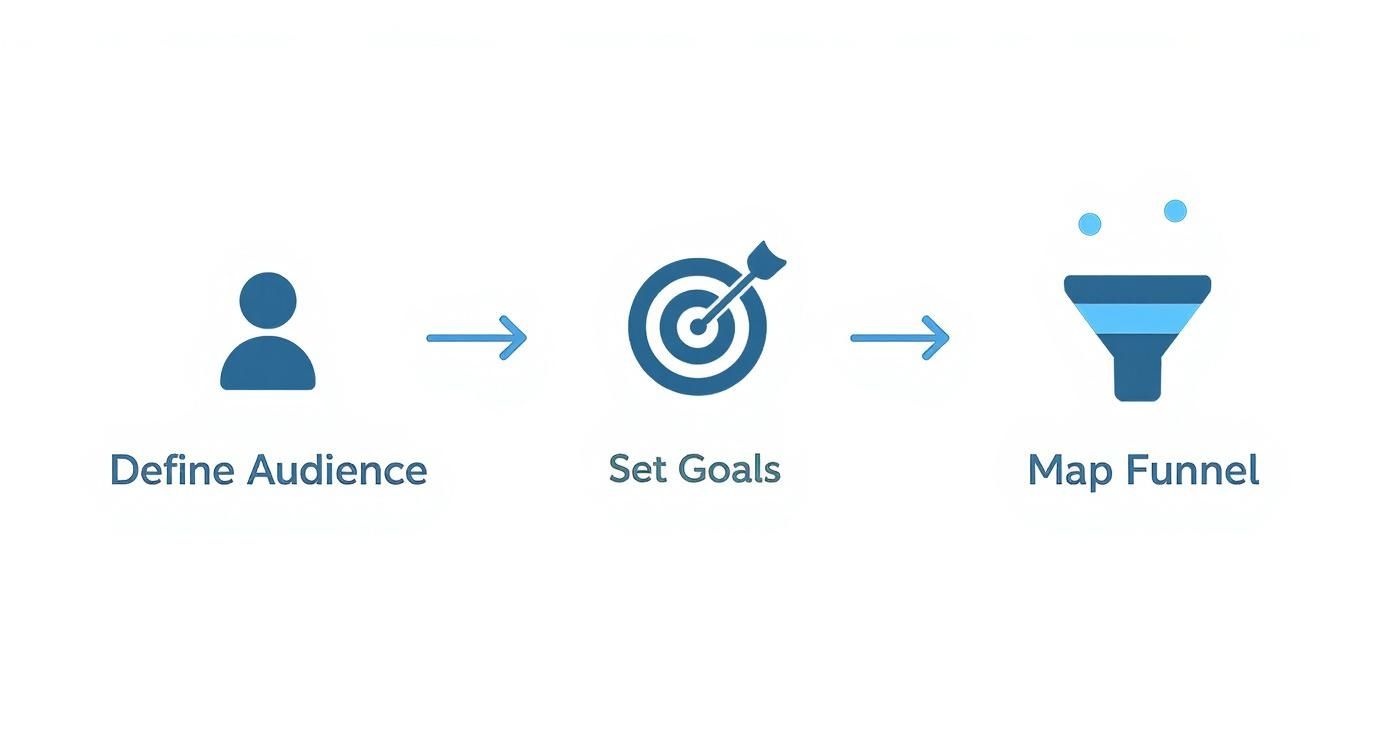
As you can see, it all begins with your audience and goals. Once you've nailed those down, you can start mapping specific video ideas to the different stages of their journey.
Step 2: Choose Video Formats That Actually Engage

Okay, you know who you're talking to and what you want to achieve. Now for the fun part: choosing how to deliver your message. In a world saturated with content, picking the right video format is the difference between being seen and being scrolled past.
This isn’t about chasing trends. It's about strategically selecting formats that fit your audience's habits and your business goals. The right format meets your audience where they are, whether they're killing time on a lunch break or deeply researching a major purchase.
A powerful video content marketing strategy uses a smart mix of formats to connect with people at every one of those moments.
And the opportunity is massive. Video is set to make up 82% of all internet traffic by 2025. Engagement is sky-high, too, with 92% of internet users watching videos every month. The real kicker? A 75% global increase in short-form video consumption shows exactly where attention is shifting. You can dive deeper into the unstoppable rise of video marketing.
Short-Form Videos for Quick Wins
Short-form video is your secret weapon for grabbing attention. Think Instagram Reels, TikToks, and YouTube Shorts. These quick, snackable clips are perfect for showing off your brand's personality, sharing a quick tip, or joining a trending conversation.
Their magic lies in their shareability and potential for massive organic reach. A 30-second Reel revealing a little-known keyboard shortcut is valuable, fast, and highly shareable. Just like that, you've introduced your brand to a new audience without a stuffy sales pitch.
Short-form video is about making a great first impression, delivering a quick hit of value, and earning a follow. It plants the seed for a future relationship.
In-Depth Videos That Build Authority
While short-form content opens the door, longer formats build trust and establish expertise. This is your authority-building content—the videos that solve a significant problem for your audience.
Here are a few essential formats for your toolkit:
- Tutorials & How-To Guides: These are search engine gold. When someone is stuck, their first stop is often YouTube. A detailed video walking them through a solution step-by-step positions you as the go-to expert.
- Webinars & Expert Interviews: Hosting a webinar on a hot industry topic is a fantastic way to generate qualified leads. It gives you a platform to provide serious value and interact directly with potential customers.
- Case Studies & Customer Stories: Nothing builds trust faster than social proof. A video case study showing how you helped a customer succeed is infinitely more powerful than a bulleted list of features.
Videos That Humanize Your Brand
Ultimately, people buy from brands they know, like, and trust. These formats pull back the curtain and show the real humans behind the logo.
Try weaving these into your content plan:
- Behind-the-Scenes (BTS) Content: Give your audience a peek at how your products are made, your office culture, or a day in the life of your team. This transparency creates a strong bond.
- Customer Testimonials: A short, authentic video from a happy customer is one of your most effective sales tools. It's relatable, credible, and speaks directly to the concerns of your next customer.
- Product Demos: A great demo doesn't just list features; it shows the product in action, solving a real problem for the viewer. It helps them visualize themselves using your product.
By mixing these formats in your content calendar, you create a complete journey for your audience. You can hook them with short clips, educate them with deep dives, and build lasting loyalty with authentic stories.
Step 3: Create a Smart Video Production Workflow
Great video production isn't about having the biggest budget; it's about having the smartest workflow. Many teams abandon their video content marketing strategy simply because their process is disorganized.
The secret to consistency is a repeatable system. Let's break down the process into three manageable stages: pre-production (planning), production (filming), and post-production (editing). Nailing each stage ensures every video you release is polished, on-brand, and effective.
The Power of Pre-Production
This is where videos are won or lost. Pre-production is the groundwork you do before the camera rolls, and it's the most critical phase. Rushing this step leads to costly mistakes, frustrating reshoots, and a final product that falls flat.
A solid content calendar is your command center. For a deep dive, check out this excellent guide on creating a YouTube content calendar.
Your pre-production checklist must include these items:
- Scripting: Write it all down—every word and visual cue. A tight script prevents rambling and ensures your message is crystal clear. Even for informal videos, a bulleted outline keeps you focused.
- Storyboarding: You don't need to be an artist. Stick figures or quick sketches work perfectly. The goal is to map out the visual flow to plan your shots more efficiently.
- Shot List: This is your filming-day checklist. It details every shot you need, including camera angles, locations, and actions. This turns a potentially chaotic filming day into a smooth, efficient one.
Nailing the Production Phase
With a solid plan, filming day becomes much less stressful. Your job is simply to capture the raw ingredients for a great video. You don't need a Hollywood studio to get it right.
Just focus on these two fundamentals:
- Clear Audio: Viewers will forgive slightly shaky video, but they will click away instantly for bad audio. Invest in a decent external microphone. A simple lapel mic is a huge, affordable upgrade from your camera's built-in option.
- Good Lighting: Soft, diffused light is your best friend. A budget-friendly ring light or filming facing a window with natural light can produce great results. Avoid harsh overhead lighting, which creates unflattering shadows.
A common mistake is trying to do too much on shoot day. Stick to your shot list. It's better to get a few simple, well-executed shots than to waste time on complex camera moves that don't quite work.
Streamlining Post-Production
This is where your story truly comes together. The key to efficient editing is organization. Before you start cutting clips, organize all your footage, audio files, and graphics into clearly labeled folders. This simple habit will save you hours of frustration.
When editing, focus on telling a clear story. Your first cut should follow your script. After that, it’s all about refining—trimming excess footage, adding B-roll to cover cuts, and using graphics or text to highlight key points.
Essential Tools for Any Budget
Your toolkit will grow over time, but you can start creating professional-looking videos with surprisingly affordable gear.
| Tool Category | Budget-Friendly Options | Professional-Grade Options |
|---|---|---|
| Editing Software | CapCut (Mobile), DaVinci Resolve (Desktop – Free) | Adobe Premiere Pro, Final Cut Pro |
| Microphones | Lavalier Mics, USB Microphones (e.g., Blue Yeti) | Shotgun Mics (e.g., Rode), Wireless Lav Systems |
| Stock Footage/Music | Pexels, Pixabay, YouTube Audio Library | Artlist, Epidemic Sound, Storyblocks |
| AI Video Generation | LunaBloom AI (Text-to-video, AI avatars) | Synthesia, HeyGen |
For tasks like creating animated explainer videos or producing content in multiple languages, tools like LunaBloom AI can be a game-changer, drastically cutting down production time and costs.
By building and refining this workflow, you're not just making videos—you're creating a sustainable content engine.
Step 4: Distribute Your Videos for Maximum Reach
Here’s a hard truth: a brilliant video that nobody sees has zero impact. Creating the video is only half the battle. A powerful distribution plan is what turns your content into a true strategic asset. It's time to move beyond the "upload and pray" mindset.
Tailor Your Content for Every Platform
Each social media platform has its own culture, algorithm, and expectations. Blasting the same horizontal video across YouTube, Instagram, and TikTok is a recipe for failure. A native approach is crucial.
- YouTube: This is the home for your pillar content—in-depth tutorials, product reviews, and interviews. Since YouTube is a search engine, your titles, descriptions, and keywords are everything.
- Instagram & Facebook: Vertical video is king. Reels are perfect for quick tips, behind-the-scenes clips, and personality-driven content. Your goal is to stop the scroll in the first three seconds.
- TikTok: This platform craves authenticity and creativity. Jump on trends, use popular sounds, and deliver value in a raw, entertaining package. To make a splash, it helps to understand strategies to go viral on TikTok.
- LinkedIn: The vibe is professional but not boring. Short, insightful videos breaking down an industry trend or sharing a customer success story work wonders. Always add subtitles, as most users watch with the sound off.
The core principle is simple: adapt, don't just duplicate. Rework your core video idea to feel native to each platform.
Master Video SEO to Get Discovered
Think of YouTube and Google as the world's two largest video libraries. Video SEO is how you catalog your content so they know who to show it to. Skipping this is like hiding your best book on the wrong shelf.
Your optimization checklist should include:
- Keyword-Rich Titles: Your title is the most important signal. It needs to grab human attention while telling the algorithm what the video is about. "Our New Software" is forgettable. "How to Save 5 Hours a Week with Our New Software" is a compelling promise.
- Detailed Descriptions: Use this space to elaborate. Include primary and secondary keywords, add relevant links, and use timestamps to help viewers navigate longer videos.
- Strategic Tagging: Tags help YouTube connect your video with similar content. Use a mix of broad tags ("content marketing") and specific ones ("video repurposing tactics").
Earn the Click with Killer Thumbnails and Titles
Your video's thumbnail and title are its billboard. In a sea of content, they have a split second to spark curiosity and earn a click.
The winning formula is:
- A High-Contrast Thumbnail: Use bold colors, clear faces showing emotion, and large, easy-to-read text. It must be eye-catching even at a small size on a phone.
- A Benefit-Driven Title: Your title must answer the viewer’s unspoken question: "What's in it for me?" Promise a solution, an answer, or a feeling.
Squeeze Every Drop of Value from Your Content
One of the smartest tactics in any video content marketing strategy is repurposing. It’s the art of taking one large piece of content and slicing it into multiple smaller assets for different channels. This saves time, ensures consistent messaging, and fills your content calendar.
Here’s how a single 15-minute YouTube tutorial becomes a content goldmine:
- Six 60-second Reels: Pull out the best tips for Instagram and TikTok.
- A Blog Post: Embed the full video and write an article summarizing the key takeaways.
- An Email Newsletter: Share the most valuable insight and link to the full video.
- Quote Graphics: Turn powerful statements into shareable images for social media.
With this approach, one big production effort can fuel a full week of content across multiple channels, maximizing your return on investment.
Step 5: Measure Performance and Optimize for ROI

Making a great video is just the start. Real growth comes from understanding what the data tells you. A top-tier video content marketing strategy is fueled by metrics, analysis, and a relentless drive to optimize.
This is how you connect your creative work to tangible business results. By tracking the right key performance indicators (KPIs), you can prove your video's value, justify the budget, and make smarter decisions that boost your return on investment (ROI). It's time to move from "I think this video did well" to "I know this video worked, and here's why."
Identify Your Core Video KPIs
A high view count is a vanity metric; it doesn't reveal if people cared or took action. To get the real picture, you need to dig into metrics that reflect viewer behavior and business goals.
Focus on the KPIs that truly matter:
- Watch Time: The total minutes people spent watching your video. Platforms like YouTube heavily favor this metric in their algorithms, as it signals engaging content.
- Audience Retention: This graph shows the percentage of viewers still watching at any point in your video. A big drop-off in the first 10 seconds is a clear sign your intro needs work.
- Click-Through Rate (CTR): The percentage of people who saw your thumbnail and title and clicked to watch. A high CTR means your topic and packaging are effective.
- Conversion Rate: The ultimate money metric. This tracks how many viewers took your desired action, like clicking a link, signing up, or buying a product. It's the direct proof that your video is working.
Here’s a breakdown of essential metrics and where to find them.
Essential Video Marketing KPIs and Tracking Tools
| KPI (Key Performance Indicator) | What It Measures | Why It's Important | Recommended Tools |
|---|---|---|---|
| Watch Time | The total accumulated minutes viewers spent watching your video. | Signals content quality to platform algorithms (especially YouTube), boosting reach. | YouTube Studio, Vimeo Analytics, Wistia |
| Audience Retention | The percentage of viewers who continue watching through your video. | Pinpoints where viewers lose interest, helping you improve intros and pacing. | YouTube Studio, Native Social Media Analytics |
| Click-Through Rate (CTR) | The percentage of impressions that resulted in a click to watch your video. | Shows the effectiveness of your thumbnail, title, and topic choice. | YouTube Studio, Google Ads, LinkedIn Campaign Manager |
| Conversion Rate | The percentage of viewers who completed a desired action (e.g., sign-up, purchase). | Directly ties video performance to business goals and ROI. | Google Analytics, HubSpot, Platform-specific Ad Managers |
Consistent tracking is what separates a strategy from a series of one-off videos. It’s the feedback loop that drives sustainable growth.
Calculate Your True Return on Investment
Calculating ROI doesn't have to be complicated. At its core, you're comparing what you spent to the value you got back.
First, add up all your costs: gear, software, freelance fees, and ad spend. This is your total investment.
Next, assign a dollar value to your results. This is easy for direct sales. For other goals, like lead generation, determine the average value of a new lead to your sales team. This allows you to calculate the total value your video generated.
The proof is in the numbers. Global spending on digital video ads is projected to hit $207.5 billion by 2025, a nearly six-fold jump since 2017. This shows that businesses are seeing a massive return. You can discover more insights about video marketing investment on Wix.com.
Use Analytics to Make Smarter Decisions
Data is worthless if you don't act on it. Make a habit of diving into your analytics dashboards to find actionable insights.
Don't just look at the numbers; look for the stories they tell. Is one video format consistently getting higher retention? Are specific calls-to-action driving more conversions? These patterns are your roadmap for improvement.
Use this intelligence to take action:
- Double Down on What Works: Identify your top-performing videos and create more content like them. This could mean similar topics, formats, or thumbnail styles.
- Fix What's Broken: Analyze videos with weak retention or low CTR. Can you A/B test a new thumbnail or re-edit the intro to be more engaging?
- Refine Your Master Plan: Let your findings guide your overall strategy. If short-form videos are driving views but no leads, you know you need to create content that bridges that gap.
When data-driven optimization becomes a core part of your workflow, your video content marketing strategy transforms into a self-improving engine that delivers better results over time.
Common Video Strategy Questions Answered
Even with a great plan, questions will come up as you execute your video content marketing strategy. Let's tackle some of the most common ones to help you move forward with confidence.
How Much Should I Budget for Video Marketing?
The answer depends entirely on your goals. You can start with almost no budget using your smartphone and a free editing app like CapCut to create authentic content.
As you grow, a small business might invest $500-$2,000 per month for better gear, software subscriptions like Adobe Premiere Pro, and a small ad budget.
Mid-sized companies often budget $2,000-$10,000 monthly, allowing for higher production quality and freelance help. My advice? Start lean, prove your ROI, and then scale your spending based on what the data shows is working.
What Is the Ideal Length for a Marketing Video?
There's no single magic number. The right length is determined by the platform and the viewer's intent.
- Under 60 seconds: The sweet spot for grabbing attention on TikTok, Instagram Reels, and YouTube Shorts.
- 1 to 3 minutes: Perfect for product demos or quick explainers on your website where viewers want a concise answer.
- 5 to 15 minutes: Great for in-depth tutorials on YouTube where your audience is actively seeking detailed help.
The real answer is in your analytics. Your audience retention graphs will show you exactly where people start dropping off, giving you a roadmap for your next video's length.
How Often Should I Post New Video Content?
Consistency always beats frequency. It's better to publish one high-value video each week than five mediocre ones. An unsustainable pace is the fastest way to kill your momentum.
For most businesses, a sustainable rhythm looks like this:
- 1-2 short-form videos (Reels, TikToks) per week to stay top-of-mind.
- One longer, pillar video (e.g., a YouTube tutorial) every one to two weeks to build authority.
This cadence creates a reliable presence your audience can count on. A content calendar is your best tool for planning and batch-producing videos to avoid burnout.
Can My Video Strategy Succeed Without Showing My Face?
Absolutely. While showing your face builds a strong connection, it's not the only way to succeed. Many successful brands use "faceless" video formats to deliver immense value.
You have plenty of options that don't require being on camera:
- Screen recordings are perfect for software tutorials.
- Animated explainer videos simplify complex topics.
- Cinematic B-roll footage with a strong voiceover can tell a powerful story.
- User-generated content (UGC) showcases real customers and builds social proof.
As long as the visuals are engaging and the audio is clear, your videos can be incredibly effective without you ever stepping in front of the lens.
Ready to create stunning videos from simple text, complete with AI avatars and voice cloning? LunaBloom AI makes it easy to produce professional-grade content at scale, saving you time and resources. Start creating your next video in minutes at https://lunabloomai.com.