Emotional text-to-speech is a massive leap forward in AI voice technology. It’s no longer just about turning words on a page into sound; it’s about making that sound feel real. This technology can generate speech filled with human-like feelings—joy, sadness, excitement, you name it.
Unlike the robotic narrators we're all used to, text to speech with emotions is smart enough to understand the context of a script. It then adjusts its tone, pitch, and speed to create a listening experience that’s far more natural and engaging. This isn't just a machine reading words aloud; it's an AI interpreting the meaning behind them to connect with the listener.
From Robotic Voices to Emotional AI
Remember those clunky, monotone voices from early GPS systems? For years, text-to-speech was functional but completely soulless. The goal was simply to be understood, not to connect with the listener. The output was robotic because the software was just mapping letters to pre-recorded sounds, with zero grasp of context or feeling. It was a machine reading a script, and it was missing the one thing that makes human speech so powerful: emotion.
This created a huge disconnect. A flat, lifeless voice can make content feel boring, untrustworthy, or just plain annoying. But the evolution to emotional AI is changing the game for anyone who creates audio content.
The Leap to Expressive AI
Modern text to speech with emotions works less like a machine and more like a talented voice actor. It's built on complex AI models trained on massive libraries of human speech, which allows them to pick up on the subtle cues that signal how we feel.
This includes shifts in:
- Pitch: How high or low the voice is, which often rises with excitement or drops in serious moments.
- Pacing: The speed of speech, which might slow down to add emphasis or quicken with a sense of urgency.
- Intonation: The natural rise and fall of the voice that helps distinguish a question from a statement.
This jump in technology is turning what was once a niche tool into a creative powerhouse. If you're interested in the bigger picture of how AI is shaping audio, there are great resources like this show exploring how generative AI is making voices more human.
Emotional TTS isn't just a feature; it's a strategic tool for creating more human, impactful experiences that resonate deeply with audiences and drive better outcomes.
Why This Matters Now
People are craving more authentic digital interactions, and the market is responding. The global Text-to-Speech market is expected to grow to somewhere between $7.28 billion and $14.6 billion by 2030-2033, and emotional expressiveness is a massive reason for that surge. It’s a clear sign that both creators and consumers are looking for something more than basic narration.
Platforms like LunaBloom AI are leading this charge, making emotionally rich voice generation easy and accessible for everyone. As we dig in deeper, we'll break down exactly how this tech works and why it’s quickly becoming a must-have for modern content.
How AI Learns to Speak with Feeling
Ever wonder how a machine goes from just reading words to actually feeling them? It’s not magic. It’s a pretty intense training process that teaches AI to pick up on and replicate all the subtle clues in human emotion. This is what turns a basic text reader into an expressive voice artist.
The technology behind text to speech with emotions is built on AI models called neural networks, which are designed to learn a lot like the human brain does. These models get fed a massive diet of human speech—we’re talking thousands upon thousands of hours of audio from countless speakers, all expressing different feelings.
Think of it like a student actor shadowing a seasoned pro. The AI doesn’t just memorize the lines (the words). It obsessively studies the entire performance: the timing, the pauses, the shifts in tone, and the volume changes that give the delivery its heart.
The Foundation of Feeling: Prosody
That "heart" in our speech has a technical name: prosody. It’s the mix of rhythm, stress, and intonation that injects meaning into our words, far beyond their dictionary definitions. For an AI to truly sound human, it has to become a master of prosody.
This means learning to control things like:
- Pitch: The highs and lows of the voice. Think about how your pitch naturally rises when you're excited or drops when you're serious.
- Intonation: The melody of speech. It’s how we know "You're going?" is a question, but "You're going." is a statement.
- Rhythm and Pace: The speed and flow of talking. The AI learns to speed up for urgency or slow right down to make a point.
- Volume: The loudness or quietness of the voice. This can signal anything from anger to a shared secret.
By analyzing these patterns across millions of audio examples, the AI starts to build a detailed map connecting certain words and punctuation to specific vocal expressions. It learns, for instance, that an exclamation point usually means a higher pitch and a quicker pace.
From Text Analysis to Vocal Performance
Once it's trained, the system works in two main steps. First, it reads the text you give it and tries to figure out the emotional intent. This is where natural language processing (NLP) comes in, helping the AI detect the underlying sentiment and context.
Second, the AI generates the voice. It doesn't just pull from a library of pre-recorded clips. Instead, it creates entirely new speech from scratch, putting together all the right prosodic elements to deliver a performance that sounds natural and convincing.
This technology is about more than just convenience; it’s a fundamental shift in how we interact with machines. By giving AI a voice with feeling, we make digital experiences more intuitive, relatable, and genuinely human.
The demand for this kind of human-like AI is exploding. The global emotion AI market, which includes emotional TTS, was valued at $2.9 billion and is expected to grow at a staggering 21.7% annually between 2025 and 2034. You can dig into more data on the rapidly expanding market for emotion AI technologies.
Ultimately, the goal is to get to a point where you forget you're even listening to an AI. This deep learning process is what makes it possible for a machine to sound genuinely happy to help you out or sincerely empathetic, closing the gap between artificial intelligence and real human connection.
The Real Impact of an Emotional Connection in Audio
Beyond all the impressive tech, the real magic of text to speech with emotions is its ability to create a genuine human connection. Our brains are hardwired to respond to the emotion in a voice—it’s a core part of how we communicate, build trust, and take in new information. A flat, robotic voice forces our brains to work overtime just to process the words, let alone connect with or trust the message.
An emotional voice, on the other hand, does the complete opposite. It makes information more memorable, more persuasive, and a whole lot easier to digest. Think about getting a critical healthcare update: a calm, empathetic voice builds trust and offers reassurance. That same message delivered by a robot? It would likely just create more anxiety and confusion. This isn't just about sounding nice; it's about making audio that actually works.
Why Emotional Voices Are More Effective
The difference in how people respond is night and day. An emotional delivery grabs your attention and keeps it, which is everything in a world overflowing with distractions. When a voice has real feeling behind it, it lights up the parts of our brain linked to empathy and social connection, making us far more open to what's being said.
This translates into some serious benefits:
- Improved Listener Retention: We’ve all seen it: emotional engagement helps lock information into our long-term memory. A lesson delivered with enthusiasm sticks with you. One read from a script in a monotone voice is forgotten almost instantly.
- Increased Trust and Credibility: We instinctively trust voices that sound real and sincere. For any brand, a voiceover that aligns with the right emotion can seriously boost credibility and build a stronger bond with customers.
- Enhanced Comprehension: Emotional cues are shortcuts to meaning. A sarcastic tone, a concerned whisper, or an excited shout can completely flip the meaning of a sentence. Without those cues, the message can easily get lost.
This infographic breaks down how AI systems are trained to mimic these complex human emotions in speech.
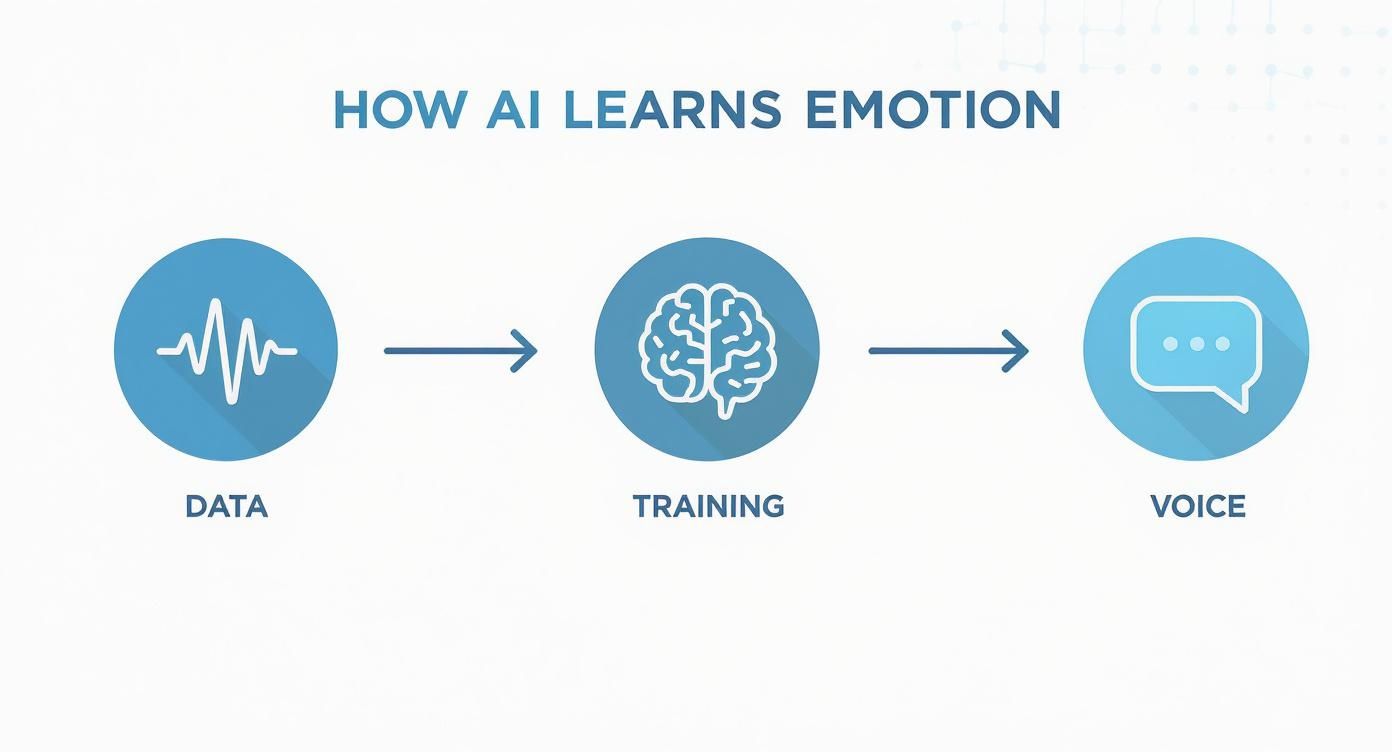
It’s a cycle of analyzing huge troves of voice data, training sophisticated models on those patterns, and generating a nuanced output that connects the text to the right emotional tone.
The Growing Demand for Authentic Audio
The market is exploding because more and more people are realizing how much emotional audio matters. The AI voice generation industry was recently valued at around $3.0 billion and is projected to hit $20.4 billion by 2030. This massive growth is being fueled by industries like e-learning, marketing, and customer service that are seeing a clear payoff from using more human-like AI voices.
By injecting emotion into digital audio, we move from simply transmitting information to creating a shared experience. It’s the difference between a memo and a conversation.
This push for emotional AI is also a huge leap forward in accessibility. It’s a powerful example of cognitive AI's role in enhancing understanding and usability for accessibility across the digital world. For anyone with a visual impairment or a reading disability, an expressive voice can make content not just available, but genuinely engaging and easy to follow.
Ultimately, emotional TTS is about bringing a critical piece of our humanity back into our digital lives. It ensures that as our world gets more automated, our communications don’t lose the warmth, empathy, and connection that make them meaningful. This proves that emotion isn't just a "nice-to-have" feature—it's the key to unlocking the true power of voice technology.
Real-World Uses for Emotional Text to Speech
The true power of text to speech with emotions really shines when you see it in action. Stepping away from the theory, this tech is already making waves across different industries, creating experiences that feel more human and engaging. It’s not just a cool gimmick; it's a serious tool delivering real results, from higher engagement to better accessibility.
These examples prove that swapping a flat, robotic voice for an expressive one can completely change how an audience connects with a message. The mission is always the same: build an emotional bridge that makes digital interactions feel less like talking to a machine and more like a genuine conversation.
Transforming Marketing and Advertising
In marketing, you have seconds to grab someone's attention. Emotional TTS is quickly becoming a secret weapon for creating ad voiceovers that actually stick. An upbeat, excited voice can make a new product feel like a must-have, while a calm, sincere tone can build a foundation of trust for your brand.
This gives marketers the power to test different emotional deliveries for their ads without the high costs and long waits of hiring multiple voice actors. By syncing the voice's emotion with the campaign's goal, brands can craft audio that feels both personal and incredibly persuasive.
The result is an ad that doesn’t just get a message across—it makes the listener feel something. That emotional connection is often what convinces a potential customer to click, buy, or just listen a little longer.
Revolutionizing E-Learning and Corporate Training
Let’s be honest: nothing kills focus faster than a monotone, robotic voice droning on in an e-learning module. Learners zone out, and information goes in one ear and out the other.
This is where text to speech with emotions is a total game-changer for educators and corporate trainers.
- Encouraging Voices: A patient and supportive voice can help someone tackle a tough subject, cutting down on frustration and boosting their confidence.
- Authoritative Tones: For important compliance or safety training, a firm, serious voice makes it clear that the material needs to be taken seriously.
- Enthusiastic Delivery: An energetic, passionate voice can inject life into even the driest topics, keeping learners hooked from beginning to end.
This simple shift turns passive listening into an active learning experience, which makes a huge difference in how much people actually remember.
Enhancing Accessibility and Entertainment
For audiobooks and podcasts, emotion isn't just a bonus—it's everything. Expressive TTS lets authors and creators bring their stories to life with voices that are rich, dynamic, and full of character. A single AI narrator can switch tones for different characters, pulling the listener deep into the story.
This tech also opens up a new world of accessibility. For people with visual impairments or reading disabilities, an expressive voice transforms a flat wall of text into a vibrant auditory experience. It ensures the emotional heart of the content—whether it's the humor in an article or the urgency in a news alert—comes through loud and clear, making digital content not just accessible, but genuinely enjoyable.
Powering Next-Generation Virtual Assistants
Finally, customer service is getting a major upgrade with virtual assistants and IVR (Interactive Voice Response) systems that sound genuinely helpful. Instead of a cold, robotic greeting, customers are now met with a friendly, empathetic voice that instantly creates a better experience.
When a customer calls in frustrated, an AI voice that can adopt a calm and reassuring tone can actually help de-escalate the situation. This ability to match the emotional context of a conversation makes automated systems feel less like frustrating hurdles and more like helpful partners. Tools like LunaBloom AI are designed to make generating these emotionally intelligent voices straightforward, putting human-like automation within reach for any business.
How to Direct Your AI Voice Actor
To get the most out of text to speech with emotions, you need a small but crucial shift in mindset. Stop just feeding the AI a script. Instead, picture yourself as a director and the AI as your talented voice actor. Your job is to give clear, precise instructions to get the exact emotional delivery you have in mind.
This isn't about complex coding; it's about the art of communication. With the right techniques, you can turn a decent AI voiceover into something truly unforgettable. It all starts with understanding how the AI "reads" your script and responds to the subtle cues you give it.
Scripting for Natural Conversation
The most common mistake people make when writing for AI voices is creating text that’s meant to be read, not spoken. Those long, complex sentences with a bunch of clauses might look smart on a page, but they sound clunky and robotic when spoken aloud.
If you want a more human-like performance, you have to script for conversational flow.
- Use Shorter Sentences: Break down your big ideas into shorter, more digestible sentences. This naturally creates a better rhythm and gives the AI more places to add realistic pauses.
- Read Your Script Aloud: This is the best trick in the book. If a sentence feels awkward or you find yourself running out of breath trying to say it, the AI is going to struggle with it, too.
- Write for the Ear: Use contractions like "it's" or "you're" to make the script feel less formal and more like how people actually talk.
Taking this approach will make the final audio sound less like a boring narration and more like an authentic conversation.
Mastering Punctuation as Your Director's Toolkit
In emotional TTS, punctuation marks become your main tools for directing the AI’s performance. They’re the little notes in the script that tell your voice actor when to breathe, where to put emphasis, and how to change their tone.
Think of it like this:
- Commas (,): These create short, natural pauses inside a sentence. Use them to break up thoughts and control the pacing so the AI doesn't rush through everything.
- Periods (.): A period signals a full stop, a definitive end to a thought. It creates a longer, more conclusive pause than a comma does.
- Exclamation Marks (!): This is your go-to for energy and excitement. Using an exclamation mark will naturally raise the AI’s pitch and intensity, which is perfect for showing enthusiasm or urgency.
- Question Marks (?): A question mark triggers that classic upward inflection that signals a question, making it sound genuine and inquisitive rather than flat.
By placing these simple marks strategically, you can fine-tune the delivery with a surprising amount of precision.
A well-placed comma can be the difference between a rushed, confusing sentence and a clear, impactful statement. It’s the subtle breath that gives speech its natural cadence.
Choosing the Right Voice for the Job
Just like casting a movie, picking the right voice is critical to making your message stick. The voice you choose sets the entire tone for your content before a single word is even spoken. A deep, authoritative voice might be perfect for a corporate training video, but it would feel completely out of place in a fun social media ad.
Think about the context of your message and the emotional reaction you want from your audience. Platforms like LunaBloom AI offer a whole library of diverse voices, each with its own personality and style. Take some time to listen to different options and find the one that truly fits your brand and the script's intent.
This deliberate casting process makes sure the voice itself reinforces the emotional core of your content. It’s the final piece of the puzzle in directing a truly compelling AI performance.
Common Questions About Emotional TTS
As this technology becomes more common, it’s natural to have questions about how text to speech with emotions really works and what you can do with it. It's a powerful tool, but getting a handle on its capabilities and limits is the key to making it work for you.
Here are direct answers to some of the most common questions.
What Is the Difference Between Standard TTS and Emotional TTS?
The difference is simple but massive. Standard Text-to-Speech (TTS) has one job: turn words on a page into clear, audible speech. It’s great for clarity but almost always sounds flat, robotic, and totally neutral. It’s a machine reading a script, period.
Emotional TTS goes a step further. It doesn’t just read the words; it tries to understand their emotional context. By playing with pitch, speed, and tone, it can add genuine human-like feelings—whether that’s joy, empathy, or excitement.
In short, standard TTS informs, while emotional TTS communicates and connects. It’s the shift from basic narration to storytelling that actually makes people feel something.
How Much Control Do I Have Over the AI Voice's Emotion?
You have a surprising amount of creative control. Modern emotional TTS platforms let you direct the AI’s performance much like a voice actor. You're not stuck with a single "happy" or "sad" setting.
Instead, you can fine-tune the delivery in a few key ways:
- Pre-set Emotional Styles: Most tools offer a menu of options like 'Cheerful,' 'Angry,' 'Sad,' or 'Empathetic.' You just pick the one that fits the general vibe of your script.
- Punctuation-Driven Performance: As we touched on earlier, simple punctuation is your friend. An exclamation mark pumps in energy, while a comma signals a natural, thoughtful pause. The AI knows how to interpret these cues.
- In-Text Tags (Advanced): Some platforms let you insert special tags right into your script. This gives you sentence-by-sentence control, allowing you to signal a shift in emotion without changing the overall style.
This layered approach puts you in the director’s chair, guiding the AI to hit the exact emotional notes your project needs.
Is It Difficult to Use Emotional TTS in My Projects?
Not at all. One of the best things about today's text to speech with emotions platforms is how user-friendly they are. They’re built for creators, not just coders.
For most people, the process is dead simple:
- Paste Your Script: Just drop your text into the editor.
- Choose Your Voice and Style: Pick a voice you like from the library and select an emotional style from a dropdown menu.
- Generate and Download: Click a button, listen to the preview, and download the final audio file (usually an MP3 or WAV).
For developers who want to build this tech into their own apps, providers offer clean, well-documented APIs. This makes it easy to add emotional voice features directly into websites, software, or mobile apps with very little fuss.
What Are the Most Popular Uses for Emotional Text to Speech?
Emotional TTS shines brightest anywhere a human connection matters. It’s what takes content from just being functional to being genuinely engaging.
Here are some of the most popular places you'll see it:
- Marketing & Advertising: Creating voiceovers for video ads or social media that grab attention and build trust with a sincere or excited tone.
- E-Learning & Training: Developing training materials with encouraging or authoritative voices that help learners focus and remember more.
- Audiobooks & Podcasting: Bringing characters and stories to life with dynamic narration that keeps listeners hooked.
- Customer Service Automation: Building virtual assistants and IVR systems with friendly, empathetic voices that make the experience less frustrating for users.
- Accessibility Content: Giving visually impaired users a richer audio experience that conveys the full emotional context of a piece of writing.
These examples show that emotional TTS is much more than a cool gimmick—it’s a practical tool for making audio content that resonates with people across all kinds of industries.
Your Next Step in Emotional Audio
We've covered how text to speech with emotions works, why it matters, and how you can use it to create more compelling audio. From making your marketing more persuasive to bringing stories to life, the potential is huge. By moving beyond robotic voices and embracing expressive, human-like AI, you can build a stronger connection with your audience.
The key takeaway? Emotion isn't just a feature; it's the future of voice technology. It's what makes digital interactions feel less artificial and more authentic. The tools are here, and they're easier to use than ever. Now is the time to explore what they can do for your projects.
Ready to create voiceovers that truly connect with your audience? With LunaBloom AI, you can generate lifelike, emotional audio in minutes. Explore our library of expressive AI voices and see how easy it is to bring your scripts to life. Start creating with LunaBloom AI today!