Staring at a blank page can feel intimidating, whether you're crafting a new marketing campaign, a training module, or a viral social media video. What's the secret to turning a great idea into a compelling story? It's not magic—it's structure. A solid script outline is your blueprint, giving your narrative the framework it needs to be clear, engaging, and impactful.
Think of it as the difference between a video that wanders aimlessly and one that captivates your audience from start to finish.
This guide provides seven actionable script outline example formats you can adapt for any project right now. We'll explore classic and modern structures designed to organize your creative vision. For more on how outlines shape different content, the principles behind creating effective educational videos offer valuable, transferable insights. We’ll also show you how AI tools like LunaBloom AI can supercharge these frameworks, helping you move from script to screen faster than ever.
1. The Three-Act Structure Outline
The three-act structure is the most universally recognized framework in storytelling. It’s a powerful script outline example because it provides a clear and emotionally satisfying progression that audiences just get. It divides your narrative into three simple parts: Setup, Confrontation, and Resolution.
How It Works: The Narrative Arc
This structure is more than just a beginning, middle, and end. Each act serves a specific purpose, driven by key turning points that push the story forward.
- Act One: The Setup. Introduce your main character, their world, and the status quo. This is where you establish the central theme. The act ends with an "inciting incident"—a pivotal event that disrupts everything and launches the story.
- Act Two: The Confrontation. This is the longest act. Your character faces escalating obstacles while chasing their goal. Rising action, subplots, and a major "midpoint" twist all happen here, testing the character's resolve.
- Act Three: The Resolution. The conflict hits its peak in the climax. Following this, the falling action ties up loose ends, and the story concludes by showing the character's "new normal" after their journey.
Strategic Application and Tips
This model is the backbone of countless successful films like Star Wars: A New Hope. It’s a masterclass in managing pacing and audience engagement.
Actionable Takeaway: Before writing a single word, define your inciting incident (Act One), the midpoint twist (Act Two), and the final climax (Act Three). These three points will form the skeleton of your entire narrative.
For video creators, this structure is a perfect roadmap. When using tools like LunaBloom AI, you can assign different scenes or even avatar expressions to match the emotional tone of each act, making your story visually compelling.
2. The Save the Cat Beat Sheet Outline
Popularized by screenwriter Blake Snyder, the Save the Cat beat sheet is a highly detailed script outline example that breaks the three-act structure into 15 specific story "beats." It’s famous for its prescriptive approach, giving writers a precise map to nail pacing, emotional high points, and audience expectations.
How It Works: The Narrative Arc
The beat sheet breaks down your story into 15 key moments, from the Opening Image to the Final Image. Each beat has a function and a suggested runtime percentage, ensuring your story moves at the right pace.
- Beats 1-5: The Setup. This section establishes the world and ends with the "Break into Two," where the protagonist commits to their new journey. It includes the crucial "Save the Cat" moment, where the hero does something likable.
- Beats 6-12: The Confrontation. Welcome to the "upside-down" world of Act Two. Key beats include "Fun and Games" (delivering on the story's promise) and the "All Is Lost" moment (where the hero hits rock bottom).
- Beats 13-15: The Resolution. The hero uses a "shard of glass" (a lesson learned earlier) to triumph in the "Finale." The story wraps with a "Final Image" that mirrors the opening but shows a significant character change.
Strategic Application and Tips
This model is a favorite for genre films and commercial storytelling, as seen in movies like Finding Nemo. Why? It creates a predictable yet satisfying rhythm that audiences love.
Actionable Takeaway: Before you start writing, map your story to the 15 beats. Pay close attention to the "Theme Stated" (beat 5) and the "B Story" character who helps the hero learn it. This ensures your plot and theme are perfectly woven together.
For planning your video, this structure is invaluable. With a tool like LunaBloom AI, you can create a scene for each of the 15 beats, using different AI avatar gestures or voice tones to reflect the specific emotional goal of that beat.
3. The Hero's Journey Outline
The Hero's Journey is an archetypal story pattern detailing a protagonist's transformative adventure. Popularized by Joseph Campbell, this powerful script outline example connects with audiences on a deep level because it taps into universal themes of challenge, growth, and return. It expands the three-act structure into a 12-stage cycle, perfect for creating epic and emotionally rich stories.
How It Works: The Narrative Arc
While its 12 stages can seem complex, they map logically onto a beginning, middle, and end. The journey is all about leaving a familiar world, facing trials in the unknown, and coming home with new wisdom.
- Act One: The Departure. This covers the hero's "Ordinary World," the "Call to Adventure" that disrupts it, their "Refusal of the Call," and "Meeting the Mentor." It ends when the hero finally "Crosses the Threshold" into the unknown.
- Act Two: The Initiation. Here, the hero faces "Tests, Allies, and Enemies" and approaches the "inmost cave" where their greatest fears reside. They survive the "Ordeal" and finally seize the "Reward."
- Act Three: The Return. The journey home isn't easy. It involves "The Road Back," a final "Resurrection" or climax, and the ultimate "Return with the Elixir," bringing a treasure or wisdom back to their ordinary world.
Strategic Application and Tips
This model is the DNA of countless epic stories, from The Lord of the Rings to The Matrix. It excels at creating character-driven narratives where internal transformation is just as important as the external conflict.
Actionable Takeaway: To make your hero relatable, really lean into the "Refusal of the Call." This moment of hesitation makes their eventual decision to "Cross the Threshold" feel more heroic and impactful.
The Hero's Journey offers a rich emotional map for video creators. Using a tool like LunaBloom AI, you can visually represent this transformation, perhaps by using a cloned voice that grows more confident after the "Ordeal" or adding multilingual subtitles to make your hero's universal story accessible globally.
4. The Five-Act Structure Outline
For storytellers who want more control over pacing and dramatic tension, the five-act structure is a classic and powerful script outline example. Originating from playwrights like Shakespeare, it expands the three-act model to create clearer phases for a narrative’s journey. This structure divides a story into five parts: Exposition, Rising Action, Climax, Falling Action, and Dénouement (or Resolution).
How It Works: The Narrative Arc
The five-act structure offers a more detailed map for a character's journey, building suspense methodically before providing a thorough resolution.
- Act One: Exposition. This introduces the characters, setting, and the initial conflict. It establishes the "normal world" before the story really kicks off.
- Act Two: Rising Action. The central conflict develops through a series of escalating obstacles. The protagonist actively pursues their goal, but the stakes get higher and higher.
- Act Three: Climax. This is the story's peak and a major turning point. The protagonist confronts the main antagonistic force, leading to a dramatic, irreversible outcome.
- Act Four: Falling Action. The immediate consequences of the climax unfold. This act deals with the direct aftermath, showing who won or lost the conflict.
- Act Five: Dénouement/Resolution. The story concludes by tying up all remaining loose ends. It establishes a "new normal" for the characters and reveals the ultimate outcome of their journey.
Strategic Application and Tips
This detailed structure is ideal for complex narratives with significant character development, like those in cinematic classics such as Sunset Boulevard. It allows for a deeper exploration of cause and effect.
Actionable Takeaway: Identify the single most dramatic moment of your story and make it your Act Three Climax. Then, work backward to define the Rising Action that leads to it and forward to map out the consequences in the Falling Action.
In a tool like LunaBloom AI, this structure is perfect for creating in-depth training modules. You can dedicate a video segment to each act, using different voice tones to match the mood—calm for the Exposition, urgent for the Rising Action, and somber for the Falling Action.
5. Freytag's Pyramid Outline
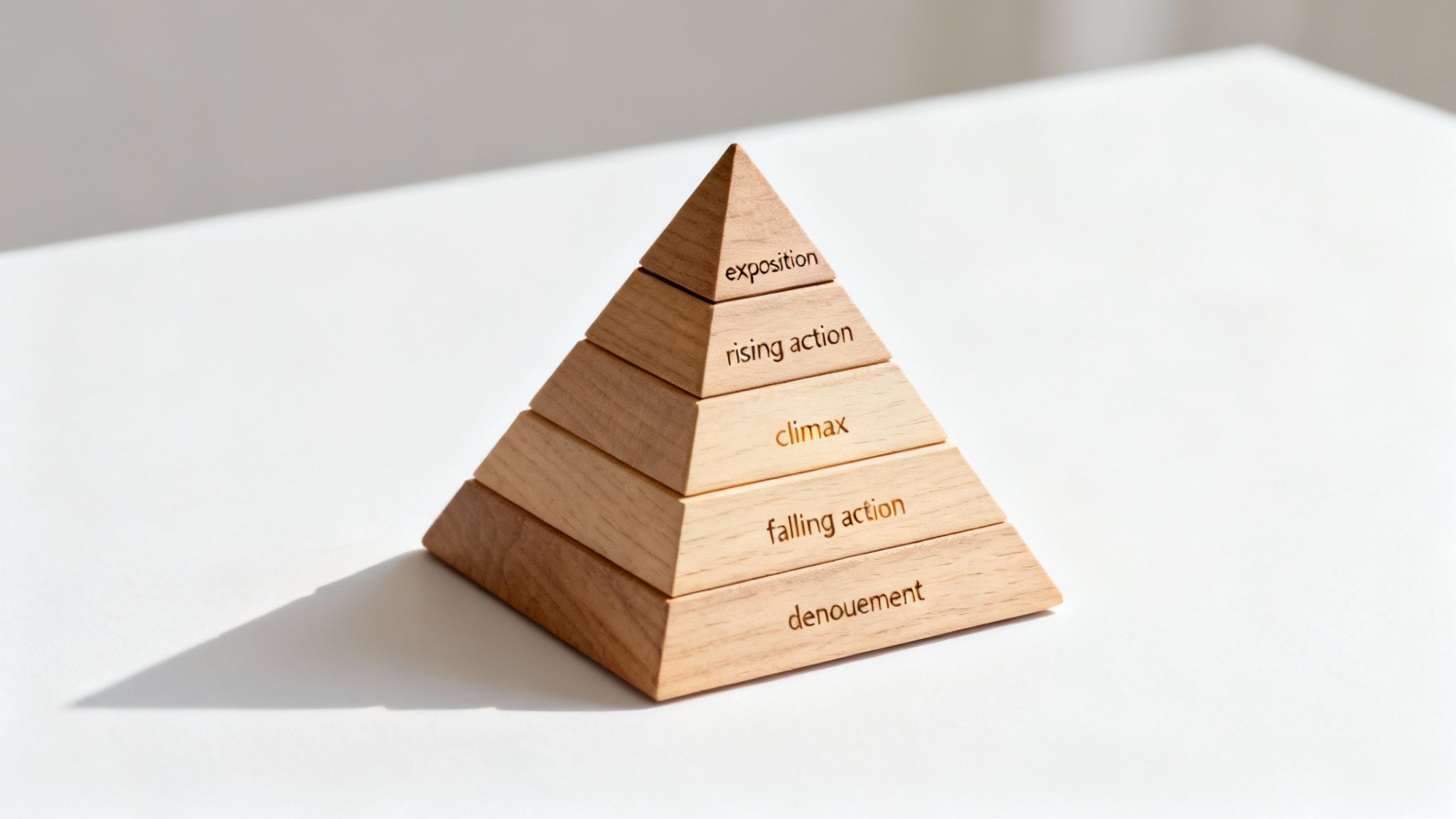
Expanding on classical dramatic principles, Freytag's Pyramid is a highly structured script outline example developed by 19th-century German novelist Gustav Freytag. It visualizes the narrative arc as a symmetrical, five-part pyramid, emphasizing a central climax as the story's peak. This model is exceptional for creating stories with a clear, rising tension and a deliberate, paced resolution.
How It Works: The Narrative Arc
Freytag's Pyramid meticulously charts the story's emotional journey, with each stage serving a distinct purpose in building and releasing dramatic tension.
- Exposition: The foundation of the story. This part introduces the characters, setting, and the initial state of affairs before the central conflict begins.
- Rising Action: A series of events that build suspense and escalate the conflict. This is where the protagonist actively struggles against opposing forces as the stakes get higher.
- Climax: The turning point. This is the moment of greatest tension where the protagonist faces their ultimate challenge, leading to a decisive outcome.
- Falling Action: The events immediately following the climax. This section deals with the direct consequences, and the tension begins to subside as the story moves toward its conclusion.
- Denouement/Resolution: The final part where the conflict is fully resolved. It provides a sense of closure and reveals the characters' final situation.
Strategic Application and Tips
This structure is a cornerstone of classical drama, evident in works like Shakespeare’s Romeo and Juliet. Its rigid form is perfect for character-driven stories where a single, pivotal moment defines the entire narrative.
Actionable Takeaway: To use Freytag’s Pyramid effectively, pinpoint your single most dramatic moment and make it your Climax. Then, build the Rising Action to lead directly to that moment and use the Falling Action to explore its immediate fallout.
For content creators, this model is ideal for crafting impactful case study videos. You can map the "Exposition" to the problem, the "Rising Action" to attempted solutions, the "Climax" to implementing your product, the "Falling Action" to immediate positive results, and the "Denouement" to the long-term success story.
6. The Kishotenketsu Outline
Originating from East Asian narrative traditions, Kishotenketsu offers a refreshing alternative to conflict-driven plots. This unique script outline example prioritizes thematic development and unexpected revelations over direct confrontation, creating a subtle yet profound impact. It divides a story into four movements: Introduction, Development, Twist, and Reconciliation.
How It Works: The Narrative Arc
Unlike the three-act structure, Kishotenketsu doesn't rely on a central conflict to create tension. Instead, it builds momentum by exploring a theme from different angles, culminating in a twist that re-frames the entire narrative.
- Ki (Introduction): The first part introduces the characters, setting, and central theme or situation. It establishes the initial world without hinting at any conflict.
- Shō (Development): This phase explores and elaborates on the elements from "Ki." It builds on the initial theme without major plot escalation.
- Ten (Twist): This is the core of the structure. A new, seemingly unrelated element is introduced, creating an unexpected turn. This twist isn't a conflict but a surprise that forces the audience to see the story in a new light.
- Ketsu (Reconciliation): The final act connects the twist back to the first two parts, creating a harmonious conclusion. It reconciles the different elements, leading to a new understanding or emotional closure rather than a victory.
Strategic Application and Tips
This model is brilliantly used in works like Hayao Miyazaki’s My Neighbor Totoro. It's ideal for brand stories, educational content, or emotional marketing where the goal is to build a connection rather than create high-stakes drama.
Actionable Takeaway: First, identify your video's core theme. Then, design a "twist" that isn't a problem to be solved, but a new perspective that enriches the audience's understanding of that theme. The power is in the revelation, not the fight.
This structure excels when using a tool like LunaBloom AI. You can use one consistent avatar and background for the "Ki" and "Shō" parts to build familiarity. For the "Ten" (twist), introduce a sudden change in the avatar’s expression or background. The "Ketsu" can then return to the original setting, with the avatar displaying a more thoughtful expression.
7. The Snowflake Method Outline
Developed by Randy Ingermanson, the Snowflake Method is an outlining technique that starts with a single sentence and progressively expands into a detailed narrative. It’s a powerful script outline example for creators who prefer to build their story organically, ensuring every character motivation and plot point is deeply connected from the start.

How It Works: The Narrative Arc
The Snowflake Method follows a fractal-like process of expansion, where each step adds a new layer of detail. This approach breaks down the overwhelming task of starting from scratch into manageable, iterative steps.
- Step 1: The Core Sentence. Summarize your entire story in a single, 15-word sentence. This is the foundation for everything that follows.
- Step 2: The Paragraph Summary. Expand that sentence into a full paragraph that outlines the major plot points—essentially, a simplified three-act structure.
- Step 3: Character Development. For each main character, write a one-page summary detailing their motivations, goals, conflicts, and epiphanies.
- Step 4: Scene Expansion. Expand each sentence from your summary paragraph into its own paragraph. From there, you can develop these into a full list of scenes.
Strategic Application and Tips
This method is beloved by writers tackling complex narratives, like those in science fiction and fantasy, because it guarantees a high level of internal consistency. It forces you to understand your characters' motivations before plotting their actions.
Actionable Takeaway: Before you write your script, perfect your one-sentence summary. This core idea will be your North Star. Test different versions to ensure it captures the central conflict and emotional hook of your story.
This iterative approach is ideal for complex training videos or detailed product demos. You can start with a core benefit statement (your one-sentence summary) and expand it into different modules. With a tool like LunaBloom AI, you can even assign a unique, consistent cloned voice to each key character you develop.
7 Script Outline Comparison
| Outline Method | 🔄 Implementation complexity | ⚡ Resource requirements | 📊 Expected outcomes | 💡 Ideal use cases | ⭐ Key advantages |
|---|---|---|---|---|---|
| The Three-Act Structure Outline | Low — simple setup/confrontation/resolution division | Low — minimal tools/planning needed | Steady pacing and clear character arcs | Feature films, mainstream scripts, beginner outlines | Proven, versatile framework for plotting |
| The Save the Cat Beat Sheet Outline | Medium — 15 prescriptive beats with page targets | Medium — beat tracking and timing discipline | Tight commercial pacing and clear emotional beats | Commercial/genre screenplays, writers seeking craftable template | Highly actionable; maintains consistent momentum |
| The Hero's Journey Outline | Medium — 12 archetypal stages requiring thematic work | Low–Medium — focus on protagonist development | Strong transformational arcs and mythic resonance | Epic, fantasy, adventure, myth-inspired stories | Deep psychological resonance and universal appeal |
| The Five-Act Structure Outline | Medium — more granular act divisions and turning points | Medium — more detailed plotting and act planning | Detailed escalation and clearer dramatic phases | Stage plays, long-form dramas, complex multi-thread narratives | Greater control over escalation and fallout |
| Freytag's Pyramid Outline | Low — visual, symmetrical model centered on climax | Low — conceptual tool useful for mapping tension | Clear tension curve with a central climactic peak | Tragedies, classical drama, teaching narrative tension | Visual simplicity; highlights climax placement |
| Kishotenketsu Outline | Medium — four-part, non-conflict emphasis requires thematic subtlety | Low–Medium — emphasis on theme and recontextualization | Harmonious resolution, thematic depth, unexpected turns | Slice-of-life, literary fiction, anime/manga, experimental work | Supports nuance and surprise without conflict-driven beats |
| Snowflake Method Outline | Medium–High — 10 iterative expansion steps (recursive) | High — time-consuming iterative development | Thoroughly developed plots and character networks; fewer plot holes | Novels, long-form fiction, complex worldbuilding projects | Scalable detail; catches inconsistencies early |
Choose Your Blueprint, Tell Your Story
The journey from a blank page to a compelling video always starts with a solid foundation. The seven script outline examples we’ve explored—from the classic Three-Act Structure to the intricate Snowflake Method—are more than just rigid templates. They are powerful blueprints, each offering a unique way to structure your narrative and connect with your audience.
Think of each script outline example as a different lens. Freytag's Pyramid helps build dramatic tension, while the Hero's Journey taps into universal human experiences. Kishotenketsu offers a fresh perspective for a gentle brand story. The real skill is knowing which framework best serves your message.
From Structure to Screen: Actionable Next Steps
Mastering these structures gives you a strategic advantage. It turns storytelling from an abstract art into a repeatable process. Here are the key takeaways to put into practice immediately:
- Match the Framework to the Goal: Before you write, define your video's objective. Are you solving a problem (Hero's Journey) or building suspense for a launch (Freytag's Pyramid)? Let your goal guide your choice of outline.
- Embrace Iteration: Your first outline is a draft, not a decree. Use it as a tool, but be willing to move scenes, adjust pacing, and refine plot points. Flexibility leads to a more polished script.
- Think Visually from the Start: As you outline, jot down ideas for visuals, B-roll, and on-screen text. Integrating visual storytelling early makes the transition from text to production seamless.
Ultimately, a great script outline provides clarity and confidence. It ensures every scene has a purpose, every character arc is meaningful, and your core message hits home. By internalizing these structures, you're not just creating videos—you're engineering narratives that capture attention and drive action.
Ready to turn your perfectly structured script into a professional-quality video in minutes? LunaBloom AI empowers you to bring any script outline example to life using realistic AI avatars, custom voice cloning, and instant multilingual subtitles. Skip the cameras and microphones, and start producing stunning videos at scale today by visiting LunaBloom AI.