A customer education program isn't just a fancy help center. It's a strategic plan to teach customers how to get maximum value from your product so they can achieve their goals. Think of it as proactively arming users with skills and knowledge, transforming them from confused beginners into your biggest advocates.
What Are Customer Education Programs, Really?
Imagine giving every customer a personalized GPS for your product. Instead of letting them wander around, you hand them a clear, guided path from their first login all the way to becoming a power user. This is about designing a journey that ensures your customers see the real value you offer.
When done right, these programs shift the customer experience from reactive troubleshooting to proactive guidance. You're actively helping people hit their targets faster, which builds confidence and keeps them happy. A well-educated customer is a successful customer, and that's the fuel for sustainable growth.
The Core Purpose of Educating Customers
The main goal of customer education is to close the gap between what your product can do and what your customers know how to do with it. When you empower them with this knowledge, you directly impact key business metrics and build a more loyal community.
Here’s what these programs are designed to achieve:
- Boost Product Adoption: Help users discover and use powerful features they might have otherwise ignored, making your product stickier.
- Slash Support Requests: Proactively answer common questions with clear guides, freeing up your support team for more complex problems.
- Increase Customer Loyalty: When customers master your product, they're far more likely to stick around. In fact, 90% of companies report a positive ROI from their education investments for this reason.
- Create Brand Advocates: Confident, successful users become your best marketers, raving about their experience to others.
A common mistake is to view customer education as a cost center. It’s actually a powerful revenue engine. By turning confused users into confident experts, you create a loyal customer base that stays longer and spends more.
Why It Matters For Your Business
Without a formal education plan, you're just hoping customers figure things out on their own. That's a risky strategy that often leads to frustration, churn, and a mountain of support tickets. Customer education programs bring structure to the process of creating successful users, systematically.
Think of these programs as a strategic asset, not just a folder of help docs. They are a scalable way to onboard, engage, and retain customers throughout their journey. Investing in your customers' success is one of the smartest investments you can make in your own. To dig deeper into how our team approaches this, you can learn more about LunaBloom AI's mission and values.
The Real Business Impact Of Educating Customers
Let's move past theory and talk about what really matters: the tangible value customer education programs deliver. Investing in your customers' success isn't just a nice-to-have; it’s a powerful business strategy with a measurable return. The data tells a clear story of growth, efficiency, and loyalty.
These programs directly influence the metrics your leadership team cares about. By empowering users to become self-sufficient, you're not just helping them—you’re building a more resilient and profitable business. This is where you shift from reactive support to proactive empowerment.
This infographic paints a clear picture of how education directly impacts key business areas, from product adoption and customer loyalty to support efficiency.
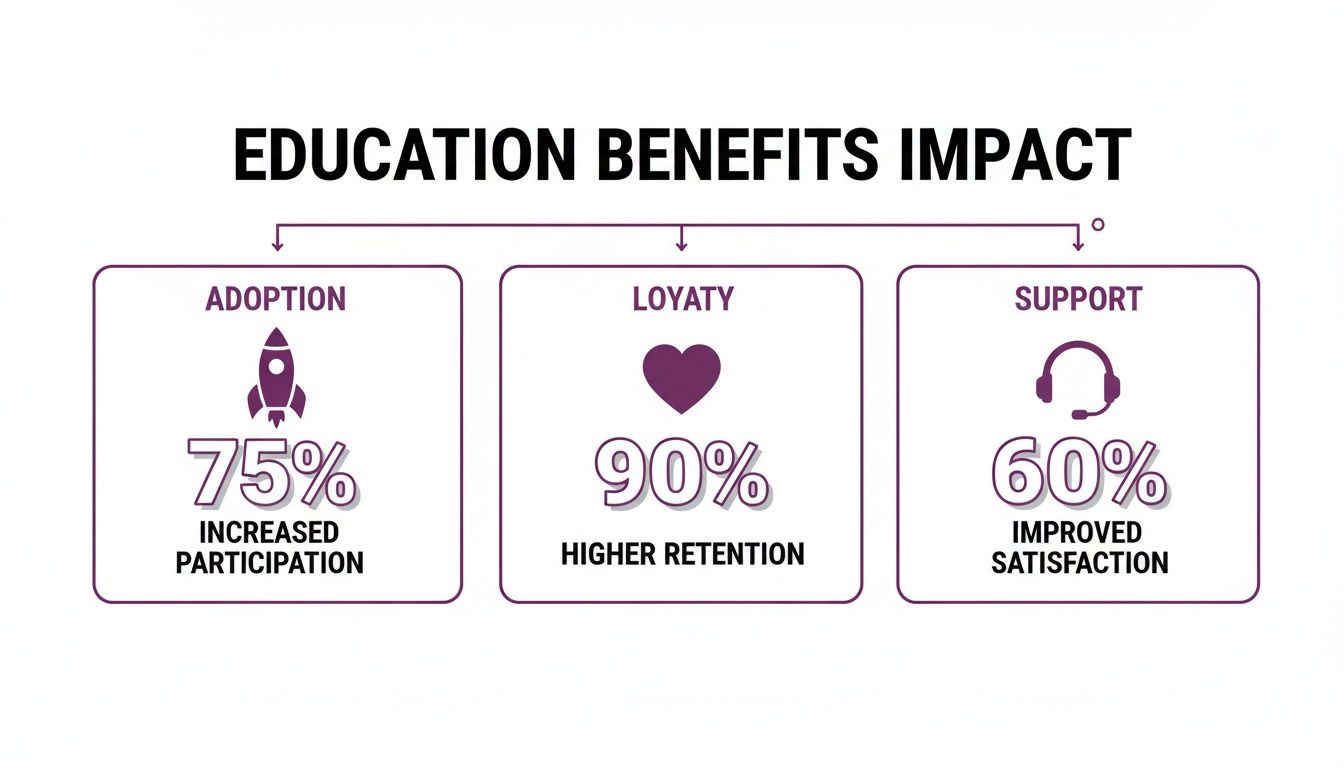
As you can see, a well-designed program creates a powerful feedback loop, boosting engagement while driving down operational costs.
Fueling Revenue and Retention
The most compelling reason to invest in customer education is its direct impact on your bottom line. Simply put: educated customers stick around longer, use more of your product, and ultimately spend more. The numbers prove it.
A deep dive by Forrester found that companies with formal education programs see a stunning 7.4% increase in customer retention. That might not seem huge, but its ripple effect on long-term revenue is massive. The same report also found a 7.1% lift in customer lifetime value (CLTV) and a huge 11.6% jump in customer satisfaction.
This is clear proof that when customers feel confident and successful with your product, they become deeply invested in it and your company's success.
Key Metrics Driven By Customer Education
The table below breaks down the direct impact of effective customer education programs on critical business metrics, offering a clear snapshot of their value.
| Business Metric | Average Improvement with Education Program | Why It Matters for Your Business |
|---|---|---|
| Customer Retention | 7.4% increase | Loyal customers are the bedrock of sustainable revenue. Even a small lift in retention compounds into significant long-term growth. |
| Customer Lifetime Value (CLTV) | 7.1% increase | Educated customers adopt more features and are more likely to upgrade, increasing their total value to your business over time. |
| Customer Satisfaction (CSAT) | 11.6% increase | Happy customers become your best advocates. Higher satisfaction reduces churn and fuels positive word-of-mouth marketing. |
| Support Ticket Volume | 6.1% decrease | Fewer tickets mean lower support costs and a more efficient team that can focus on complex, high-impact issues instead of repetitive questions. |
Ultimately, these metrics show that customer education isn't just a cost center—it's a profit driver that builds a healthier, more sustainable business.
Driving Down Operational Costs
Beyond boosting revenue, customer education is an incredible tool for making your operations leaner. Every time a customer finds an answer in a tutorial instead of opening a support ticket, you save money. This adds up to a major reduction in operational overhead.
The core idea is straightforward: an ounce of proactive education is worth a pound of reactive support. By answering questions before they’re even asked, you free up your support team to handle high-value issues that truly need a human touch.
This efficiency translates directly into cost savings. That same Forrester study revealed that these programs lead to a 6.1% decrease in support tickets. This lets you grow your customer base without having to grow your support team at the same frantic pace.
A smarter, more self-sufficient customer base results in:
- Lower Support Volume: Fewer repetitive "how-to" questions clogging the support queue.
- Faster Resolution Times: Support agents can focus their expertise on more complex problems.
- Increased Agent Satisfaction: Agents spend less time on mundane tasks and more time solving meaningful challenges.
Enhancing Product Adoption and Engagement
A great customer education program does more than teach the basics. It acts as a bridge, guiding users to discover the full power of your product and driving deeper adoption. When a user uncovers an advanced feature that solves a major pain point, their perception of your product's value skyrockets.
To see the full business impact, it’s critical to integrate education into your customer engagement plans. These programs shouldn't be an afterthought; they should be a core pillar of how you build lasting relationships.
Education ensures users continuously find new reasons to make your product an essential part of their workflow. This is what transforms passive users into active, loyal advocates for your brand.
Building Your Modern Education Program

Putting together a world-class customer education program is like building a house. You need a solid foundation and a clear blueprint. It all starts with a smart strategy that pinpoints what you want to achieve and who you're trying to help.
The goal isn't just to produce content. It's to build a structured, easy-to-use system that guides a user from total novice to certified expert. This means moving past a random collection of articles and creating a unified educational experience.
The Anatomy Of A Winning Program
An effective program rests on a few key pillars. If you neglect one, the whole structure gets wobbly. These are the must-have components that transform disconnected content into a reliable engine for customer success.
Here are the non-negotiable building blocks:
- A Centralized Learning Hub: This is your program's home base—a single source of truth where customers find everything. Whether you call it an "Academy," "University," or "Resource Center," it must be simple to navigate.
- A Blended Learning Approach: People learn in different ways. A modern program mixes formats—like self-paced courses, live events, and quick tutorials—to appeal to different styles and schedules.
- Content Mapped to the Customer Journey: Educational material should appear at the right moments. Onboarding content should focus on quick wins, while advanced guides target power users.
- Clear Learning Paths: Don't just give users a library of content; give them a map. Guided paths help people move logically from one skill to the next, building momentum and confidence.
A common mistake is creating content in a silo. The best customer education programs are deeply woven into the product itself, offering help right when and where the user needs it most.
Choosing The Right Content Formats
Not all content formats are created equal. The right choice depends on what you're teaching. A short video is perfect for a quick "how-to," but it's the wrong tool for a complex process.
Think of your content formats as different tools in a toolbox:
- Self-Paced Courses: Perfect for foundational knowledge and complex topics that need a step-by-step explanation. They let people learn at their own pace and are great for certifications.
- Live Webinars and Workshops: When you need real-time interaction, nothing beats a live session. Webinars are fantastic for product updates, deep dives, and live Q&A.
- Short-Form Video Tutorials: For quick, specific tasks, you can't beat short videos (under 3 minutes). They offer immediate fixes and are easy for busy users to digest.
- Knowledge Base Articles: This is your product encyclopedia. Detailed, text-based articles are essential for in-depth explanations, troubleshooting, and comprehensive documentation.
Creating A Centralized Learning Hub
Your education program needs a home. A central hub, like the well-known HubSpot Academy, is vital for making your content discoverable and building credibility. It shows customers you're serious about their success.
This hub should be more than a simple storage folder. It needs to be a dynamic environment that encourages exploration. By organizing content into logical categories and learning paths, you empower users to find their own answers. As you build out your program, get more ideas on structuring content by checking out resources on the LunaBloom AI blog.
This blended, centralized model ensures your customer education programs are accessible, engaging, and effective, turning your educational content into a real competitive advantage.
Designing A Curriculum Customers Will Love

Now for the fun part: creating content that actually helps customers win. A great curriculum is more than a list of features; it's a roadmap mirroring the user's journey. It should guide them from their first "aha!" moment to becoming a true power user.
The most effective customer education programs are built around outcomes, not just information. Instead of asking, "What can we teach?" start by asking, "What does our customer need to accomplish?" This simple shift is the secret to designing content people want.
Pinpoint The User's Desired Outcome
Before you create anything, get inside your customer's head. What’s the real-world goal they're trying to achieve with your product? Forget features for a second and think about what success looks like for them.
This desired outcome becomes the north star for your entire curriculum.
For instance, if you sell a marketing automation tool, a user's goal isn't just to "learn the email builder." Their real goal is to "launch a successful email campaign that gets results." Framing it this way changes everything.
The core of a great curriculum is empathy. It starts by understanding the user's destination first, then building the road to get them there. Forget what you want to teach and focus on what they need to achieve.
When you center your curriculum on their goals, the learning process becomes instantly relevant. You're no longer just explaining tools; you're handing them a direct path to success.
Map The Essential Steps To Mastery
Once you know the destination, it’s time to plot the key milestones. Break down the entire journey into a logical, step-by-step progression. This approach turns a daunting goal into a series of small, confidence-boosting wins.
A simple yet powerful way to do this is by mapping your content to three core stages:
- The "Aha!" Moment (Onboarding): Content here is all about the quick win, designed to show value immediately and build initial confidence.
- The Launch (Adoption): This stage helps users weave your product into their daily workflow. The content needs to be practical and action-oriented.
- The Mastery (Advanced Use): Here's where you empower your most engaged users to become true experts, diving into complex strategies and advanced features.
This structured approach ensures you’re delivering the right information at the right time, avoiding overwhelming new users while still challenging your pros.
Build Engaging And Digestible Content
With your roadmap in hand, you can finally build out the lessons. The key is to make everything as easy to consume as possible. Modern learners are busy, so your material has to be clear, concise, and engaging.
Here are a few practical tips for creating content that sticks:
- Embrace Microlearning: Break down complex topics into bite-sized lessons. Think short video tutorials (under five minutes), quick-start guides, and focused articles that solve one specific problem.
- Make It Interactive: People learn best by doing. Include quizzes, checklists, and hands-on exercises that encourage users to apply what they've learned right inside your product.
- Show, Don't Just Tell: Use real-world examples to make abstract concepts concrete. For a platform like LunaBloom AI, which you can see in the LunaBloom AI app, a lesson titled "Create Your First Marketing Video in 10 Minutes" is far more compelling than a generic tour of the video editor.
By designing a curriculum that is outcome-focused, logically structured, and easy to digest, you create an educational experience that customers will genuinely love.
How To Measure The Success Of Your Program
If you can't measure your customer education programs, you can't improve them—or prove their value to leadership. We have to move past gut feelings and build a clear framework for tracking success and calculating a real return on investment.
A classic mistake is getting stuck on vanity metrics like video views or clicks. Those numbers don't tell the whole story. You need to connect the dots between what people are learning and how it changes their behavior.
Tracking Learner Engagement Metrics
The first layer of measurement is about how customers interact with your content. These numbers give you a window into what’s working and where people are dropping off.
Here are the essential engagement metrics to watch:
- Course Completion Rates: What percentage of users who start a course actually finish it? A big drop-off might mean the content is too long or not engaging enough.
- Assessment Scores: If you use quizzes, how are people doing? This shows if the knowledge is actually sticking.
- Time to Completion: How long does it take the average person to finish a module? This helps you dial in the right length and pacing.
- Content Popularity: Which courses, videos, or articles are getting the most attention? This tells you what your customers are hungry to learn.
These metrics are your feedback loop, telling you what to refine and improve.
Connecting Education to Business Impact
This is where the magic happens. Your goal is to draw a straight line from a customer's learning activity to their actions inside your product. This means linking data from your learning platform (LMS) with your product analytics and CRM.
For instance, track if customers who finished the "Advanced Reporting" course are now using that feature more than those who didn't. A robust student management software can be a game-changer for tracking this effectively.
The ultimate goal is to prove causation, not just correlation. When you can show that "educated customers" adopt features 60% faster or churn 20% less often, you have an undeniable case for the program's value.
The data backs this up. Research shows that the average customer education program boosts product adoption by 38%, helping users get the most out of key features. This success is directly tied to a 22% jump in product retention and a 31% surge in overall engagement.
Calculating Financial Return and ROI
Finally, you have to speak the language of the C-suite: dollars and cents. By measuring the financial return, you can justify your budget and make the case for future investment.
Here are the key financial metrics to handle:
- Reduction in Support Costs: Figure out your cost per support ticket. Then, show how educated customers submit fewer tickets, which translates to direct savings.
- Increase in Customer Lifetime Value (CLTV): Compare the CLTV of customers who've gone through your program versus those who haven't. The difference is often striking.
- Reduced Churn Rate: Put a dollar amount on the revenue you've saved by keeping customers who completed your training. A small drop in churn has a massive impact.
By tracking these three levels of data—engagement, business impact, and financial return—you'll have a complete and powerful picture of your program's success.
Scaling Your Program For Long Term Success
Getting your first curriculum launched is a huge win, but the real work has just begun. An effective customer education program isn't a "set and forget" project. It’s a living asset that must grow with your business and customers. Scaling ensures it stays relevant and keeps delivering value.
This is all about building a sustainable model. You need clear governance, a process for keeping content fresh, and a forward-looking strategy. Without that structure, even the most brilliant content will become useless.
Establishing Program Governance and Maintenance
For a program to last, it needs a solid operational backbone. Start by defining who does what. Who owns new content creation? Who’s responsible for updating tutorials when the product changes? Answering these questions upfront eliminates confusion.
Next, set clear standards for content quality. This creates a consistent voice and experience. A simple checklist covering brand guidelines, tone, and technical accuracy can ensure every piece of content hits the mark.
Finally, get a content refresh cadence on the calendar. A good rule is to review your core curriculum quarterly and the entire library annually. This keeps you proactive, ensuring your materials are always in sync with your product.
Promoting Your Program To Drive Engagement
The best educational content is worthless if nobody sees it. Getting users to engage requires a smart promotion strategy that weaves learning opportunities into their natural workflow.
Here are proven ways to get more eyes on your content:
- In-App Notifications: Use tooltips to point users toward a helpful tutorial the moment they explore a new feature.
- Targeted Email Campaigns: Announce new courses or webinars to specific customer segments who will get the most value from them.
- Empower Your Support Team: Train your support agents to share links to relevant help articles and videos instead of writing long answers.
A common pitfall is treating education as a separate destination. To maximize impact, weave your content into every touchpoint of the customer journey, making learning a seamless part of their product experience.
Looking Ahead: The Future of Customer Education
The world of customer education is always changing, driven by new tech and evolving learner expectations. Staying on top of trends is key to long-term success, and the biggest shift on the horizon is artificial intelligence.
The global customer education market hit USD 2.78 billion in 2024, and with online education revenues projected to hit US$221.71bn in 2026, the opportunity is huge. It’s no surprise that 95% of teams plan to bring AI into their programs in the next 12-18 months, as highlighted in recent customer education trend reports.
AI is set to unlock hyper-personalized learning paths, tailoring content to each user's needs. Imagine a program that automatically suggests the perfect next tutorial based on someone's in-app behavior. You can see a simple version of this in action by exploring the LunaBloom AI starter app. This is how your program not only scales but gets smarter over time.
Common Customer Education Questions
When teams first start building customer education programs, the same few questions always come up. Here are straight answers to the most common queries to help you sidestep hurdles and get moving.
How do I start a program with a small budget?
Starting small is the smartest way to begin. Forget trying to do everything at once. Your goal is to score a few high-impact, low-effort wins right away.
A great place to start is your support ticket queue. Dig in and find the top two or three problems customers constantly face.
Once you've identified those repeat issues, you can:
- Create targeted micro-content: Use a screen recorder to create a handful of quick, 2-3 minute video tutorials that solve those exact problems. You don't need fancy gear, and you can host the videos on YouTube for free.
- Build a basic knowledge base: A simple "Help Center" page on your website is all you need to house these videos and related articles.
- Measure the impact: This is the most important part. Watch your support tickets. Are you seeing fewer tickets for the issues you addressed?
When you can show data proving a measurable drop in support requests, you’ll have a rock-solid case for a bigger investment.
What is the difference between onboarding and education?
This is a classic question. While they feel similar, they play very different roles.
Think of onboarding as the "first day of school." It's a structured, time-bound process designed to get a new user to their first "aha!" moment as quickly as possible. The main goal is activation.
Customer education, on the other hand, is the entire "school curriculum." It’s an ongoing strategy that nurtures the customer through their entire journey, from novice to expert.
Onboarding is the critical first chapter, but customer education is the whole book. It picks up where onboarding leaves off, guiding users to explore advanced features and become true power users.
How do you get customers to use the materials?
Creating brilliant content is only half the job. The trick is to meet customers where they are, weaving learning directly into their experience instead of making it an optional side quest.
A smart promotional strategy uses a few different channels:
- Integrate learning into the product: Use simple in-app tooltips or pop-ups that link to a relevant guide when a user is exploring a new feature.
- Empower your support team: Coach your support reps to respond with a helpful tutorial video instead of typing out a long answer. It’s faster for them and more effective for the customer.
- Use targeted communication: Announce new courses in email campaigns, but don't blast your whole list. Send them to specific user segments who will actually benefit from that topic.
Don't force people to go searching for your help content. By building it into their daily workflow, you make learning a natural part of using your product. If you're ready to start, you can connect with our team to map out a program that delivers real results.
Ready to transform your ideas into stunning videos effortlessly? LunaBloom AI provides the tools you need to create professional-grade video content from simple text in minutes. Start creating with LunaBloom AI today!