Welcome to the ultimate guide on turning your website traffic into tangible results. In today’s competitive digital world, attracting visitors is only half the battle. The real challenge is converting those visitors into leads, customers, and loyal brand advocates. This is the heart of Conversion Rate Optimization (CRO), a systematic process for enhancing your website to increase the percentage of users who take a desired action.
This isn’t about guesswork. It’s about making data-driven decisions that can significantly multiply your website’s effectiveness without increasing your ad spend. Effective CRO means you get more value from the traffic you already have, directly boosting your return on investment and fueling sustainable growth.
We are about to dive deep into ten powerful conversion rate optimization strategies, each packed with actionable steps and practical tips. For a comprehensive look at top strategies, you can also refer to these 10 conversion rate optimization best practices to see how psychological principles drive revenue.
By the end of this article, you will have a clear roadmap. You’ll learn how to implement proven techniques for:
- A/B and Multivariate Testing
- Landing Page and Form Optimization
- Enhancing User Experience (UX)
- Crafting compelling Calls-to-Action (CTAs)
- Leveraging personalization and social proof
This guide will help you not just improve your metrics, but fundamentally enhance your user’s journey and measurably boost your bottom line. Let’s begin.
1. A/B Testing (Split Testing)
A/B testing, also known as split testing, is a cornerstone of effective conversion rate optimization strategies. It’s a methodical process where you compare two versions of a webpage or email (Version A, the control, and Version B, the variation) to see which one performs better. By showing each version to a different segment of your audience, you can collect real data on which variant achieves a higher conversion rate.
This approach removes guesswork from your optimization efforts. Instead of relying on what you think will work, you make decisions based on what your audience’s behavior actually proves. The goal is to identify and implement changes that lead to measurable improvements in user engagement and conversions.
How A/B Testing Works in Practice
The process is straightforward. First, you identify an element to test, like a headline, a call-to-action (CTA) button color, or an image. Then, you create a variation (B) with a change to that single element. Traffic is split randomly between the original page (A) and the new version (B). Performance is tracked until a statistically significant result is reached, determining the winner.
For example, Netflix famously A/B tests the artwork for its titles to see which image compels more users to watch. Similarly, a B2B company might test a short contact form against a longer one to see which generates more qualified leads.
Actionable Tips for Effective A/B Testing
To ensure your tests yield reliable insights, follow these best practices:
- Test One Variable at a Time: To know exactly what caused a change in performance, isolate a single element. If you change the headline, the button color, and the main image all at once, you won’t know which change was responsible for the outcome.
- Run Tests for a Sufficient Duration: A test should run long enough to gather a significant sample size and account for fluctuations in user behavior. A common best practice is to run a test for at least two full business cycles (e.g., two weeks) to smooth out daily and weekly variations.
- Aim for Statistical Significance: Don’t declare a winner prematurely. Aim for a statistical confidence level of at least 95%. This means you can be 95% certain the results are not due to random chance. Tools like Optimizely make this calculation easy.
- Document Everything: Keep a detailed log of every test you run, including your hypothesis, the variants tested, the duration, and the results. This creates a valuable knowledge base for your team to learn from.
2. Landing Page Optimization
Landing page optimization is a critical conversion rate optimization strategy that involves refining web pages built for a single, focused objective. Unlike a homepage that serves many purposes, a dedicated landing page receives traffic from a specific campaign (like a PPC ad) and persuades visitors to take one specific action, such as signing up for a webinar.
This targeted approach works because it eliminates distractions and maintains “message match” between the ad and the page. By removing navigation bars and other competing links, you create a direct path from visitor arrival to conversion. The entire page, from headline to CTA, is engineered to support one goal, drastically increasing its success.

How Landing Page Optimization Works in Practice
The process begins with a specific campaign and a single conversion goal. You create a standalone page where every element supports that goal. For instance, a software company might create a unique landing page for an enterprise-focused ad campaign, highlighting features relevant to large teams, while a separate page for a small business campaign would emphasize affordability.
Similarly, platforms like Unbounce showcase success stories where clients achieve massive conversion lifts by directing ad traffic to optimized landing pages instead of their general homepage. The key is the one-to-one relationship between the ad’s promise and the page’s content, creating a seamless user journey.
Actionable Tips for Effective Landing Page Optimization
To build landing pages that convert, implement these proven practices:
- Maintain Scent and Message Match: Your landing page headline and core message must directly reflect the ad copy or link that brought the visitor there. This reassures users they are in the right place and reduces bounce rates.
- Keep Forms Simple: Only ask for the information you absolutely need. For top-of-funnel offers, a name and email are often enough. Longer forms create friction and can deter potential leads.
- Use Strong Visual and Directional Cues: Guide the user’s eye toward the call-to-action. This can be done with arrows, strategic use of white space, or images of people looking toward the form or button.
- Leverage Social Proof Above the Fold: Display testimonials, customer logos, or star ratings prominently. Placing this trust-building content “above the fold” (visible without scrolling) can immediately boost credibility.
3. User Experience (UX) Design Optimization
User Experience (UX) design optimization is a critical conversion rate optimization strategy focused on enhancing how visitors interact with your website. It involves improving usability and accessibility to remove friction points that prevent users from converting. A seamless and intuitive experience encourages visitors to stay longer, engage more deeply, and ultimately take the desired action.
This strategy moves beyond just looks to address the core functionality of your site. By understanding user frustrations, like confusing navigation or slow load times, you can create a journey that feels effortless. A relentless focus on improving the user journey is central to effective CRO. Further insights into user experience best practices can provide valuable guidance.
How UX Optimization Works in Practice
UX optimization is a user-centric process of identifying and fixing problems in the user journey. It begins with research to understand user behavior and identify pain points. Techniques like user testing, heatmaps, and session recordings reveal where users get stuck. Based on these insights, designers and developers implement changes to improve clarity and simplify processes.
For instance, Stripe’s famously clean and simple checkout process minimizes the number of fields and distractions, reducing cart abandonment. Similarly, Asana’s intuitive project management interface uses clear visual hierarchies and straightforward navigation, allowing users to adopt the tool quickly.
Actionable Tips for Effective UX Optimization
To successfully integrate UX into your conversion rate optimization strategies, follow these tips:
- Prioritize Mobile Optimization: With a majority of traffic coming from mobile devices, a mobile-first design is non-negotiable. Ensure your site is fully responsive, with touch-friendly buttons and easily readable text on smaller screens.
- Conduct User Testing: Recruit people from your target audience to perform tasks on your website. Observing their struggles provides invaluable insights into usability issues you might have missed.
- Use Heatmaps and Session Recordings: Tools like Hotjar allow you to see where users click, how far they scroll, and how they navigate your pages. Session recordings provide video playbacks of individual user journeys, exposing specific friction points.
- Reduce Cognitive Load: Simplify choices and streamline user paths. Avoid overwhelming visitors with too many options or cluttered layouts. A clear, focused journey guides users directly toward the conversion goal.
4. Form Optimization
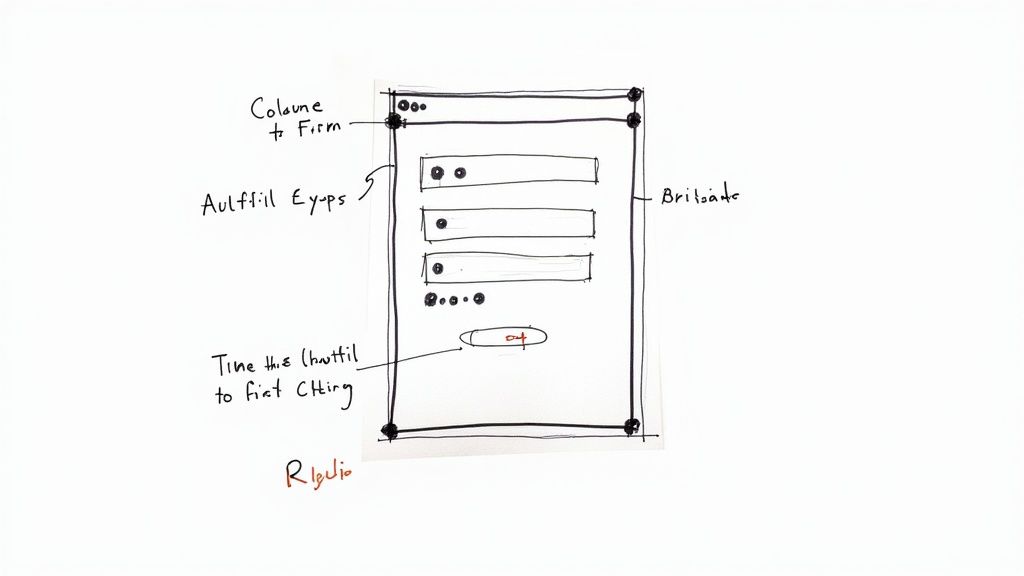
Forms are often the final barrier between a user and a conversion, making form optimization a vital component of any conversion rate optimization strategy. This practice involves strategically designing and simplifying web forms to reduce friction and encourage completion. By minimizing fields, improving clarity, and employing user-friendly design, you can significantly increase lead generation and sign-ups.
The core principle is to make the process as painless and intuitive as possible. Instead of overwhelming users with a long list of questions, the goal is to guide them smoothly toward the submission button. This thoughtful approach transforms a potential point of abandonment into an efficient conversion tool.
How Form Optimization Works in Practice
Form optimization analyzes every element of a form, from the number of fields to the layout and error messages, with the objective of removing any obstacle. This involves a deep understanding of user psychology and behavior, often informed by analytics and user testing.
For example, Typeform has revolutionized the user experience with its conversational, one-question-at-a-time design, which feels more like a friendly chat than a tedious task. Similarly, HubSpot uses progressive profiling, asking for small bits of information over multiple interactions instead of demanding everything upfront. These methods reduce the initial effort, boosting completion rates.
Actionable Tips for Effective Form Optimization
To turn your forms into high-converting assets, apply these proven techniques:
- Minimize Form Fields: Only ask for what is absolutely necessary. Each additional field increases friction. A/B test removing non-essential fields to find the optimal balance between data collection and conversion.
- Use Smart Defaults and Auto-Population: Pre-fill known information (like a returning user’s email) and use browser autofill capabilities. Smart defaults, such as selecting the user’s country based on their IP address, also streamline the process
. - Implement Real-Time Validation: Provide instant feedback as users fill out the form. A green checkmark for a correctly formatted field is encouraging, while an immediate red error message is far better than an error after submission.
- Show Progress on Multi-Step Forms: If a longer form is unavoidable, break it into logical steps. A progress bar shows users how far they’ve come and how much is left, making the process feel more manageable.
5. Call-to-Action (CTA) Optimization
The call-to-action (CTA) is arguably the most critical element on a conversion-focused page. CTA optimization is the process of strategically designing, writing, and placing these prompts to maximize the number of users who take action. It involves refining every aspect of your buttons, from their wording and color to their size and placement.
This is one of the highest-impact conversion rate optimization strategies because even minor tweaks can yield significant gains. An effective CTA bridges the gap between a user consuming your content and becoming a lead or customer. It provides a clear, compelling path forward, turning passive visitors into active participants.
How CTA Optimization Works in Practice
The goal is to make your primary CTA impossible to miss and irresistible to click. This involves creating a strong visual hierarchy where the CTA button stands out and using persuasive copy that communicates clear value. The process is iterative, relying heavily on A/B testing to validate which changes resonate most with your audience.
For example, the team at Unbounce continuously tests their homepage CTAs, experimenting with wording like “Build a Landing Page” versus “Start My Free Trial” to see which phrase better aligns with user intent. Similarly, Evernote found that its simple “Sign Up Free” CTA clearly communicates the no-cost entry point, reducing hesitation.
Actionable Tips for Effective CTA Optimization
To transform your CTAs into conversion powerhouses, apply these proven tactics:
- Use Action-Oriented Verbs: Start your CTA with a strong command verb that communicates a clear benefit. Instead of “Submit,” try “Get Your Free Quote” or “Claim My Discount.” This tells users exactly what they will get.
- Create Visual Contrast: Your CTA button should pop. Use a color that contrasts with the background and surrounding elements. If your brand palette is blue and white, an orange or green button will draw the eye immediately.
- Strategic Placement: Place CTAs where they are most logical and visible. Position them above the fold for immediate action and repeat them on longer pages after presenting a compelling value proposition.
- Test First-Person Language: Experiment with changing the point of view from the standard “Start Your Trial” to a more personal “Start My Trial.” This can create a stronger sense of ownership and has been shown to boost click-through rates.
6. Personalization and Segmentation
Personalization is a powerful conversion rate optimization strategy that involves tailoring the user experience to individual visitors. Instead of offering a one-size-fits-all website, you deliver customized content and offers based on user data like demographics, behavior, and browsing history. This makes the user journey feel more relevant and intuitive.
By segmenting your audience into distinct groups, you can move beyond generic messaging and create highly targeted experiences. This approach makes visitors feel understood and valued, which builds trust and significantly increases the likelihood of conversion. The core principle is simple: a relevant experience is a higher-converting experience.
How Personalization Works in Practice
The process begins by collecting user data through cookies, account information, and onsite behavior tracking. This data is then used to place users into specific segments. When a user from a particular segment visits your site, dynamic content rules are triggered to display personalized elements.
For instance, Amazon’s recommendation engine analyzes your past purchases and browsing history to suggest products you are likely to buy. Similarly, Spotify creates “Discover Weekly” playlists tailored to each user’s listening habits. E-commerce sites can also use this to show a returning visitor items they previously left in their cart, prompting them to complete the purchase.
Actionable Tips for Effective Personalization
To implement this strategy successfully, consider these best practices:
- Start with Simple Segments: Begin by segmenting based on straightforward criteria like new vs. returning visitors or traffic source. You can show returning visitors a “Welcome back!” message or different offers than first-time visitors.
- Use Behavioral Data: Leverage data such as pages visited, time spent on site, and past purchases to create more sophisticated targeting. A user who has repeatedly viewed a specific product category can be shown a targeted promotion.
- Implement Dynamic Content: Use tools like Dynamic Yield or Optimizely to swap out headlines, images, and CTAs based on user segments. This ensures the most relevant message is always displayed.
- Ensure Privacy Compliance: Always be transparent about the data you collect and adhere strictly to privacy regulations like GDPR and CCPA. Provide users with clear options to manage their data.
7. Social Proof and Trust Signals
Leveraging social proof is one of the most powerful psychological conversion rate optimization strategies. Based on the principle that people conform to the actions of others, it builds credibility and alleviates purchase anxiety. By showing that other people trust your product or service, you lower the perceived risk for new customers, making them more likely to convert.
This strategy uses the voice of existing customers and third-party validation to build trust. When a potential buyer sees that peers, industry leaders, or a large number of people are already benefiting from your offer, their confidence in making a decision increases significantly. The goal is to make the choice to convert feel like a safe and popular one.
How Social Proof Works in Practice
The implementation of social proof involves strategically placing evidence of customer satisfaction and popularity across your website. This can range from customer reviews and testimonials to real-time notifications of recent purchases. The key is to make these signals visible at critical decision-making points, such as on product pages, pricing pages, and during checkout.
For example, Slack prominently displays logos of well-known clients and the impressive figure “Trusted by millions of users at the world’s best companies” on its homepage. Similarly, e-commerce sites like Amazon utilize customer ratings and “Verified Purchase” reviews to guide buying decisions.
Actionable Tips for Effective Social Proof
To ensure your trust signals are authentic and impactful, follow these best practices:
- Be Specific and Quantifiable: Instead of a generic “Great service!” testimonial, use one that says, “We increased our lead generation by 45% in the first quarter.” Specific numbers are far more persuasive.
- Use Authentic Faces and Names: Whenever possible, pair testimonials and reviews with a real photo and full name of the customer. This humanizes the feedback and makes it more credible.
- Display Security Badges and Certifications: Showcase SSL certificates, payment provider logos (like Visa, PayPal), and industry awards. These trust signals are crucial on checkout pages to reassure users their data is safe.
- Leverage Video Testimonials: A video of a happy customer sharing their story can be significantly more engaging and convincing than text. It adds a layer of authenticity that is difficult to fake.
8. Multivariate Testing (MVT)
Multivariate testing (MVT) is a more complex form of testing compared to its A/B counterpart. Instead of comparing two different page versions, MVT simultaneously tests multiple variables on a single page to discover which combination of elements performs best. This method allows you to understand the individual impact of each element and how different elements interact with each other.
This sophisticated approach is one of the more advanced conversion rate optimization strategies. It helps identify the optimal combination of headlines, images, and CTAs that work in synergy to drive the highest conversions, providing a deeper level of insight than a series of A/B tests could.
How Multivariate Testing Works in Practice
In MVT, you create multiple variations of several elements on a single page. For instance, you might test three different headlines, two main images, and two CTA button texts. The testing software then combines these variations to create every possible permutation (in this case, 12 combinations) and shows each one to a segment of your audience.
A large e-commerce site might use MVT on a product page to test the product title, a promotional banner, and the “Add to Cart” button color all at once. This reveals not only which button color works best but which button color works best with a specific headline and banner combination.
Actionable Tips for Effective Multivariate Testing
To leverage MVT successfully, a strategic approach is essential:
- Ensure Sufficient Traffic: MVT requires a significant amount of traffic because it splits your audience into many small segments. It’s generally recommended for pages receiving over 100,000 visitors per month to achieve statistically significant results in a reasonable timeframe.
- Test High-Impact Combinations: Form a hypothesis about how different elements might interact. For example, does a benefit-driven headline perform better when paired with a customer testimonial image?
- Start with Fewer Variables: Begin with two or three key elements and a limited number of variations for each. As you gather data, you can gradually increase the complexity of your tests.
- Allocate Ample Time: Due to the high number of variations, MVT tests need to run longer than A/B tests. Plan for a minimum duration of four weeks, but be prepared to extend it if needed. Tools like Convert and Optimizely provide robust MVT capabilities.
9. Heat Mapping and Session Recording
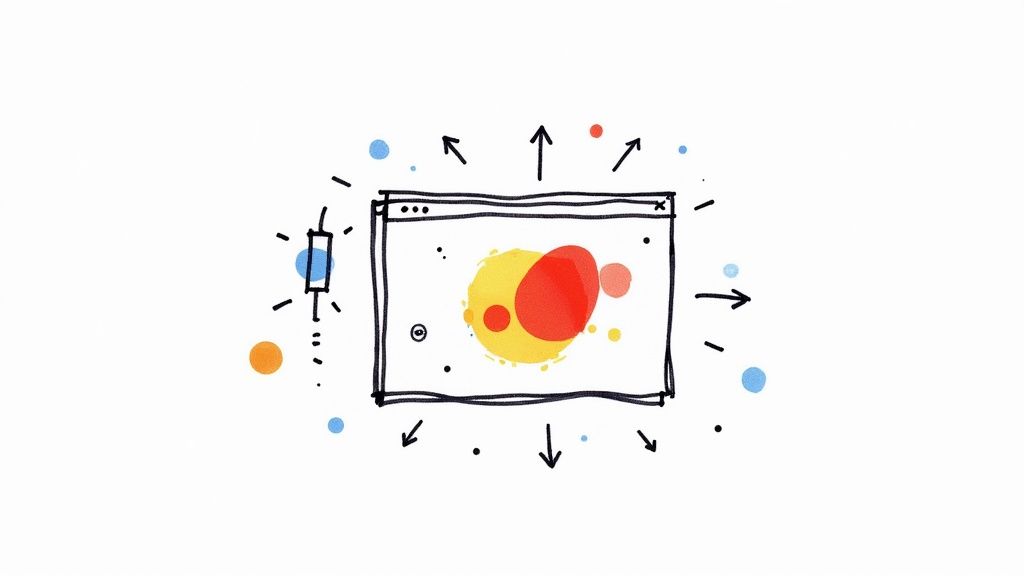
While quantitative analytics tell you what users are doing, qualitative tools like heat maps and session recordings reveal why. These visual technologies are crucial for understanding user behavior on a deeper level. Heat maps provide an aggregated visual summary of where users click, move their mouse, and scroll, while session recordings are video playbacks of individual user journeys.
This combination is one of the most powerful conversion rate optimization strategies because it exposes hidden friction points and uncovers opportunities you would otherwise miss. Instead of guessing why a page has a high bounce rate, you can watch recordings of users getting stuck or see on a heat map that they are ignoring your primary call-to-action.
How Heat Maps and Session Recordings Work in Practice
These tools work by adding a small snippet of code to your website. Once installed, platforms like Hotjar or Microsoft Clarity begin collecting interaction data. A scroll map might reveal that 80% of users never see the content below the fold, prompting you to move key information higher up. Similarly, watching session recordings can show a customer repeatedly trying to click a non-clickable element, indicating a clear design flaw.
By analyzing these visual insights, a SaaS company could discover that users struggle to navigate a key feature, or a publisher could learn which headlines are most effective. This direct observation of user behavior is invaluable for generating data-backed hypotheses for A/B tests.
Actionable Tips for Effective Analysis
To get the most out of these visual tools, approach your analysis systematically:
- Start with High-Impact Pages: Focus your initial efforts on pages with high traffic or those critical to your conversion funnel, like product pages, landing pages, or the checkout process.
- Segment Your Data: Filter recordings and heat maps by traffic source, device type, or user behavior (e.g., users who converted vs. those who abandoned). This helps identify patterns specific to certain audience segments.
- Look for “Rage Clicks”: Identify areas where users click repeatedly in frustration. These are clear indicators of broken elements or confusing UI design that need immediate attention.
- Connect Insights to Analytics: Use your findings to understand the “why” behind your quantitative data. If Google Analytics shows a high exit rate on a form, session recordings can show you exactly why users are dropping off.
10. Value Proposition and Messaging Optimization
Your value proposition is the core promise you make to a customer: what problem you solve and why you are the best choice. Value proposition optimization is the process of refining how you communicate this promise to ensure it instantly resonates with your target audience. It answers the visitor’s fundamental question: “What’s in it for me?”
This strategy moves beyond simple design tweaks to address the heart of your marketing communication. Effective messaging clarifies your unique benefits and differentiates you from competitors. Getting this right is one of the most impactful conversion rate optimization strategies because it shapes a user’s entire perception of your brand.
How Messaging Optimization Works in Practice
The process involves deep customer research to understand their pain points, goals, and the language they use. This insight is then translated into compelling headlines and copy that articulate your value. These new messages are then A/B tested against the old ones to measure their impact on conversions.
For example, Slack famously shifted its messaging from a feature-focused “Team communication for the 21st century” to a benefit-driven one that promised to make “your working life simpler, more pleasant, and more productive.” Similarly, Dropbox evolved its positioning from a simple “cloud storage” tool to a comprehensive “collaboration platform,” broadening its appeal.
Actionable Tips for Effective Messaging Optimization
To ensure your messaging hits the mark and drives conversions, apply these best practices:
- Lead with Benefits, Not Features: Instead of listing what your product does, explain what your customer gets. Frame features in terms of outcomes. For example, “Save 5 hours per week” is more powerful than “Advanced automation tools.”
- Use the Customer’s Language: Conduct interviews and survey your existing customers. Pay close attention to the exact words they use to describe their problems and the value they get from your solution, then incorporate that language into your copy.
- Address Objections Head-On: Identify the primary doubts a potential customer might have and address them directly in your headlines or subheadings. This builds trust and removes friction from the decision-making process.
- Be Specific and Quantifiable: Use numbers and concrete data to make your claims more believable. “Used by 200,000+ marketing teams” is more persuasive than “Used by marketing teams worldwide.” The framework from StoryBrand is an excellent resource for clarifying your message.
CRO Strategies: 10-Point Comparison
| Technique | Implementation Complexity 🔄 | Resource Requirements ⚡ | Expected Outcomes ⭐📊 | Ideal Use Cases 💡 | Key Advantages 📊 |
|---|---|---|---|---|---|
| A/B Testing (Split Testing) | Medium 🔄🔄 — experiment setup, stats, QA | Moderate dev & analytics; needs significant traffic; A/B platform | Reliable, measurable CVR lifts; validated changes (weeks–months) ⭐📊 | Validating CTAs, layouts, copy on high-traffic pages 💡 | Data-driven decisions; risk reduction; widely applicable |
| Landing Page Optimization | Low–Medium 🔄🔄 — design & copy focus | Design/dev time; landing-builder tools; ongoing maintenance ⚡ | Higher campaign conversion rates; better ad alignment ⭐📊 | Paid campaigns, product launches, lead-gen landing funnels 💡 | Focused CTAs; easy tracking; improves Quality Score |
| UX Design Optimization | High 🔄🔄🔄 — research, prototyping, cross-team work | Specialized UX/design/dev teams; time and testing resources | Broad, long-term conversion and retention gains; lower support load ⭐📊 | Sitewide usability fixes; mobile-first redesigns 💡 | Improves usability, SEO, retention; holistic impact |
| Form Optimization | Low–Medium 🔄🔄 — field logic, validation tweaks | Low dev effort; analytics & testing; quick iterations ⚡ | Direct increase in completions (often 10–50%); better data quality ⭐📊 | Lead capture, signup flows, checkout forms 💡 | Quick wins; low cost; easy to A/B test |
| Call-to-Action (CTA) Optimization | Low 🔄 — copy & visual tweaks | Minimal dev; simple A/B tests; low traffic OK ⚡ | Fast CTR/CVR improvements (can be large, short-term) ⭐⚡📊 | Buttons across pages, signups, pricing pages 💡 | Rapid, low-cost improvements; highly testable |
| Personalization & Segmentation | High 🔄🔄🔄 — targeting rules, data pipelines | Significant data infrastructure (CDP), tooling, privacy compliance | Higher relevance and conversions (~up to 20%+); AOV lift ⭐📊 | E‑commerce recommendations; returning-user experiences 💡 | Strongly increases relevance and ROI when done right |
| Social Proof & Trust Signals | Low 🔄 — content collection & placement | Low cost; content sourcing; periodic updates | Reduces purchase hesitation; uplifts CVR (5–30%) ⭐📊 | Pricing pages, checkout, B2B case-study pages 💡 | Builds credibility quickly; inexpensive; broad use |
| Multivariate Testing (MVT) | Very High 🔄🔄🔄🔄 — complex design & stats | Very high traffic (100k+/mo), advanced tools, statistical expertise | Identifies optimal element combinations; finds interaction effects ⭐📊 | Enterprise/high-traffic product or landing pages 💡 | Reveals synergistic wins; efficient at scale but costly |
| Heat Mapping & Session Recording | Low–Medium 🔄🔄 — tool setup + analysis | Moderate tooling/storage; privacy/GDPR attention | Qualitative insights into behavior; identifies friction points 📊 | Diagnosing UX issues, form abandonment, funnel leaks 💡 | Visualizes user behavior; prioritizes fixes; complements analytics |
| Value Proposition & Messaging Optimization | Medium 🔄🔄 — research + copy testing | Moderate — customer research, copywriting, testing tools | Clearer messaging; higher relevance and conversion; brand positioning ⭐📊 | New product launches, homepage, ad-copy alignment 💡 | Improves clarity and relevance; cross-channel impact |
Your Next Step: From Insight to Impact
You’ve just explored ten powerful conversion rate optimization strategies, each capable of transforming your digital performance. From the precision of A/B testing to the psychological power of social proof, you now have the knowledge to turn casual visitors into loyal customers. The journey begins not with implementing everything at once, but with a single, strategic step.
The true art of CRO lies in its iterative nature. It’s a continuous cycle of listening, hypothesizing, testing, and learning. Your website is a living ecosystem, and these strategies are the tools you use to cultivate its growth. The most successful marketers understand that optimization is not a one-time project; it’s a core business process. It’s about developing a culture of curiosity where every assumption is questioned.
Synthesizing Your CRO Game Plan
Before you dive in, remember the key takeaways. The most impactful CRO initiatives are built on understanding user behavior and aligning your website’s goals with your users’ needs.
Remember these core principles:
- Start with Data, Not Assumptions: Your journey should begin with analytics, heatmaps, and user feedback. Tools like session recordings are your direct line to understanding your customers’ “why.” Identify the biggest drop-off points in your funnel or the pages with the highest bounce rates. This is your starting line.
- Prioritize for Maximum Impact: Not all tests are equal. Focus your initial efforts on high-traffic pages where even small wins can lead to significant gains. A 1% lift on a checkout page is far more valuable than a 10% lift on a seldom-visited blog post. Use a framework like ICE (Impact, Confidence, Ease) to decide which conversion rate optimization strategies to deploy first.
- Embrace the Small Wins: Most growth comes from consistent, incremental improvements. A better headline, a clearer CTA, or a simplified form field can each contribute to a compounding effect that dramatically elevates your overall performance over time.
Your Actionable Roadmap to Higher Conversions
Feeling overwhelmed? Don’t be. Here is a simple, actionable path to get started today:
- Choose Your Battlefield: Pick one key page or user flow to focus on. Is it your homepage’s value proposition? A specific product landing page? Your checkout process? Concentrate your energy where it matters most.
- Formulate a Hypothesis: Based on your data, make an educated guess. For example: “I believe changing the CTA button text from ‘Submit’ to ‘Get Your Free Quote’ on the contact page will increase form submissions because it more clearly communicates the value.”
- Select Your Strategy: Choose one of the ten strategies we’ve discussed. If your hypothesis is about button text, A/B testing is your tool. If it’s about user confusion, analyzing heatmaps is the right approach. If it’s about building trust, adding social proof is your move.
- Launch, Measure, and Learn: Run your test until you reach statistical significance. Whether your hypothesis is proven right or wrong, you win. Every test provides a valuable insight into your audience that you can apply to future optimizations.
Mastering these conversion rate optimization strategies is a commitment to customer-centricity. It’s about building a better, more persuasive digital experience that not only drives growth but also creates happier customers. Now, it’s time to move from reading to doing. Go identify your first opportunity, launch your first test, and begin your journey toward unlocking your website’s true potential.
Ready to enhance your messaging and build powerful social proof? Many of the conversion rate optimization strategies discussed, from improving your value proposition to showcasing customer trust, can be supercharged with compelling video. LunaBloom AI makes it effortless to create studio-quality video testimonials and product explainers directly from text, helping you communicate your message with undeniable impact. Start creating videos that convert by visiting LunaBloom AI today.