A buy a house meme turns home-buying emotions, market frustration, and property-marketing choices into a shareable joke. In 2024, the average U.S. home buyer was 35, while 90% of Gen Z respondents expected to buy younger than that, including 33% who expected to own by age 25.
That gap helps explain why the format keeps working. A home purchase combines high stakes, confusing decisions, and emotions almost everyone recognizes, from excitement and envy to panic over closing costs. The joke makes an intimidating subject easier to discuss.
Most examples use a familiar visual template with new captions. The format might contrast renting with ownership, outdated listing photos with a polished property tour, or unrealistic financial advice with actual buyer constraints.
The strongest memes do more than collect likes. They give agents, sellers, buyers, agencies, and educators a simple way to explain a choice. The examples below show how to select a format, write sharper captions, customize the visual, and adapt the idea for responsible real estate marketing. Verify current claims before publishing, especially when a meme mentions prices, rates, costs, timelines, or outcomes. For broader campaign planning, pair these ideas with a practical Facebook Ads for Real Estate guide.
1. Drake Approval and Disapproval for Real Estate
Drake memes turn a marketing decision into a quick visual scorecard. The upper panel rejects a familiar frustration, while the lower panel names a clearer alternative. For real estate, this structure compares listing experiences without making the joke about a buyer, agent, or competitor.
A buyer-focused caption set could read:
- Disapproval: “Scrolling through another listing with five dark photos.”
- Approval: “Opening a clear virtual property tour before booking a viewing.”
The framework works for several audiences. Buyers can compare confusing listing information with a more useful first step. Agents can contrast a standard open house announcement with an AI-assisted video walkthrough. Agencies can show the difference between coordinating a long production and turning a script, listing details, and property images into a social-ready draft.
Build the joke around a process comparison, not a promise. An AI video may give a team more presentation options to create and test. It does not guarantee a sale, faster offers, or a better outcome. That distinction keeps the post useful and responsible.
Make the lower panel specific
Replace vague copy such as “modern marketing wins” with an observable action. Try “create a walkthrough from existing listing assets” or “add captions for silent viewing.” LunaBloom AI describes a workflow that turns text prompts, scripts, and images into edited videos with voiceovers and captions, making it a possible approved-panel solution.
Customize the template in three steps: choose one audience, name its frustration, then show the next action. Keep both images visually consistent, make the lower caption practical, and invite viewers to watch the full tour or visit the listing page.
Practical rule: Contrast an old workflow with a better-defined workflow, not a real person or competitor with a caricature.

2. Expanding Brain for House-Hunting Evolution
A strong buy a house meme can teach a complete content strategy in four quick steps. The Expanding Brain format works like a staircase: each panel answers more of the buyer's questions while keeping the joke easy to follow.
Start with a listing campaign built around this progression:
- Small brain: Uploading static property photos.
- Growing brain: Adding a written description and floor plan.
- Large brain: Publishing a narrated property video.
- Expanded brain: Creating versions for different buyer questions, platforms, and languages.
The humor comes from treating each improvement as a sudden burst of genius. The marketing value comes from showing what changes for the viewer. An agent can use the meme to explain why presentation needs to match the way people assess a home.
Buyers can follow the same pattern. Their panels might move from “saving random listings” to “comparing commute, condition, financing needs, and viewing availability before making an offer.” That turns a familiar joke into a practical checklist for house hunting.
Give every panel a clear job. If the final panel uses an AI-generated tour, name the benefit instead of relying on technical language: a clearer sense of room flow, a narrated explanation, or localized captions. The audience should understand what the added format helps them see or hear.
The AI video app can support drafts based on prompts and images. Use it as an optional production step, then show a finished sample. The meme should explain the workflow, not promise a sale, faster offers, or a better result.
Keep captions short enough for phone screens. Four panels are easier to scan than a crowded sequence. After choosing one audience, adapt the same visual logic for sellers, luxury listings, rentals, commercial properties, or new builds.
A useful final caption is “show the home from the buyer's point of view.” It gives the agent a concrete brief for the next tour, while inviting viewers to consider which detail they still need answered.
“The cleverest panel isn't the most complicated one. It's the one that solves a buyer's next question.”

3. Woman Yelling at Cat for Buyer and Market Reality
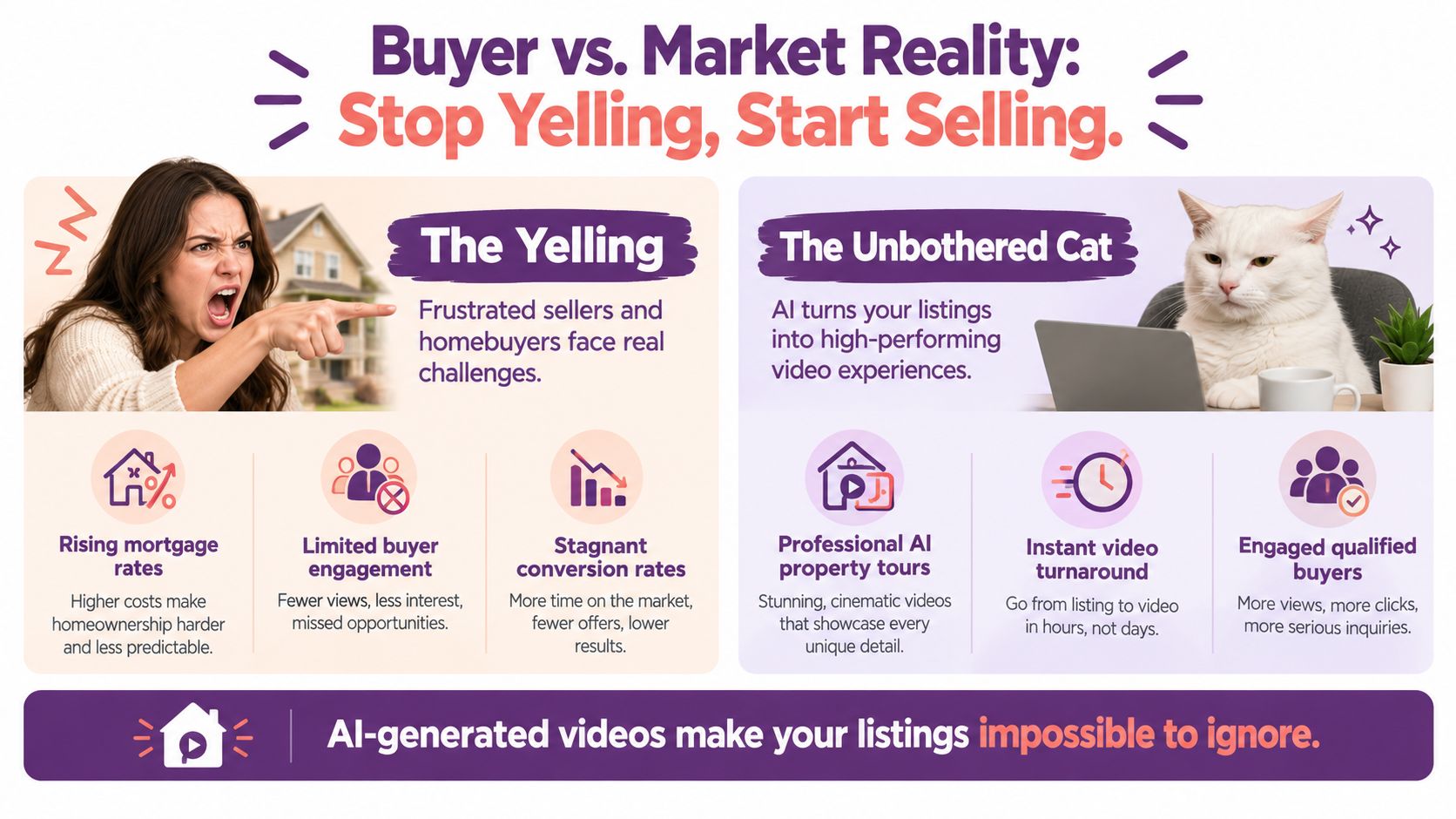
The Woman Yelling at Cat meme turns a frustrated complaint into a clear contrast: one person reacts intensely, while the cat looks confused or unmoved. In real estate, that gap can show the difference between a buyer's concern and a listing that fails to answer it.
Use four panels, with each panel doing one job:
- Buyer: “I've saved for years, but every home raises new questions.”
- Cat: “Just make a stronger offer.”
- Buyer: “What about the layout, condition, and monthly cost?”
- Cat: “Show the home from the buyer's point of view.”
Keep the captions brief enough for a phone screen. The final panel gives an agent a practical brief for the next tour while asking viewers which detail they still need answered. An optional AI video can turn approved property images into a narrated walkthrough, clearer room flow, or localized captions. The AI video app can support drafts from prompts and images. Show the finished sample as a workflow, not as a promise of a sale, faster offers, or a better result.
After choosing one audience, reuse the same visual logic for sellers, luxury listings, rentals, commercial properties, or new builds. A seller version might contrast “Why is interest low?” with incomplete property information. A rental version could pair “Is this space practical?” with a tour that shows storage, access, and room connections.
The joke should identify a real pain point without mocking people excluded by housing costs. Affordability is structural. The original “buy a house” joke grew from Australia's affordability backlash, after Bernard Salt criticized spending on “smashed avocado” and Tim Gurner's comments were amplified by Australian media on May 15, 2017, as documented in this history of the avocado toast meme.
“The cleverest panel isn't the most complicated one. It's the one that solves a buyer's next question.”
4. Loss and Gain Comparison for Property Marketing
A loss-and-gain meme turns an invisible production tradeoff into something viewers can understand at a glance. For property marketing, compare the work behind a listing campaign rather than reducing the joke to the home's sale price.
Start with a specific audience. Budget-conscious agents may recognize the tension between limited production capacity and the need for fresh listing content. A caption sequence could show:
- Loss: “Waiting for a production slot while the listing needs fresh content.”
- Gain: “Creating a new tour from approved images and a revised script.”
A second version can address agencies serving different audiences:
- Loss: “One version that only serves one audience.”
- Gain: “Adaptable captions, narration, and formats for different channels.”
These panels work like a receipt. They show what changes in the workflow, while avoiding a misleading return-on-investment promise.
Compare the full process before publishing. Traditional video production can include scheduling, equipment, travel, editing, revisions, approvals, and delivery. An AI workflow may reduce some of those steps, yet a person still needs to review the result. Confirm that generated visuals match the property, disclose meaningful alterations, and remove any detail that suggests a feature the home does not have.
LunaBloom describes its product as a cinematic AI video generator for businesses and creators, offering editing, voiceovers, captions, localization, and social publishing. Teams can review LunaBloom's company information and compare those capabilities with their own production requirements.
Use real inputs: Verify any price, turnaround claim, subscription cost, or savings figure against a current internal record or product page before publishing.
The strongest comparison gives decision-makers enough context to judge the tradeoff. It explains what changes, what remains manual, and where professional judgment is needed. It should not promise a particular number of offers because an asset appears cheaper or faster.
5. Success and Failure Kid for House-Buying Outcomes
A success-and-failure meme turns a house-buying process into two visible outcomes. One panel celebrates progress, while the other shows what went wrong. For a buy a house meme, the contrast can compare an accepted offer with a rejected one, a clear viewing with a confusing one, or useful listing information with unanswered questions.
Make each panel describe an outcome the audience can understand or the agent can influence. For example:
- Success: “The buyer understands the layout before the viewing.”
- Failure: “The buyer still can't tell how the rooms connect.”
- Success: “The seller approves a localized version for a new audience.”
- Failure: “The campaign uses one caption for every channel.”
- Success: “The agent has a reusable tour for follow-up.”
- Failure: “Every inquiry requires the same manual explanation.”
The format works like a simple lesson: show the desired result, identify the preventable obstacle, then give viewers a next action. A short video adaptation can demonstrate the successful path with labeled rooms or captions. An optional AI-assisted draft still needs human review for accurate property details.
Keep outcome claims honest
A meme can explain a scenario without serving as evidence. Real estate professionals should not invent before-and-after metrics, testimonials, or case studies. Replace generic captions with verified campaign findings only when agency records support them, and link to the relevant case study if one exists.
First-time buyers can use the same structure to examine their own decisions. The success panel can show someone checking affordability, asking about ongoing costs, and learning the offer process. The failure panel can show the mistaken belief that “just buy a house” is a complete plan. Under-30 homebuyers appear as a recurring meme format, according to this real estate meme analysis. Their rarity in the joke does not make ownership impossible.
End with a neutral action, such as “save the questions for your viewing” or “request the full listing details.” The meme then teaches a practical step instead of pressuring people toward a major financial decision.
6. Distracted Boyfriend for Buyer Attention
The Distracted Boyfriend meme turns buyer attention into a simple three-part diagram. The boyfriend is the buyer, the girlfriend is the familiar listing format, and the new person is a clearer alternative competing for attention.
For a property campaign, use labels such as:
- Boyfriend: “Buyer scrolling on a phone”
- Girlfriend: “Static gallery with limited context”
- New person: “Clear narrated tour with captions”
The comparison should explain a content choice, not ridicule photo listings. Accurate, well-lit images paired with complete details still help buyers assess a property. A gallery can show condition and finishes, while a video can explain movement through the space, room relationships, or the order of a tour.
Customize the three roles
Start with a real audience behavior. An agent may be drawn to a faster content workflow while a competing team remains tied to a slower process. An international buyer may prefer translated narration when a monolingual description leaves important context unclear. Focus the joke on the viewing experience, not on another agent.
A caption framework can follow this sequence: “Buyer wants [question answered], old format offers [limited clue], improved format provides [specific context].” Replace each bracket with verified property information. An optional AI video adaptation can turn the same script and images into a short narrated tour, with captions and localization options available through LunaBloom. The agent can test the concept in the LunaBloom starter app, then review every scene for accurate rooms, features, and claims.
Keep the focal point readable. Use large labels, an uncluttered background, and property images that accurately represent room scale. The message is that better presentation can earn attention. It does not guarantee an offer or replace an in-person or remote viewing.

7. This Is Fine for Market Chaos and Solutions
“This Is Fine” works for housing content because the character faces chaos while acting as if everything is manageable. A real estate version can place an agent among buyer confusion, changing conditions, unanswered inquiries, and unfinished listing assets. The image becomes a pressure gauge: the more problems surrounding the character, the clearer the audience understands the situation.
Start with a specific problem in the first frame:
“The seller wants fresh content, the buyer wants more context, and the team has three listings to publish.”
Then give the second frame a practical response. An agent could build a draft tour from approved property images, add concise narration, and submit it for review before publishing. That shows a better workflow without suggesting that content can make the market predictable.
Use the chaos as the setup
For first-time buyers, place “just buy a house” beside decisions about affordability, location, condition, financing, inspections, and closing requirements. The caption framework is simple: “Advice says [easy action], reality requires [verified decision list], so start with [useful next step].” Sellers can use the same format to contrast broad exposure with accurate, accessible information.
The “if you're homeless, just buy a house” variation is deliberately absurd. It is widely associated with Molly-Mae Hague and parodies the earlier idea that everyone has the same 24 hours, turning oversimplified self-help advice into an impossible housing solution, as explained in this video discussion of the meme. Use the joke to criticize detached advice, never to present it as a housing recommendation.
Short-form creators can keep the repeated line while changing the visuals, music, and character reactions. Each variation can target a different audience, such as buyers confused by financing or sellers waiting for usable listing assets. These remixed short-form examples show how the format supports that customization.
End with a calm CTA: “view the full property details” or “ask an agent what the listing does not show.” If motion would clarify the solution, turn the final panel into a short AI-assisted property tour using approved information, then invite viewers to check the original listing. Teams ready to test that workflow can contact LunaBloom for setup support.
7-Point Comparison of House‑Buying Memes
| Meme Format | 🔄 Implementation Complexity | ⚡ Resource / Speed | ⭐ Expected Outcomes (Quality) | 📊 Ideal Use Cases | 💡 Key Advantages / Tips |
|---|---|---|---|---|---|
| Drake Approval/Disapproval | Low, 2-panel contrast, easy layout | Low resources, fast to produce (images + one AI "approved" video) | ⭐⭐⭐⭐, High shareability and instant clarity | Social posts, awareness campaigns, quick product vs. old-method comparisons | Use high‑quality images, caption approved panel with specific benefits, include CTA |
| Expanding Brain, House Hunting Evolution | Medium, 3–5 panels require logical progression | Moderate resources (multiple panels, clear copy), moderate speed | ⭐⭐⭐, Strong at explaining product evolution and features | B2B, technical demos, feature roadmaps, education content | Create 4–5 panels, ensure each step is clearly superior, include metrics (e.g., time saved) |
| Woman Yelling at Cat, Buyer vs. Market Reality | Low, two contrasting emotional panels | Low–medium resources, quick turnaround | ⭐⭐⭐⭐, High emotional resonance and engagement | Pain‑point marketing, empathy-driven posts targeting agents/sellers | Pair authentic pain points with the AI solution panel, post during market stress |
| Loss/Gain Comparison, Financial Impact | Medium, needs accurate data and clear visuals | Medium–high resources (infographic design, verified numbers), slower to create | ⭐⭐⭐⭐, Persuasive for budget-conscious decision‑makers | ROI-focused pitches, case studies, sales decks, pricing comparisons | Use real pricing and hidden-costs, show speed-to-market plus cost savings |
| Success/Failure Kid, Decision Outcomes | Low, two-panel outcomes, emotion-driven | Low–medium resources, moderate speed if adding metrics | ⭐⭐⭐, Motivational and memorable for performance messaging | Case studies, testimonials, sales enablement, motivational social posts | Highlight measurable outcomes (days-on-market, offers), support claims with data/testimonials |
| Distracted Boyfriend, Buyer Attention Spans | Medium, three-role composition requires clear labeling | Low–medium resources, fast if roles are defined | ⭐⭐⭐, Effective for competitive positioning and attention capture | Competitive ads, listing highlight posts, attention-grabbing comparisons | Define the three elements clearly, make the "distraction" visually compelling without insulting |
| This is Fine (Dog in Fire), Market Chaos & Solution | Low, single-scene irony, simple setup | Low resources, quick to produce (image + solution caption) | ⭐⭐⭐⭐, Strong relatability during volatile periods | Crisis messaging, market‑stress commentary, solution-as-calming-punchline | Establish chaos clearly then pivot to LunaBloom as relief; include metrics where possible |
Turn the Joke Into a Shareable Post
A good buy a house meme does two jobs at once. It gives people a recognizable joke, then helps them understand a real choice. Drake clarifies a contrast between two workflows. Expanding Brain explains a progression. Woman Yelling at Cat captures frustration. Loss-and-gain formats communicate value. Success and Failure Kid illustrates possible outcomes, while Distracted Boyfriend shows how presentation competes for attention. “This Is Fine” acknowledges chaos before offering a practical next step.
The format also reflects a broader affordability conversation. The meme has lasted because “just buy a house” advice often ignores the gap between aspiration and access. Younger adults may want ownership while facing prices, rent, financing requirements, and other barriers that a casual slogan can't solve. A related satirical housing meme economy has even used the $HOUSE meme coin to comment on real estate, with coverage connecting the joke to high price-to-income ratios and global affordability stress in this analysis of the meme coin's housing narrative.
Before you publish, run through this short customization process:
- Choose one audience: Write for buyers, sellers, agents, marketers, or educators, not everyone at once.
- Write opposing captions: Give each panel one clear idea and remove words that don't improve the joke.
- Verify every claim: Check current prices, rates, costs, timelines, product features, and outcomes before including them.
- Protect readability: Preview the meme on a phone and make sure the text remains legible over the image.
- Add a relevant CTA: Send viewers to a listing, viewing request, educational guide, or full property tour.
- Test the finished asset: Adapt the crop, caption length, and pacing to the platform where it will appear.
The meme should also respect the audience's circumstances. Don't use affordability frustration to shame renters, imply that skipping small pleasures solves a structural problem, or present generated visuals as a substitute for accurate property information. Humor earns attention, but trust keeps a real estate audience engaged.
Static images won't always show the idea clearly. Convert a Drake contrast into a short before-and-after video, turn Expanding Brain into a narrated workflow, or use “This Is Fine” as the opening scene for a property tour. LunaBloom AI can help creators and marketing teams turn prompts, scripts, and images into edited video with voiceovers, captions, and localization. For distribution ideas, combine the meme with a practical guide to Instagram growth for real estate.
The strongest post leaves viewers with something useful. They should understand the joke, recognize the underlying problem behind it, and know what to do next, whether that means checking the listing details, asking a better buying question, or watching a clearer property tour.
LunaBloom AI helps creators, agents, and marketing teams turn property scripts, images, and prompts into edited videos with natural voiceovers, captions, and adaptable social formats. Visit LunaBloom AI to create a more engaging version of your next buy a house meme or property-tour campaign.