You're not short on ideas. You're short on a system that can turn one idea into a week of branded video production without blowing up reviews, reshoots, and deadlines. That's why the work feels heavier every quarter, especially when the channel mix keeps growing and last month's videos didn't move the needle.
Why Branded Video Production Feels Harder Than It Should
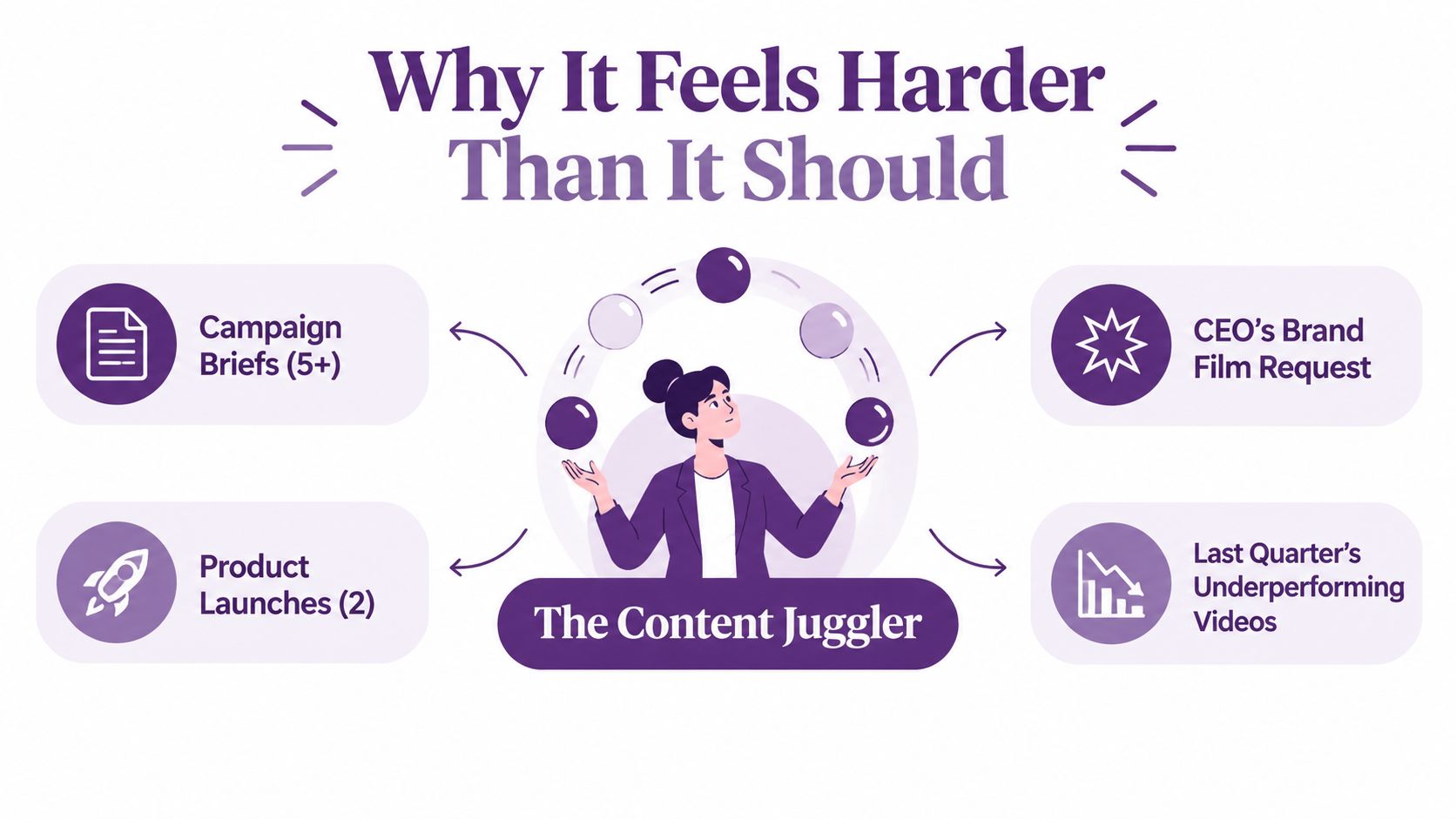
A lot of teams are living the same day: five campaign briefs on the desk, two launches in motion, and a CEO asking for a brand film by Friday. The last set of videos shipped, but they didn't perform well enough to justify the scramble, so now every new request feels like a risk instead of momentum. The result is familiar, duplicated briefs, inconsistent messaging, and a production backlog that expands every time the team adds another channel.
The hidden problem usually isn't creative talent. It's that video gets treated like a one-off deliverable instead of a repeatable operating model. Without reusable templates, a shared review rhythm, and a clear owner for the process, every video starts from zero, even when the team already has the raw ingredients for ten more assets.
Practical rule: if your team rewrites the same story for every cutdown, you don't have a content problem, you have a workflow problem.
That's why the teams shipping consistently in 2026 aren't just filming more. They're building a pipeline that turns one strong concept into multiple on-brand outputs, then using performance feedback to sharpen the next round. If that sounds like the missing piece, LunaBloom AI is one place to see how faster draft-to-export workflows are changing the pace of production.
What Branded Video Production Actually Is
Branded video production is the end-to-end work of planning, creating, editing, and distributing video that carries a recognisable brand identity across every frame and second. That includes the opening hook, the visual language, the sound design, the captions, the end card, and the distribution plan that gets the piece in front of the right people. It's broader than a TV commercial, narrower than general content marketing, and much more operational than “make something cool.”
A useful way to define it is by business objective. Some videos are built for awareness, some for education and consideration, some for conversion, and some for retention or training. The production choices should change based on which of those goals matters most, because a brand film, a product demo, and an onboarding clip should not be judged by the same standard.
For context on how brand narrative works across channels, Polaris Marketing Solutions has a practical guide on what brand storytelling means that pairs well with a production mindset. The important distinction is that storytelling is the message layer, while production is the system that turns that message into usable assets.
A modular view helps here. Instead of thinking, “We need one hero video,” think, “We need a library of scenes, messages, and cutdowns that can be recombined.” That shift makes it easier to create a hero film, then extract landing-page clips, vertical ads, internal explainers, and testimonial variants from the same shoot.
| Objective | Typical Format | Audience Intent | Funnel Stage |
|---|---|---|---|
| Awareness | Brand film, documentary-style piece | Learn who the brand is | Top |
| Consideration and education | Explainer, demo, testimonial | Understand the offer | Mid |
| Conversion | Landing page video, short ad | Take the next step | Mid to bottom |
| Retention or training | Onboarding, compliance, internal updates | Learn, remember, follow process | Post-purchase |
A quick exercise helps. Map every current video asset to one of those four objectives, then circle the gaps. If everything you've made is awareness content, the issue probably isn't volume, it's imbalance.
Building a Production Workflow That Ships Weekly
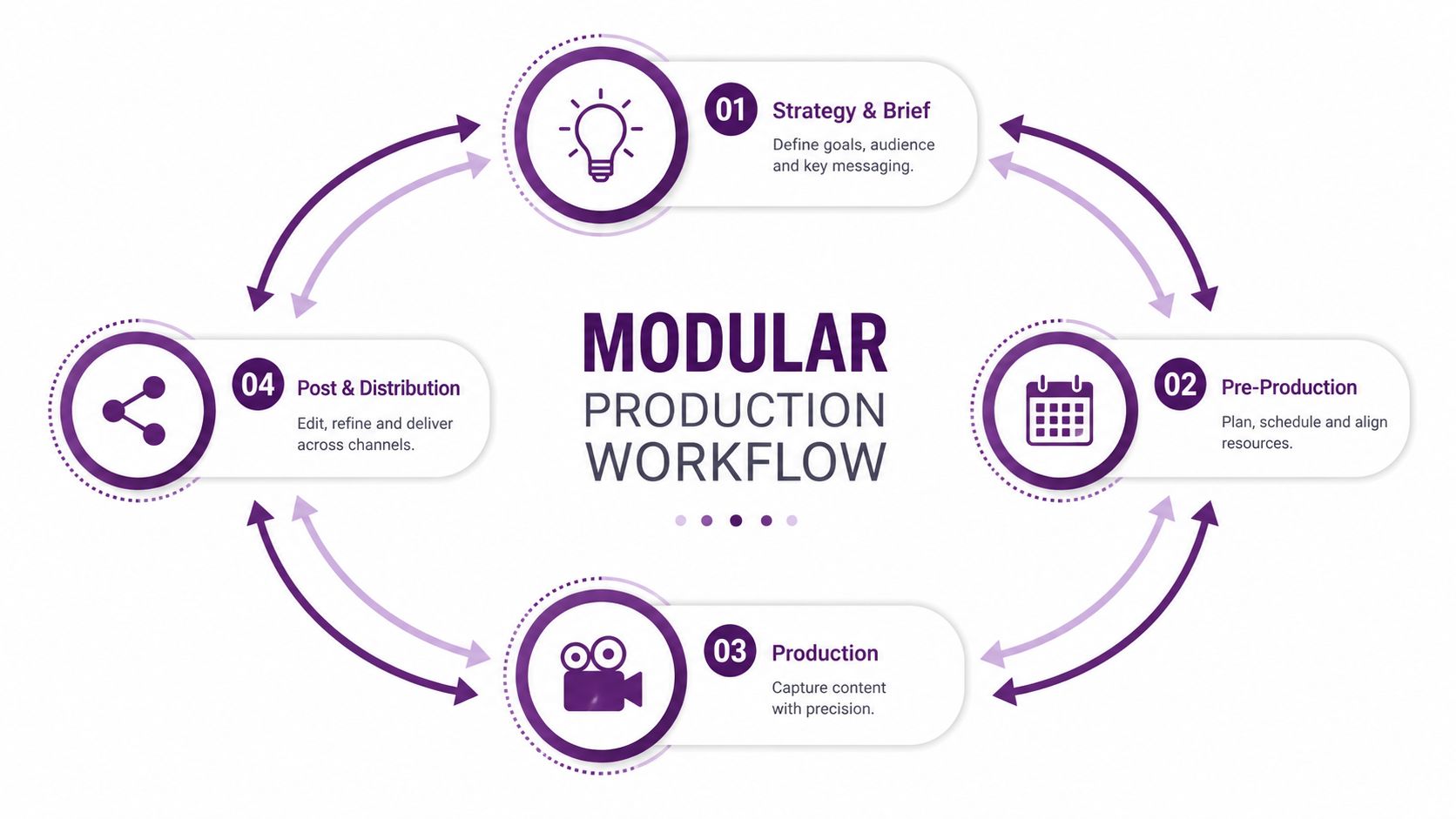
The teams that ship weekly rarely run video as a straight line. They run it as a loop, where strategy informs pre-production, production informs post, and distribution feeds the next brief. That matters because the most common workflow failures happen when one stage is treated as separate from the others.
Start with the brief and the asset plan
A one-page creative brief should answer four things fast, the objective, the audience, the hook, and the single CTA. If the brief can't do that, the shoot will drift. The next artifact is the asset plan, which lists the hero cut, the short cutdowns, the quote snippets, the thumbnail options, and the versioning needs for each channel.
The early-stage mistake that burns the most time is skipping script lock. Teams rush into filming because the calendar is tight, then spend days reconciling conflicting notes in edit. A better habit is to hold a fixed weekly review window, keep all approved brand files in one source of truth, and name versions consistently so no one is guessing which export is final.
Treat post-production and distribution as part of the same job
Production doesn't end when the camera stops rolling. Post should already know which clips are meant for social, landing pages, email, and paid media, because that determines framing, pacing, captions, and text treatments. Distribution is also where the measurement sheet gets built, so the team knows what will be checked after publish.
A small team can usually maintain a rhythm of two to four pieces per week if the assets are modular and the approvals are predictable. When the calendar slips, cut the least essential variant first, not the hero message. The goal is to protect the system, not force every slot to be filled.
The easiest video program to maintain is the one where the edit list was built before the shoot, not after it.
The internal team at LunaBloom AI app is a useful example of how tighter planning and faster iteration can shorten the path from draft to distribution without changing the core creative decisions.
Budgets, Timelines, and the In-House Question
The right production model depends on how often you need video, how complex the brand is, and how much control you want over editing, scripting, and analysis. A high-volume social program and a single flagship brand film are different financial problems, even if both live under the same marketing umbrella.
Choose the model based on output, not ego
In-house production makes sense when the team needs speed, frequent iteration, and close brand control. It's especially useful when editing and scripting can stay close to the marketers who know the campaign context. Agencies still matter when the brand needs heavier creative direction, larger crews, or a high-stakes launch where polish matters more than volume.
Freelancers sit in the middle. They're often the right answer for one-off shoots, overflow support, or specialized skills like motion graphics or color grading. AI-assisted workflows change the math again, because they can compress scripting, rough-cutting, and variant creation without removing human judgment from the process.
Hidden costs matter more than most budgets admit. Storyboard revisions, music licensing, localization, and extra review rounds can slow everything down and stretch the budget even when the initial quote looked clean. Those costs don't always show up in the first proposal, but they show up in the calendar.
| Model | Cost per Video | Typical Turnaround | Best For | Key Trade-off |
|---|---|---|---|---|
| DIY or lean in-house | Lower-budget social clips | Fastest once systems are in place | Always-on social and testing | Less polish and more internal time |
| Freelancer crew | Mid-range deliverables | Moderate | Single shoots, specialty edits | Quality varies by operator |
| Agency partner | Higher-budget campaigns | Slower, more structured | Launches, brand films, complex approvals | Premium cost and more process |
| AI-assisted hybrid | Variable, often lower on revisions | Fast for drafts and variants | Scaling cutdowns and local versions | Needs strong human creative direction |
The cleanest decision rule is simple. If your team needs recurring assets every week, build closer to in-house. If the work is rare, high-risk, and visually demanding, the premium on agency support can be justified. For teams that want faster scripting, variant generation, and rough-cut support in one place, LunaBloom AI about fits naturally into a hybrid workflow.
Matching Video Format to Real Use Cases
The best format is the one that matches the job. A vertical ad, a product walkthrough, and an internal onboarding video may all be branded, but they solve different problems and should be produced differently. If you force every use case into the same visual style, the output gets generic fast.
Match the format to the intent
Vertical short-form ads for TikTok, Reels, and Shorts need a quick hook, light production complexity, and a clear thumbstop moment. Product demo walkthroughs belong on landing pages and in sales enablement because they can trade brevity for clarity. Animated explainers work better when the product is technical or abstract, while testimonial cuts are strongest when the buyer needs proof from another customer.
Long-form YouTube brand documentaries belong in awareness plays where narrative depth matters more than immediate response. Internal training clips serve onboarding and compliance, where knowledge recall matters more than reach. Live-action brand films still have a place in launches, especially when the goal is to signal identity and ambition in a single piece.
| Use Case | Recommended Format | Ideal Length | Primary Metric |
|---|---|---|---|
| TikTok, Reels, Shorts | Vertical short-form ad | Short | Thumbstop rate |
| Landing pages, sales enablement | Product demo walkthrough | Moderate | Demo completion |
| Technical products | Animated explainer | Moderate | Understanding and recall |
| Mid-funnel trust | Customer testimonial cut | Short to moderate | Watch completion |
| Awareness | YouTube brand documentary | Long-form | Completion and brand response |
| Onboarding, compliance | Internal training video | Moderate | Knowledge recall |
| Launches | Live-action brand film | Longer hero piece | Brand lift and recall |
One practical way to think about it, the hook style should be different for each asset. Social ads need a fast visual claim, demos need an immediate problem statement, and testimonials need credibility as early as possible. The format is not the creative idea, it's the container for the idea.
Distribution and the Metrics That Actually Matter
Distribution should be designed before the video is finished. If you know where a piece will live, you'll frame it differently, subtitle it differently, and cut it differently. A single upload to YouTube isn't a distribution strategy, it's just a posting habit.
Think in channel groups, not one-off posts
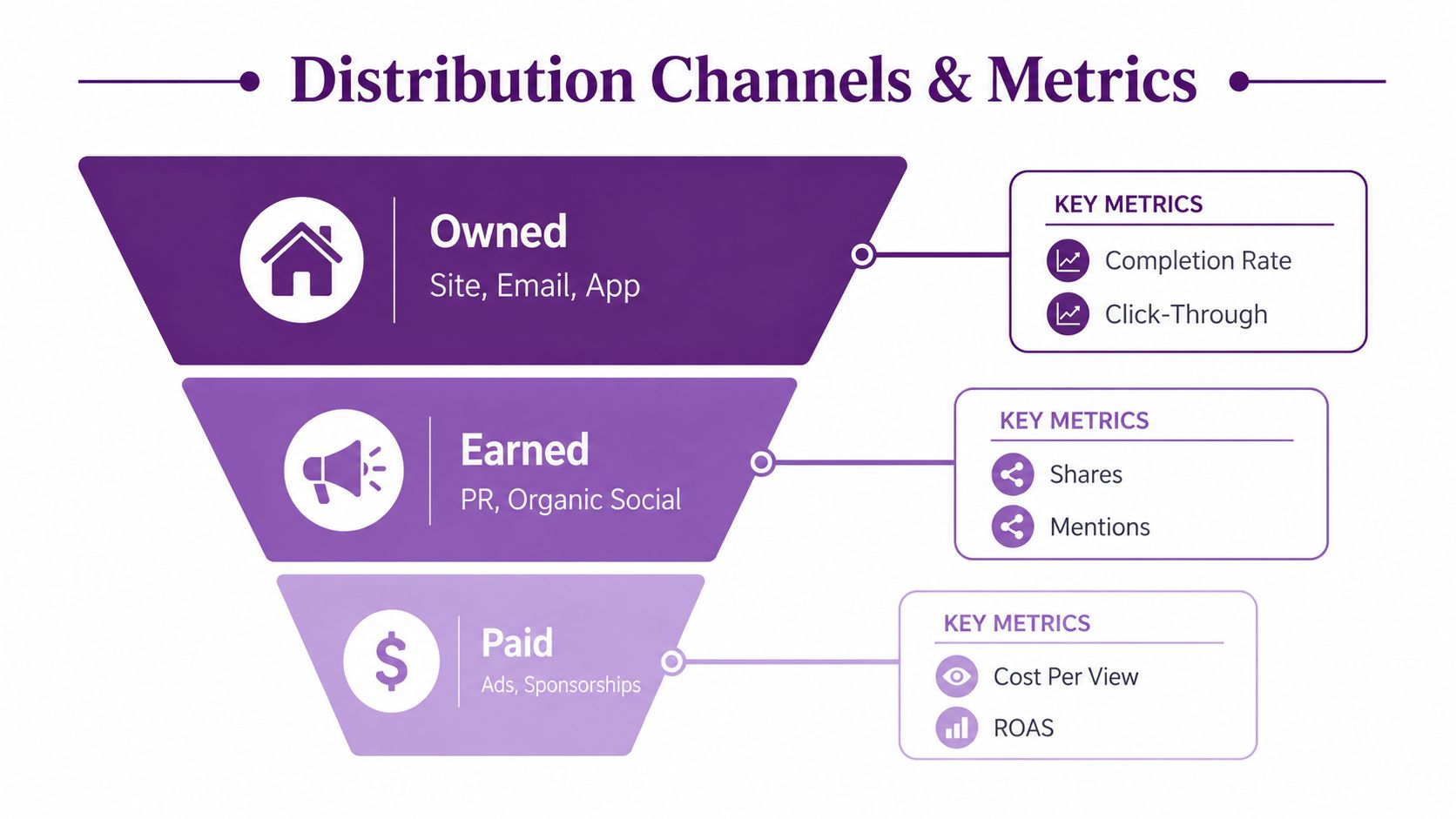
Owned channels include the site, email, and app. Earned channels include PR and organic social. Paid channels cover Meta, TikTok, YouTube, CTV, and LinkedIn. Each one rewards a different cut, which is why the same master asset should usually be repurposed into multiple versions rather than pushed everywhere unchanged.
The strongest effectiveness signals for branded video are completion rate, hook retention at three seconds, and thumbstop rate. Clicks matter, shares matter, conversions matter, but they're downstream outcomes. Completion is closer to whether the audience consumed the message, which is why it's the better baseline for judging creative.
Build a simple measurement loop
Use native platform analytics for the first layer of readout, then add GA4 events for site behavior and conversion paths. Attention APIs can help when the placement or platform supports them, and brand lift studies are useful when you need to understand perception changes rather than immediate response. A basic test loop should isolate one variable at a time, often the hook, the thumbnail, or the CTA.
The source of truth should be the creative variable, not the vanity metric. If one hook keeps people watching longer, keep the core structure and test the next version around the intro instead of rewriting the whole asset. That approach saves time and gives the team a real learning system instead of a stream of disconnected exports.
The LunaBloom AI site is relevant here because distribution gets easier when the production stack already supports captions, thumbnails, and version control in the same workflow.
Tips, Templates, and Where AI Fits In
A good branded video program starts with a brief, not a brainstorm. The brief should fit on one page and cover the objective, audience, hook, single CTA, and KPI. That keeps the team from loading too many jobs into one asset and makes review much faster.
Use a modular checklist on every shoot
A strong shoot should be planned to produce more than one finished asset. The best teams leave with a hero video, several cut-downs, GIF-friendly moments, thumbnails, and a transcript that can be mined for copy and captions. If you only leave with one final edit, you've probably overpaid for the shoot.
Seven operator-grade habits help the system hold together:
- Lead with the hook early: if the first three seconds don't earn attention, the rest of the edit works harder than it should.
- Write captions before polishing the script: the on-screen text often exposes weak structure faster than a spoken draft.
- Name files for retrieval: include project, version, aspect ratio, and channel so no one has to guess.
- Plan the CTA once: changing the call-to-action across cuts creates confusion and slows approvals.
- Capture more than the hero angle: alternate takes and reaction shots make repurposing easier.
- Keep the transcript editable: transcript-based cutdowns are faster when the source text is clean.
- Separate review from revision: one round to comment, one round to fix, or the feedback loop gets noisy.
AI fits best when it speeds up the repetitive layers and leaves strategic judgment intact. It can help draft scripts, generate shot lists, create transcript-based rough cuts, and produce on-brand variants for different channels. A practical example is using AI content creation platforms to compress the early production steps, then keeping human review on the final message, pacing, and brand voice.
That's also where LunaBloom AI starter app makes sense for a solo marketer or small team. It can support faster ideation, rough-cut assembly, and variant creation without turning the process into a pure automation exercise.
A realistic 30-day starter plan looks like this. Week one, define the one-page brief and the modular checklist. Week two, create the first hero asset and two cutdowns. Week three, publish, measure, and compare hook performance. Week four, refine the best-performing angle and ship the next round.
Quick Answers to Common Branded Video Questions
How long does branded video production take? For a simple social cut, a focused team can move quickly if the brief is clear and approvals are tight. A larger hero campaign takes longer because the script, shoot, edit, and versioning all have more moving parts.
What should the budget look like? Lean social clips can live on the low end, while polished hero campaigns can move into much higher spend because of crew, creative direction, and post-production. The key question isn't the number by itself, it's whether the asset will be reused across multiple channels.
Should you keep production in-house or outsource it? Keep it in-house when you need frequent output, fast edits, and tighter control. Bring in freelancers or an agency when the work needs specialized craft, a larger production footprint, or a launch-level finish.
What's the minimum team for a weekly cadence? You need someone owning strategy and approvals, someone handling creative production or editing, and someone responsible for distribution and measurement. One person can cover more than one role in a small team, but those functions still need to exist.
How do you measure ROI without drowning in vanity metrics? Start with completion, hook retention, and the action tied to the campaign objective. Then connect those signals to site behavior, pipeline actions, or brand lift rather than chasing views alone.
Can you start with existing footage? Yes, if the footage is usable, on-brand, and easy to repurpose. Existing assets become much more valuable when they're organized, captioned, and mapped to specific use cases.
LunaBloom AI can sit alongside human review as a speed layer for ideation, rough cuts, and variant testing, while your team keeps control of the final voice and visual standards.
If you're building a repeatable video system, LunaBloom AI can help you move faster from script to cutdown without losing control of the brand. Use it to draft, version, and repurpose more efficiently, then keep your team focused on the story, the hook, and the final approval.