Most buyers still shop for a video cloning app like they're buying a flashy demo. That's backward. Deepfake video volume has been reported at about 14,000 videos in 2019, with a projection of 8 million by 2025, or roughly a 571x increase in six years, according to deepfake statistics compiled here. The same source says verified deepfake incidents went from 22 total incidents between 2017 and 2022 to 42 in 2023, 150 in 2024, and 179 in the first quarter of 2025 alone. That's context for any modern video cloning app. You're not just buying speed. You're buying a publishing system that has to survive scrutiny.
I've seen teams obsess over avatar realism and ignore the ugly parts. Consent capture. takedown workflows. metadata. version control. QA under deadline. Those are the details that decide whether a synthetic-media workflow helps your team or creates a cleanup job for legal and brand.
If you're evaluating a video cloning app in 2026, the smart question isn't “Which one looks coolest in a product video?” It's “Which one can my team use every week without drift, rework, or compliance surprises?”
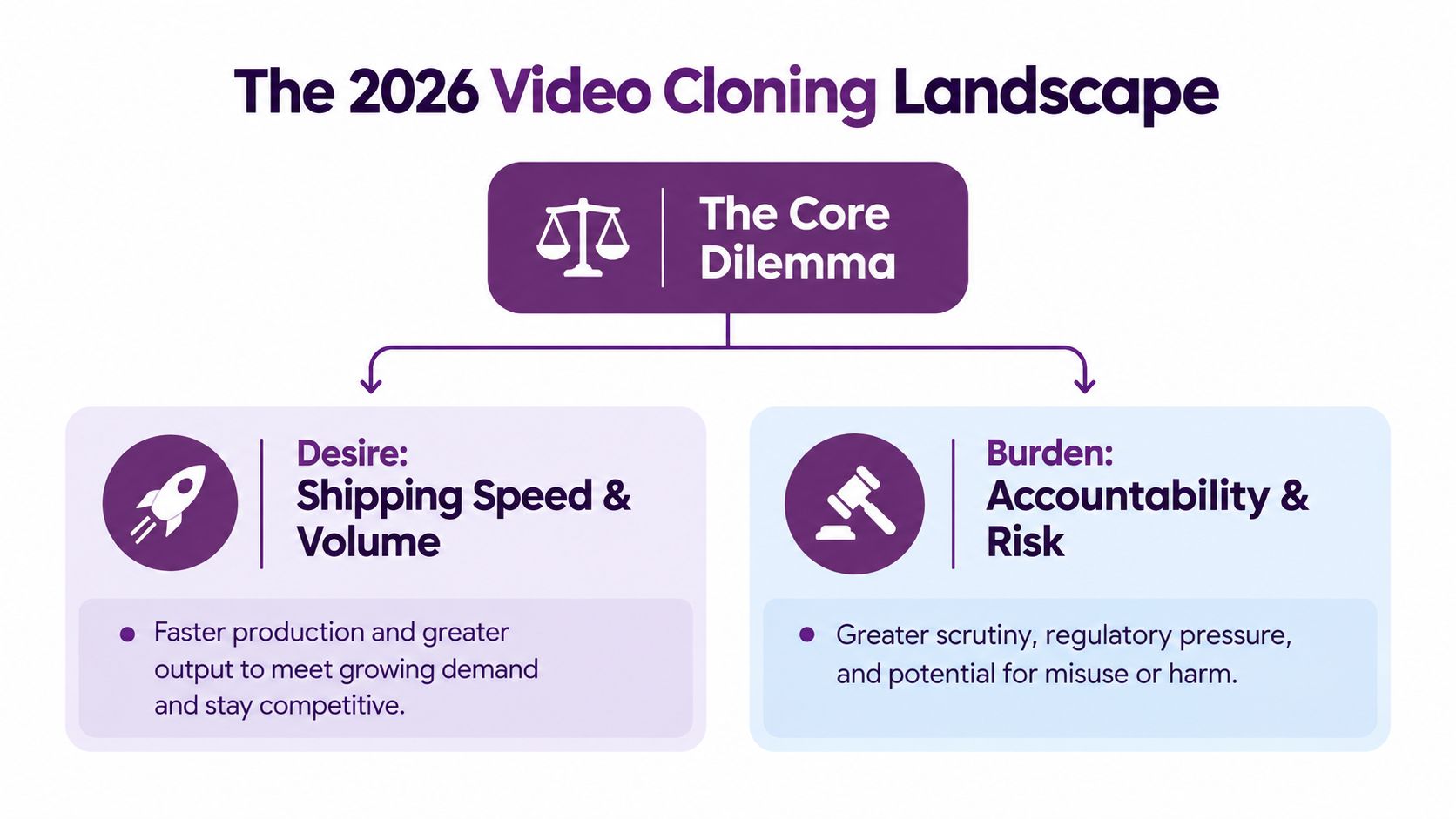
The 2026 Video Cloning Landscape at a Glance
The market split is simple. Teams want same-day output, but regulators, platforms, and audiences now expect proof that synthetic media is labeled, consented, and controllable. That tension is only getting sharper as the ecosystem scales. One industry summary says the deepfake detection market is projected to reach $15.7 billion by 2026 with roughly 42% annual growth, while another places the broader deepfake AI market at about $765 million in 2024 and projects $19.8 billion by 2033. A separate estimate says the deepfake video market crossed $1.67 billion in 2026 and is growing at a 36.2% CAGR through 2031, based on figures collected in this market roundup.
Three tiers buyers actually face
| Tier | Typical platforms | Best for | Main trade-off |
|---|---|---|---|
| Enterprise suites | Synthesia, HeyGen Enterprise, Colossyan | Larger teams with review chains and policy requirements | Less flexible for custom visual direction |
| Creator-focused platforms | HeyGen, Captions, VEED, Descript-style workflows | Fast social content, one-person teams, rapid iteration | Governance and audit controls are usually lighter |
| Open-source stacks | Wav2Lip, SadTalker, ComfyUI-based builds, custom pipelines | Teams with ML talent and strong internal control | Hidden maintenance burden, QA overhead, no turnkey accountability |
The novelty phase is over. Buyers now need repeatable publishing pipelines, not one-off renders.
Practical rule: If the tool can make a convincing avatar but can't show you how consent, approvals, and labeled exports work, it isn't production-ready.
Marketing teams fit one of three profiles. Marketing teams want volume. Training teams want consistency. Enterprise teams want traceability. If you're still in the browsing phase, LunaBloom AI sits in the conversation because this category has moved beyond toy avatars into full workflow design.
What matters more than the feature grid
A tool wins in real life when it handles:
- Predictable output: The avatar should stay stable across multiple renders, not just the landing-page sample.
- Review-friendly workflows: Your script, voice, captions, and final export should be easy to revise.
- Governance controls: Labeling, consent records, and content history need to exist before legal asks for them.
- Operational fit: A solo creator and a regulated enterprise should not buy the same stack.
That's the lens that matters. Not who has the slickest homepage.
What a Video Cloning App Actually Does
Mash three different jobs into one label and buyers get confused. A video cloning app can clone a voice, synthesize a face or avatar, and in some cases generate or manipulate a whole scene. Those are different production layers with different failure modes.
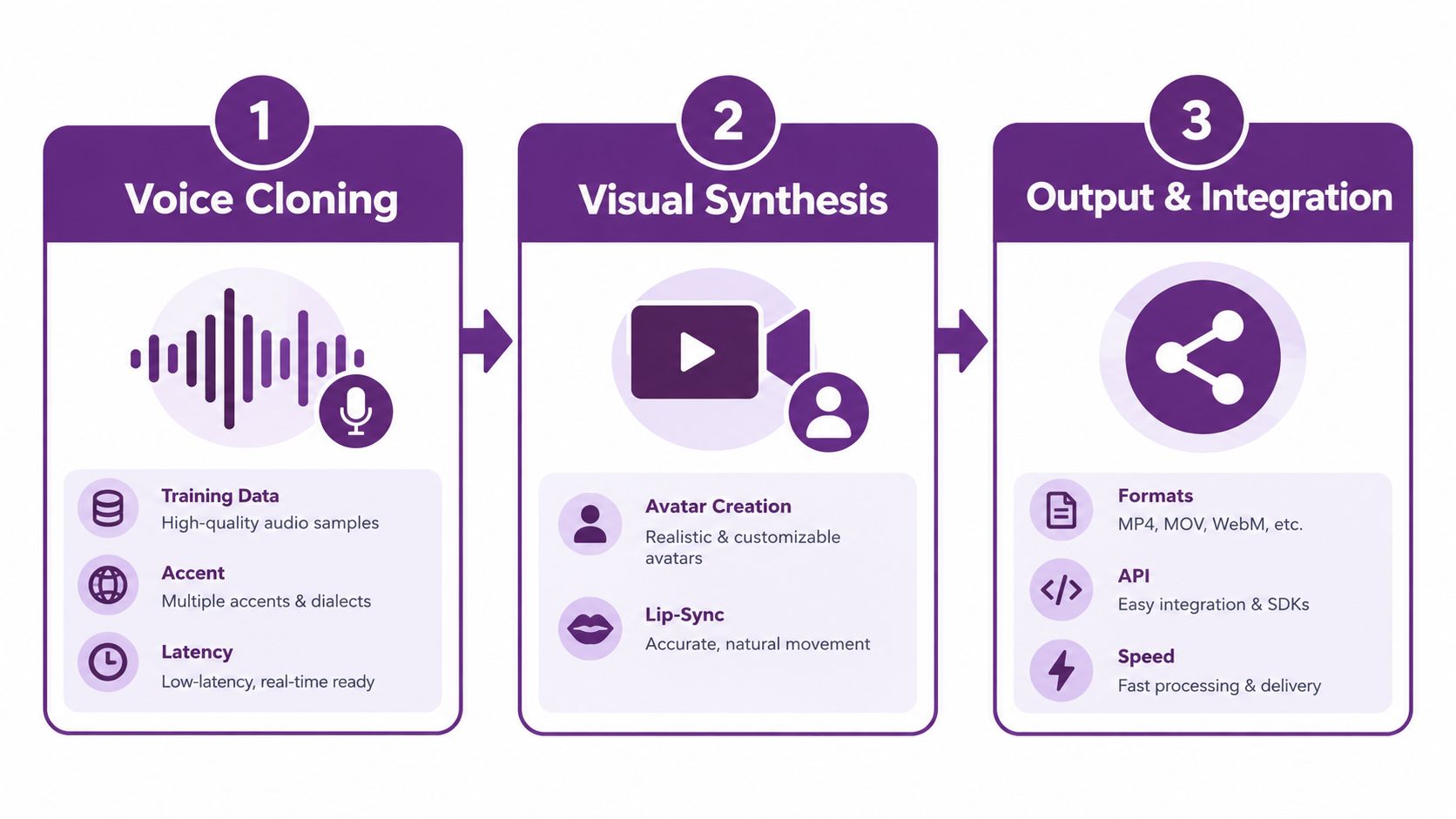
Layer one is voice cloning
This is the audio engine. It takes reference speech and generates new spoken lines in the target voice.
What you need to evaluate:
- Training input: Clean recordings beat noisy samples every time.
- Accent handling: Some tools flatten the speaker's identity when switching languages or dialects.
- Latency: Fast preview matters if your team scripts in iterations.
- Emotion control: Neutral reads are easy. Tension, warmth, urgency, laughter, or restraint are where weak models fall apart.
If you're trying to understand the simpler end of identity swapping before you evaluate full video systems, this guide on how to put different faces on pictures is useful context. Static image face replacement is a much easier problem than keeping a synthetic face believable over time in motion.
Layer two is face and avatar cloning
This is what most vendors showcase. A script goes in, and a speaking avatar comes out.
Watch for these details:
- Lip sync accuracy
- Head motion
- Eye-line behavior
- Skin consistency
- Background preservation
- Teeth and tongue artifacts on hard consonants
A good demo often hides weak edge cases. Long sentences, side angles, compressed uploads, and multilingual lines expose them fast.
Layer three is full-scene cloning
Things become expensive, messy, and far more production-sensitive. Full-body movement, multiple actors, camera changes, gesture continuity, and scene composition move the product from “presentation tool” to “synthetic production system.”
That shift changes the buying criteria. You're no longer judging only avatar fidelity. You're judging whether the app can support a repeatable render pipeline, export formats, publishing handoff, and team review. That's why a browser tool and a studio-grade system can look similar in a demo but behave very differently under deadline pressure. If you want to test a hands-on workflow instead of just watching marketing pages, the LunaBloom starter app shows the kind of end-to-end setup buyers should be evaluating.
Comparing the Top Video Cloning App Options
The fastest way to narrow the field is to stop asking which platform has the most features and start asking which one fails least often in your actual workflow. Week one tells the truth. Can your team write, render, revise, localize, approve, and publish without duct tape?
Video Cloning App Comparison 2026
| Platform | Avatar Fidelity | Voice Cloning | Languages | Integrations | Starting Price | Compliance Tools |
|---|---|---|---|---|---|---|
| Synthesia | Strong presenter-style avatars | Available, structured for business use | Broad multilingual support | LMS, enterprise workflow integrations | Custom and tiered plans | Stronger enterprise governance posture |
| HeyGen | Strong for marketing and creator use | Strong consumer-friendly voice features | Broad language support | API, marketing workflows | Subscription-based | Some compliance features, lighter than enterprise-first stacks |
| Colossyan | Good for training and learning content | Business-focused voice workflows | Multilingual | Learning and internal comms workflows | Tiered business pricing | Better fit for internal training governance |
| Descript | Less avatar-centric, stronger for edit-based workflows | Good voice tools for editing and overdub style tasks | Useful for common localization workflows | Editing stack integrations | Subscription-based | Better on editing than synthetic identity governance |
| Open-source stack | Highly variable | Highly variable | Depends on implementation | Fully custom | No single starting price | You build it yourself |
| LunaBloom AI | Supports photo-real, animated, and 3D avatar workflows with voice cloning and localization | Voice cloning built into a broader video workflow | Supports 50+ languages and regional accents | Collaboration, analytics, API integrations | Free pay-as-you-go trial plus subscription tiers | Includes workflow features relevant to consent and team operations via the LunaBloom app |
Where each category wins
Enterprise suites earn their keep when legal review, procurement, and internal stakeholders slow everything down. They usually have better role control, approvals, and documentation. The downside is creative rigidity. You may get safer outputs, but not always the most flexible production style.
Creator platforms win on speed. They're good for quick social videos, founder content, and campaign experimentation. If your team cares more about publishing cadence than policy architecture, they can be enough.
Open-source is the trap people romanticize. Yes, you can build exactly what you want. You also inherit model updates, breakage, QA, moderation design, and infrastructure headaches. That's fine if you already run an ML-heavy stack. It's foolish if your video team just needs to ship localized onboarding content every month.
Don't confuse “customizable” with “operationally cheaper.” Open-source often flips your software savings into labor and review costs.
My shortlist logic
Use this rule set:
- Choose enterprise-first if approvals and traceability matter more than design freedom.
- Choose creator-first if you need quick campaign throughput and can tolerate lighter controls.
- Choose open-source only if you have technical staff who can own it long term.
- Choose a balanced platform if you need strong output, multilingual production, and less pipeline assembly.
That last category is where most mid-market teams should look. Not because it's flashy. Because it's survivable.
Avatar and Voice Quality Explained
Vendor demos love vanity claims. Hours rendered. impressions generated. number of avatars. None of that tells you whether the output will survive three rounds of client review.
Researchers judge deepfake-style systems using accuracy, equal error rate, and AUC for evaluation, while generation quality is often measured with SSIM, LPIPS, FID, and FVD, according to this deepfake evaluation overview. In plain English, that means good systems need to hold up both frame by frame and across a full sequence.
Avatar and voice quality benchmarks that actually matter
| Metric | What it measures | Production target | Vendor claim to question |
|---|---|---|---|
| SSIM | Structural similarity to reference visuals | High enough to preserve facial structure and scene integrity | “Looks realistic” without side-by-side comparison |
| LPIPS | Perceptual similarity | Low perceptual distortion across expressions and lighting | “Human-like quality” with no stress test |
| FID | Distribution-level realism for generated imagery | Strong visual realism across many outputs, not one sample | Handpicked showcase reels |
| FVD | Video-level realism and temporal coherence | Stable identity and motion over full clips | Any demo shorter than your real deliverable |
| EER | Detection-related error balance | Lower error rates indicate more robust evaluation performance | Claims about “undetectable” output |
| AUC | Quality of discrimination in evaluation tasks | Stronger overall separation performance | Security or authenticity claims with no methodology |
| PSNR | Signal reconstruction quality | Guidance suggests above 30 dB is generally visually acceptable in this quality discussion | “HD quality” used as a stand-in for realism |
| Mask-SSIM | Artifact-sensitive similarity in masked regions | Higher scores indicate fewer visible artifacts in critical regions | Close-up face demos with no motion variation |
The QA test I'd run before buying
Use three scripts.
Neutral narrator read
Checks pacing, breath, and baseline naturalness.Emotionally loaded line
Exposes whether the model breaks under stress, urgency, softness, or emphasis.Multilingual line
Reveals accent drift, lip mismatch, and prosody collapse.
Then score each platform on:
- Naturalness across takes
- Consistency after revisions
- Compression resilience after export
- Failure rate on long sentences
- Approval readiness without manual cleanup
A one-minute clean sample can impress anyone. A six-video approval cycle exposes the truth.
I care more about re-record rate than homepage polish. If a voice sounds good once but falls apart when the copy changes, that app is costing you time.
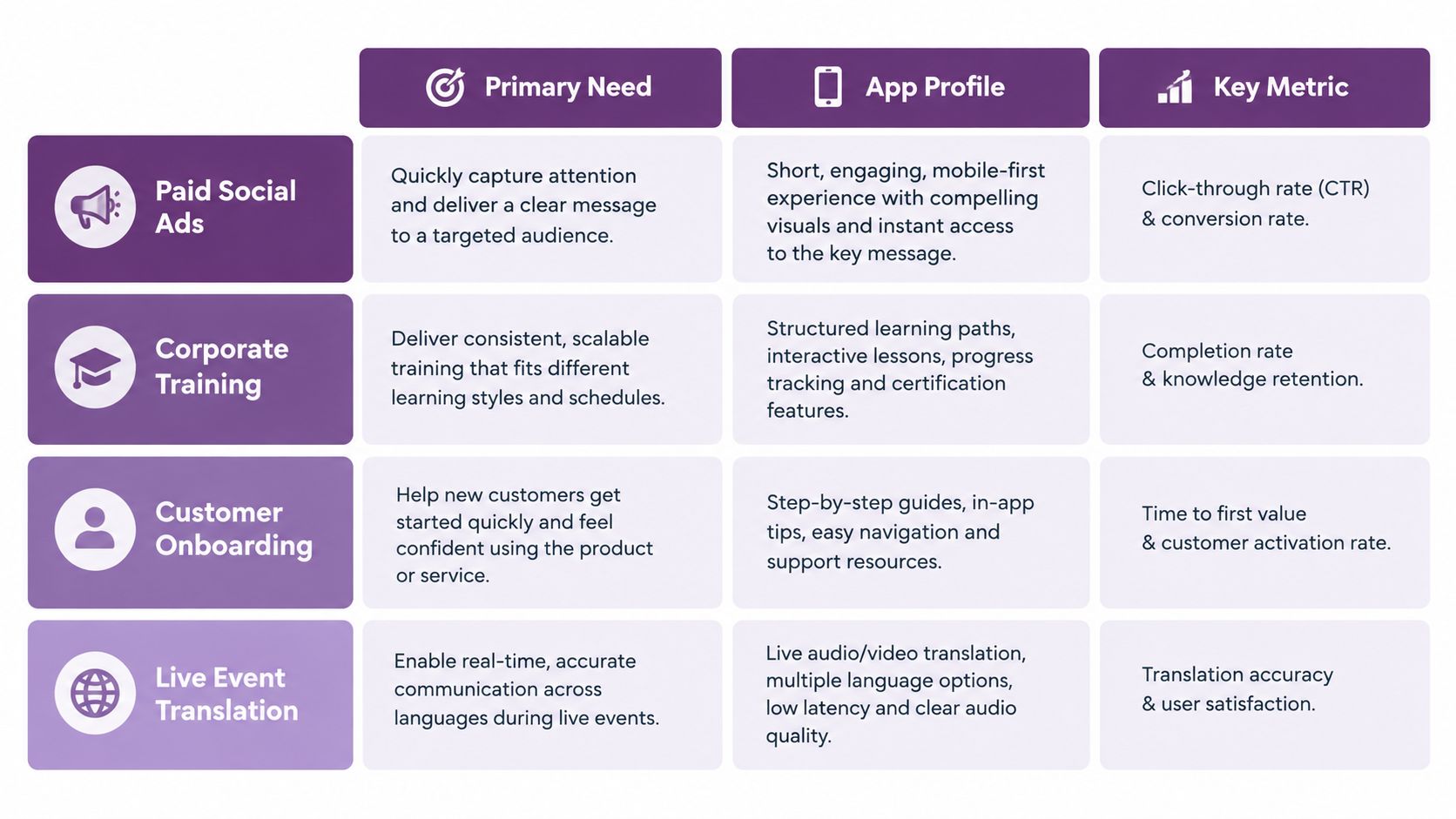
Matching a Video Cloning App to Your Use Case
Buyers get into trouble when they choose a tool by category hype instead of by production pattern. The right video cloning app for paid social is often the wrong one for training or localization.
Paid social ads
This team usually needs speed, batch output, and enough quality to stop the scroll. Perfect realism matters less than turnaround.
Non-negotiables:
- Batch rendering
- Quick script swaps
- Caption styling
- Aspect-ratio flexibility
Approval is usually light. A marketer and maybe a creative lead can run it. Don't overbuy governance if your content shelf life is short and the identity risk is low.
Product demos and SaaS walkthroughs
Many avatar-first tools feel clumsy. Product demo teams need screen capture integration, revision control, and tight script versioning. The avatar is secondary. Clarity wins.
A good fit here has:
- screen-recording support
- easy voice updates
- chaptered edits
- clean export for help centers and sales teams
A specialist screen-demo tool can beat a glamorous cloning platform in this scenario.
Internal training and enablement
Training libraries punish inconsistency. If one module sounds stiff, one avatar drifts, and one lesson uses different pronunciation, the whole system feels amateur.
What matters most:
- Stable anchor avatar
- Reliable voice control
- Template standardization
- Version history
- Repeatable review workflow
A more structured platform makes sense. You're building a catalog, not a one-off asset.
Global localization at scale
This is the hardest use case and the one buyers most often underestimate. Once you localize into many markets, lip sync, dialect handling, subtitle accuracy, and publishing rules all become operational issues. Based on the publisher capabilities, LunaBloom AI fits this profile because it combines cloning, localization across 50+ languages and regional accents, and team workflow features in one system. It also fits training teams that need a controlled anchor voice and repeatable updates. A dubbing-first specialist is still smarter if your entire workflow revolves around voice replacement into existing live-action footage and little else.
A fast matching framework
- Ads team with no engineer: pick a lightweight browser-first tool.
- Demo-heavy SaaS team: pick editing and screen integration over avatar theatrics.
- Training team with recurring modules: pick consistency and approvals.
- Localization team shipping across markets: pick multilingual control and publishing discipline.
The wrong match creates hidden work. The right one disappears into the routine.
Why Faster Cloning Is Not Always Better
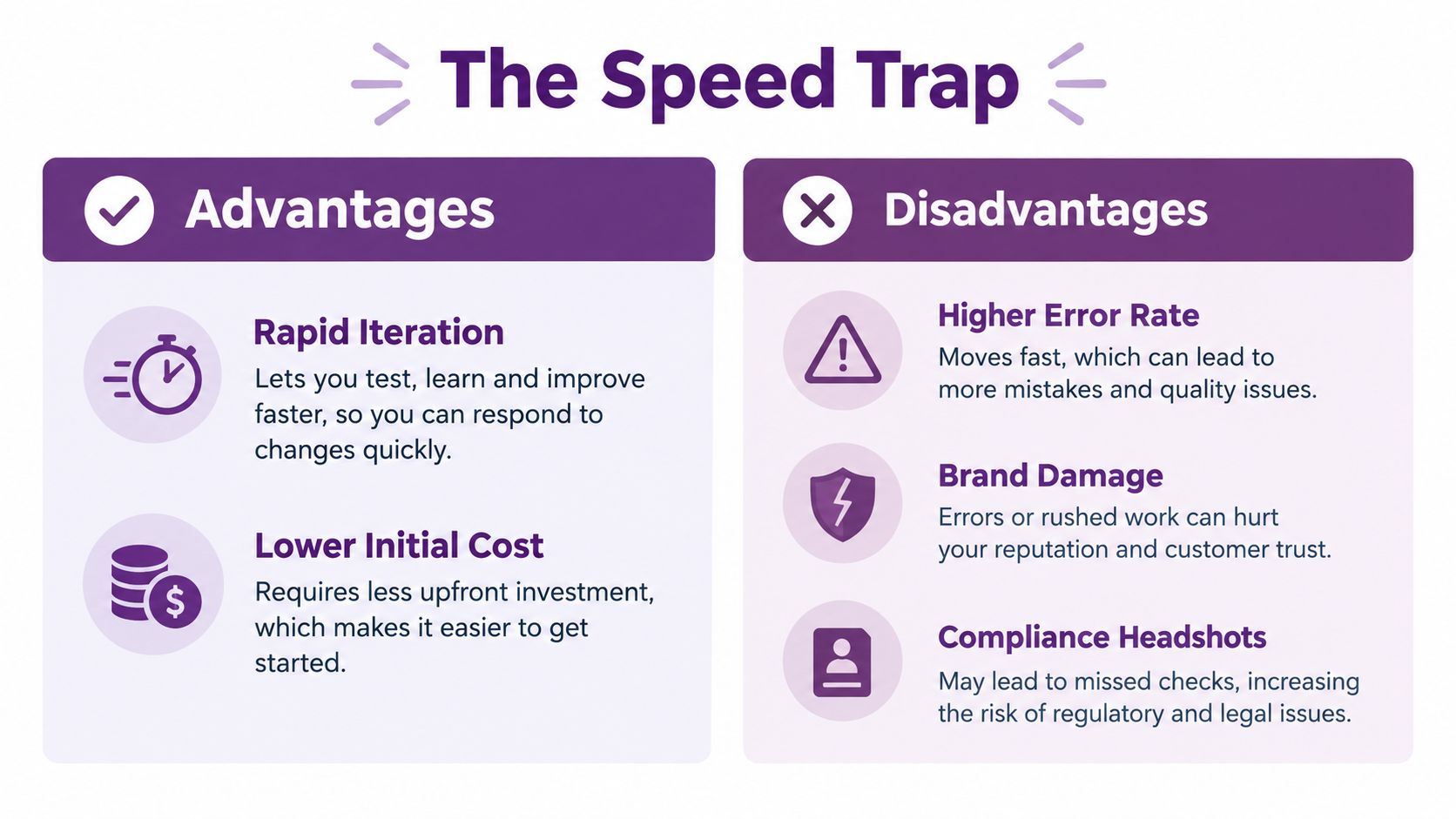
The sales pitch is always speed. Faster render. faster turnaround. faster publishing. Fine. But speed without controls is where synthetic media starts charging interest.
One deepfake-focused report says a convincing 60-second deepfake can be produced in under 25 minutes at low cost, and a TIME-reported safeguard bypass was said to happen within 24 hours, as summarized in this deepfake risk guide. That should kill the lazy assumption that “fast” equals “safe enough.”
Three failure modes I see constantly
- Identity drift over long outputs: The avatar subtly changes across a longer video. Jawline, age, skin rendering, eye behavior. Then the team notices it after review and has to rerender or reshoot.
- Voice artifacts under emotional load: Neutral lines sound clean. Add urgency, sarcasm, a whisper, or a laugh, and the model exposes itself.
- Moderation gaps: A platform optimized for throughput often skimps on watermarking, provenance handling, and reporting tools.
The real buying priority
Buy speed after you've locked down:
- consent capture
- labeling behavior
- audit history
- takedown workflow
- export consistency
Fast generation is useful. Fast correction, safe publishing, and documented accountability are more useful.
The toy mindset is “Can it render quickly?” The operator mindset is “Can my team trust the output enough to publish it repeatedly?”
Compliance and Consent Checklist for 2026
This part isn't optional anymore. If your video cloning app produces synthetic faces, voices, or scenes, your workflow now sits inside a compliance problem as much as a creative one.
The EU AI Act applies from 2 August 2026 and requires AI systems generating audio, image, video, or text to mark synthetic output in a machine-readable format, according to this summary of the 2026 deepfake labeling rule. In the U.S., the Take It Down Act requires covered platforms to maintain a notice-and-takedown process by May 19, 2026 and remove valid reported content within 48 hours, based on this legal overview of deepfake laws. India's amended IT rules took effect on 20 February 2026, and China's courts have also clarified that recognizable digital replicas cannot be created or distributed without consent, as noted in this review of 2026 deepfake regulation updates.
The four checks every team should run
Identity-verified consent capture
Voice cloning without explicit permission is treated as unlawful or highly restricted in many jurisdictions, and GDPR treatment can be especially strict when voice data is used to identify a person, according to this voice cloning consent law explainer.
Your vendor should capture:
- Who consented
- What was approved
- Which purpose was approved
- How long the permission lasts
- Whether training or future reuse is allowed
Retention and data handling
Ask direct questions about biometric handling and deletion. If the vendor gets fuzzy, walk.
Request evidence such as:
- timestamped consent receipts
- opt-out handling for training data
- deletion workflow documentation
- access logs for internal users
Disclosure and labeling
Synthetic output should be visibly labeled where needed and machine-readable where required. This isn't a nice-to-have. It's part of product design now.
If your team also wants a practical way to review suspicious audio before publication, this guide on how to spot AI fakes in audio is worth keeping in your internal review docs.
Takedown readiness
A platform needs more than an abuse email inbox. It needs a documented reporting channel, a triage process, and a way to remove known copies when applicable.
For buyers who care about policy posture and data handling details, the LunaBloom privacy page is the sort of documentation you should expect vendors to make easy to inspect.
Red flags that should disqualify a vendor
- No consent receipt trail
- No explanation of synthetic labeling
- No takedown workflow
- No answer on data retention
- No region-specific policy controls
- Terms of service used as a substitute for explicit cloning permission
If a vendor treats compliance like a support article problem, not a product workflow problem, move on.
Choosing the Right Video Cloning App for Your Team
The right buying framework is team-based, not feature-based.
Three buyer profiles
Solo creators and small studios should favor browser-first tools that help them script, render, and publish quickly. They don't need heavy orchestration. They need reliability and enough control to avoid embarrassing artifacts.
In-house marketing teams need a more disciplined stack. Batch rendering, brand kits, approvals, localization support, and SSO start to matter because multiple people touch the workflow. That's where lightweight creator tools often start to creak.
Regulated enterprises should buy for auditability first. Consent infrastructure, access control, documented labeling, and takedown readiness aren't overhead. They're the whole point.
If you want a broader category scan beyond cloning-specific tools, this roundup of best AI video tools for 2026 is a decent companion list because it helps separate all-purpose video generators from cloning-centric platforms.
My blunt recommendation
Pick the lightest system that can still survive your review process.
Use a specialist dubbing tool when your core job is replacing or localizing voice tracks inside existing footage. Use a motion-capture or production studio when physical performance and scene direction matter more than speed. Use a workflow-oriented synthetic video platform when your team needs recurring output, version control, multilingual publishing, and fewer moving parts. If you're comparing teams, procurement posture, and operating model, the LunaBloom about page gives the kind of company context enterprise buyers usually want before they shortlist a vendor.
The mistake is buying aspiration. Buy fit.
LunaBloom AI gives teams a practical way to turn scripts, images, and prompts into finished synthetic video with avatars, voice cloning, localization, captions, and publishing workflows in one place. If your team needs a video cloning app that works beyond the demo and holds up in repeat production, take a look at LunaBloom AI.