You've been handed a familiar assignment: “We need an animated explainer video.” The product team has a complicated feature to explain, sales wants a leave-behind, marketing wants a stronger landing page, and nobody has agreed on the budget, approval process, or even the one thing viewers should remember.
That uncertainty is where expensive video projects go wrong. Buyers choose a reel instead of a production partner, approve a script that tries to explain everything, then discover that every late change affects the storyboard, voiceover, animation, and delivery schedule.
An animated explainer video company can solve that problem, but only if you hire one for the right reason. The key decision is often build versus buy: should a studio develop a bespoke narrative, should your team use an AI video generator for speed and volume, or should you combine both?
When You Actually Need an Explainer Video
An explainer video earns its place when understanding is blocking an action. That action might be signing up, booking a demo, completing onboarding, adopting a feature, or approving a purchase. If your audience already understands the product and only needs proof, a product demo, testimonial, or short screen recording may do more work.
Common triggers include:
- A new product launch: Your audience needs the problem, solution, and differentiator in one controlled narrative.
- An onboarding bottleneck: Customers repeatedly ask the same “how does this work?” question.
- A weak landing page: Visitors encounter dense copy before they understand the product's value.
- A sales enablement gap: Reps need a consistent follow-up asset after a meeting.
- An abstract product: APIs, AI workflows, infrastructure, and technical services are difficult to show with live footage.
Video adoption makes the format worth considering. A 2025 survey summarized from Wyzowl's video-marketing research found that 89% of businesses used video as a marketing tool and 95% of marketers considered video an important component of their strategy. The same survey reported that 98% of consumers had watched an explainer video to learn more about a product or service, while 87% said a marketing video had persuaded them to make a purchase. These are survey results, not guarantees, but they show that buyers already understand the format and that businesses use it across education, discovery, sales, and conversion. (Wyzowl video data)
Run the five-minute self-audit
Before contacting an animated explainer video company, answer these questions in writing:
- What decision should the viewer make immediately after watching?
- What does the viewer misunderstand today?
- Where will the video appear, and what will surround it?
- What proof can you show, rather than merely claim?
- How will you know the video worked?
If you can't answer the first two, don't commission animation yet. Fix the positioning or script first. If the project needs frequent updates, market-specific versions, or internal training modules, a reusable production system may matter more than a single polished asset.
Producer's rule: If the brief contains three primary audiences or three conversion goals, it isn't ready. Pick one audience and one job for the video.
The next decision is practical. A traditional studio gives you strategic collaboration, custom visual development, and controlled production. An AI video generator gives you rapid drafting, variation, and repeatability. The right choice depends on the cost of being wrong, the amount of customization required, and how often the content will change.
Animated Explainer Video Company vs an AI Video Generator
A traditional animated explainer video company is a good buy when the message is high-stakes, the product is difficult to simplify, or the brand needs a distinctive visual language. An AI video generator is usually the better build path when you need many versions, quick tests, localized edits, or frequent updates.
Judge the options across five dimensions:
| Dimension | Studio animated explainer video company | AI video generator | Best fit signal |
|---|---|---|---|
| Creative control | Bespoke script, storyboard, illustration, character design, and motion | Prompt-driven or template-assisted creation with automated editing | Choose a studio when visual originality carries strategic weight |
| Speed to publish | Deliberate approvals and production handoffs | Rapid drafting, versioning, and iteration | Choose AI when timing and volume dominate |
| Unit cost | Higher production commitment for a custom asset | Lower friction for repeated content, depending on usage and review needs | Choose based on total content demand, not one video |
| Governance risk | Human-led review can scrutinize claims, rights, and sensitive content | Requires explicit controls for generated voices, avatars, scenes, and source material | Choose a studio for regulated or reputation-sensitive work |
| Brand consistency | Art direction and production team manage the visual system | Templates, brand assets, and version controls can support repeatability | Choose the workflow your team can govern consistently |
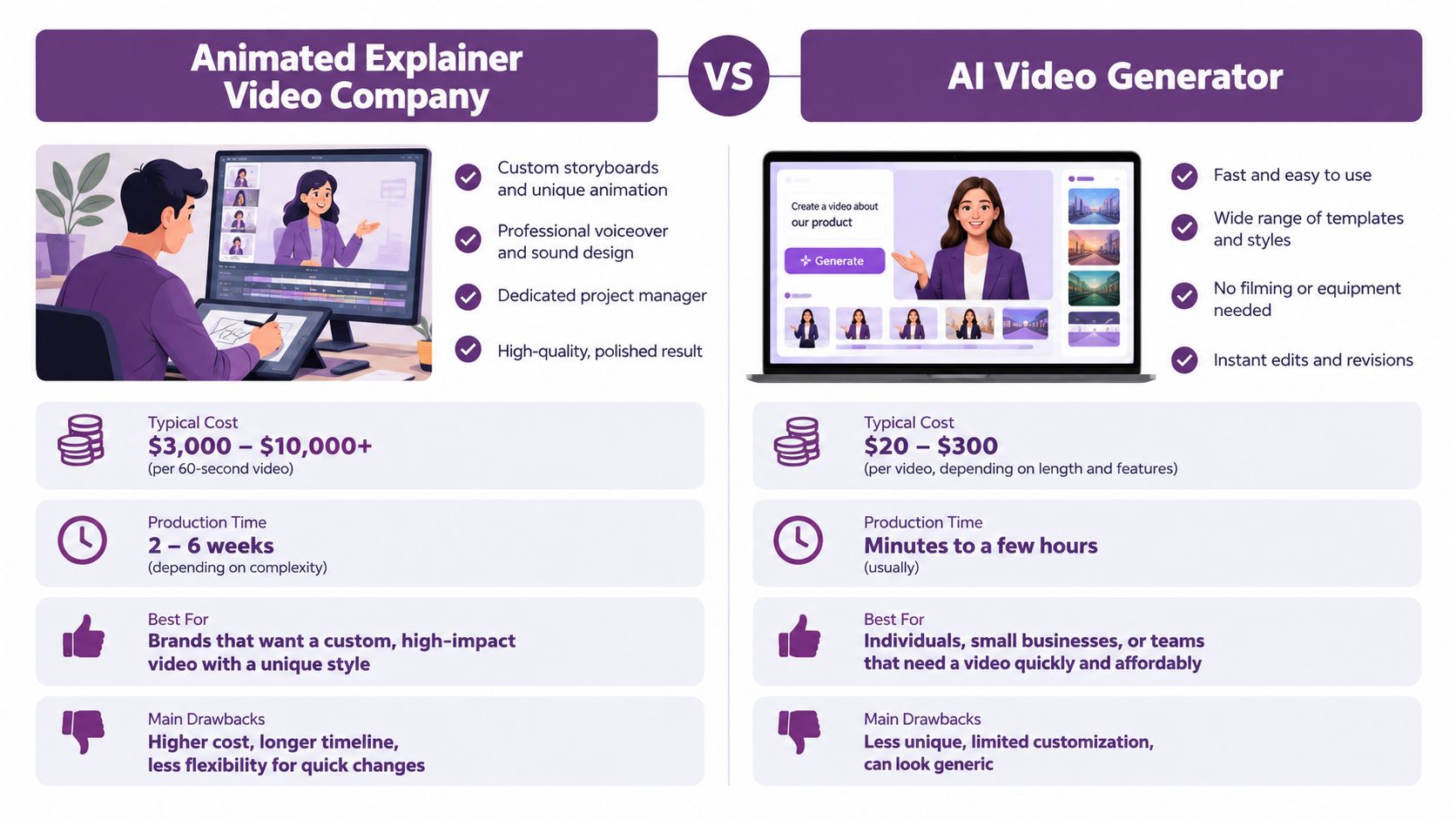
A hybrid model often makes sense. Commission the core narrative, brand world, and flagship explainer from a studio. Use an AI workflow for feature updates, internal training clips, social cutdowns, or localized variants. That approach separates creative foundation from content throughput.
If scripting is the bottleneck, use a dedicated planning resource such as Trendy's script generator guide to pressure-test hooks, structure, and scene ideas before production. Treat generated copy as a draft. A product expert still needs to verify terminology, claims, and the promised outcome.
For teams evaluating an AI-first workflow, LunaBloom AI's video workspace represents the type of tool that can turn scripts and visual inputs into edited videos with voiceovers and captions. The important question isn't whether the tool can produce a video. It's whether your team can review, approve, version, and measure the output without lowering trust.
Hire an animated explainer video company even when AI tools are available if:
- The claim could create legal or regulatory exposure.
- The video includes customer proof, testimonials, or sensitive product demonstrations.
- The brand needs a genuinely custom visual identity.
- The audience needs careful explanation rather than visual novelty.
- Stakeholders need a partner to challenge the message, not just execute it.
Selection Criteria That Actually Predict a Good Fit
A polished reel proves that a vendor can make polished work. It doesn't prove that the vendor can explain your product. Score candidates against the production decisions that affect comprehension, rights, accessibility, and revision cost.
Use this buyer's decision matrix
| Criterion | Must-have question | Nice-to-have signal |
|---|---|---|
| Relevant portfolio | Have they explained products with similar complexity and audience expectations? | They've worked in your category |
| Script discipline | Who owns the narrative, and how do they test whether one message is clear? | They challenge unnecessary claims |
| Storyboarding | Do you approve the visual plan before full animation begins? | Scenes include narration, action, and intent |
| Style range | Can they adapt the style to your audience rather than force a house look? | They can combine motion graphics, characters, UI, or diagrams |
| Voice and music rights | Do you receive documented rights for the selected voice and music? | They offer casting options and reusable licensing |
| Accessibility | Are captions, contrast, readable text, and audio-description needs considered by default? | They provide caption files and accessibility QA |
| Technical delivery | Which formats, dimensions, audio files, and project assets are included? | They provide organized masters and editable elements |
| Ownership and support | Who owns the final work, source files, and derivative versions? | The contract defines post-launch revisions clearly |
A concise video often beats an overloaded one. Wistia's analysis of a large sample of videos hosted on its platform found average engagement drop-off of 4.9% for videos lasting 1–2 minutes, compared with 17.3% for videos lasting 5–10 minutes. That supports tight editing, but it doesn't mean every short video wins. A weak first scene remains weak at any length. (Wistia audience-retention analysis)
Ask what happens when the project gets difficult
The strongest vendors can describe how they handle a disputed claim, a late stakeholder, a departing animator, or a localization request. Ask whether they maintain version control across markets and how they prevent an approved message from being changed accidentally in a later cut.
Also inspect the production team, not just the agency logo. If you're comparing creative partners with broader distributed support, research providers such as remote staffing companies can help you understand how teams structure remote expertise, although staffing support isn't a substitute for creative direction.
Use a simple scorecard:
- Must-haves: Script ownership, storyboard approval, rights documentation, accessibility plan, clear scope, and a named production lead.
- Strong preferences: Industry experience, localization capability, reusable design systems, and analytics support.
- Optional extras: Original music, advanced 3D work, character systems, or live-action integration.
For a closer view of how a platform documents its product and team context, see LunaBloom AI's company information. Don't select a vendor because it has the longest portfolio. Select the team that asks the sharpest questions before drawing the first frame.
Your Brief Template and Sample Vendor Questions
A useful video brief fits on a page. If it needs a long presentation to explain the project, the message probably isn't settled.
Copy this brief scaffold
- Objective: State the action the viewer should take.
- Audience: Identify the primary viewer, their knowledge level, and their immediate problem.
- Single takeaway: Write the one sentence the viewer should remember.
- Proof points: List evidence, product capabilities, customer facts, or demonstrations that support the takeaway.
- Tone: Define whether the video should feel technical, reassuring, energetic, practical, or authoritative.
- Visual direction: Add two or three style references and explain what you like about each.
- Deliverables: Specify the master video, cutdowns, caption files, audio stems, thumbnails, and source assets.
- Distribution: Name the landing page, sales deck, onboarding flow, social channels, or learning platform.
- Deadline: Separate the launch date from internal review dates.
- Budget range: State what has been approved and what would require a decision.
The script should use segmentation, with each scene carrying one logically complete idea. Instructional-animation research finds that segmentation and cueing improve comprehension and transfer from complex dynamic visualizations, while controlled studies show that adding relevant but nonessential animation can reduce recall and increase perceived mental workload. (Research on instructional animation)
Storyboard test: If an animated element doesn't explain the narration, direct attention, show a relationship, or reinforce the action, remove it.
Ask these questions on the first vendor call
- What part of the script will you write, edit, or challenge?
- How many formal review rounds are included, and what counts as a revision?
- What happens if a stakeholder changes the approved message?
- How do you review regulated, technical, or sensitive claims?
- Who owns the voiceover and music rights after delivery?
- Can you document consent for a cloned voice, likeness, or customer testimonial?
- What happens if the lead animator becomes unavailable?
- How do you create and QA localized versions?
- Which source files and editable assets will we receive?
- What will you measure after launch, and how will you connect it to business events?
Run a paid pilot before signing a multi-video contract. Give the vendor one contained use case, a defined audience, and a real approval path. You'll learn more from how they handle ambiguity, feedback, and a difficult claim than from another portfolio presentation.
Pricing and Timeline Benchmarks You Can Use
There's no responsible universal price for an animated explainer video. A quote reflects the production system behind the video, not only its final runtime. A short custom character animation can require more design and approval work than a longer motion-graphics piece built from an established visual system.
Read the quote by its cost drivers
The main variables are:
- Animation style: Motion graphics, 2D characters, whiteboard animation, and 3D production require different design and animation workflows.
- Script ownership: A vendor that researches, interviews experts, and rewrites the narrative is doing strategic work.
- Custom illustration: Original characters, environments, interfaces, and diagrams add design time.
- Voiceover: Casting, direction, recording, usage rights, and retakes should be itemized.
- Music and sound: Licensing, original composition, sound design, and mix revisions affect scope.
- Revision rounds: Unlimited revisions sound attractive but often conceal an undefined approval process.
- Localization: Translation, native-speaker review, retiming, graphics changes, dubbing, captions, and market-specific claims all add work.
- Delivery package: Captions, audio stems, aspect-ratio versions, thumbnails, editable assets, and project files shouldn't be assumed.
A sensible milestone structure is kickoff and discovery, script approval, storyboard and visual approval, voiceover and animation, then review and final delivery. The project usually stalls at approval points, especially when several stakeholders give conflicting feedback. Put one person in charge of consolidated comments, and make approval dates part of the contract.
Value should be discussed in business terms, not vague promises. Industry survey data reports that 93% of video marketers say video increases product or service understanding, 85% say it generates leads, 83% say it directly increases sales, and 82% say it keeps website visitors longer. These are marketer-reported outcomes, not controlled causal estimates, so use them as context rather than a forecast for your project. (Wyzowl video-marketing statistics)
Build a quote comparison sheet with columns for included deliverables, revision limits, rights, timeline assumptions, localization, and post-launch support. A low initial quote can become expensive if every necessary asset is treated as an add-on. A higher quote may be efficient if it includes the approvals and source files your team needs.
For a transparent view of one platform's available plans and packaging, review LunaBloom AI pricing. Compare the workflow, not only the headline fee. The relevant question is how much it costs to reach an approved, usable, measurable asset.
Red Flags and Governance Gaps to Watch For
A vendor can deliver attractive animation and still expose your business to avoidable risk. Treat governance as a buyer-side risk register. Ask each question directly, then record the answer in the proposal or contract.
Contract and production warnings
- Vague pricing: Which work is included, and what triggers a change order?
- Unlimited revisions: Does that mean unlimited consolidated feedback, or an open-ended production commitment?
- Unclear ownership: Do you receive the final export only, or also source files, project assets, and derivative rights?
- Missing voice rights: Can the voice be reused, edited, localized, or used in future campaigns?
- No likeness terms: Who consented to an avatar, face, or cloned performance, and for which uses?
- No accessibility defaults: Are captions, contrast, readable text, and audio-description requirements built into the workflow?
- No data policy: How are scripts, product screenshots, customer information, and uploaded media handled?
- Single-person dependency: What happens if the lead animator, editor, or producer leaves during production?
AI adds another layer. If a synthetic voice, avatar, or generated scene appears realistic, viewers may reasonably want to know what they're seeing. A 2025 global consumer survey of 2,385 respondents found that 59.5% preferred an explicit label or icon inside AI-generated video. Independent reporting on Wistia's 2025 data indicates AI use for video creation rose from 18% in 2024 to 41% in 2025, making disclosure and provenance procurement questions rather than niche concerns. (2025 AI Video Report)
Build a practical approval policy
Require human review for testimonials, performance claims, medical or financial information, customer evidence, and any statement that could be interpreted as a guarantee. Keep a provenance record showing the source of the script, voice permission, likeness consent, approved claims, and final sign-off.
Disclose synthetic elements in language your audience can understand. Don't hide an AI-generated presenter behind realistic production design when authenticity is part of the message. Trust isn't a decorative compliance layer. It affects whether viewers believe the speaker, the demonstration, and the promise.
Use LunaBloom AI's privacy information as a reference point when reviewing how an AI production platform describes data handling. Your procurement checklist should still ask platform-specific questions about retention, training use, access controls, deletion, and client ownership.
Delivery, Quality Checks, and Measuring Real Results
Don't approve the video because it looks finished. Approve it when the message, rights, accessibility, technical package, and measurement plan are finished.
Before sign-off, verify:
- Master files: Confirm required resolution, aspect ratios, codecs, and platform versions.
- Caption assets: Request caption files, burned-in captions where needed, and a transcript.
- Audio package: Collect the final mix, voiceover-only track, music track, and stems when included.
- Brand presentation: Check color, typography, logo use, safe areas, thumbnail variants, and metadata.
- Rights record: Store voice, music, stock, likeness, and customer-consent documentation.
- Comprehension: Ask representative viewers what problem the product solves and what action they'd take after watching.
Measure the complete funnel, not views alone. Track qualified view-through rate, scene-level retention, click-through rate, lead completion, assisted conversion, and post-view comprehension. Connect those events to your website or CRM, preserve the same offer and traffic conditions where possible, and compare the version with video against a suitable baseline.
For multilingual releases, use native-speaker review, a terminology glossary, subtitle safe-area checks, regional accent review, audio-description assessment, and market-specific claims approval. Translation is a production change, not a button.
A contained pilot gives your team evidence before it commits to a larger content program. Use LunaBloom AI's starter workspace if you want to test an AI-assisted production workflow, but apply the same script, governance, accessibility, and measurement standards you'd require from a traditional animated explainer video company.
LunaBloom AI turns scripts, prompts, and images into edited videos with voiceovers, captions, avatars, localization, and publishing tools for explainers, demos, training, and internal communications. Share this brief with your stakeholders, define one pilot, and visit LunaBloom AI to test whether an AI workflow fits your production volume and governance requirements.