A familiar song can be a terrible first choice for Synthesia. The problem isn't necessarily your willingness to practice. A piano sight-reading study found that tempo and musical complexity significantly affect how far ahead pianists can process the music, which makes a crowded, fast-moving arrangement a poor starting point for an inexperienced player (Psychology of Music).
That doesn't prove most beginners quit because they chose the wrong song. It does give you a better starting principle: choose the arrangement you can follow, not just the title you recognize.
Synthesia makes repeated patterns visible. Speed control gives you room to coordinate movements, hand separation lets you untangle accompaniment from melody, and looping helps you rehearse a troublesome transition without restarting the whole piece.
- Starting from scratch: Choose Ode to Joy or Twinkle, Twinkle, Little Star.
- Connecting both hands: Try a simplified Canon in D or Minuet in G major.
- Developing control: Work toward Für Elise, Gymnopédie No. 1, or Turkish March at an appropriate difficulty.
- Playing recognizable pop: Choose a melody-and-chords arrangement of Let It Be.
The best songs for Synthesia give you a clear musical milestone. Match your first pick to what your hands can manage today, then judge progress by steady playing and relaxed movement, not by how impressive the falling-note display looks.
1. Ode to Joy (Beethoven, Symphony No. 9)
Best for learning to follow repeated notes without losing your place. Beethoven's melody offers a useful combination of neighboring notes, repeated pitches, and recognizable phrases.
Choose a melody-only arrangement first. In Synthesia, repeated notes appear in the same vertical lane, so the challenge isn't finding a new key. It's releasing and pressing that key again at the right moment.
Synthesia's feature overview confirms support for imported MIDI and MusicXML, falling-note and sheet-music displays, and feedback through a connected keyboard. That flexibility helps, but it doesn't guarantee that a downloaded arrangement has sensible fingering or a playable accompaniment.
Make the repeated notes sound separate
Keep your hand comfortably positioned over the opening notes. Watch the gaps between falling bars, and listen for distinct attacks rather than holding the key through a repeated-note passage.
- Melody first: Practice the right hand until you can finish a phrase without hunting for keys.
- Accompaniment second: In a simplified C-major version, add a quiet left-hand chord where the arrangement calls for it.
- Tempo last: Raise the speed only when your releases stay clean and your hand remains relaxed.
Say you're preparing a short demonstration for a beginner. Show the melody alone, then repeat it with accompaniment so the added coordination is obvious.
This comparison illustrates the different information available in the visual and notation approaches.
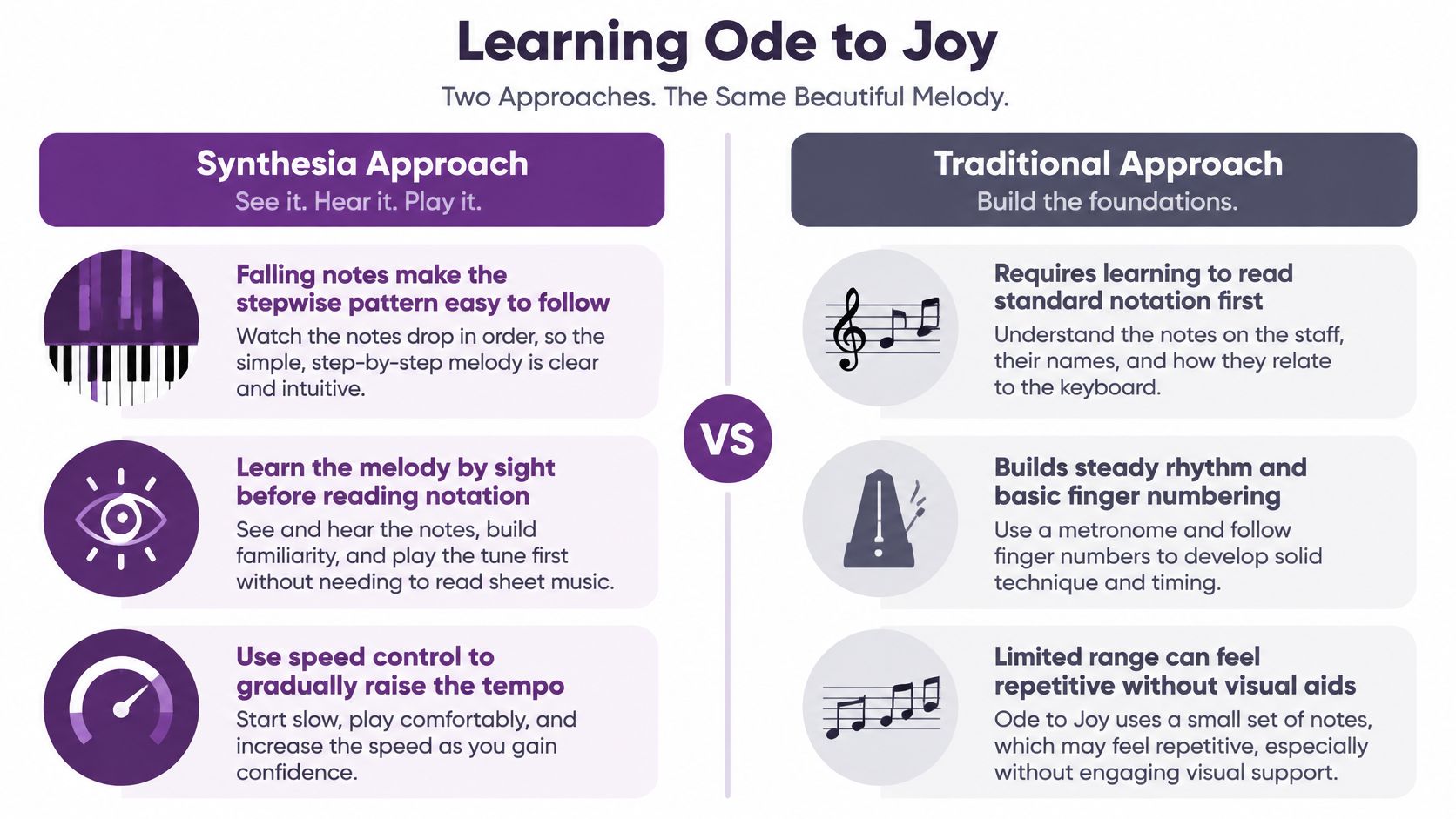
For a teaching resource published through LunaBloom AI, keep the actual keyboard demonstration central. Decorative visuals shouldn't obscure the notes students need to follow.
2. Twinkle, Twinkle, Little Star
A learner who already knows this melody can concentrate on matching sound to movement. Twinkle, Twinkle, Little Star is especially useful for learning to anticipate a phrase instead of reacting to every falling bar.
Use a plain melody arrangement with consistent rhythm. An embellished version with flowing accompaniment defeats the purpose, even if its title includes the word easy.
For a child learning with a parent, begin by singing the phrase away from the keyboard. Then play it slowly while counting aloud, keeping the counting audible even during longer notes.
Slow enough to understand, not to forget the tune
A piano sight-reading curriculum recommends starting around 40–60 BPM with short excerpts of 4–8 bars, then moving toward 60–80 BPM once playing remains uninterrupted (Transilvania University of Brașov curriculum). Treat those as a practice framework, not a required tempo for every arrangement.
Don't automatically choose the slowest possible playback. If the melody becomes difficult to recognize, use a more natural pulse and shorten the passage instead.
Teaching cue: Sing the next note before you play it. The screen should confirm what you expect, not supply every musical decision.
Add accompaniment only after the melody feels secure. A simple left-hand chord on the first and third beats can work in a suitable common-time arrangement, but don't add it while the learner is still searching for melody notes.
Keep the practice setup comfortable and the keyboard easy to see.

Parents using this publisher's educational content can find background on the About page. For home practice, a clear count-in and an unobstructed keyboard view matter more than elaborate presentation.
3. Für Elise (Beethoven)
The opening of Für Elise and the complete piece aren't the same difficulty. A learner may manage the recognizable opening while finding the contrasting passages far beyond their current coordination.
Choose an opening-theme arrangement if you're moving beyond beginner melodies. Choose the complete score only when you can manage its changes in texture and movement without tightening your hands.
The keyboard and score should remain part of the practice setup, even when falling notes provide the immediate guide.
Loop the connection, not just the difficult notes
Practice the opening motif with the right hand alone. Separately, learn the left-hand figure slowly enough to prepare each position before playing it.
Then place your loop around the handoff between phrases. Include the approach to the awkward movement and the notes that follow it. A loop containing only the difficult cluster can produce a passage you can play in isolation but can't enter during a performance.
- Choose fingering early: Compare published editions and settle on a comfortable solution before repeating the passage extensively.
- Keep accompaniment quiet: Correct left-hand notes shouldn't overpower the melody.
- Test away from the display: Play a short phrase from memory, then check the score for rhythm and articulation.
For a recital preparation scenario, use Synthesia to stabilize the opening, then rehearse without waiting for visual prompts. The milestone is an uninterrupted musical phrase, not merely a successful note match.
If you're sending an editorial question through the publisher's contact page, distinguish clearly between an opening-theme lesson and a complete-piece lesson. That distinction helps prevent unrealistic beginner expectations.
4. Canon in D (Pachelbel)
Start Canon in D from the bottom. Its repeating bass and harmonic pattern make it useful for learning how accompaniment supports a changing melody.
Choose a simplified piano arrangement rather than a dense transcription of an ensemble performance. A file that looks spectacular in Synthesia may distribute overlapping parts across an impractical keyboard texture.
For example, a learner preparing music for a family ceremony could begin with bass notes and a sparse melody. Adding decorative runs before the underlying progression is stable usually makes the result less dependable.
Build a dependable left-hand route
Play the bass alone and notice where your hand must travel. Then rehearse those movements, placing the hand over its next destination before sounding the note.
Use hand separation to hear the accompaniment clearly. When you restore the melody, listen for whether your left hand speeds up or hesitates at each change.
- Map the progression: Name the bass notes or chords instead of memorizing only their screen positions.
- Simplify the texture: Prefer sustained chords or manageable broken chords over continuous decorative patterns.
- Loop the return: Practice the end of the repeating pattern into its beginning, where small hesitations often appear.
A repeating pattern isn't secure until you can enter it comfortably and continue through the return.
Synthesia makes the recurrence easy to spot, but visual recognition isn't the same as physical preparation. Keep your gaze moving between the display and the keyboard rather than staring at the bars until a leap arrives.
You're ready for a fuller arrangement when the accompaniment stays even while you listen to the melody. Until then, a restrained version will sound more musical than a crowded one played uncertainly.
5. Gymnopédie No. 1 (Satie)
Slow doesn't mean easy. Gymnopédie No. 1 gives you time to see the next notes, but its exposed texture makes uneven accompaniment and heavy pedal difficult to hide.
This is a useful choice for a learner who can already coordinate both hands and wants to develop balance. It isn't my first recommendation for someone still locating notes across the keyboard.
Leave the score visible alongside the instrument when you're working on phrasing.
Prepare the bass-to-chord movement
Practice the left hand without pedal. Sound the bass, move toward the chord, and arrive over the keys before you need to play them.
In Synthesia, the gap between those events can look like spare time. Use it for preparation rather than waiting until the chord reaches the keyboard line.
- Count aloud: Keep the pulse consistent through sustained melody notes.
- Shape the melody: Let the right hand sing above a quieter accompaniment.
- Add pedal cautiously: Change it with the harmony, and listen for unwanted overlap.
For a useful practice comparison, record the same phrase with and without pedal. If the unpedaled version has gaps caused by late movement, fix the movement before using pedal to connect the sound.
A piano-learning app comparison distinguishes following falling notes from developing notation and expressive interpretation. Gymnopédie makes that distinction practical: the display can guide timing and pitch, but you still have to choose the balance, direction, and character of each phrase.
Finish by playing without looking continuously at the screen. Listen for a melody with shape, not just a succession of correctly timed notes.
6. Turkish March (Mozart, Rondo alla turca)
Turkish March belongs on this list as a speed-building destination, not as a promise of easy beginner repertoire. Even when a simplified arrangement removes demanding passages, the crisp articulation and quick coordination need deliberate work.
Synthesia's speed control is useful here because you can separate learning the movement from performing it quickly. Slowing playback doesn't help, however, if you practice with stiff wrists and inconsistent fingering.
For an intermediate student preparing a recital excerpt, begin with a short passage that contains the characteristic rhythm. Keep the same fingering as the tempo rises, rather than inventing a new solution each time the notes arrive faster.
Earn the next tempo
Use the metronome to check whether your internal pulse survives between note groups. If you can follow falling bars but can't maintain the rhythm without them, spend more time counting and tapping before accelerating.
- Isolate ornaments: Practice grace-note movements separately, then reconnect them to the main rhythm.
- Release promptly: Short notes need a controlled release, not a hard downward attack.
- Keep the accompaniment light: A heavy left hand makes fast playing harder to coordinate and harder to hear.
Speed rule: Don't raise playback speed when your hand starts gripping. Shorten the passage and restore an easy movement first.
Loop boundaries matter. Include enough surrounding music to practice entering and leaving the fast figure, rather than repeatedly launching from a convenient resting position.
Before budgeting for any accompanying content project, review the publisher's pricing page separately from your practice plan. For the playing itself, measure success by clean rhythm and relaxed repetition. A slower, articulate performance is a better foundation than a rushed run that only occasionally lands.
7. Minuet in G major (Petzold, BWV Anh. 114)
Minuet in G major is a coordination lesson disguised as a short dance. Often encountered under Bach's name, the piece is attributed to Christian Petzold.
Choose it when you can play a melody comfortably but lose the pulse as soon as the left hand becomes independent. Its clear phrases give you manageable places to stop, evaluate, and begin again.
Unlike a chordal accompaniment that changes with the melody, the lower part asks you to follow a separate musical line. Synthesia's hand separation helps you learn that line before combining it with the upper voice.
Hear both parts before combining them
Play each hand alone and sing or hum its contour. Then bring them together slowly, listening for the places where they move together and where their rhythms differ.
Use a short loop around a coordination problem, but periodically play the entire phrase. Otherwise, you can become fluent at the loop while losing the dance's forward motion.
- Check the score: Compare editions for fingering and articulation rather than assuming the MIDI contains those decisions.
- Plan a contrast: Try a gentler opening phrase and a slightly stronger answer.
- Keep the pulse: Don't stretch every difficult movement into an accidental pause.
For a lesson assignment, alternate hands-alone practice with a complete phrase played together. End with the phrase rather than the most troublesome fragment, so you retain its musical shape.
A University of Twente piano-learning study involving 40 non-musicians found greater accuracy and fewer mistakes after four 30-minute sessions than after one two-hour session. That supports spreading your practice across sessions rather than trying to force coordination through an exhausting marathon.
8. Let It Be (The Beatles)
Want to move from classical themes to recognizable pop? Let It Be works well as a melody-and-chords project, provided you choose a piano arrangement rather than an unedited transcription of every backing and vocal part.
Begin with the right-hand melody and uncomplicated left-hand chords. The visual benefit is immediate: you can see chord shapes approaching together and prepare the whole hand instead of searching for each note separately.
The embedded video can be a viewing companion, but check its arrangement and pace against the version you're learning.
Practice chord changes before adding detail
Mute the melody and rehearse the accompaniment through its changes. Then restore the melody at a speed that lets the left hand arrive without interrupting the phrase.
For a school talent-show arrangement, keep the accompaniment sparse enough that the melody stays clear. Add rhythmic patterns only after you can sustain a steady pulse.
- Prepare chord shapes: Move the hand as a unit where the voicing permits.
- Loop transitions: Include the last melody notes before a chord change.
- Separate practice from publishing: Permission to access a file doesn't automatically establish permission to distribute a tutorial.
The U.S. Copyright Office's musician guide explains that a musical composition and its sound recording are separate copyrighted works. Before publishing, establish rights for the arrangement, music, and recording you use.
Review the publisher's terms separately from music permissions. Platform terms don't replace authorization from music rights holders, and a polished tutorial still needs a lawful musical foundation.
8 Best Songs for Synthesia at a Glance
Use this table to match a piece to the skill you want to train with tempo control, hand separation, and looping.
| Song | Difficulty | Key | Tempo feel | Best for |
|---|---|---|---|---|
| 1. Ode to Joy (Beethoven) | Beginner | C major | Steady, moderate | First melody practice and basic rhythm |
| 2. Twinkle, Twinkle, Little Star | Beginner | C major | Simple, steady | Young learners and counting practice |
| 3. Für Elise (Beethoven) | Early intermediate | A minor | Gentle opening, faster middle section | Practicing expression and arpeggios |
| 4. Canon in D (Pachelbel) | Beginner to advanced, depending on arrangement | D major | Repeating, steady | Learning chord progressions and patterns |
| 5. Gymnopédie No. 1 (Satie) | Beginner-friendly, with focus on expression | D major | Slow, meditative | Legato touch, pedaling, and phrasing |
| 6. Turkish March (Mozart) | Intermediate | A minor | Fast, lively march | Building finger speed and accuracy |
| 7. Minuet in G major (Petzold) | Beginner | G major | Steady, dance-like | Two-hand coordination and Baroque phrasing |
| 8. Let It Be (The Beatles) | Beginner-friendly | C major in simplified arrangement | Steady | Learning pop chords and accompaniment |
Start With One Song, Then Build Your Repertoire
Pick the arrangement you can practice successfully today. Ode to Joy and Twinkle, Twinkle, Little Star suit total beginners because you can focus on melody, repeated notes, and a steady pulse without managing a crowded texture.
For developing players, Minuet in G major builds independent hands, while the opening of Für Elise introduces a different coordination challenge. Canon in D supports pattern learning, Gymnopédie No. 1 develops balance and preparation, and Let It Be provides a route into pop accompaniment.
- For a first success: Learn a short melody cleanly before adding the left hand.
- For intermediate coordination: Separate the hands, then reconnect complete phrases.
- For speed: Use Turkish March only when you can preserve relaxed movement and clear articulation.
- For lasting progress: Play away from the falling-note display and connect the passage to notation, harmony, and sound.
Don't treat the list as a strict difficulty ladder. An ambitious Canon arrangement may be harder than a simplified Für Elise, and a sparse Gymnopédie texture can demand more control than its slow pace suggests.
Use speed control to understand the movement, hand separation to clarify each part, and looping to repair specific connections. Then play a longer passage without interruption. On an acoustic piano, you can follow the visual guide, but don't expect the same input-based feedback as a connected MIDI keyboard.
Turn a clear practice process into a useful lesson
If you publish a demonstration, show the learning process step by step. Include a clear keyboard view, explain the fingering you're using, and distinguish a simplified excerpt from the complete piece.
A short upload isn't automatically exempt from copyright restrictions. The U.S. Copyright Office's fair-use guidance states that there's no predetermined allowance based on a particular number of musical notes or percentage of a work.
At LunaBloom AI, we generate videos with multilingual voiceovers, background music, and customizable visuals without requiring advanced editing skills. Our Starter plan includes text-to-video, image-to-video, dialogue videos, custom music upload, and AI Song & Dance video generation; our Creators offering also covers YouTube videos, Shorts & Reels, AI avatars, narration, and storytelling content.
Keep the educational promise specific: one musical problem, a visible demonstration, and a practice task the viewer can repeat. That's how a well-chosen song becomes both a stronger performance and a useful tutorial.
LunaBloom AI helps you turn a practice script into a lesson video with narration, captions, and customizable visuals. Choose a passage you've mastered, prepare music you have permission to publish, and visit LunaBloom AI to create a tutorial that clearly demonstrates the melody, accompaniment, and practice steps.