You've recorded the same voiceover repeatedly, but every new script still creates the same problem. Travel changes your setup, a cold changes your delivery, and a last-minute edit means booking another recording session. A voice cloning tool promises a simpler workflow, but the core question isn't only whether the result sounds convincing. It's whether you can prove that the voice was authorized, disclose its use clearly, and control what happens after publication.
That distinction matters for marketers, educators, agencies, and creators. Voice cloning can support consistent narration, multilingual content, accessibility, and faster revisions, but it can also create impersonation, privacy, security, and compliance risks. This guide explains how the technology works, why modern systems sound natural, which rules affect different distribution channels, and how to compare tools using consent and accountability as primary buying criteria.
What a Voice Cloning Tool Actually Does
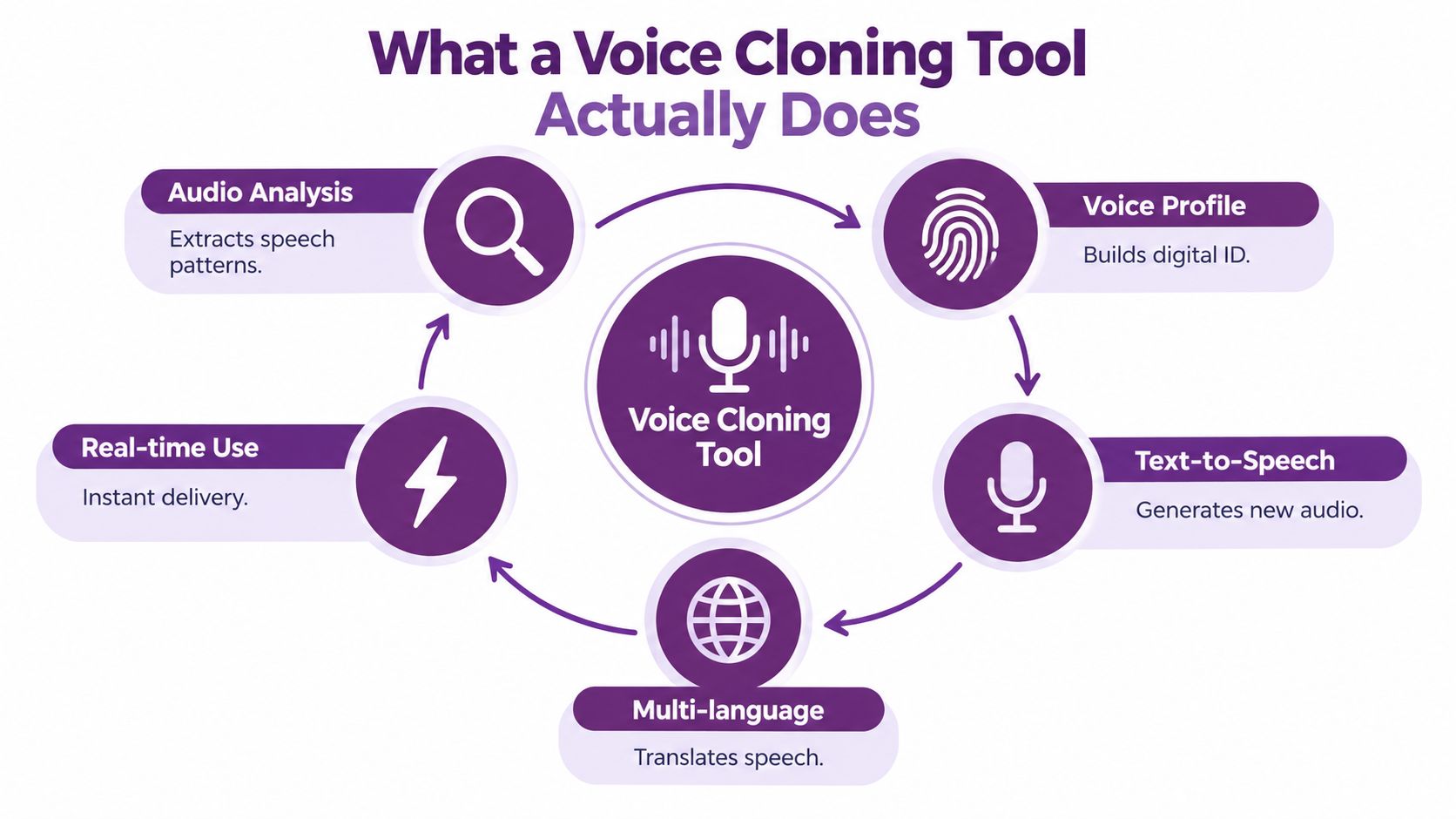
A voice cloning tool analyzes a speaker's recorded audio and builds a digital representation of that person's vocal identity. You then provide new text, and the system generates speech designed to match characteristics such as timbre, accent, pitch, rhythm, and vocal age.
That's different from ordinary text-to-speech. Generic text-to-speech converts written words into audio using a preset synthetic voice. Voice cloning adds an identity layer. Instead of choosing “Voice A” or “Voice B,” you're asking the system to reproduce the recognizable qualities of a specific speaker.
The process usually looks like this:
- Reference audio is supplied. The system studies a clean recording from the authorized speaker.
- Vocal characteristics are extracted. It identifies patterns that distinguish the speaker from others.
- A voice profile is created. This profile conditions a speech-generation model.
- New text is synthesized. The system produces fresh audio without requiring the speaker to record every line.
- The output is edited and deployed. The audio can accompany videos, lessons, advertisements, podcasts, or other media.
Why creators use it
A creator can revise a sentence without reopening a full recording session. A marketing team can maintain a consistent approved narrator across campaigns. An educator can prepare a script and generate localized narration, provided the voice and language output pass appropriate review.
The convenience also creates a new responsibility. A voice profile isn't merely an audio preset. It can resemble a person closely enough to influence trust, especially in customer support, executive communication, fundraising, or urgent requests.
When comparing vocal cloning features, look beyond sample quality. Ask whether the provider verifies the speaker, records permission, limits access, supports disclosure, and makes it possible to revoke or retire a voice.
The direct answer is simple: a voice cloning tool learns a speaker's vocal identity from reference audio and uses it to generate new spoken content from text.
How Voice Cloning Tools Work Under the Hood
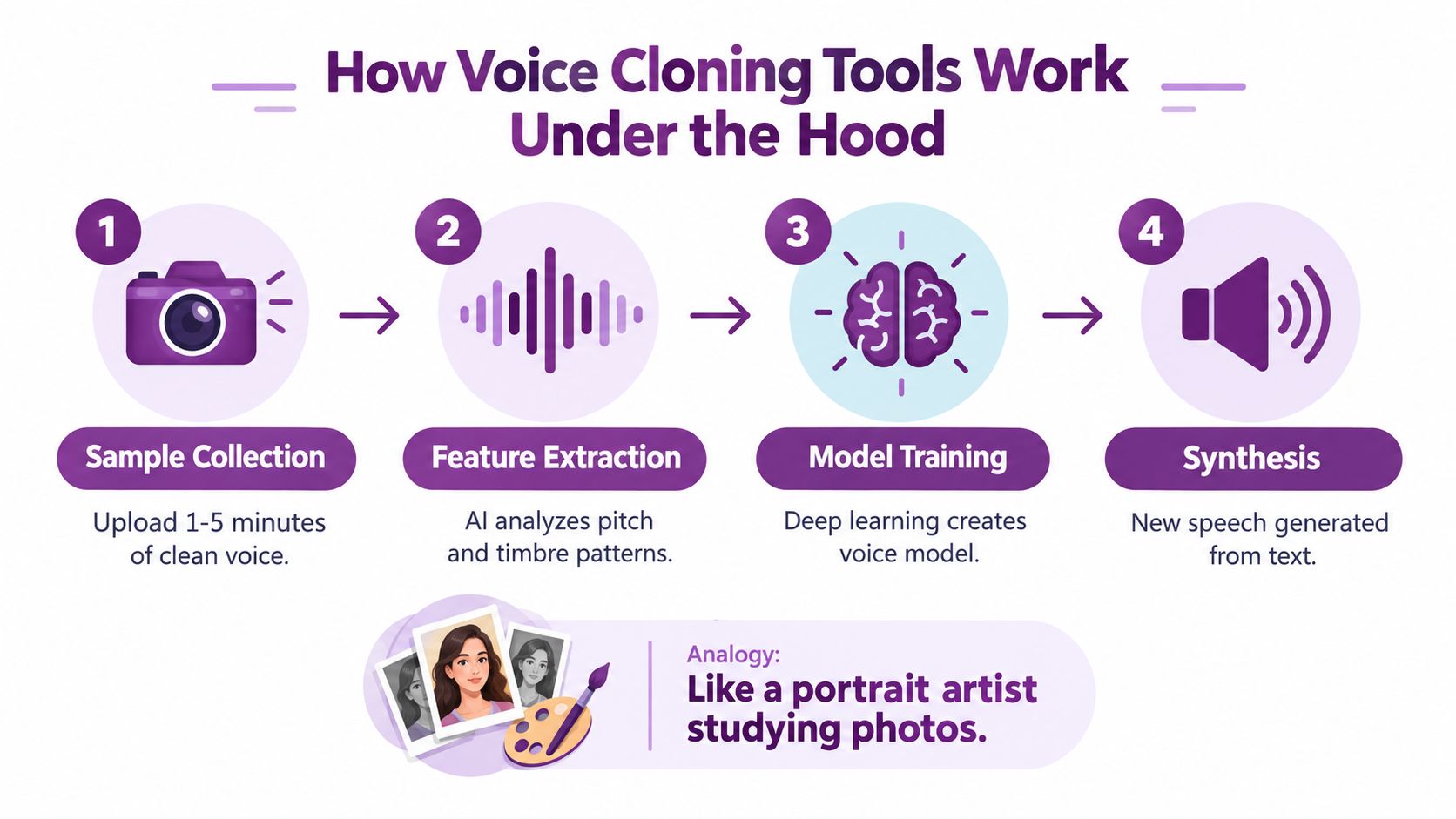
The easiest analogy is a portrait artist. Give an artist a few photographs, and they can learn the subject's face well enough to paint that person in a new pose. A voice-cloning system does something similar with sound. It studies examples of speech, separates linguistic content from speaker identity, and uses that identity representation to generate new sentences.
The four main stages
First, the system captures a reference sample. The recording may contain isolated phrases, narration, or conversational speech. Clean audio helps because background noise, room echo, overlapping speakers, and aggressive compression can become confused with the speaker's actual characteristics.
Next, the model extracts a speaker embedding. This is a numerical representation of identity-related features. It can encode cues connected to timbre, accent, vocal age, pronunciation, and other qualities that make one voice recognizable. The embedding doesn't store a recording for playback. It conditions a model that can produce speech the speaker never recorded.
Then, the embedding conditions a text-to-speech system. The written script supplies linguistic content, while the speaker representation supplies identity. Prosody controls, pronunciation settings, and language support influence how the final sentence sounds.
Finally, the system renders new audio. The model predicts speech details and produces a waveform. The output may sound natural, but naturalness alone doesn't prove that the voice is authorized or suitable for every channel.
Earlier high-quality systems commonly required extensive recordings from a target speaker. Modern neural approaches reduced that requirement by using general models that already understand speech and can adapt to a new speaker representation. Microsoft's VALL-E is described as cloning a voice from approximately 3 seconds of audio, while XTTS-v2 is reported to support zero-shot cloning from a 6-second reference and cross-language generation in 17 languages in this overview of voice-cloning systems.
Those short-input capabilities don't mean every short recording produces a reliable professional voice. Recording conditions, language coverage, pronunciation, emotional range, and prosody controls still affect the result. A short, clean sample can be more useful than a longer recording full of echo or background speech.
For examples of how synthetic vocals can be shaped for creative projects, DissTrack AI realistic vocals offers a useful adjacent reference. The same principle applies to business narration: the model needs enough signal to distinguish the speaker's identity from the environment.
Practical rule: Treat the reference recording as production data, not a casual upload. Clean audio improves the system's chance of learning the voice rather than the room.
A useful workflow for teams building media with LunaBloom's production environment is to audition the same authorized voice across short narration, long-form explanation, emotional delivery, and localized scripts. Test before committing to a large batch. Garbage in, garbage out still applies, even when the model needs only a few seconds of reference audio.
From Mechanical Talking Heads to Neural Networks
Voice cloning belongs to a roughly 180-year progression in speech synthesis. In 1846, Joseph Faber demonstrated the Euphonia, a mechanical talking head that produced speech through physical mechanisms. The idea was striking, but the output depended on fixed mechanical control rather than a learned understanding of human identity.
At the 1939 New York World's Fair, Homer Dudley presented the Voder. In 1950, Bell Laboratories' Pattern Playback converted visual representations of speech into sound. These systems showed that speech could be analyzed, reconstructed, and manipulated, but they didn't yet offer the flexible identity transfer that creators associate with modern cloning.
DECtalk became a notable commercial milestone in 1984. Its synthesized voice later provided the speech used by physicist Stephen Hawking. For many listeners, DECtalk represented the recognizable sound of machine speech, with a clear digital character rather than the subtle variation of a human speaker.
During the 1990s, unit-selection systems improved naturalness by assembling utterances from large databases of recorded speech. Instead of generating every sound from rules, the system selected and joined speech fragments that matched the requested words and context. The approach could sound smoother, but it remained tied to the material that had already been recorded.
The neural shift
The modern change came from neural systems that learned relationships in speech rather than relying mainly on fixed rules or stored fragments. DeepMind published WaveNet in September 2016, using a neural network to generate raw audio waveforms. Google's Tacotron 2 followed in December 2017, combining sequence-to-sequence prediction with a WaveNet vocoder.
In controlled listening tests reported for Tacotron 2, synthesized speech reached a mean opinion score of 4.53, compared with 4.58 for professionally recorded human speech, a gap of only 0.05 points in this history of text-to-speech.
That progression explains why a modern clone can preserve identity, rhythm, and acoustic detail more convincingly than an older robotic system. It also explains the ethical stakes. A system that learns the cues people use to recognize a speaker can be useful for authorized production, but the same capability can make unauthorized impersonation more persuasive.
The Legal and Ethical Rules You Cannot Ignore
A voice clone can be generated in one place and distributed through another. That means compliance depends on more than the model or the upload process. The intended audience, the speaker's permission, the content's presentation, and the distribution channel all matter.
Disclosure is part of the output
The European Union's AI Act creates specific transparency obligations for synthetic media. Under Article 50, providers of systems that generate synthetic audio must mark outputs in an effective, reliable, sturdy, interoperable, and machine-readable format. For deepfake audio, deployers must also disclose the artificial nature of the content to people at the latest when they're first exposed to it.
The disclosure must be clear, distinguishable, understandable, and perceivable. That can include a visible label or an audible notice. A hidden technical watermark alone doesn't satisfy the user-facing disclosure requirement according to the European Commission's Article 50 FAQ.
A practical notice might tell viewers that the narration is synthetically generated and authorized by the named speaker. The exact wording depends on the project, audience, and applicable law, but hiding the fact of generation is a poor governance choice even where a particular rule doesn't apply.
Authorization is not the same as copyright ownership
On July 31, 2024, the U.S. Copyright Office released Part 1 of its Copyright and Artificial Intelligence report, focused on digital replicas. The report addressed realistic AI-generated or digitally manipulated recordings that replicate a person's voice or appearance.
The Copyright Office recommended that Congress create a new federal law protecting individuals against the knowing distribution of unauthorized digital replicas. Its analysis also recognized that existing protections don't consistently cover every harm caused by realistic voice and likeness imitation as summarized by the U.S. Patent and Trademark Office.
This is why a marketing team shouldn't assume that owning a recording gives it unlimited rights to clone the speaker. A person's recognizable voice may raise publicity, privacy, consumer-protection, or unfair-deception issues even when the underlying sound recording wasn't copied.
Before publication, verify:
- Speaker permission: Is there documented authorization from the person whose voice is being cloned?
- Scope: Does the permission cover the exact languages, formats, campaigns, and distribution channels?
- Disclosure: Will listeners understand that the audio is synthetic when they first encounter it?
- Retention: Can the team retrieve consent records and provenance information if the use is challenged?
- Revocation: Is there a process for retiring the voice and stopping future generation?
The channel changes the obligation
An authorized voice in a training video isn't automatically authorized for an unsolicited automated phone campaign. In February 2024, the Federal Communications Commission declared that AI-generated human voices used in telephone calls fall within the Telephone Consumer Protection Act's restriction on artificial or prerecorded voice messages. Certain outbound calls therefore require prior express consent and must follow existing robocall requirements as described in this legal alert.
That distinction should appear in a campaign brief. A voice-cloning tool may be suitable for an approved advertisement, but a phone deployment requires a separate review of consent, purpose, opt-out handling, and jurisdictional requirements. Teams should also align product terms and internal policies, including the applicable LunaBloom terms, with the actual workflow rather than treating terms as a substitute for project-level approval.
Why Consent Is a Workflow Not a Checkbox
A checkbox saying “I have the rights to this voice” records an assertion. It doesn't necessarily prove that the speaker understood the use, agreed to the languages involved, or knows how to withdraw permission later.
A 2025 Consumer Reports assessment found that four of six tested voice-cloning tools allowed researchers to create a clone from publicly available audio without technical consent verification. Several relied only on self-attestation that the user had legal rights in the Consumer Reports assessment.
That finding changes how buyers should assess a platform. Consent shouldn't be a single screen at upload. It should be an auditable chain that connects the speaker, the voice profile, the permitted use, and the published output.
Build a permission record
A workable process can include:
- Record a consent statement. Ask the speaker to identify themselves, authorize voice cloning, and describe the intended use in a recorded statement.
- Define permitted uses. Document whether the voice may appear in advertisements, internal training, podcasts, customer support, social media, or localized content.
- Specify languages and channels. Permission for English video narration shouldn't automatically be treated as permission for every translated voiceover or phone deployment.
- Set expiration and revocation terms. Decide how long the authorization lasts and what happens to existing assets after withdrawal.
- Retain provenance records. Store the consent statement, approval history, generated asset details, and publication destination.
- Disclose synthetic audio. Add a visible or audible notice where required and where audience trust would benefit from clarity.
- Use watermarking where available. Technical provenance can support investigation, but it shouldn't replace a listener-facing disclosure.
The FBI warned in May 2024 that criminals were increasingly using AI-powered voice and video cloning in phishing, social-engineering, and impersonation scams involving trusted people such as family members, coworkers, and business partners in its public warning.
That's why voice recognition shouldn't be the only verification method. Payment requests, urgent password changes, confidential-data requests, and unusual instructions should be confirmed through a separate trusted channel. Teams should protect source recordings, restrict access to generated voices, and require approval before publishing or deploying synthetic audio. A documented privacy workflow, including the applicable LunaBloom privacy policy, is more useful than a vague promise to “use AI responsibly.”
The strongest buying question isn't “How realistic is the sample?” It's “Can this provider show who authorized the voice and what controls apply when someone challenges the clone?”
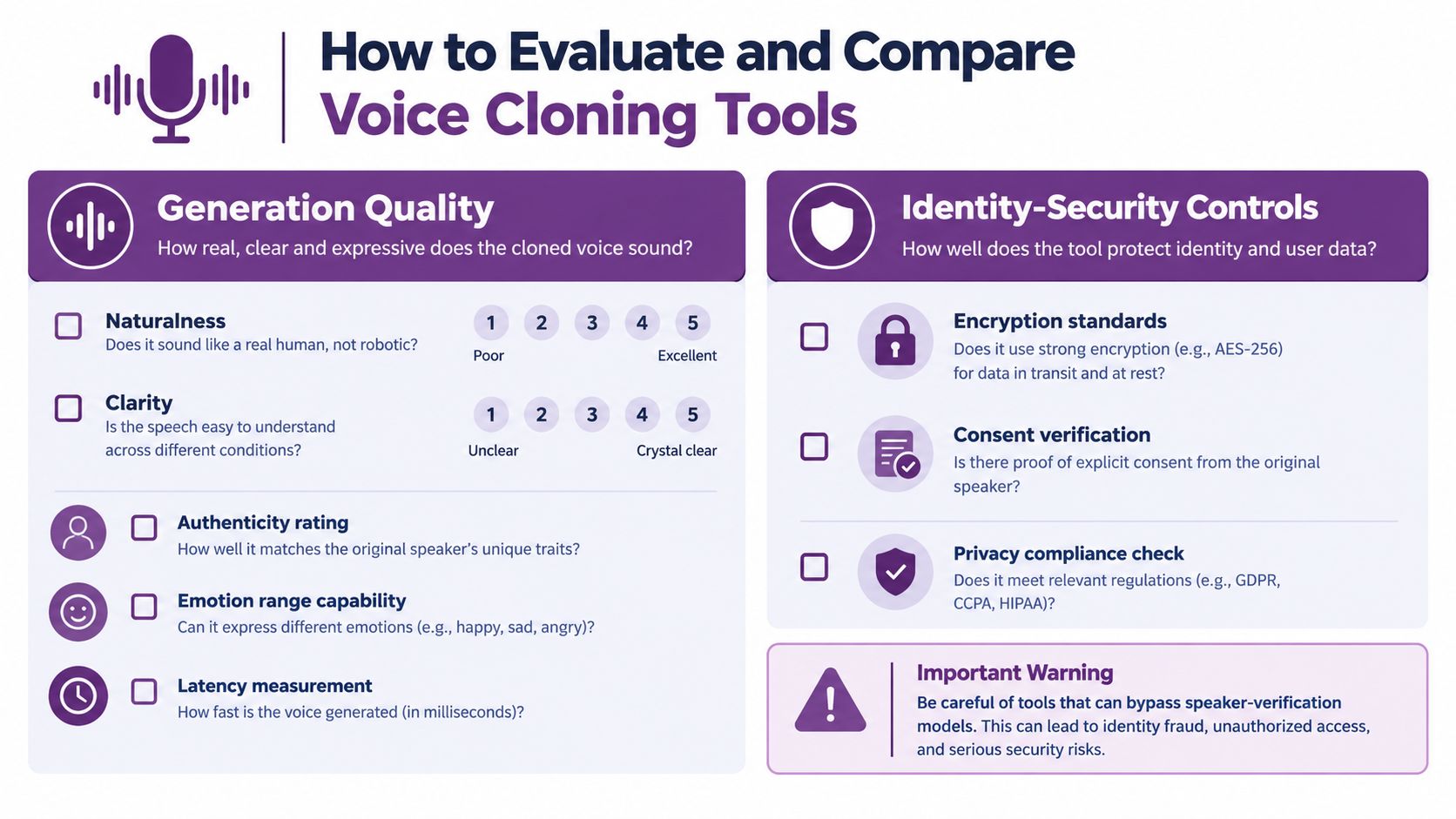
How to Evaluate and Compare Voice Cloning Tools
Start by separating two jobs that vendors often place beside each other: generating convincing speech and protecting speaker identity. A tool can perform well at the first while offering weak controls for the second.
An empirical study tested GPT-SoVITS, Bert-VITS2, and RVC against a state-of-the-art speaker-verification model. The reported bypass rates were 56.2%, 82.7%, and 43.1%, respectively, even though the verifier's genuine-user false-acceptance rate was only 0.01% in the empirical evaluation. The practical lesson is clear: ordinary authentication performance doesn't prove resilience against synthetic speech.
Ask for evidence, not adjectives
A vendor's demo usually represents a clean, favorable condition. Your testing should include compression, background noise, phone-bandwidth audio, multilingual scripts, expressive delivery, short advertisements, and long-form training content. Measure speaker-embedding similarity, transcription or intelligibility accuracy, and human ratings for prosody.
Multilingual claims deserve particular scrutiny. A 2025 FAccT study reported average accent-and-linguistic accuracy of 69% for one service and 78.5% for another. Across accents, 52% of responses preferred more robotic voices, suggesting that clearly synthetic speech can sometimes feel more trustworthy than an overly realistic imitation in the study's published paper.
| Evaluation Criterion | What to Ask the Vendor | Evidence to Request |
|---|---|---|
| Generation quality | How does the tool handle pronunciation, emotion, pacing, and long-form narration? | Audition files using your own scripts and approval rubric |
| Identity security | Does the platform verify the speaker before cloning? | Consent workflow, account controls, access policy, and audit records |
| Robustness | What happens after compression, noise, narrowband transmission, or localization? | Test outputs from clean, compressed, noisy, and phone-like conditions |
| Language fidelity | How are regional accents and low-resource languages evaluated? | Native-speaker reviews, language-specific samples, and pronunciation controls |
| Disclosure | Can outputs carry machine-readable provenance and user-facing notices? | Metadata examples, labeling controls, and disclosure documentation |
| Governance | Can an authorized user revoke or retire a voice? | Deletion process, retention policy, incident response, and escalation path |
Use a purchase checklist
Before selecting a voice cloning tool, confirm that it can:
- Verify consent: Require more than a self-attestation for sensitive voices.
- Restrict access: Separate administrators, editors, reviewers, and publishers.
- Support provenance: Preserve the source, approval, generation, and publication trail.
- Test real conditions: Benchmark output after the transformations your channels apply.
- Review native quality: Ask native speakers to approve each important language and accent.
- Disclose clearly: Provide visible or audible notices as well as technical metadata.
- Handle incidents: Explain how the provider responds to impersonation claims or misuse.
- Fit the workflow: Check collaboration, version history, exports, integrations, and available pricing details.
For teams evaluating adjacent avatar production, this HeyGen AI avatar guide can help clarify how voice decisions interact with visual identity and presentation. Don't let a polished avatar distract from the underlying permission and security review.
Putting Voice Cloning to Work with LunaBloom
A practical workflow starts with an authorized speaker and a clean reference recording. Store the consent statement and usage scope with the project, then generate a short audition in every target language or regional accent. Have native speakers review pronunciation, identity preservation, pacing, and emotional fit before producing a full campaign.
LunaBloom AI places voice cloning inside a broader cinematic video workflow. Its studio can turn scripts, text prompts, and images into edited videos with voiceovers, captions, custom avatars, localization across 50+ languages and regional accents, and one-click social publishing. It also supports collaboration, version control, analytics, and API integrations for teams producing content at scale.
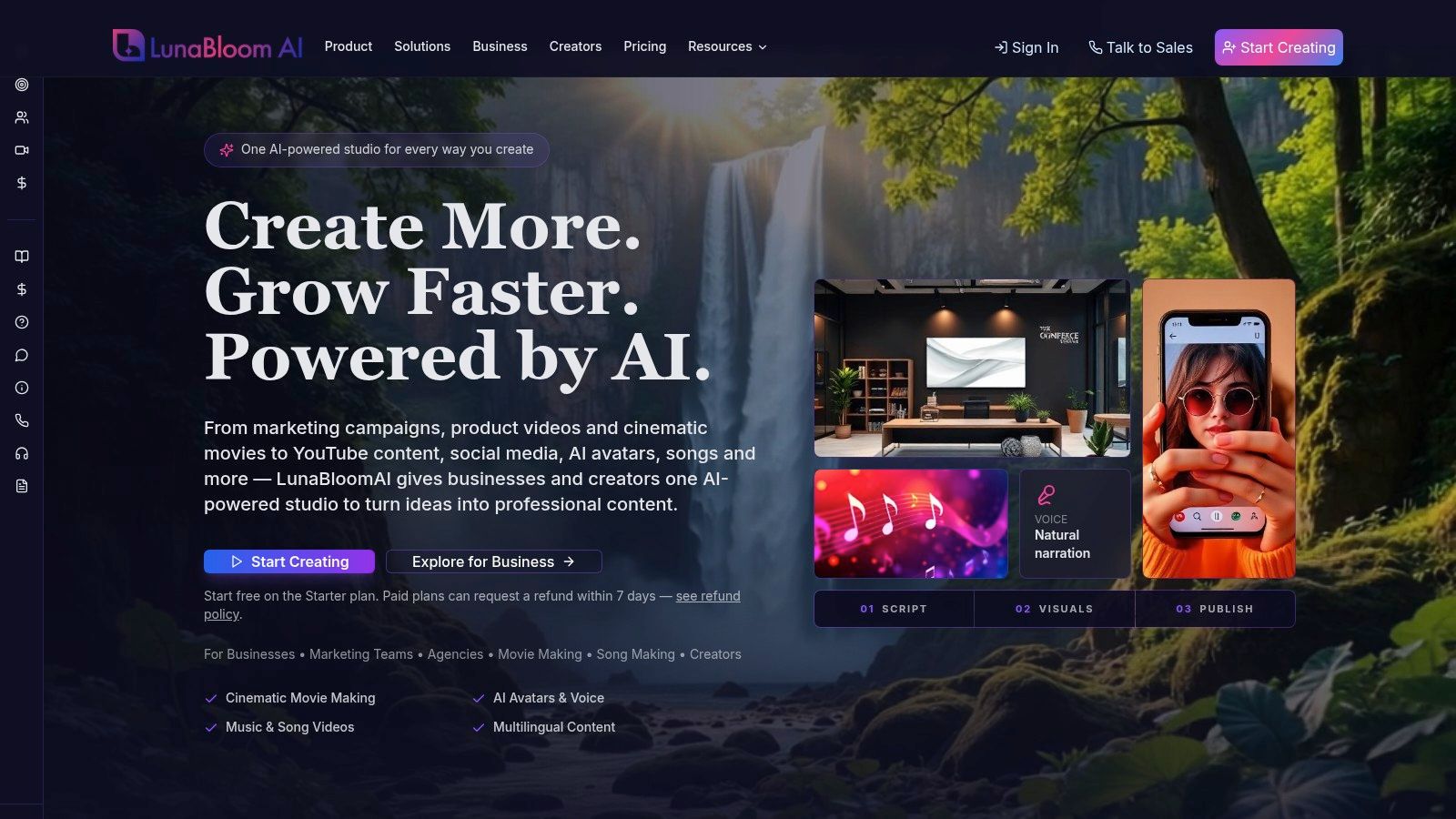
Use the LunaBloom AI app to run the same quality gates discussed above. Test a short social video and a longer training asset, inspect the localized versions, review captions, and confirm that your team's authorization records match every cloned voice used in production. A free pay-as-you-go trial provides a low-risk way to assess the workflow before expanding it.
The right voice cloning tool isn't defined by realism alone. It should help your team produce consistent audio while maintaining permission, disclosure, security, language quality, and accountability from the first sample to the final export.
LunaBloom AI combines voice cloning with script-to-video production, natural voiceovers, captions, avatars, localization, and social publishing. Visit LunaBloom AI to test an authorized voice workflow, review multilingual output, and apply practical quality gates before your next campaign.