YouTube Shorts reached more than 5 trillion total views by May 2024, after generating over 30 billion views per day by September 2022 (YouTube Shorts milestone data). That scale changed the role of AI video. It isn't just a faster way to make clips. It has become part of how creators plan, produce, localize, package, and distribute content.
The catch is that speed alone won't build a durable channel. A synthetic presenter reading interchangeable scripts can publish quickly, but repetitive or deceptive videos can create monetization problems. The practical question isn't whether YouTube allows AI videos. It does. The question is whether your workflow produces content with enough originality, transformation, viewer value, and disclosure discipline to survive platform review and earn audience trust.
Why AI Video Is No Longer Optional on YouTube
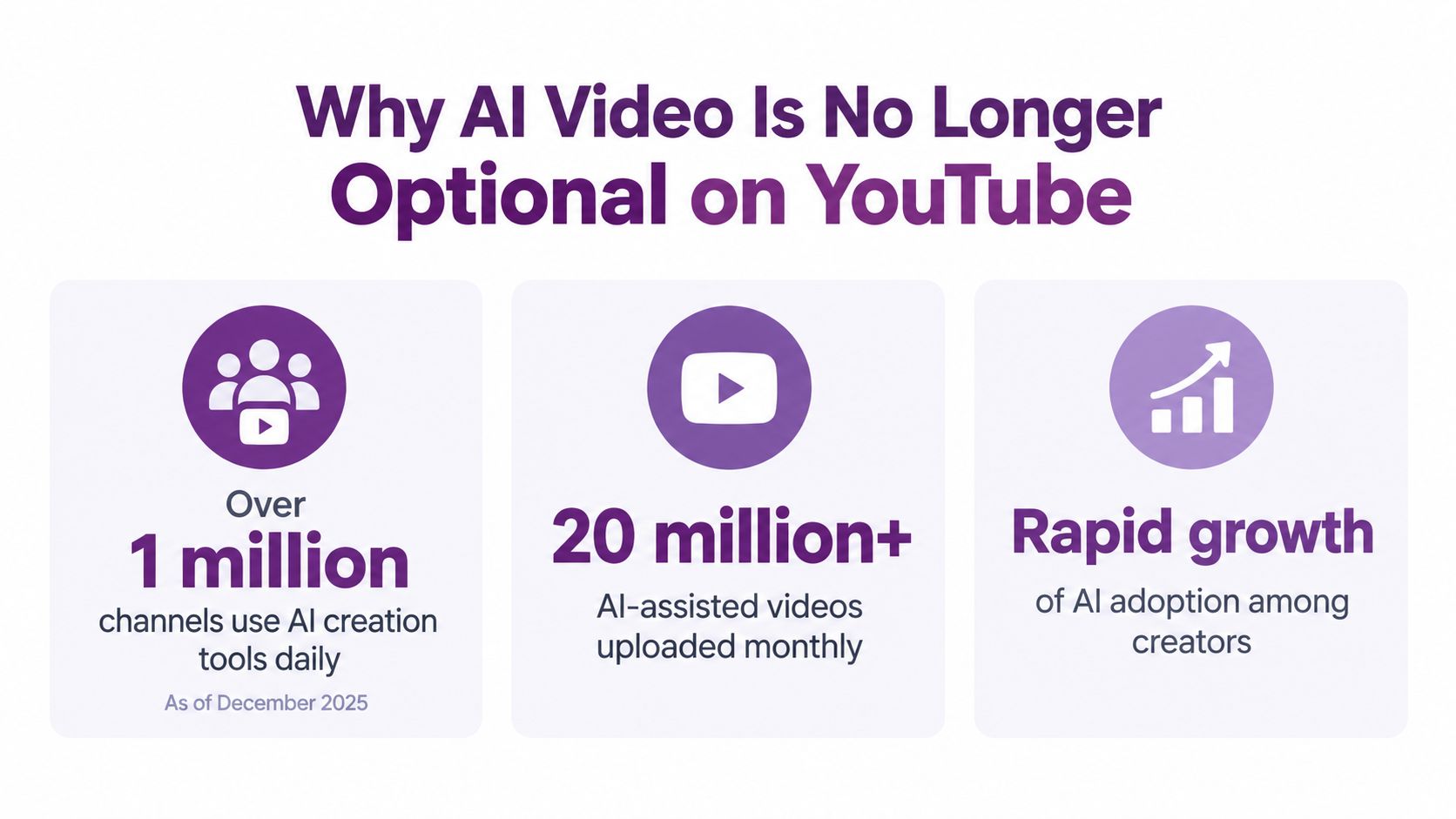
By December 2025, YouTube CEO Neal Mohan said more than 1 million channels used AI creation tools every day, while YouTube reported more than 20 million videos uploaded daily (YouTube AI creation ecosystem reporting). In that volume, production speed is only the entry point. A channel still needs a distinct argument, recognizable packaging, and enough original work to show viewers and reviewers why the video deserves attention.
AI becomes useful when one researched question supports several distinctly different viewing experiences. For example, research into a new editing feature can produce a Short that demonstrates one result, a long-form video comparing workflows, and a localized version for another audience. Each format needs its own structure, examples, and editorial decisions. Repeating the same narration over recycled visuals is faster, but it gives viewers little reason to return and may look like inauthentic production.
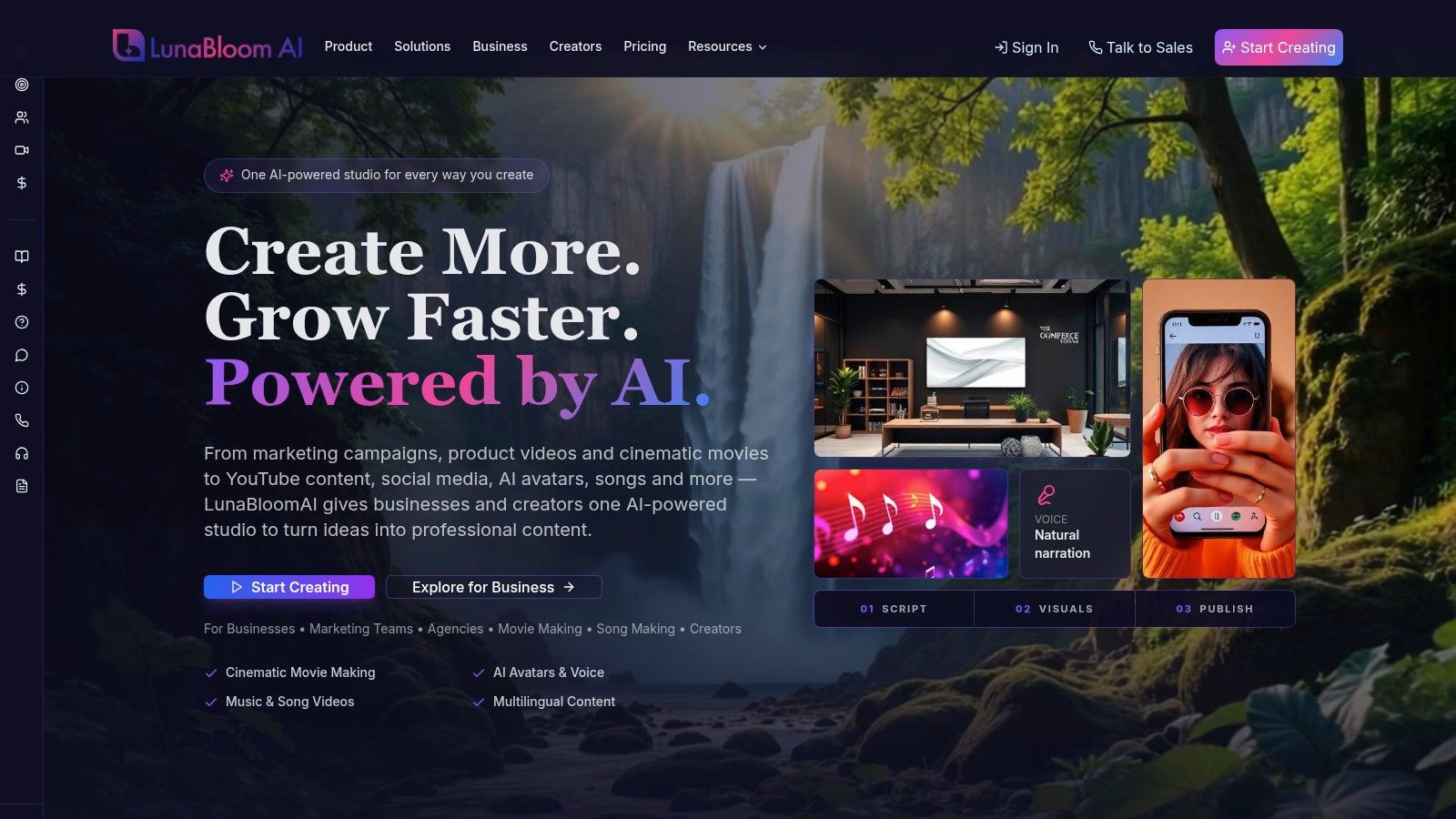
Monetization depends on the work added around the generated material. Define the claim yourself, verify the evidence, rewrite generic output, review every scene, and include analysis or demonstrations that a template could not supply. AI can assist with production, but originality, transformation, viewer value, and disclosure remain the operating standard. Creators can review an end-to-end AI video workflow such as LunaBloom AI's, while judging any platform by the controls and review process it supports.
Practical rule: Use AI to produce more thoughtful iterations, not more empty uploads.
Scripting and Avatar Voice Generation Workflow
A convincing YouTube AI video starts with a script that knows what it wants the viewer to understand. Before opening an avatar or text-to-video tool, write the promise in one sentence, identify the viewer's problem, and decide what evidence or demonstration will resolve it.
For a Short, build around one tension or question. The opening should establish the subject immediately, the middle should provide a concrete development, and the ending should deliver a useful conclusion or a reason to continue. Long-form scripts need stronger information architecture, including sections, transitions, examples, and deliberate points where the viewer gets a new payoff.
Choose the visual identity before generating
Select an avatar style based on the subject and the audience's expectations:
- Photo-real avatars suit explainers, training, product demonstrations, and presenter-led updates.
- Animated avatars work better when the channel depends on humor, education, or a deliberately stylized identity.
- 3D avatars can support fictional worlds, gaming content, music, and character-driven formats.
The wrong choice creates friction before the viewer has heard the argument. A serious financial explanation delivered by a playful character may feel evasive, while a light tutorial can become unnecessarily stiff with a highly realistic presenter.
Voice selection deserves the same care. Match pace, warmth, pronunciation, and regional accent to the intended market. If you localize across 50+ languages and regional accents, review names, technical terms, idioms, and emphasis in every version instead of assuming translation preserves meaning. A cloned voice should only be used with the speaker's permission and with a clear process for managing consent.
For most channels, natural delivery matters more than perfect lip sync. Cut long sentences into speakable units, add pauses before important ideas, and listen for unnatural stress. LunaBloom AI can combine scripts, avatars, voiceovers, captions, and editing in one workflow through its AI video creation app, but the creator still needs to approve the script and final performance.
A practical generation sequence looks like this:
- Write the hook and viewer promise.
- Draft the complete narration.
- Mark visual instructions beside each paragraph.
- Select the avatar and voice.
- Generate a short test segment.
- Correct pronunciation, pacing, and gestures.
- Produce the full video only after the test feels credible.
Editing, Captions, Thumbnails, and Metadata Optimization
Generation is only the first pass. AI footage often contains small problems that become obvious in sequence, such as a changed object between shots, a repeated gesture, a caption that conflicts with the narration, or a visual that promises something the script never explains.
Start the edit by checking the argument, not the transitions. Remove scenes that don't advance the explanation. Replace generic stock-like visuals with screenshots, diagrams, product footage, demonstrations, or original examples. A polished timeline can't rescue a video with no informational progression.
Build the publishing package before export
Captions should be accurate, synchronized, and easy to read on a small screen. Automatic subtitles save time, but review names, numbers, specialist vocabulary, punctuation, and speaker changes. Translations need editorial review too, especially when a literal version changes the force of a claim or makes a regional expression sound unnatural.
The thumbnail and title must make the same promise. Don't create a dramatic image for an instructional title, or a precise title for a vague visual. A useful pre-publish check is:
- Thumbnail: Can the viewer understand the subject and tension at a glance?
- Title: Does it state the audience problem without exaggerating the result?
- Description: Does the opening explain what the viewer will learn?
- Chapters: Do they reflect real content changes rather than decorative labels?
- Metadata: Does each keyword describe the actual video?
Keyword placement helps YouTube and viewers interpret the topic, but stuffing terms into a description won't compensate for weak relevance. Use the main query naturally in the title and opening description, then add closely related language that appears in the spoken content.
Localization can extend the usefulness of a strong idea, but it shouldn't create near-identical uploads with only superficial changes. Adapt examples, on-screen text, pronunciation, and thumbnail language for each audience. Keep a version log so you know which script, voice, captions, and metadata belong to each market.
Editing test: If removing the avatar leaves nothing distinctive, the video probably needs more original material.
Short-Form Versus Long-Form AI Video Strategy
Shorts and long-form videos fail in different ways. A Short has little room for unclear staging, while a long video must preserve meaning across scenes separated by minutes. The Video-TT benchmark examined 1,000 Shorts clips, each paired with one open-ended question and four adversarial questions, to test visual and narrative understanding (Video-TT benchmark paper).
For creators, the practical lesson is simple: clean frames do not make a publishable video. If the viewer cannot tell what changed, why a cut happened, or which detail matters, retention suffers. AI-generated visuals also need enough editorial transformation to support monetization. Add a clear point of view, original explanation, demonstrations, or commentary. A sequence of attractive clips with generic narration can look like automated production, especially when several uploads share the same structure.
Build each Short around one visible transformation. Introduce the problem, reveal the change, explain its meaning, and end with a specific takeaway. Keep character descriptions, locations, and recurring objects consistent. Prompt each shot with what stays in frame, what moves, and what the audience should notice.
Long-form exposes continuity problems at a larger scale. LVBench evaluated 103 publicly sourced YouTube videos totaling about 117 hours, with more than 1,500 annotated question-and-answer pairs, focusing on temporal grounding, causal reasoning, and entity tracking (LVBench dataset overview). Use an event-level outline that tracks names, claims, examples, and visual references from introduction to conclusion. Add recaps when later arguments depend on earlier evidence.
Shorts can generate discovery. Long-form can build authority and create more space for original analysis, but neither format earns trust through volume alone. Give each upload its own viewer promise, edit, title, thumbnail, and evidence of human judgment.
Monetization Risks and the Inauthentic Content Problem
AI-generated video can qualify for monetization, but production volume alone creates risk. YouTube's 2026 policy clarification points to three problem areas: generic or repetitive content, unsatisfying or off-putting material, and AI personas tied to sensitive topics (YouTube policy clarification reporting). The practical question is whether viewers can identify a distinct editorial contribution in each upload.
Set that threshold before rendering. A monetizable video should meet all of these conditions:
- Original premise: It addresses a specific audience problem, not merely a broad topic.
- Original substance: Your analysis, demonstration, reporting, comparison, or interpretation changes what the viewer can learn.
- Visible transformation: Source material is reshaped through explanation, structure, commentary, or editing.
- Resolved promise: The ending delivers the answer, result, or takeaway introduced at the start.
- Responsible presentation: Synthetic people, events, and claims are presented without misleading viewers.
A repeated avatar is acceptable when the editorial work changes meaningfully from episode to episode. Replacing the topic while preserving the same script cadence, visuals, conclusion, and editing pattern signals automated volume. A new background or cloned voice does not meet a meaningful originality threshold by itself.
Use a simple publishing gate: if removing the narration leaves a stock montage, or removing the visuals leaves generic commentary, revise the episode. Add a demonstration, source comparison, reported detail, or explanation that depends on your judgment. The contribution should be visible in the finished cut, not hidden in the prompt history.
Sensitive subjects raise the cost of mistakes. AI personas discussing health, news, elections, or finance may create trust and safety concerns even when the video appears polished. YouTube also applies automatic detection and labeling, so uploading at scale without review can expose a channel to avoidable scrutiny.
Document permissions before production. Review each platform's terms, including LunaBloom AI's terms, before cloning voices, using likenesses, uploading client material, or assigning commercial rights. A disclaimer cannot replace permission, original work, or editorial review.
Disclosure Rules and International Distribution
YouTube requires disclosure when content is photorealistic and meaningfully altered or generated. This covers a realistic event that never happened, changed footage of a real place or event, or a real person made to appear as if they said or did something they did not. Review YouTube's current AI disclosure guidance before publishing.
Minor aesthetic changes, such as beauty filters or color correction, generally do not require disclosure. AI used for scripts, outlines, or production assistance is treated differently, as are clearly fantastical or non-realistic animations. Music has a separate rule: generative AI used to create music requires disclosure, while AI used for scripts or content ideas does not, according to YouTube's disclosure announcement.
Sensitive topics deserve stricter review. Labels may receive greater prominence for health, news, elections, and finance. An avatar that presents synthetic claims in these areas can create trust, moderation, and monetization problems even if the edit looks polished.
Build the decision into your international publishing process. Before release, record:
- whether photorealistic synthetic content appears,
- whether a real person or event was altered,
- whether generative AI created music,
- which languages, accents, and voices were used,
- who approved the final version.
Localization adds a practical risk. A voice that sounds natural in one market may sound misleading, unnatural, or culturally inappropriate elsewhere. Review translated claims, pronunciation, visual context, and disclosure text separately rather than assuming one approval covers every version.
Prominent labels do not automatically reduce recommendations. YouTube has said its AI flags will not affect recommendations, but labels can still influence trust, click behavior, comments, and moderation disputes. Keep the disclosure decision with the project files, and use YouTube's challenge path when an automatic label is wrong.
Teams handling client assets or voice data should review LunaBloom AI's privacy information before production, especially when distributing localized versions across markets.
Building a Sustainable YouTube AI Video Workflow
A sustainable YouTube AI video operation looks less like a prompt queue and more like a small editorial studio. The workflow I recommend starts with a topic backlog, a clear audience question, and a decision about whether the idea deserves a Short, a long-form treatment, or both.
Write the title and thumbnail concept early. That forces the promise into the open before you spend time generating scenes. Then create the script, define visual references, produce a short avatar and voice test, and approve the tone before generating the full timeline.
Keep production modular
Store each project with separate files for:
- the approved premise and research notes,
- the master script,
- scene prompts and visual assets,
- voice and avatar permissions,
- caption and translation versions,
- thumbnail, title, and description variants,
- disclosure decisions and final approvals.
This structure makes revisions safer. If a claim changes, you can update the master script and regenerate dependent assets instead of rebuilding the project from memory. It also helps agencies maintain a clean record for clients.
After publishing, review audience responses and retention patterns qualitatively, then identify where viewers lose context, question a claim, or ask for a missing demonstration. Repurpose only the parts that remain coherent on their own. A Short should have its own opening and payoff, not feel like an arbitrary crop from a long video.
Creators who want a broader view of the operating model can also explore this guide to monetizing automated YouTube content. The commercial lesson is simple. Automation should reduce repetitive labor while preserving editorial ownership.
Start small. Build a repeatable process around the bottleneck you feel, then add version control, localization, analytics, and publishing automation as the channel earns that complexity. LunaBloom's starter app can fit into that process when you need script-to-video production with avatars, voices, captions, editing, and social publishing in one place.
LunaBloom AI turns scripts, prompts, and images into edited YouTube videos with avatars, natural voiceovers, captions, localization, thumbnails, titles, and metadata support. Visit LunaBloom AI to test a workflow that prioritizes production speed while keeping originality, disclosure, and editorial review in your hands.