Meta description: AI avatar ads can scale creative fast, but they don't win everywhere. Learn the full workflow, scripting tactics, localization process, testing setup, and compliance rules for Meta, TikTok, and YouTube.
You're probably here because the same thing keeps happening.
A campaign brief lands. The media budget is ready. The product angle is clear enough. But creative production is the bottleneck again. You need more variants for Meta, more native-looking cuts for TikTok, a few YouTube versions, and ideally localized versions too. Then creator timelines slip, reshoots pile up, and the whole testing plan gets compressed into whatever assets happen to arrive on time.
That pressure is why AI avatar ads moved from novelty to actual media-buying infrastructure. They solve a production problem first. They let teams ship more hooks, more intros, more offers, and more language variants without waiting on casting, filming, and back-and-forth revisions every time.
The catch is that faster production doesn't automatically mean better performance. Avatar ads work when the script, funnel stage, disclosure setup, and platform treatment all line up. They fall apart when marketers use them as a substitute for trust instead of a tool for scale.
Why AI Avatar Ads Are Suddenly Everywhere
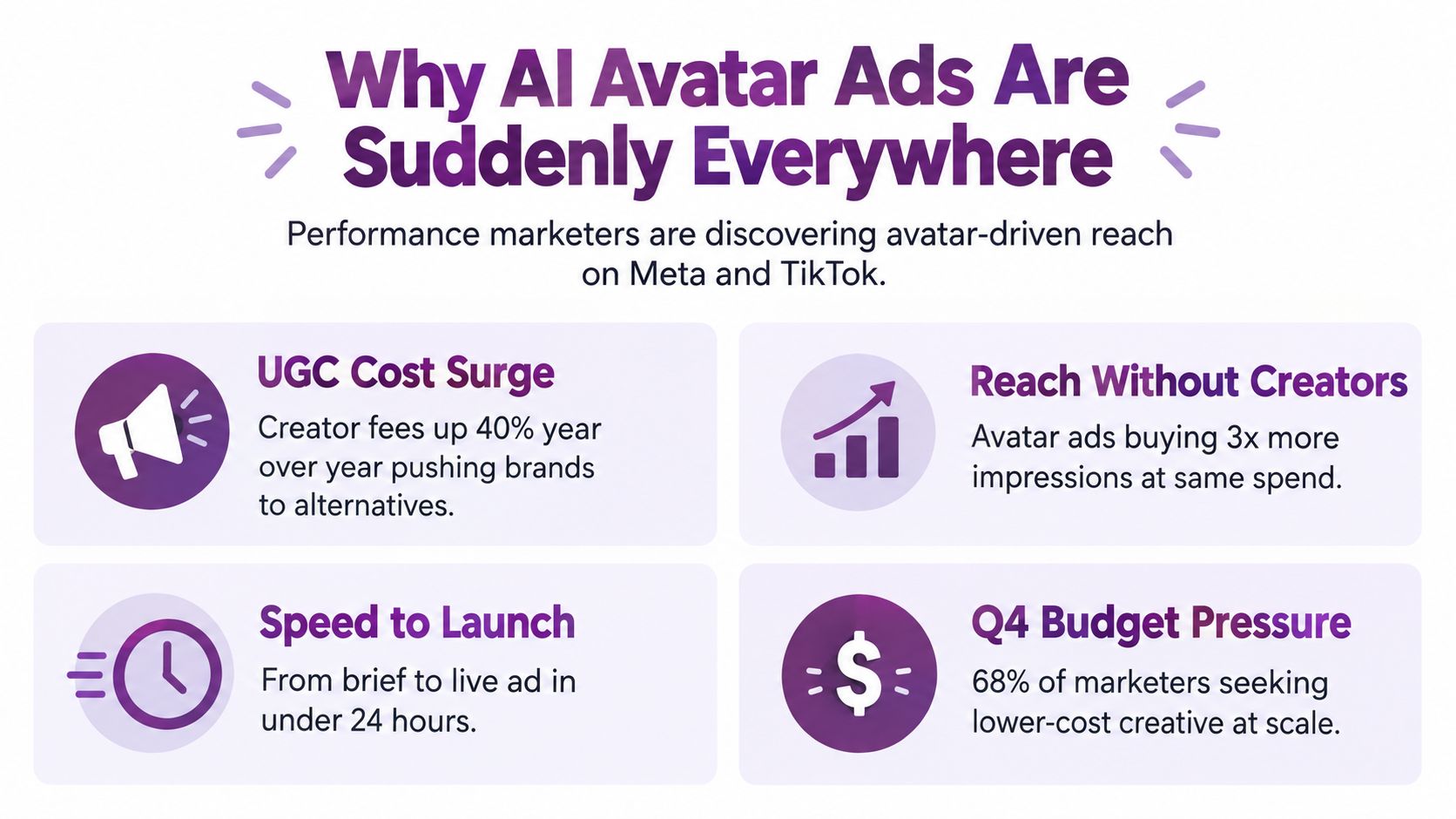
A paid social team has three days before launch. The offer is approved. Budget is live. What is missing is creative volume: fresh hooks for Meta, native-looking cuts for TikTok, shorter variants for YouTube, and localized versions for the geos that already convert. That production gap is why AI avatar ads spread so fast.
Teams spending serious money on acquisition rarely struggle with ideas alone. They struggle with turnaround. Avatar ads shorten the time between concept and publish, which makes them useful for the main job: testing more angles before the audience burns out.
The market shifted from novelty to production
Ad buyers did not adopt avatars because synthetic presenters suddenly became interesting. They adopted them because creative requirements changed. Meta rewards iteration. TikTok punishes ads that feel overproduced or stale. YouTube often needs multiple first-five-second approaches to find a hold rate worth scaling. In that environment, one polished hero asset is usually not enough.
Analysts tracking AI advertising and synthetic media have also documented broader market growth, which helps explain why tools and workflows matured so quickly. The format now sits inside normal creative operations instead of side experiments.
For teams building around that workflow, tools such as LunaBloom AI can turn scripts, prompts, and brand assets into publish-ready avatar videos fast enough to support an actual testing cadence. That matters more than the novelty factor.
Speed changes the economics of testing
The strongest case for avatar ads is simple. They let marketers test more messages inside the same launch window.
In a large online experiment with over 21,000 consumers, researchers featured by MIT IDE reported that AI-generated personalized video ads with an avatar tied to customized text scripts produced click-through rates 9.4% higher than personalized image ads and 6.5% higher than generic video ads. The same research said generative AI cut personalized video ad production costs by about 90% (personalized AI video ad research).
That does not mean avatar ads beat filmed creative by default. They usually win in specific conditions: mid-funnel explainers, offer refreshes, localization, testimonial-style scripts that do not depend on real customer identity, and rapid hook testing where production speed matters more than cinematic polish. They often lose when trust has to be earned through lived experience, hands-on product proof, or a founder face that the audience already recognizes.
Disclosure also plays a role. If an avatar is presented like a real employee or customer without clear context, performance can drop once viewers sense the mismatch. Clear labeling, the right funnel stage, and platform-native editing do more for conversion than the avatar itself.
The format is everywhere because it solves a workflow problem tied directly to CAC, testing velocity, and launch reliability. The teams getting results are not just generating avatars. They are building a concept-to-publish system that matches the ad to the funnel, the script to the platform, and the disclosure to the trust level required.
The Concept-to-Publish Workflow for AI Avatar Ads
Teams lose money on AI avatar ads before the avatar is even generated. They start with a tool instead of a conversion decision.
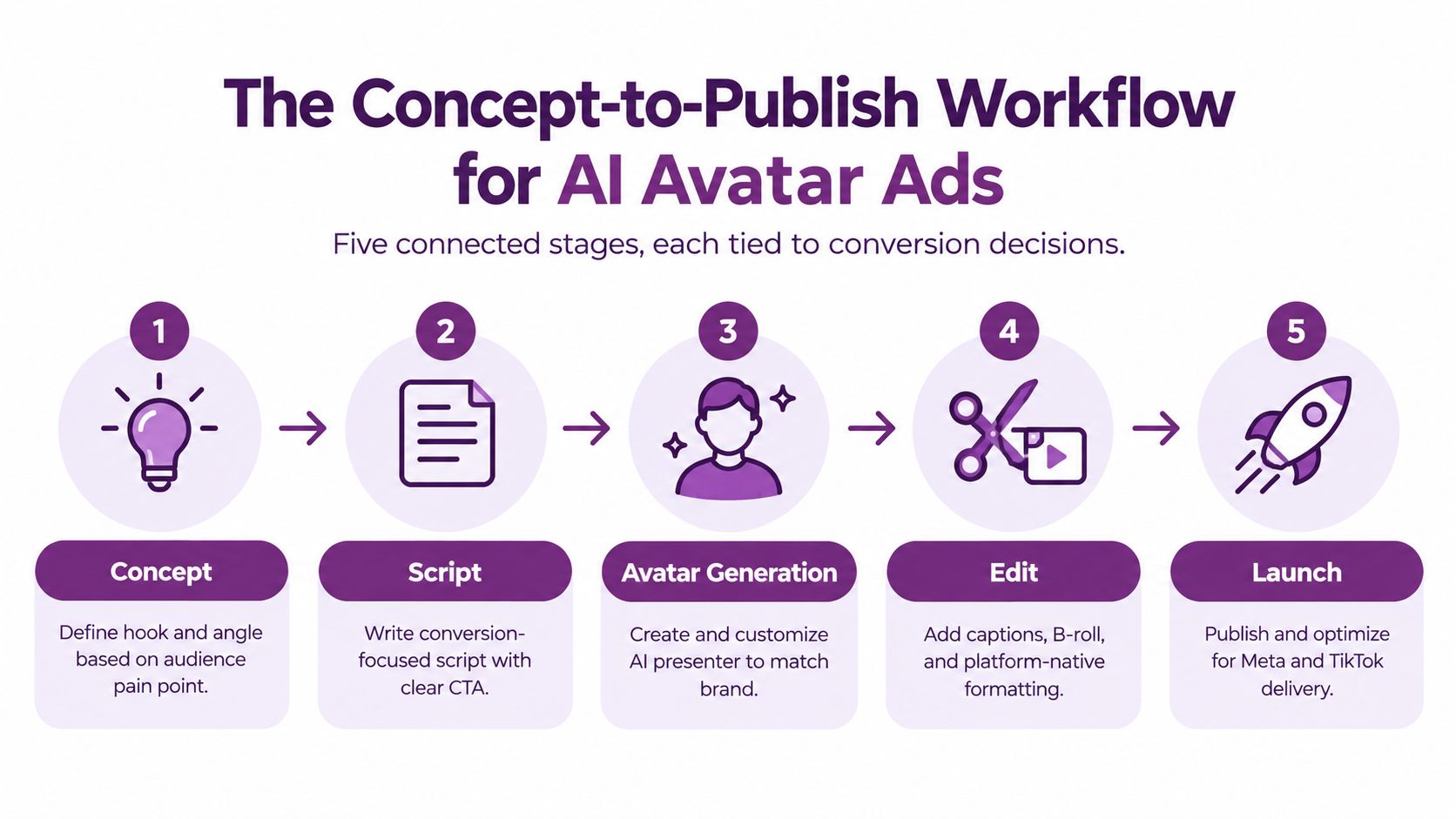
The clean workflow has five stages. Concept, script, avatar generation, edit, and launch. Each one should answer a media-buying question, not just a production one.
A simple process map helps keep the handoffs clean.
Start with funnel stage, not visuals
Before you pick an avatar, define where the ad sits in the funnel.
A cold prospecting ad needs a fast pattern interrupt and a low-friction ask. A retargeting ad can assume category awareness and push harder on objections, product proof, or offer framing. Those are different jobs. They should not share the same on-camera delivery.
Use a brief that answers these questions:
- Audience temperature. Is this cold traffic, site visitors, cart abandoners, or returning customers?
- Primary action. Do you want the click, the lead, the free trial start, or the purchase?
- Claim type. Is this an explainer, a demo, an offer announcement, or a testimonial-style frame?
- Risk level. Would a synthetic presenter change how the viewer interprets authenticity?
If the ad is utility-driven, avatar production usually fits well. If it relies on lived experience or personal endorsement, it usually doesn't.
Build the script around the event you want
Write the CTA before you write the body. That keeps the script honest.
A good internal naming structure also saves pain later. Use naming that captures platform, audience, angle, avatar, hook, and CTA version. Keep UTMs and event mapping locked before launch so the reporting doesn't collapse into vague “creative performed well” summaries.
Useful production checklist:
- Concept approval: Lock audience, offer, and landing page before scripting.
- Script approval: Read it aloud. If it sounds stiff in your mouth, it'll sound worse through synthetic delivery.
- Avatar QA: Check eye-line, lip sync, blink behavior, and pacing.
- Edit pass: Add captions, safe-zone-aware overlays, and B-roll where the face alone won't hold attention.
- Launch setup: Confirm campaign naming, pixel event, destination URL, and disclosure treatment.
A lot of teams also pair avatar presenters with product visuals or rendered objects. If you need product scenes, packaging mockups, or stylized demo environments, this overview of AI-powered 3D asset creation is useful because it connects the visual asset pipeline to ad production, not just design work.
Later in the workflow, the actual build can happen in platforms such as LunaBloom's app, where avatar generation, voice, captions, and export sit closer together. That matters when you're producing multiple cuts, not just a single demo video.
A quick walkthrough is easier to grasp in motion than in screenshots.
The handoff that kills most campaigns is between script approval and launch setup. Great copy with sloppy naming, tracking, or disclosure still produces bad decisions.
Scripting Hooks and On-Camera Lines That Convert
The first three seconds do most of the heavy lifting. If the hook misses, the rest of the script doesn't matter.
Avatar delivery magnifies weak writing. Flat lines feel flatter. Long setup feels longer. Generic claims feel even more synthetic. That's why tight spoken phrasing matters more here than it does in a founder video or creator ad.
Hook patterns that still work
For a fictional SaaS tool that automates customer-support summaries, these hook types are reliable starting points:
- Direct pain hook: “Still ending every support shift with a backlog of notes?”
- Specific outcome hook: “This cuts the time it takes to turn support calls into clean CRM updates.”
- Direct address hook: “If your support team is copying notes between tabs all day, watch this.”
Each one earns attention for a different reason. The first names a familiar frustration. The second promises a concrete operational improvement without overselling. The third qualifies the viewer quickly, which helps both relevance and self-selection.
If you want a sharper framework for opening lines, the ShipTeaser guide to hooks is worth reviewing because it focuses on the first few seconds as an editorial decision, not just a copywriting trick.
Write for the ear, not the page
A working short-form structure looks like this:
- Hook
- Problem in one or two lines
- Product mechanism
- Proof cue or use case
- CTA
Example script:
“Still ending every support shift with a backlog of notes?
Most teams don't need more calls. They need faster cleanup after the call.
This tool turns the conversation into a usable summary and pushes it into your workflow.
So your reps spend less time recapping and more time replying.
Try it if you want your team moving faster this week.”
That works better than a polished brand paragraph because spoken rhythm matters. Short lines. Clear verbs. One thought at a time.
CTA style should match traffic temperature
Cold traffic usually responds better to lighter asks:
- Soft CTA: “See how it works.”
- Curiosity CTA: “Watch the full demo.”
- Problem-solution CTA: “Check if this fits your workflow.”
Retargeting can handle firmer language:
- Offer CTA: “Start your trial today.”
- Objection-close CTA: “Compare plans and launch your first workflow.”
- Decision CTA: “Go finish setup now.”
If you're building first drafts inside an avatar workflow, LunaBloom's starter app is one example of a setup where scripting and video generation stay connected. That helps when you need to revise lines based on delivery, not just copy preference.
Don't write avatar scripts to sound impressive. Write them so a tired person scrolling with sound on half-listens and still gets the point.
Localizing Avatar Ads Across Languages and Regions
A U.S. creative that clears Meta CPA targets can miss badly in Germany, Brazil, or Mexico even when the product and offer stay the same. The failure usually happens before the click. The words are technically translated, but the cadence is off, the hook sounds imported, or the avatar's delivery clashes with what viewers expect from ads in that market.
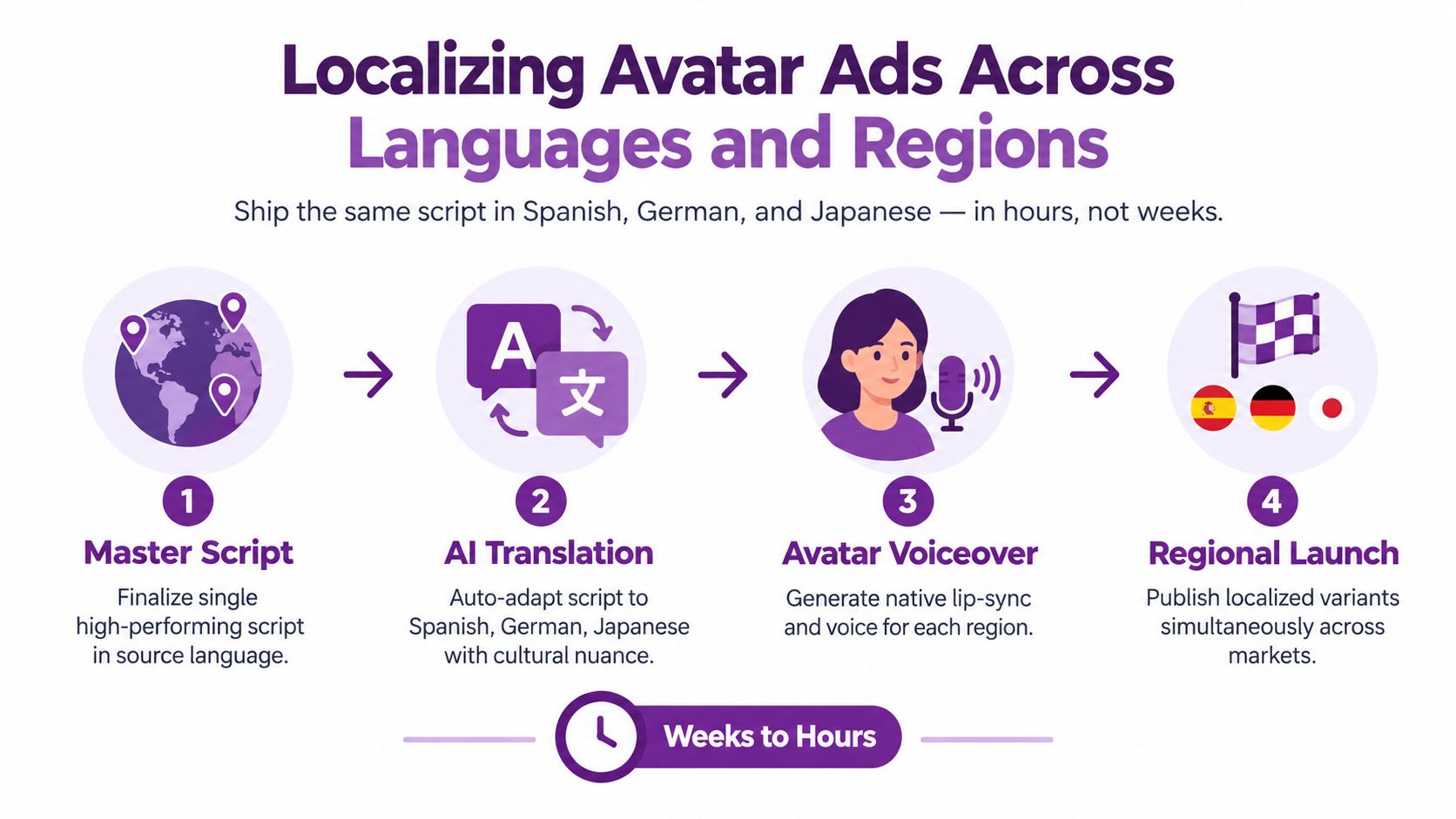
Localization fixes that only when it starts upstream. The job is not to translate a finished video. The job is to adapt a proven concept, script, voice, captions, disclosure, and CTA so the ad still feels credible in the target region and still matches the funnel stage you built it for.
What makes a localized avatar ad feel native
Three things decide whether people keep watching or scroll.
- Voice delivery: The translated read has to sound like a local speaker, not a dubbing pass. Stress, pause length, and sentence shape matter more than perfect literal accuracy.
- Lip sync: It does not need film-level precision, but it has to stay close enough that viewers stop noticing the mouth.
- Regional language choices: Spanish for Spain, Mexican Spanish, and neutral LATAM Spanish are different creative decisions. The same applies to English variants, Portuguese, French, and Arabic markets.
Disclosure also changes by region and placement. In colder traffic, a light visual label is often enough if platform rules allow it. In warmer traffic or higher-consideration offers, clearer disclosure usually protects trust better than trying to hide the format. If the ad starts to feel evasive, conversion rate often drops later in the funnel even when CTR looks fine.
Build a localization matrix before you generate anything
Use one source creative that already works. Then map every adaptation before production so the team is not making ad hoc edits in the video tool.
A useful matrix includes:
- Source ad and control metrics from the original market
- Target region and funnel stage for each variant
- Hook rewrite based on local phrasing, not direct translation
- Voice and accent choice by market
- Caption and on-screen text review separate from the spoken script
- Disclosure treatment by platform and region
- Native-speaker QA owner with approval rights before publish
That last point saves money.
I have seen teams approve a translated script because the grammar was fine, then lose the first three seconds because the opening line sounded like website copy instead of something a real person would say on TikTok or Reels.
Translate the intent, not the sentence
Hooks need the heaviest rewrite. Benefit lines and CTA language come second.
A direct English hook such as “Still wasting hours on manual follow-up?” may work in one market and feel too aggressive in another. The better move is to preserve the job of the line. Call out the pain fast, make it sound local, and keep the rhythm short enough for paid social. The same rule applies to on-screen text, price framing, urgency language, and proof cues.
Do not assume one localized cut can run everywhere on the same settings either. Meta can tolerate slightly denser copy if the first line is clear. TikTok usually needs looser phrasing and more conversational delivery. YouTube often gives you a little more room to state context before the pitch, but the opening still has to earn attention quickly.
A localized avatar ad can be grammatically correct and still miss. Tone is usually the reason.
Where Avatar Ads Win and Where They Fall Apart
The biggest mistake with AI avatar ads is forcing them into jobs they were never built to do.
They are not a universal replacement for human creators, founders, experts, or customers. They're a format with clear strengths and equally clear failure modes. Once you map those to funnel stage and price point, campaign planning gets much easier.
Where they tend to work
Independent evidence points to a real split by funnel stage and trust level. A 2026 creative-analysis source reported that AI spokesperson ads were at parity or better for cold traffic and sub-$100 offers, but performance diverged in retargeting and mid-ticket products. The same discussion of trust risk also pointed to controlled survey evidence showing that hyper-realistic AI personas without disclosure can sharply reduce trust on integrity and benevolence (AI spokesperson ad analysis).
That aligns with how the format behaves in practice. Avatar ads usually do well when the job is structured and informational:
- Feature walkthroughs
- Offer announcements
- Product explainers
- Comparison-style ads
- High-volume hook testing
- Fast localization across markets
They also make sense when the product is straightforward and the emotional stakes are low.
Where they start to break
Trust becomes the constraint in warmer or higher-consideration environments.
An APA-indexed marketing study found that when a video avatar was disclosed as synthetic, purchase intention fell because source trustworthiness dropped, with stronger negative effects for women and higher-income consumers. A related 2024 study using 290 participants found no statistically significant difference in information retention, engagement, or trust between a real human and a hyper-realistic avatar, but disclosure still caused a measurable retention decline, with scores falling from 4.065 to 3.593 and the difference reported as statistically significant (p = .003). A 2026 industry-research summary also reported an “AI ad gap,” where 82% of advertising executives believed Gen Z and Millennial consumers felt positively about AI-generated ads, while only 45% of those consumers felt that way, a 37-point gap (APA-linked synthetic avatar research summary).
That's the trade-off. The format can hold attention and scale production, but trust remains fragile.
Avatar Ad Performance by Funnel Stage and Price Point
| Funnel Stage | Low Price (<$50) | Mid Price ($50-$300) | High Price (>$300) |
|---|---|---|---|
| Top of funnel | Good fit for utility-driven offers and simple product intros | Mixed. Needs stronger proof and tighter scripting | Weak fit in most cases. Use human-led creative first |
| Middle of funnel | Strong for demos, feature comparison, and objection handling | Selective fit if the ad stays factual and product-led | Usually better with a real expert or founder |
| Bottom of funnel | Useful for reminders, offer framing, and urgency variants | Can work for retargeting if trust is already established | Risky unless the brand already has strong familiarity |
If your team is evaluating whether the format belongs in your stack at all, company context matters as much as creative taste. A vendor page like LunaBloom AI's about page gives the broader product context, but decision should come from your funnel, price point, and claim type.
Running A/B Tests That Actually Tell You Something
Most avatar ad tests are messy by design.
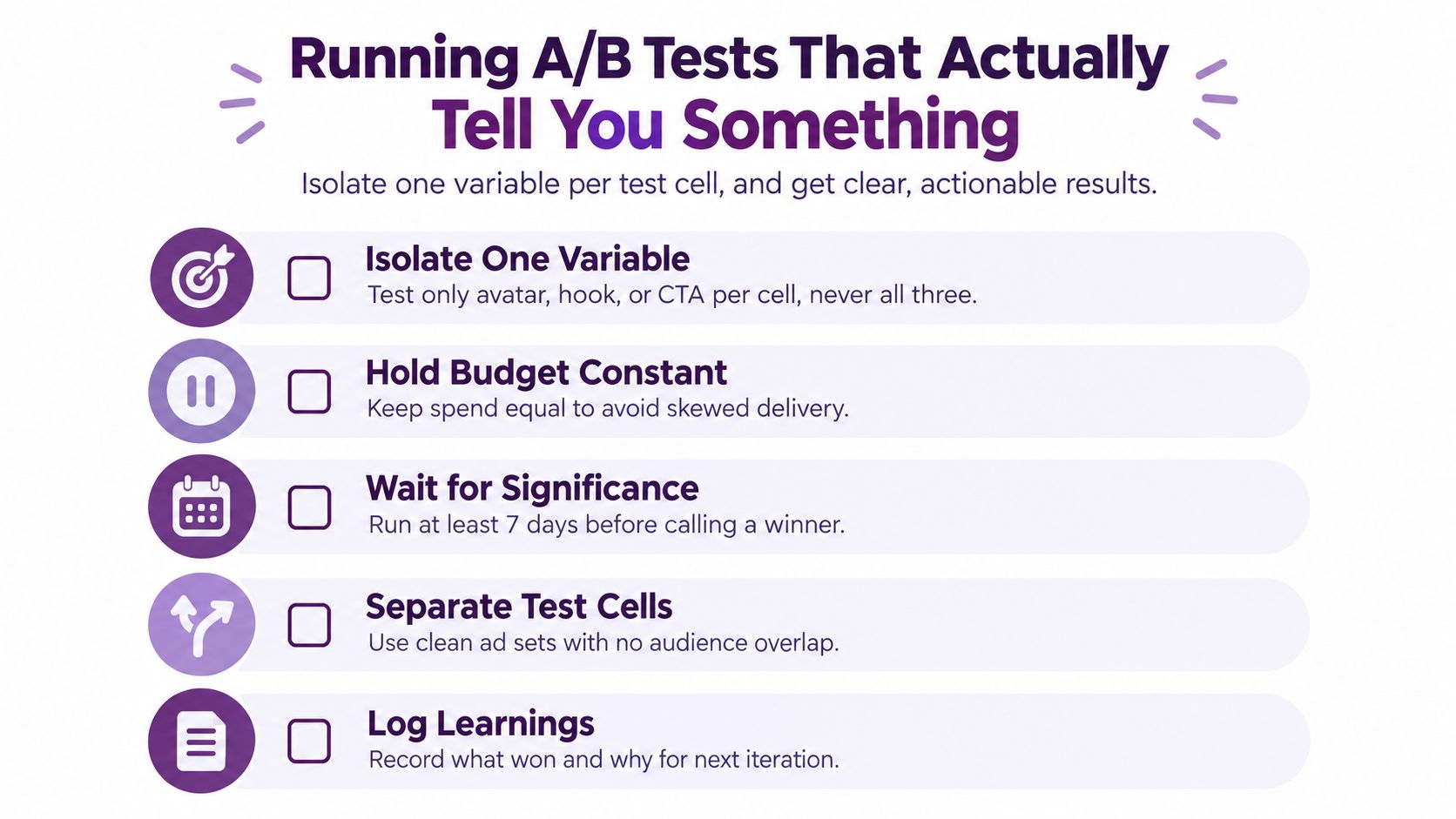
The team changes the hook, the avatar, the background, the CTA, and the edit style all at once. Then one ad gets an early lead and everybody calls it a winner. That isn't testing. It's guessing with ad spend.
Test one variable at a time
Set a primary metric before launch. That metric should match the job of the creative.
Good priorities look like this:
- Hook rate: Useful when testing the first three seconds
- Hold rate: Useful for testing pacing and structure
- CTR: Useful when comparing angle or offer framing
- CPA: Useful once you're testing mature variants deeper in the funnel
The variable order I'd use most often is:
- Hook
- On-camera line structure
- Avatar appearance
- CTA wording
- Caption overlay or thumbnail treatment
Use enough data to avoid fake winners
There is one quantitative rule worth keeping in mind here. A 20 percent lift detection at 95 percent confidence typically requires roughly 10,000 impressions per cell for a 2 percent baseline CTR. If you stop a test long before that, the risk of crowning a false winner goes up fast.
That's why early readouts should stay directional, not definitive.
A clean testing routine:
- Lock the audience: Don't compare creatives across shifting audience pools.
- Hold spend steady: Delivery skew can make a weak creative look stronger.
- Keep landing pages identical: Otherwise you're testing post-click friction too.
- Log the hypothesis: “Problem-first hook will beat benefit-first hook” is better than “testing some ideas.”
- Promote carefully: Move a winner into the next isolated test. Don't rebuild the whole ad at once.
The point of A/B testing isn't to find one magic ad. It's to learn which creative variable actually caused the lift.
Platform-Specific Tweaks and Compliance Essentials
The same avatar ad shouldn't go live on Meta, TikTok, and YouTube unchanged.
Each platform rewards different pacing, framing, and screen usage. A creative that feels native on TikTok can look cramped on Meta Reels. A YouTube version often needs more setup discipline because the viewer experience is different and the ad can appear in different contexts.
Creative adjustments by platform
For Meta, I usually prioritize 4:5 and 9:16 cuts with clear caption hierarchy and early branding handled lightly. Sound-off viewing matters, so captions and visual context carry more weight.
TikTok needs a faster cold open. The first line has to feel like feed content, not a commercial read. Looser pacing and simpler overlays usually work better than heavy graphic treatment.
YouTube gives you a little more room to set context, but it punishes slow starts. If the ad is skippable, the first few seconds still need a reason to stay. Avatar ads that work there usually lead with a specific problem or a direct product payoff.
AI Avatar Ad Specs Across Meta, TikTok, and YouTube
| Platform | Best Aspect Ratio | Sound Default | Hook Window | Disclosure Required |
|---|---|---|---|---|
| Meta | 4:5 and 9:16 | Often viewed sound-off | First few seconds need visual clarity | Required when AI materially shapes authenticity-related content |
| TikTok | 9:16 | Sound-on is common | Immediate native-style hook | Required for realistic synthetic people or scenes |
| YouTube | 16:9 and 9:16 depending on placement | Sound-on is common | Immediate relevance matters, especially for skippable ads | Required for meaningfully altered or synthetic photorealistic content |
Disclosure isn't a footer detail
The IAB's 2026 AI Transparency and Disclosure Framework says consumer-facing disclosures are required only when AI materially shapes content in ways that could mislead a reasonable consumer about authenticity, identity, or representation, and it explicitly names synthetic humans, images, videos, and AI voice cloning as disclosure triggers. The same framework says routine post-production, standard audio enhancement, text generation, and obvious stylized or cartoon avatars do not automatically require labels (IAB disclosure framework PDF).
The mechanics matter too. The IAB also recommends a two-layer model with consumer-facing labels plus internal governance and documentation for higher-risk uses such as synthetic avatars and digital twins. For consumer-facing disclosures, it lists standardized text labels, visual indicators like watermarks or badges, tap-or-hover info icons, and adjacent placement next to the creative asset rather than burying the disclosure elsewhere (IAB framework overview).
Regional triggers you can't ignore
A few concrete rules already matter in practice:
- California: A recent summary of SB 1050 states that AI-generated performers must be disclosed in ads when they are prominently featured, including when the synthetic performer is in the foreground demonstrating the product, narrating the ad, or reacting to narration (California SB 1050 summary).
- New York: A 2026 synthetic-performer law requires conspicuous disclosure in ads seen by New York audiences, including online and social campaigns, which makes cross-border campaign setup more operationally complex (New York AI regulation overview).
- New York commercial content practice: A July 2026 compliance summary reports dual disclosure for AI avatars in sponsored commercial content, with a promotional tag such as #ad or #sponsored plus a creation-method tag such as #AIGenerated or #synthetic (AI avatar disclosure compliance summary).
That's why disclosure needs to be part of trafficking and QA, not something added after export. If your workflow touches user data, campaign assets, or audience-level publishing logic, it's worth reviewing the platform policies and your own data handling standards together, including pages such as LunaBloom AI's privacy information.
AI avatar ads are ready for real campaign use now. But they only perform well when the team treats them like a system. Right funnel stage, right script, right platform cut, right disclosure, and disciplined testing.
LunaBloom AI gives teams a practical way to produce avatar-led ads, localized video variants, captions, voiceovers, and social-ready exports without stitching together a dozen separate tools. If you want to move from idea to publish-ready creative faster, visit LunaBloom AI and see how it fits your ad production workflow.