You've written a product demo, chosen the visuals, and reached the final decision: what should the narrator sound like? A warm AI female voice might make the video feel approachable, while a calm, authoritative voice could give the same script more credibility. That choice affects more than tone. It can influence how viewers interpret expertise, empathy, personality, and even the role your product appears to play.
An AI female voice is a synthetic voice generated from text, recordings, or a customized voice model. Creators use these voices for product demos, tutorials, social ads, training, accessibility, avatars, and multilingual videos. In a workflow such as LunaBloom AI, the voice can sit inside a larger production process that turns a script into a video with narration, captions, synchronized visuals, and publishing assets.
Introduction to AI Female Voice and Why It Matters Now
Suppose a small business owner is preparing a short video for a new wellness app. The script is clear, the screen recordings are ready, and the brand feels friendly but professional. A bright, energetic narrator may help the video perform well as a social ad, but the same voice could feel distracting in a guided tutorial. A softer, measured delivery might work better for onboarding, even if both voices read the exact same words.
That's the practical meaning of an AI female voice. It isn't a woman reading through a microphone. It's a generated performance shaped by vocal qualities such as pitch, timbre, pacing, pronunciation, emphasis, and emotional delivery. A preset voice can sound conversational, formal, reassuring, playful, or characterful, depending on the model and the controls available.
Demand helps explain why female-oriented voice technology appears so often in creator tools and assistant products. One industry summary reports that 66% of internet video viewers prefer a female voiceover to a male voiceover, while the same source says that 92% of the U.S. market uses female voices for AI assistants. These figures come from an industry summary, not a universal rule for every audience, so they should guide testing rather than replace it. The cited voice-over industry summary also estimates the U.S. synthetic voice market at USD 0.56 billion in 2024, with a 27.6% CAGR.
What this guide helps you decide
You'll learn how synthetic female voices are built, why some sound natural while others feel artificial, and how to match a voice style to a specific use case. You'll also see how pitch and prosody controls differ from voice cloning, why localization needs more than translation, and why consent and disclosure belong in the production checklist.
The central idea is simple: voice selection is product design. Choose it with the same care you'd apply to visuals, copy, or an interface.
How AI Female Voices Are Created and How They Sound Human
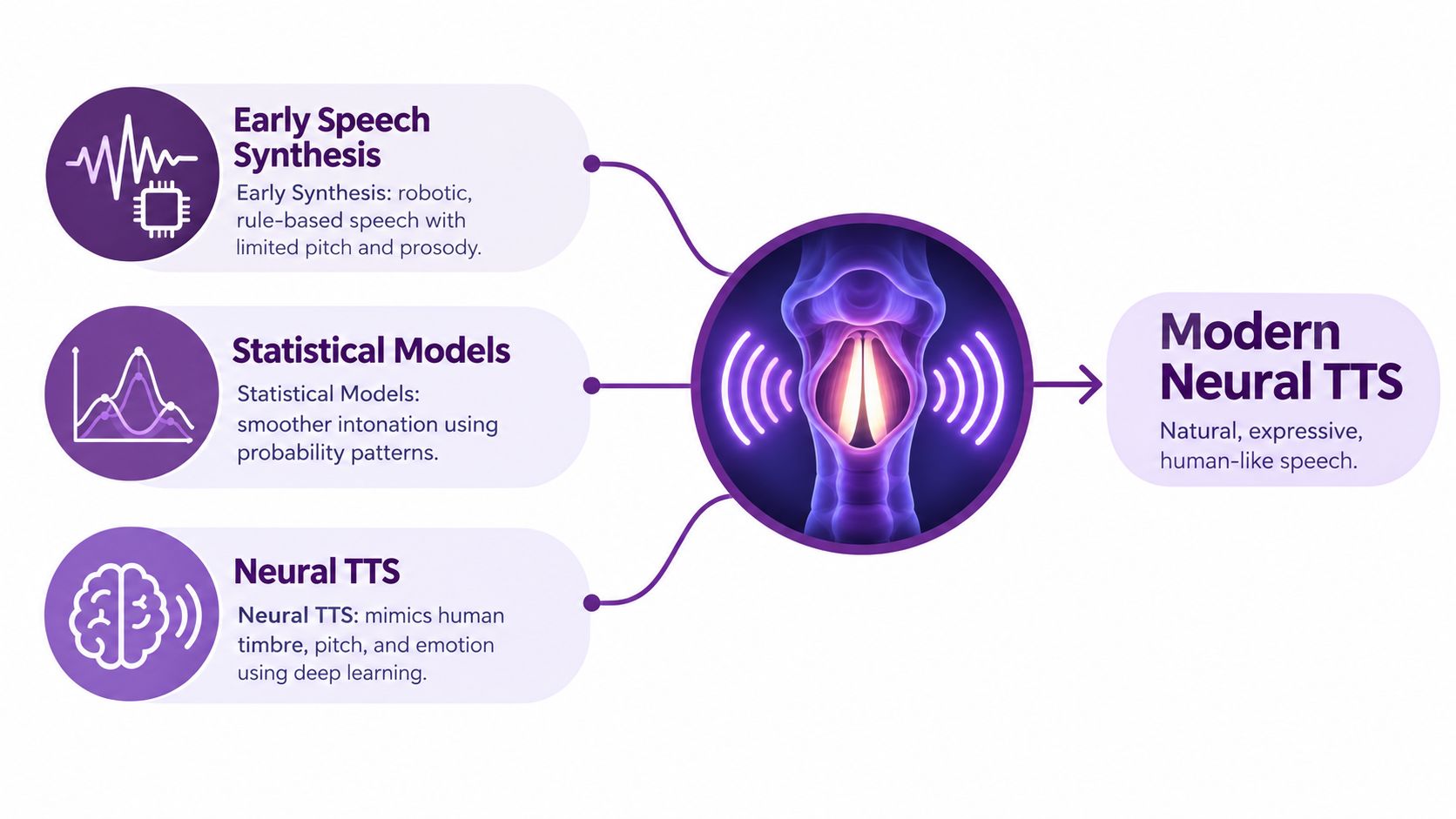
Text-to-speech, often called TTS, converts written language into spoken audio. Older systems relied on hand-written pronunciation rules and carefully assembled sound units. Modern systems use neural models that learn patterns from speech data, then generate a new performance from text.
A useful analogy is learning an instrument. The model doesn't memorize one recording and replay it for every sentence. It learns the instrument's character, the timing between notes, how emphasis changes meaning, and how a phrase rises or falls. For a voice model, those elements correspond to timbre, pitch, prosody, pronunciation, rhythm, and pauses.
Synthetic female voices have a long research history. Early parametric speech systems were built around 1950, and by 1956–1957, researchers were demonstrating male-female voice conversations. In 1998, Bell Labs' high-quality female-sounding synthesized voice “Julia” won an international competition, a milestone showing that female voice synthesis had moved beyond laboratory experiments toward recognized quality benchmarks. The historical review of speech synthesis documents that progression.
The qualities listeners notice
A natural result usually combines several details rather than relying on pitch alone:
- Timbre: The recognizable color or texture of the voice.
- Pitch movement: The way the voice rises, falls, and varies across a sentence.
- Prosody: Timing, stress, pauses, and phrasing that communicate meaning.
- Pronunciation: Correct treatment of names, acronyms, technical terms, and local words.
- Breath and rhythm: Subtle variation that prevents every sentence from sounding equally shaped.
A high pitch doesn't automatically create a convincing female voice. If the model keeps the same rhythm for every sentence, misplaces emphasis, or pronounces a brand name incorrectly, listeners may notice the artificial quality immediately. Naturalness comes from coordinated control.
The quality of a model also depends on its training and evaluation data. A system can sound strong in one language or accent and less convincing in another, particularly when names, regional pronunciation, or expressive delivery receive less coverage. Before committing to a long project, listen to a representative sample that includes numbers, questions, abbreviations, emotional lines, and the proper nouns in your script. You can find product details and company information about LunaBloom through its about page.
Exploring AI Female Voice Types and Where Each Shines
The best voice isn't the one that sounds impressive in isolation. It's the one that supports the listener's task. A customer support explainer needs ease and patience, while a corporate announcement may need controlled authority. A gaming trailer can tolerate more sparkle and theatrical energy than a compliance tutorial.
Use the following styles as starting points, then test the complete script rather than judging a voice from a single sentence.
A practical comparison
| Voice Style | Best For | Tonal Traits |
|---|---|---|
| Warm and friendly | Customer support, onboarding, brand assistants | Open, empathetic, conversational |
| Professional and authoritative | Corporate training, announcements, narrations | Clear, composed, confident |
| Cheerful and energetic | Gaming, apps, social ads, marketing videos | Lively, bright, enthusiastic |
| Calm and soothing | Meditation, wellness, audiobooks, reflective content | Measured, gentle, reassuring |
Warm and friendly voices work when the audience needs to feel welcomed. They can make a software walkthrough less intimidating or help a new customer understand the first steps in an app. Watch for over-familiar delivery in serious contexts, where excessive cheerfulness may weaken trust.
Professional and authoritative voices suit information that requires attention. They're useful for workplace training, safety instructions, educational narration, and formal announcements. Authority comes from precise diction and steady pacing, not from lowering the pitch.
Cheerful and energetic delivery gives short-form content momentum. It can support a product launch, game update, app feature, or creator-led advertisement. Keep the script concise and let the visuals share the energy, because a highly animated voice can compete with dense on-screen text.
Calm and soothing voices create space for listening. Wellness content, meditations, bedtime stories, and audiobook passages benefit from deliberate pauses and a restrained emotional range. A calm voice still needs variation, otherwise reassurance can turn into monotony.
Selection rule: Choose the emotional job first, then choose the vocal personality that performs it.
The reported preference for female voiceovers may make a female preset a reasonable first test for video content, but it doesn't remove the need for audience feedback. Compare two or three options using the same opening, call to action, and key product explanation. Ask whether the voice makes the brand feel more capable, more caring, more exciting, or more stereotyped.
Customization Cloning and Localization for AI Female Voices
A preset voice gives you a starting point. Customization gives you control over how that voice behaves in your video. Think of the process as three layers: adjust the performance, decide whether a distinct identity is needed, and then adapt the result for each audience.
Layer one adjusts the performance
Start with the script before touching advanced settings. Mark words that need emphasis, identify technical terms, and insert pauses where the viewer needs time to process an idea. Then adjust:
- Pitch: Use small changes to support character and clarity, rather than forcing an exaggerated register.
- Pace: Slow instructional material and allow faster movement in short promotional sections.
- Emotion: Match intensity to the content. A serious announcement needs a different range from a celebratory launch.
- Pronunciation: Add guidance for names, acronyms, product terms, and unfamiliar locations.
- Emphasis: Highlight the words that carry the promise, instruction, or next action.
Read the final video with the visuals in place. A line that sounds natural alone may feel rushed when paired with a screen transition or caption animation.
Layer two considers voice cloning
Voice cloning creates a model that resembles a particular speaker from reference recordings. That can help a creator maintain a recognizable identity across videos, or allow a brand to build a consistent narrator without recording every revision.
Cloning is not the same as making a generic female voice. A cloned voice carries identity cues, so permission and usage scope matter. It also needs clean source audio and a consistent recording style. If the samples vary sharply in room sound, microphone quality, or delivery, the output may reproduce those inconsistencies.
A controlled voice-conversion study reported that same-gender transfer produced higher similarity than cross-gender transfer. For female targets, cross-gender and single-gender intelligibility scores were close, with WER described as very similar in the female-target case. The voice-conversion benchmark material supports a useful production distinction: speech can remain understandable even when the output doesn't preserve the target identity as convincingly.
Layer three handles localization
Localization changes more than vocabulary. A good localized voiceover may need different pronunciation, rhythm, formality, and cultural delivery. Review translated scripts for sentence length, names, idioms, and words that carry a different emotional weight in the target market.
For a stock voice, select a locale-specific option when available. For a cloned voice, check whether the model preserves the speaker's identity while speaking the new language or accent. Always review captions against the spoken output, especially for names and specialized terminology. A workflow such as the LunaBloom AI starter app can be considered when you need voice generation inside a broader video creation process.
Why Female Voices Dominate and How Choice Shapes Perception
Female voices became common in assistants and media for several overlapping reasons. Producers may associate them with warmth, approachability, or service, while audiences may respond differently to a narrator depending on the task and context. Historical defaults then reinforce familiarity, making the next product team more likely to select a similar voice.
That pattern deserves scrutiny because a voice can assign a social role before the speaker says anything meaningful.
Research on speech AI bias has identified gender stereotypes in voice systems, including examples where models default to female voices for stereotyped roles such as “Nurse.” Separate work on text-to-audio generation has also reported strong gender bias, with some terms disproportionately associated with male or female voices. These findings make voice selection a design decision about perceived authority, empathy, and occupational identity, not only a cosmetic preference. The discussion of consent and voice-related risks provides further context for evaluating those choices.
The effect can extend into the AI system itself. A 2026 arXiv study on audio-enabled large language models found systematic gender discrimination, with responses shifting toward gender-stereotyped adjectives and occupations solely because of the speaker's voice. The study reported that this bias was stronger in audio-based interaction than in text-based interaction. The reported analysis of gender effects in audio-enabled models shows why voice testing should include the system's responses, not only the rendered audio.
Design question: If you replaced the female voice with a male or non-gendered voice, would the perceived authority, role, or trust change?
Test that question with real listeners. Ask them to describe the narrator's role, expertise, warmth, and confidence without giving them your intended answer. If the output consistently pushes a support role when you intended a technical expert, adjust the voice, script, visual identity, or all three.
One experiment cited in recent reporting found that 18% of interactions with a female-embodied agent were sexual, compared with 10% for male-embodied agents and 2% for non-gendered embodiments. The reporting on feminine AI embodiment and stereotypes illustrates an uncomfortable product risk: a female persona may attract interactions that affect moderation, safety, and user trust. Teams should plan boundaries, escalation paths, and neutral alternatives before launch.
Legal and Ethical Essentials for Using AI Female Voices Responsibly
The common assumption is that uploading a recording makes it available for cloning. That assumption is unsafe. Voice cloning can be legal, but the standard differs across jurisdictions, and a platform's general audio-processing terms may not cover the exact commercial use you have in mind.
The safest workflow is to obtain explicit written permission for another person's voice and clear the source recording before creating or distributing a clone. This guide to AI voice-cloning laws and ethics recommends treating consent as specific to the cloning use, rather than assuming that permission to upload audio for transcription or editing also permits synthetic voice creation.
Build consent into production
Before recording or uploading a reference voice, document:
- Identity: Confirm who the speaker is.
- Age: Confirm that the speaker can provide the relevant permission, with extra care for a minor.
- Authority: Verify that the person signing has the right to authorize the voice.
- Purpose: State whether the voice will be used for narration, advertising, training, assistants, or other work.
- Scope: Define platforms, territories, languages, duration, editing rights, and whether sublicensing is allowed.
- Withdrawal and records: Keep the signed permission, dates, versions, and any changes to the approved use.
A consent form should also address disclosure. A major policy direction around synthetic voices emphasizes consent, disclosure, and traceability, including written informed consent, notice that a voice is AI-generated, and records showing when permission was granted and what it covered. The same regulatory summary notes that AI-voice robocalls without consent were restricted by the FCC in February 2024, while unauthorized commercial voice clones can create liability under Tennessee's ELVIS Act. The country-by-country voice-cloning regulation overview explains why a single global assumption won't work.
Protect audiences as well as speakers
Ethical use also means reducing deception. Label synthetic narration where a reasonable viewer could mistake it for a real person, especially in advertising, political content, customer contact, or sensitive communications. Don't use a recognizable woman's voice to imply endorsement when she hasn't approved that association.
For suspicious files, impersonation attempts, or audio that may have been manipulated, creators and moderators can use resources that explain how to verify suspicious audio files. Keep the result of that review with your project records, particularly when the content may affect someone's reputation or access to money.
LunaBloom's privacy information is available through its privacy page. Read the terms of any voice platform you use, and obtain legal advice for high-risk or cross-border projects.
Bringing Your AI Female Voice Into Real Videos With Confidence
A polished result comes from testing the voice as part of the whole video. Start with a short script that includes your strongest claim, a technical term, a question, a pause, and the final call to action. Render it with the chosen visuals, captions, and music before producing the full library.
Use this checklist:
- Voice fit: Does the style match the audience's task?
- Natural delivery: Do pauses, emphasis, and pitch movement sound intentional?
- Identity: If you cloned a speaker, does the output preserve recognizable qualities?
- Localization: Do pronunciation, rhythm, captions, and cultural phrasing work in every target locale?
- Fairness: Does the voice assign a stereotype or service role that conflicts with the product?
- Disclosure: Can viewers understand that the narration is synthetic where disclosure is appropriate?
- Permission: Do your records cover the speaker, exact use, scope, and source recordings?
Benchmark averages can hide uneven performance. In neutral zero-shot TTS voice-cloning data, female voices represented 45% in en-US, 38% in es-ES, 37% in es-MX, 18% in nl-NL, 9% in pt-BR, and 17% in ky. The benchmark paired those samples with human-topline measures for WER and speaker similarity, showing why gender and locale should be reported separately rather than reduced to one pooled score. The multilingual TTS benchmark offers a useful model for that testing approach.
For campaign production, a tool such as the ShortGenius AI video ad maker can help teams turn voice-led concepts into ad variations, while LunaBloom's video creation app supports a broader workflow for scripts, narration, captions, avatars, and localized video output. Choose tools according to the controls, permissions, and review process your project needs.
LunaBloom AI turns scripts, prompts, and images into edited videos with natural voiceovers, captions, avatars, localization, and lip-synced visuals, including workflows built around custom voice creation. Visit LunaBloom AI to test an AI female voice on a short product demo or tutorial, then review its tone, identity, locale, and disclosure before scaling the project.