If you want to successfully translate a video from Spanish to English, the process breaks down into three key steps. First, you need an accurate transcription of the original Spanish audio. Second, you use a reliable AI-powered translation tool to convert that text to English. Finally, you integrate the English text back into your video, either as subtitles or a new dubbed audio track.
It’s a simple workflow that can open your content to a massive new, English-speaking audience.
Why Translating Spanish Videos to English is a Game-Changer
Breaking into new markets can feel overwhelming. But what if you could reach a vast, English-speaking audience with content you’ve already made? This isn't just an idea—it's a smart strategy to amplify your message, brand, and revenue.
Many creators and businesses have Spanish-language videos packed with value that is currently inaccessible to millions on platforms like YouTube and Instagram. Translating that content is the key to unlocking its full global potential.
Expanding Your Global Footprint
Let's look at a practical example. Imagine you’re a Spanish vlogger creating travel guides for Latin America. Your local audience loves your content, but your growth has stalled. By adding English subtitles or an AI-generated dub, you instantly make your videos accessible to tourists and travel enthusiasts in the United States, Europe, and beyond. Your expertise is suddenly on a global stage.
The same principle applies to businesses. A company in Mexico City with a great product demo in Spanish can reach international customers simply by translating it. This single action transforms a local marketing asset into a powerful global sales tool.
The demand for this is exploding. The global AI Video Translation Market is projected to grow from USD 5,039.4 million in 2025 to USD 38,031.5 million by 2034. This surge shows a clear need for tools that can handle this work seamlessly, helping creators connect with new audiences. AI platforms that handle subtitles and voice cloning can reduce production time by up to 80%, making cross-border engagement easier than ever.
The real power of translation isn't just about swapping words from one language to another. It's about forging a connection with a new culture and community, expanding your impact far beyond your original borders.
The Modern Advantage of AI Solutions
So, how do you actually do this? In the past, video translation was a nightmare—slow, expensive, and required hiring manual transcribers and voice actors. It was a significant barrier for most creators.
Today, AI has completely changed the game.
Video Translation Methods at a Glance
To understand how much things have improved, let's compare the old way with modern AI solutions. The difference in speed, cost, and accessibility is dramatic.
| Feature | Traditional Methods (Manual) | AI Solutions (like LunaBloom AI) |
|---|---|---|
| Speed & Efficiency | Days or weeks per video. Involves multiple professionals. | Minutes to a few hours. Fully automated workflow. |
| Cost | Very high. Requires hiring transcribers, translators, and voice actors. | Highly affordable. Subscription-based or pay-as-you-go models. |
| Accuracy | High, but depends entirely on the skill of the individuals hired. | Very high (95%+), with continuous AI model improvements. |
| Scalability | Difficult and expensive to scale. Each video is a new, costly project. | Extremely scalable. Translate entire libraries of content quickly. |
| Consistency | Can vary between different translators and projects. | Consistently applies brand-specific terminology and tone. |
| Accessibility | Limited to those with significant budgets and industry contacts. | Accessible to everyone, from solo creators to large enterprises. |
As you can see, AI hasn't just made the process easier; it has made professional-grade video translation available to anyone, regardless of budget or team size. This shift is empowering more creators than ever to go global.
Modern AI platforms offer a faster, more cost-effective, and highly accurate alternative. These tools can automatically transcribe Spanish audio, translate the text with precision, and generate subtitles or a natural-sounding English voiceover. This efficiency allows solo creators to produce multilingual content that rivals major studios. You can learn more about the mission behind these accessible AI tools on our about page.
Your Core Translation Workflow From Start to Finish
Diving into video translation might seem complex, but it boils down to a straightforward process. I think of it in three phases: transcribing the original Spanish audio, translating that text into natural-sounding English, and finally, adding the new English content back into your video.
This is more than a technical checklist; it’s about preserving your message's original feel so it resonates with a new audience. When you translate video from Spanish to English, the goal is for the final product to feel intentional, not like a tacked-on afterthought.
Phase One: Accurate Spanish Transcription
Before any translation happens, you need a perfect script of everything said in the video. This is your foundation. If this step is wrong, the errors will multiply, resulting in a confusing or inaccurate translation.
You could type it all out by hand, but that's incredibly time-consuming. Modern AI transcription tools are the way to go. Platforms like LunaBloom AI can analyze your video's audio and produce a highly accurate, time-stamped Spanish transcript in minutes. This captures not only the words but also their exact timing—which is crucial for subtitles.
Key Takeaway: Don't rush transcription. A clean, accurate Spanish transcript is the most important factor for a high-quality translation. It's the blueprint for everything that follows.
This first step alone saves hours of tedious work and provides a professional-grade document to build upon.
Phase Two: Smart Translation and Review
With your Spanish transcript ready, it's time for translation. AI translation engines excel here, instantly converting your entire script into English. For common language pairs like Spanish and English, accuracy rates often exceed 95%.
However, language is more than just words. It's filled with cultural context, idioms, and nuances that a machine might miss.
Consider the Spanish phrase "no tener pelos en la lengua" (literally "to not have hairs on the tongue"). A direct AI translation would be nonsensical. A human knows the English equivalent is "to be blunt" or "to speak one's mind." This context is key.
This is why a quick human review is invaluable. Let the AI handle the heavy lifting, then have a fluent speaker scan the text to catch cultural quirks and refine awkward phrasing. It’s the perfect blend of machine speed and human polish. If you want to explore other options, this ultimate guide to AI video translation tools can help you find the best fit for your needs.
Phase Three: Implementation Into Your Video
Now for the final step: bringing your new English text to life. You have two main options, and the best choice depends on your audience and distribution platform.
- Generating Subtitles: This involves creating a subtitle file, typically an .SRT file. This simple text file syncs the translated English text with the timestamps from your transcript. When uploaded to a platform like YouTube, viewers can easily toggle captions on or off.
- Creating an AI Dub: For a more immersive experience, you can use AI dubbing. This generates a completely new audio track in English, using a synthetic voice to read the translated script. Advanced tools even offer voice cloning, making the English version sound remarkably like the original Spanish speaker.
Both options can be handled automatically within a platform like LunaBloom AI. To see how easy it is, you can get started with our starter app and try it yourself. This final step brings all your work together, transforming your Spanish video into content anyone in the world can enjoy.
Choosing the Right Subtitle Strategy
So, your English translation is ready. Now you have to decide how to present it in your video. Subtitles are not just an add-on; they are crucial for making your content accessible and engaging when you translate video from Spanish to English. Your choice here impacts user experience and even your video's discoverability.
You have two main paths: soft subtitles or hardcoded subtitles. The difference is simple but has a significant impact on how people interact with your content.
Understanding Soft Subtitles
Soft subtitles, also known as closed captions, are a separate text file that you upload alongside your video. The most common format is .SRT.
Think of them as a text layer that viewers can turn on or off on platforms like YouTube or Vimeo. This approach offers flexibility and several key benefits:
- Viewer Control: Your audience is in charge. They can enable captions based on their needs, environment (like a quiet office), or hearing ability.
- SEO Advantages: This is a major benefit. Search engines can read the text within .SRT files. This makes your video indexable for all the English keywords in your translated script, dramatically improving its chances of being discovered.
- Multi-Language Support: Want to add more languages later? No problem. You can upload multiple .SRT files, making a single video accessible to a truly global audience.
This diagram illustrates the core process.
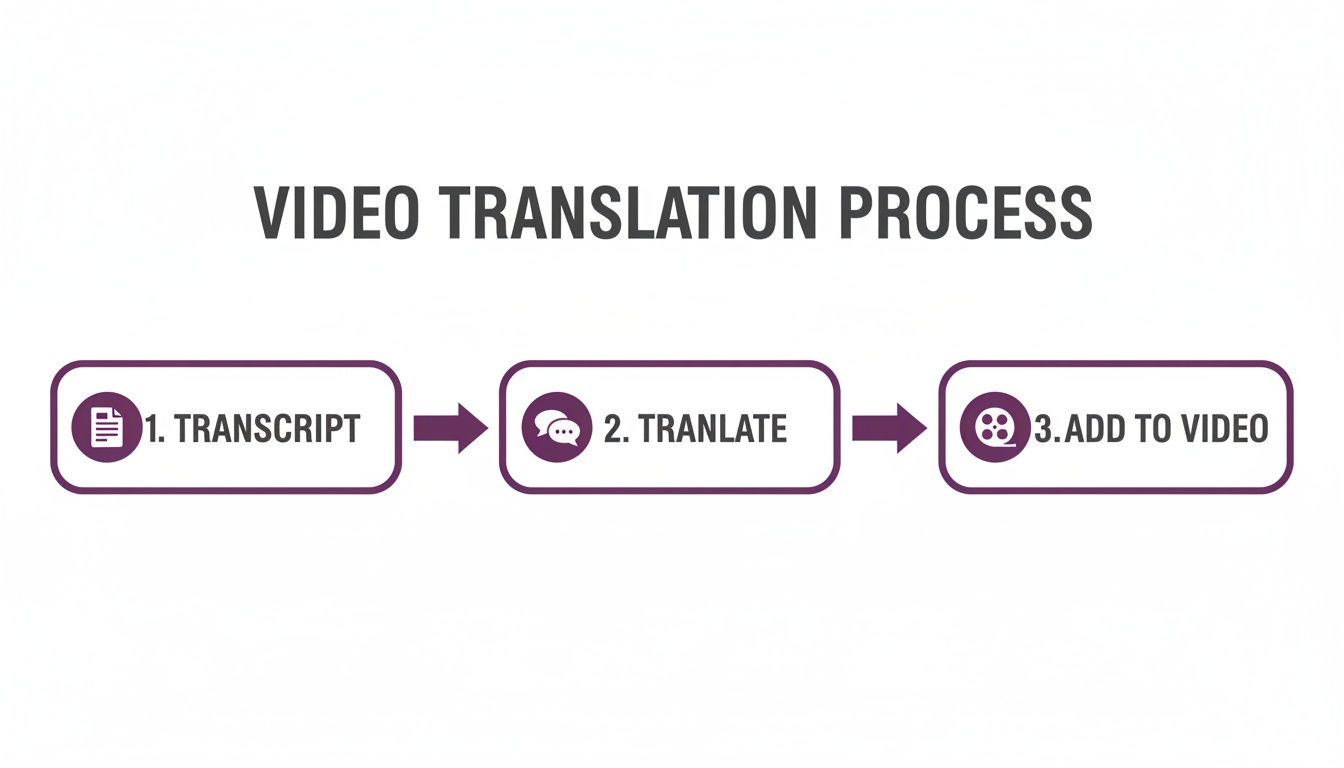
Whether you choose soft or hardcoded subtitles, this basic workflow—transcribe, translate, and add to video—is your starting point.
The Case for Hardcoded Subtitles
Hardcoded subtitles, or open captions, are the opposite. They are permanently "burned" into the video file itself. They become part of the image and cannot be turned off.
While you lose viewer control, this method is essential for certain platforms.
Think about scrolling through Instagram Reels or TikTok. Videos often autoplay without sound. If captions aren't immediately visible, you're likely to keep scrolling. Hardcoded subtitles grab attention from the first second, with or without audio.
For social media, hardcoded subtitles are a survival tactic. They ensure your message gets across even when users watch on mute, which is how a huge portion of mobile video is consumed.
If you are posting a marketing video on Instagram Stories or a promo clip on LinkedIn, you should always use hardcoded subtitles. The goal is to remove any friction that might prevent someone from engaging.
The video translation market is growing rapidly at a 10.00% CAGR. With over 500 million native speakers, Spanish is a huge part of this market. Using AI for subtitling not only saves money—traditional methods can cost $10-20 per minute—but has also been shown to increase viewer retention by 30-50%.
Tools like LunaBloom AI make this process incredibly simple, allowing you to generate professional-looking subtitles automatically.
You can generate the subtitles and then customize the font, color, and size to match your brand's aesthetic before finalizing the video. This control ensures your hardcoded captions feel like a seamless part of your content.
For more deep dives and practical tips, check out the LunaBloom AI blog.
Going Further With AI Dubbing and Voice Cloning
Subtitles are a fantastic start, but if you want to create a truly seamless experience for your English-speaking audience, consider AI dubbing. This is the next level when you translate video from Spanish to English, moving beyond on-screen text to replace the original audio entirely.
Let's be honest: not everyone wants to read subtitles. Dubbing delivers your content in a way that feels native and effortless. It gives your video a high-production quality that captures viewers who prefer listening, making your work feel more professional and accessible.
AI dubbing works by generating a new audio track from your translated English script. This English voiceover is then perfectly synchronized with the video, matching the timing and on-screen actions. It's a powerful way to eliminate the disconnect some viewers feel with foreign-language content.
Maintaining Authenticity With Voice Cloning
A common concern with dubbing is losing the original speaker's personality. That's a valid point, and it’s where voice cloning comes in. This advanced form of AI dubbing analyzes the original Spanish speaker's vocal characteristics—their unique pitch, tone, and rhythm—and replicates them in the new English audio.
This technology is a game-changer for authenticity. The new English track doesn't sound like a generic, robotic narrator. It sounds like the original person, just speaking fluent English.
Key Takeaway: Voice cloning makes AI dubbing feel real. It preserves the speaker's unique vocal fingerprint, making the translated video feel personal and genuine instead of disconnected.
This ensures the emotion and personality of the original performance are carried over, which is crucial for building trust with a new audience.
The Impact of a Great Dub
A well-executed dub isn't just about convenience; it can dramatically impact viewer engagement and retention.
Here’s a real-world example:
- The Creator: A Spanish-speaking educator with a successful YouTube channel on digital marketing.
- The Problem: Her analytics showed significant traffic from the U.S., but watch time was low. Viewers were leaving due to the language barrier.
- The Solution: She used AI to dub her top ten videos into English, using voice cloning to retain her familiar, trusted teaching voice.
- The Result: In just three months, her average watch time from U.S. viewers more than doubled, and her subscriber growth in that region increased significantly.
This shows that removing the friction of reading subtitles can deliver measurable results. When you meet your audience on their terms, you make it easy for them to connect with your content. You can see how simple this process is by checking out the LunaBloom AI app.
How to Polish and Optimize Your Translated Video
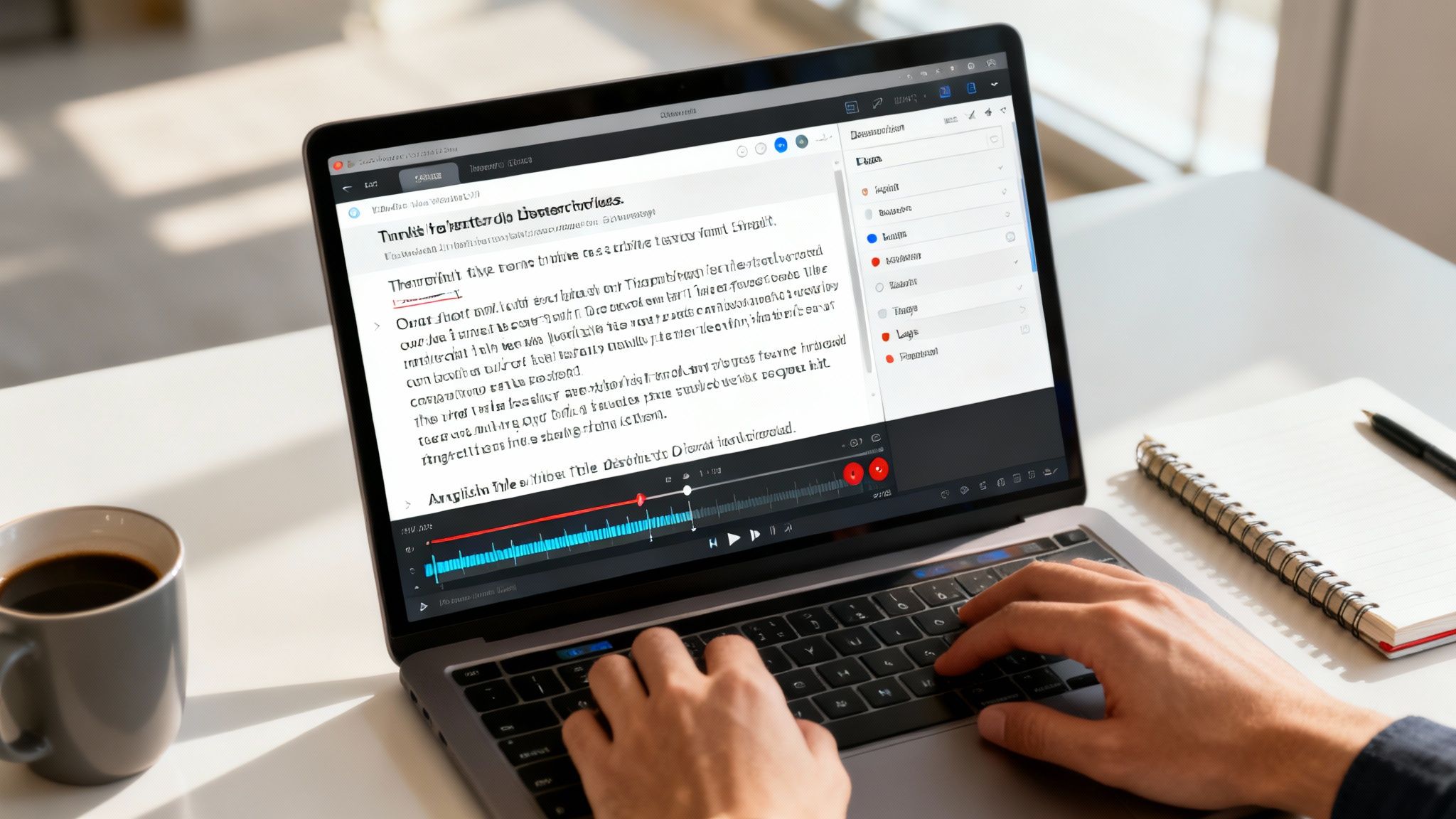
A good translation conveys your message, but a polished video is what truly engages an audience and helps them find you. This final review is where you catch the small details that make a huge difference in how professional your content feels.
This is the human touch. It’s about spotting things an AI might miss, like awkwardly translated idioms or subtitle timing that's slightly off. This is what separates a decent translation from exceptional content.
Your Final Quality Control Checklist
Before you hit publish, dedicate time to one last, crucial review. This step ensures all your hard work pays off with a video that genuinely connects with English-speaking viewers.
Here’s what to look for:
- Subtitle Timing and Sync: Watch the video while reading the subtitles. Do they appear and disappear in sync with the speaker's rhythm? Even a slight delay can be very distracting.
- Cultural Nuances and Idioms: Check for any Spanish phrases that received a clunky, literal translation. A phrase like "ponerse las pilas" should be translated as "get your act together," not "put in the batteries."
- Dubbing Clarity and Pacing: If you chose an AI voice, close your eyes and listen. Is the voice clear and easy to understand? Does the pacing sound natural, or is it rushed and robotic?
- On-Screen Text: Don't forget any text that is part of the video itself, like on graphics or title cards. Ensure these have also been translated correctly.
This final pass is non-negotiable for producing high-quality work.
Optimizing for Search and Discovery
Your video is polished and ready. Now, you need to make sure people can find it. Simply adding English subtitles isn't enough; you must signal to platforms like YouTube that your content is intended for an English-speaking audience. This comes down to optimizing your metadata.
The growth in machine translation is staggering—the market is projected to hit USD 3 billion by 2027, with Spanish-to-English accuracy already reaching 95%. This technology can reduce time-to-market for creators by 60% in what is expected to be a USD 98.11 billion market by 2028.
Start by translating your video's title and description. But don't just translate them—optimize them with keywords an English speaker would actually search for. Use relevant tags in English to help the algorithm understand who to show your video to.
Pro Tip: When you upload an .SRT subtitle file to YouTube, its algorithm indexes every single word. This makes your video searchable for everything spoken in it, providing a massive—and often overlooked—SEO boost.
To give your video the best chance of success, consider using an AI Content Optimizer tool to fine-tune your titles and descriptions. Properly labeling your video helps the platform get it in front of the right viewers, turning your translation efforts into real growth.
Common Questions About Translating Spanish Videos
Even with a clear plan, a few questions often come up. Let's tackle some of the most common ones people ask when they decide to translate video from Spanish to English. Answering these will help you move forward with confidence.
How much does it cost to translate a video?
This is the big one, and the answer has changed dramatically. In the past, this process required hiring manual transcribers, human translators, and professional voice actors, which could cost hundreds or even thousands of dollars for a single video.
Today, AI-powered platforms have changed everything. Instead of paying per word or per minute, you can now use subscription-based services. This allows you to translate an entire library of content for a flat monthly fee, making professional translation accessible to solo creators and small businesses.
How long does the process take?
Speed is another area where modern tools have a huge advantage. The traditional, human-only workflow could take anywhere from several days to a few weeks, depending on video length and professional availability.
With an AI workflow, what used to take weeks now takes minutes or hours.
- AI Transcription: Get a full Spanish transcript in just a few minutes.
- AI Translation: Converting the script to English is nearly instantaneous.
- Subtitle Generation/AI Dubbing: Creating the final .SRT file or dubbed audio track usually takes less than an hour.
The only manual step remaining is a quick human review. While it adds a bit of time, it provides an essential layer of quality and polish to your final video.
Can I ensure cultural accuracy?
This is a great question that touches on what makes a translation truly effective. While AI is excellent at direct, literal translation, it can sometimes miss the cultural nuances, slang, or idioms that give a language its character. A word-for-word translation of a joke or a common saying might fall flat or cause confusion.
The best strategy is a hybrid approach. Let AI handle the heavy lifting of the initial translation. Then, have a native English speaker review it. They can spot tricky phrases and suggest alternatives that capture the original intent and spirit, not just the literal words.
This final human touch is what elevates a good translation to a great one. It ensures your message lands exactly as intended, building a genuine connection with your new audience. If you have more specific questions, you can always get in touch with our team for guidance.
Ready to unlock a global audience for your content? With LunaBloom AI, you can translate, subtitle, and dub your videos in minutes, not weeks. Start creating with LunaBloom AI today and discover how easy it is to share your message with the world.