If your content only speaks English, you're missing out on a massive, highly engaged audience. Adding a voice over Spanish track isn't just about translating words; it's about connecting with over 500 million native speakers on a cultural level. This simple addition can unlock incredible growth and expand your brand's reach far beyond its current borders.
This guide will walk you through everything you need to know, from understanding the market to generating a flawless AI voice over.
Why a Spanish Voice Over Unlocks Global Growth
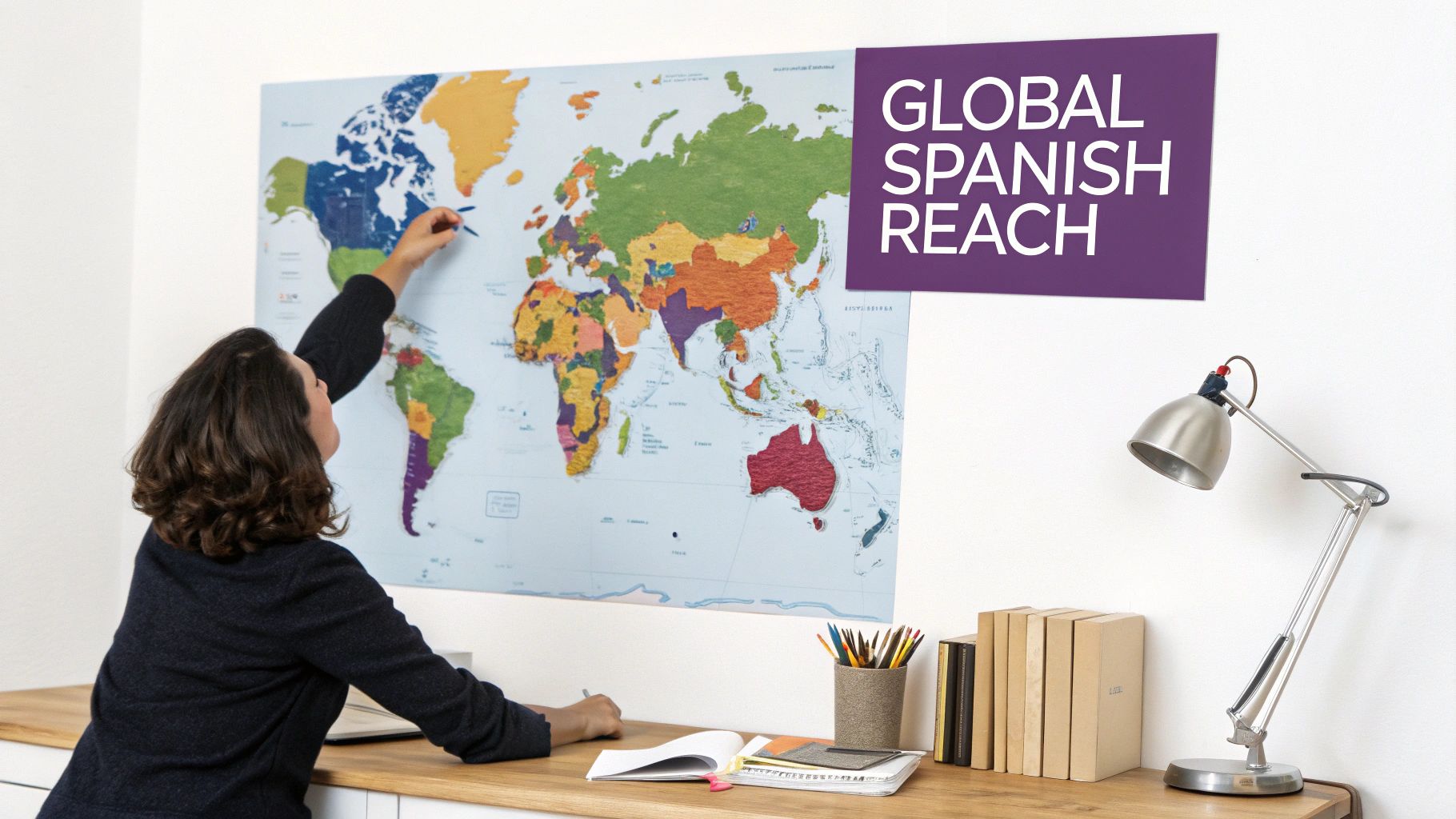
Expanding into the Spanish-speaking market is no longer a "nice-to-have"—it's a strategic necessity. The sheer size of this audience presents a golden opportunity for creators and businesses ready to move beyond basic subtitles.
But why a full voice over? It all comes down to engagement. Listening to content in your native language creates a much deeper, more immediate connection than reading text on a screen. This is especially true for video, where tone, emotion, and emphasis carry so much of the message.
The Data Speaks for Itself
The numbers behind the Spanish-speaking world are staggering. As the second most spoken native language globally, its influence continues to grow. Recent industry analysis shows that 46% of businesses now see Spanish as a top priority for expansion.
Even more telling, 40% of clients are actively hiring or planning to hire Spanish voice talent—a figure second only to English. You can explore the full research on these global voice over trends to see the data for yourself.
This demand is driven by clear audience behavior:
- Massive Reach: On YouTube alone, a staggering 91% of Spanish-speaking adults aged 18-54 are active users.
- Deeper Connection: Authentic narration builds trust and loyalty, making viewers far more likely to engage with and share your content.
- Global Authority: A professional voice over instantly positions your brand as a serious global player that values its international audience.
If you're ignoring this demographic, you're leaving a massive audience on the table. A high-quality voice over in Spanish bridges that gap, making your content not just accessible, but genuinely appealing.
Modern Tools Have Changed the Game
Not long ago, producing professional voice overs was a major headache. The process was an expensive and complicated mess of studios, talent agencies, and long turnaround times. Fortunately, modern tools like LunaBloom AI have completely changed the game.
Now, you can generate broadcast-quality Spanish narration in minutes using advanced AI that captures the subtle nuances of human speech. With features like voice cloning, you can even replicate your own voice in fluent Spanish, maintaining brand consistency across languages. This technology shatters old barriers, making global content creation affordable and accessible for everyone.
Preparing Your Script for Flawless Spanish Narration
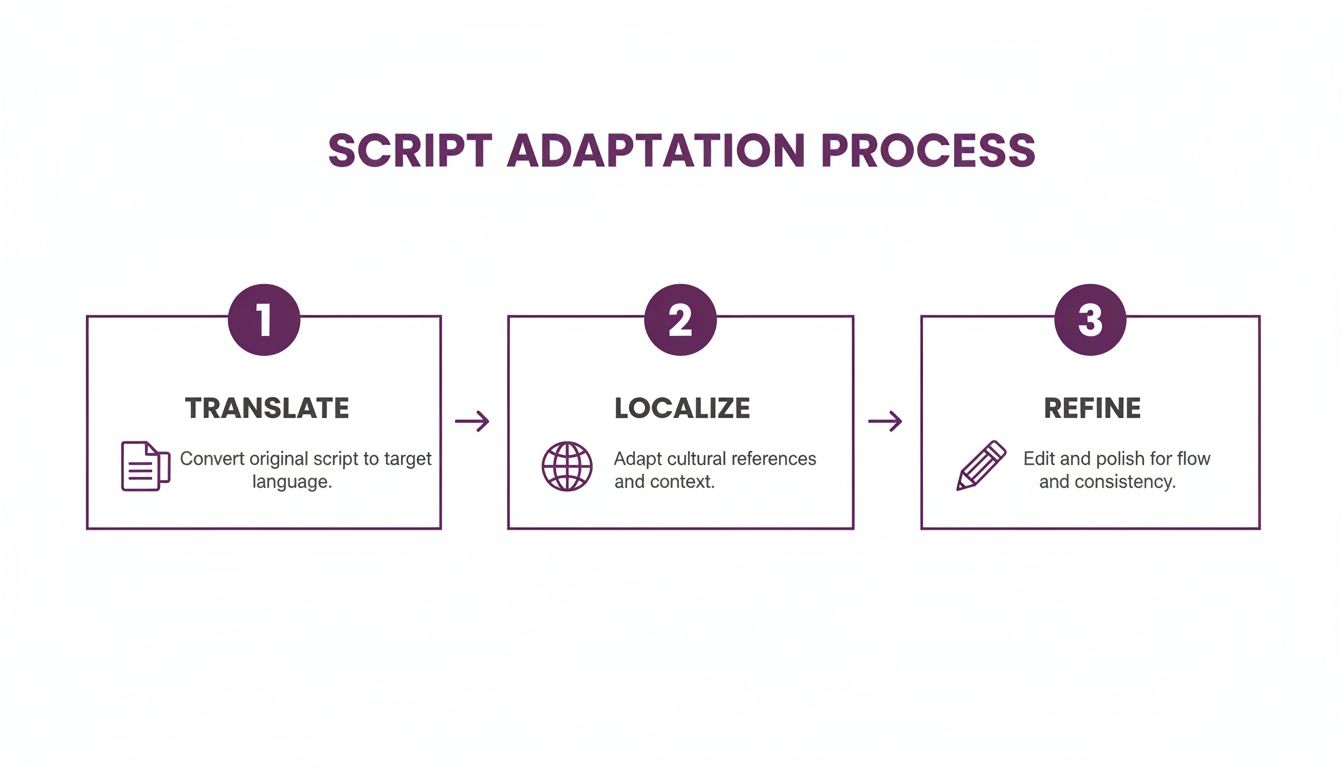
Here’s a hard truth: a direct, word-for-word translation of your English script will almost always sound unnatural. To truly connect with a Spanish-speaking audience, you must go deeper than just swapping words. This process is called localization, and it's the most critical step before generating a voice over Spanish track.
Simple translation ignores the rhythm, humor, and cultural details that make content feel authentic. Consider the English phrase "it's raining cats and dogs." A literal translation would sound absurd in Spanish. A properly localized script would use something like "está lloviendo a cántaros" (it's raining by the pitcher-full), which conveys the same idea in a way that feels completely natural.
Step 1: Choose Your Spanish Dialect
Your first big decision is choosing the right dialect. Spanish is not a one-size-fits-all language; the Spanish spoken in Madrid is very different from that in Mexico City or Buenos Aires. Your target audience should be your only guide.
- Castilian Spanish: This is the dialect of Spain, known for its distinct "c" and "z" sounds (the ceceo). If you're aiming for a European audience, this is your best choice.
- Latin American Spanish: A much broader category. For content targeting multiple countries, creators often use a "neutral" Latin American accent. This avoids slang specific to one country, ensuring it's easily understood from Mexico to Argentina.
- Regional Accents: If you have a specific audience in mind, using a regional accent like Argentinian (Rioplatense) or Caribbean Spanish can build an incredibly strong local connection.
Nailing this choice early allows you to select an AI voice in a tool like LunaBloom AI that perfectly matches your script's vocabulary and tone.
Step 2: Localize Idioms and Cultural Cues
This is where the real magic of localization happens. It’s all about adapting the small details that don't travel well across cultures.
Take common English idioms. A phrase like "bite the bullet" means nothing in Spanish. A local equivalent might be "hacer de tripas corazón" (literally, "to make a heart from guts"), which perfectly captures the idea of facing a tough situation with courage.
The goal is to make your script sound like it was written by a native speaker, for native speakers. This means hunting down cultural references, jokes, and even units of measurement (like feet to meters or Fahrenheit to Celsius) that might confuse or alienate your new audience.
Step 3: Refine Your Script for the AI
Before you hit "generate," give your script one last review. AI voice generators are incredibly precise—they will read exactly what you give them, mistakes and all. A clean, well-formatted script is the key to a natural-sounding final product.
Here’s a quick pre-generation checklist:
- Read it Aloud: Does the Spanish version flow naturally? Long, complex English sentences often need to be broken up to sound right in Spanish.
- Check for Ambiguity: Are there any phrases that could be misinterpreted? When in doubt, simplify for clarity.
- Format for Pauses: Use punctuation wisely. Commas and periods act as direct instructions for the AI's pacing, creating the natural breaks that make a voiceover sound human.
Getting this prep work right saves a massive amount of time you'd otherwise spend fixing things later.
Generating Your Spanish AI Voice Over
With your perfectly localized script ready, it's time to bring it to life. A tool like LunaBloom AI makes creating your voice over Spanish track feel more like directing than engineering. The process is straightforward, starting with the most important choice: the voice itself.
Selecting the Perfect AI Voice
The voice you select becomes the audible identity of your brand for your Spanish-speaking audience. It's about more than just clarity; you're choosing a personality.
Filter your options based on what truly matters for your content:
- Accent: We've already covered how critical this is. Is your script written for a Castilian, neutral Latin American, or specific regional audience? Match the voice to the script.
- Gender and Age: Consider the context. A younger, energetic female voice might be perfect for a social media ad, while a mature, authoritative male voice could be better for a corporate training video.
- Style: Listen to the delivery. Some voices are naturally upbeat and promotional. Others are more narrative, calm, and trustworthy. Pick the one that fits the mood you want to create.
Navigating the different types of AI voices can be tricky. This table breaks down the main options to help you match the right voice to your project.
Choosing the Right Spanish AI Voice for Your Project
| Voice Type | Best For | Key Characteristics | LunaBloom AI Feature |
|---|---|---|---|
| Pre-made Stock Voice | General content, tutorials, social media ads, quick turnarounds. | High quality, ready to use instantly, diverse selection of accents and styles. | Voice Library |
| Voice Cloning | Branded content, podcasts, personalized marketing, creator channels. | Creates a unique digital replica of a specific voice for ultimate brand consistency. | Voice Cloning |
| Custom Voice | Enterprise-level applications, long-term brand identity, unique character creation. | A bespoke voice designed exclusively for your brand, offering unparalleled uniqueness. | Custom Voice Creation |
Each type has its place, but for creators focused on building a personal connection, voice cloning is in a league of its own.
The Power of Voice Cloning
For ultimate brand consistency, nothing beats voice cloning. This feature creates a digital twin of a specific person's voice—it could be a professional voice actor, your CEO, or even yourself. The incredible part? That cloned voice can then speak fluent Spanish, even if the original speaker cannot.
This is a game-changer. Imagine your audience hearing your distinct voice delivering content flawlessly in their native language. It builds a powerful, personal connection that a generic stock voice can't match. The process is surprisingly simple: provide a short, high-quality audio sample of the source voice, and the AI handles the rest. If you're curious about the technology, you can learn more about how to generate audio from text.
Fine-Tuning Your Audio for a Human Touch
You've chosen your voice and pasted in the script. Now the artistry begins. Modern AI platforms give you an incredible amount of control to polish the audio until it sounds completely natural.
A great AI voice over isn't just about correct pronunciation; it's about conveying emotion through pacing and emphasis. Tiny adjustments can transform a robotic reading into a compelling human performance.
Here are the key settings to master within a platform like LunaBloom AI:
- Adjusting Pace: Is your content high-energy? Speed it up a bit. Is it a thoughtful narration? Slow it down.
- Modifying Pitch: Lowering the pitch can add gravity and authority. Raising it can create excitement or a friendlier tone.
- Adding Pauses: This is your most powerful tool. Inserting tiny pauses before a key phrase adds emphasis. Longer pauses between paragraphs give your audience a moment to let ideas sink in.
By experimenting with these settings, you can sculpt every sentence to perfection, ensuring your voice over Spanish isn't just understood, but truly felt.
Refining Pronunciation and Natural Flow
Getting the first draft of your voice over Spanish is a great start, but the real magic happens in the final edits. This is where you elevate a good AI voice into one that's virtually indistinguishable from a human. Your mission is to hunt down and eliminate any trace of robotic speech by refining cadence, emphasis, and tone.
Mastering Tricky Pronunciations
Even the smartest AI can stumble on unfamiliar words like brand names, acronyms, or technical jargon. Simply typing "LunaBloom AI" might lead to a clunky pronunciation that pulls the listener out of the experience.
The fix is simple: spell it out phonetically. Instead of typing the brand name, guide the AI by writing something like "Loo-nah-bloom Ay-Eye." This trick gives you surgical control over every unique term.
Use this technique for:
- Brand Names: Ensure non-Spanish names are pronounced perfectly.
- Acronyms: Tell the AI whether to spell out letters (like "FBI") or say the word (like "NASA").
- Technical Terms: Make sure complex industry language is articulated with authority.
The Art of the Pause and Intonation
In real conversation, silence often speaks as loudly as words. Smartly placed pauses build rhythm, add weight to important points, and give your audience a moment to absorb information. While punctuation in your script sets the foundation, manually adjusting pauses in a tool like LunaBloom AI is how you truly shape the delivery.
A well-placed pause before a key statistic or a big reveal makes it land with much more power. It’s the digital equivalent of a speaker leaning in to share a secret.
Likewise, tweaking intonation and pitch turns a monotone sentence into something with real feeling. A slight lift in pitch can signal excitement, while a lower tone adds gravity. Playing with these variables injects genuine emotion, ensuring your message is not just heard, but felt.
The payoff for this detail is huge. Hispanic consumers represent an astonishing $3.2 trillion in global purchasing power. One Fortune 500 retailer saw a 52% jump in Hispanic customer satisfaction and added $4.2 million in revenue after deploying Spanish voice agents. You can read more about how advanced voice AI is capturing the Spanish-speaking market and delivering a serious ROI.
Syncing Audio with Video and Adding Subtitles
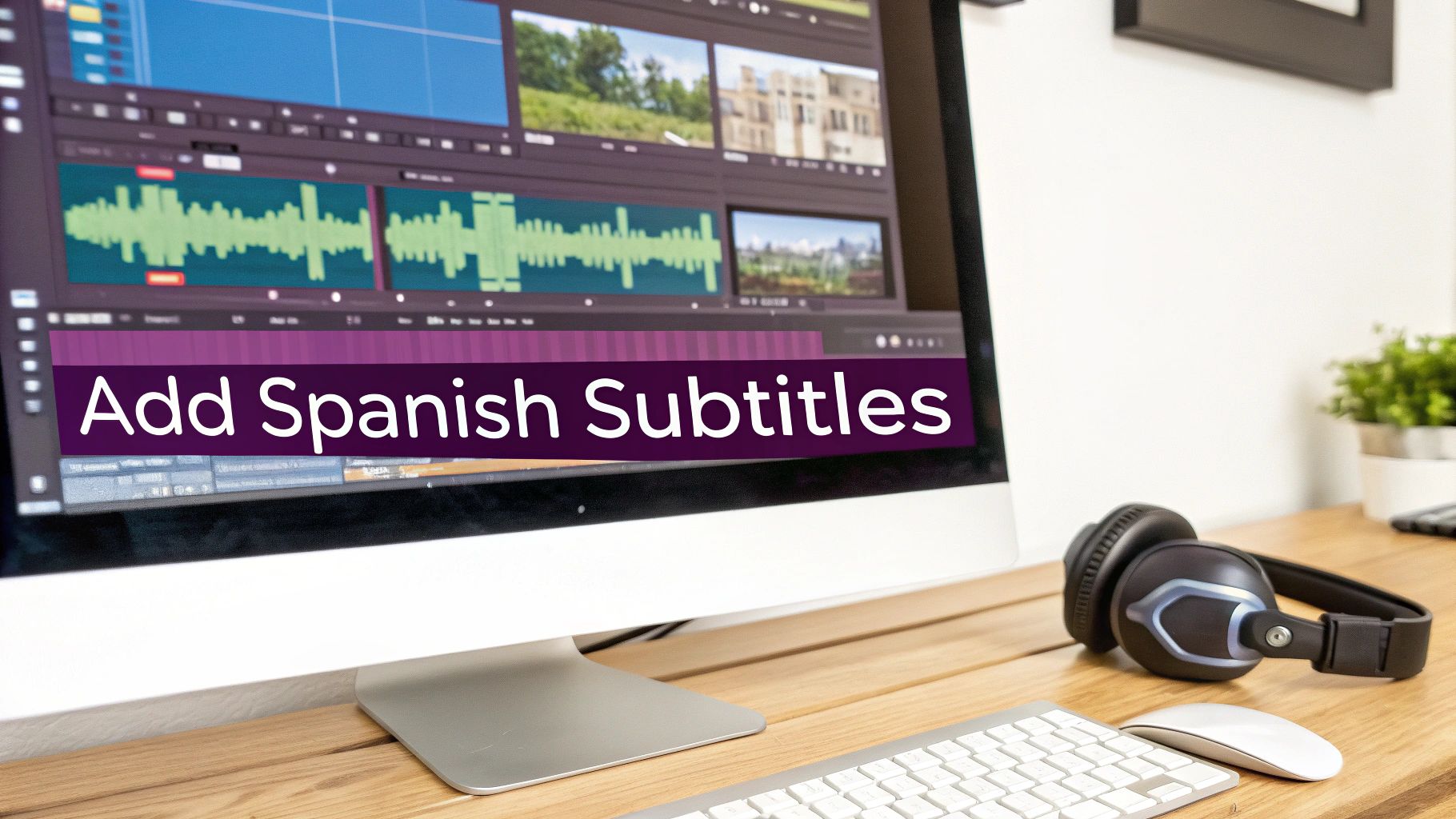
You have the perfect voice over Spanish audio track. Now comes the final step: syncing it with your video. This is more than just dropping an audio file into a timeline; it's about making the new narration feel like it was there from the start.
The goal is to match your Spanish voice over to the on-screen action perfectly. In your video editor, drop the new Spanish audio onto its own track, then mute or delete the original English audio. Watch it back and nudge the new track until every word lines up with the visual cues, just like in the original.
Why Subtitles Are a Must-Have
Once your audio is synced, there's one more step that can make or break your video's reach: adding Spanish subtitles. This is no longer just an accessibility feature; it's a massive growth lever.
- Boost Your SEO: Platforms like YouTube read subtitle files. Adding Spanish subtitles helps your video appear in Spanish-language searches, opening the door to a whole new audience.
- Engage "Sound-Off" Viewers: Many people scroll social media with their phones on silent. Subtitles ensure your message lands, even without audio.
- Reinforce Your Message: Reading along while listening improves comprehension and retention, especially for complex topics.
This is especially true for Spanish-speaking viewers. The latest data from the State of Spanish-Language Media 2025 report shows that 93% of Spanish speakers watch short-form videos, and YouTube has a 91% penetration rate among those aged 18-54.
Automate Your Subtitle Workflow
Manually typing and timing subtitles is a tedious task. Thankfully, you don't have to. Platforms like LunaBloom AI can automate the entire process. It takes the same localized script used for the voice over and generates a perfectly timed subtitle file (.srt) in seconds.
By automating subtitle creation, you're not just saving hours of manual work; you're ensuring accuracy and consistency.
You can upload that file directly to YouTube, Vimeo, or your hosting platform of choice. For more details, this guide to understanding the nuances of subtitles and closed captions is a great resource. When you pair a flawless Spanish voice over with crisp, accurate subtitles, you create content that works harder for you and reaches a much wider audience.
Common Questions About AI Spanish Voice Overs
As you explore AI for Spanish voice overs, a few questions are bound to come up. Here are answers to the most common ones.
Can AI Handle Different Spanish Accents and Dialects Accurately?
Yes, absolutely. This is where modern AI platforms excel. Top-tier tools like LunaBloom AI are built on massive audio datasets that cover a wide range of regional accents.
This means you can be incredibly specific. Need a Castilian accent for a video targeting Spain? Done. Need a Mexican or Argentinian voice for a Latin American campaign? You can select the exact variant to connect with your audience. Just remember to localize your script for that specific region first for the most authentic result.
Is Voice Cloning Legal and Ethical?
Voice cloning is completely legal and ethical, with one critical requirement: you must have explicit, provable consent from the person whose voice is being cloned. This is non-negotiable.
You can clone your own voice or hire a professional actor and make voice cloning part of the contract. Reputable platforms are very strict about this and have safeguards in place to require proof of consent. Done correctly, it's a fantastic way to build a consistent brand sound across all your Spanish content.
How Does AI Voice Over Cost Compare to a Human Actor?
The cost difference is significant. A professional Spanish voice actor can cost anywhere from a few hundred to over a thousand dollars for a single project. For creators who produce content regularly, this adds up quickly.
In contrast, most AI voice over services operate on a subscription model. For a relatively low monthly fee, you can generate hours of high-quality audio. It's a game-changer for producing Spanish content at scale without breaking the bank.
Will a Spanish Voice Over Improve My Video SEO?
Without a doubt. Adding a Spanish voice over—and more importantly, Spanish subtitles and a translated description—is a massive SEO win. Your content suddenly becomes discoverable to a whole new, enormous audience.
Search engines like Google and YouTube read the text in your subtitles and descriptions, allowing your video to appear in Spanish-language search results. This isn't just translation; it’s a strategic move to dramatically expand your reach and signal to algorithms that your content has global appeal.
Conclusion: Your Next Step to Global Reach
Adding a high-quality voice over Spanish track to your content is one of the most powerful moves you can make to grow your audience. By localizing your script, choosing the right AI voice, and refining the performance, you can create professional-grade narration that genuinely connects with millions of new viewers.
The old barriers of cost and complexity are gone. With today's AI tools, reaching a global audience is easier and more affordable than ever.
Ready to create your own professional-grade Spanish voice overs in minutes? With LunaBloom AI, you can access a library of authentic Spanish voices, clone your own voice for ultimate brand consistency, and automatically generate subtitles to maximize your reach. Transform your content and connect with a global audience today by exploring the powerful features at https://lunabloomai.com.