Video Translation Services Overview
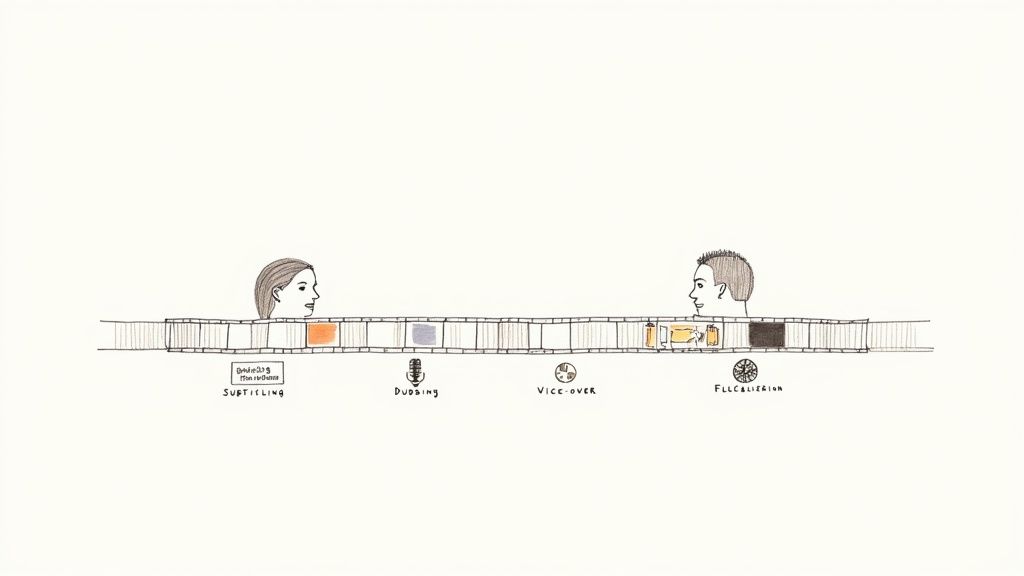
Video translation services open doors to new audiences by reshaping your video content into different languages. Whether you need subtitling, dubbing, voice-over, or full localization, each approach ensures your message lands clearly and resonates culturally.
This overview will serve as your roadmap to picking the right strategy.
- Build bridges between cultures
- Boost engagement with native-language content
- Smooth the path from scriptwriting to final playback
Think of video translation like directing an international play—each method calls for different talents and tools to make your story feel at home.
How Each Method Works
- Subtitling adds on-screen captions while preserving the original audio. It’s perfect for e-learning and interviews, letting viewers follow every spoken word without losing the speaker’s voice.
- Dubbing swaps out the original voice for actors speaking the new language. Imagine recasting a film for a different country—every line sounds like it was written for that audience.
- Voice-over layers a translated narration on top of the original soundtrack. It’s like having a live translator guiding you through the action without wiping away the background atmosphere.
- Full Localization reinvents visuals, text, and cultural references so every element feels custom-made. This is the most comprehensive option, ensuring nothing feels out of place.
73% of users say they prefer videos in their native language, making translation critical for engagement.
To help you compare quickly, here’s a snapshot of each method:
Quick Comparison of Video Translation Methods
| Method | Description |
|---|---|
| Subtitling | Adds synchronized text captions under original audio |
| Dubbing | Replaces original voice with translated voice actors |
| Voice-over | Overlays translation while keeping background audio |
| Full Localization | Adapts audio, visuals, and context for cultural authenticity |
Global brands show these methods in action: Netflix leans on dubbing, Coursera relies on subtitling, and Nike embraces full localization for its worldwide campaigns.
A typical workflow looks like this: script adaptation, time-coding, audio recording, and final quality checks. We’ll walk through these steps in depth in the next sections.
Who Benefits Most
- Marketers looking to expand into new regions and boost conversion rates
- Educators aiming to deliver clear instruction to diverse learners
- Brands hungry to build trust by speaking the local language
Next, we’ll dive into detailed workflows and real-world examples to make your decision straightforward. Stay tuned.
Key Concepts Of Video Translation Services
Video translation services are your ticket to connecting with audiences across language barriers while keeping the soul of your content intact. Whether you’re sharing a tutorial, a marketing pitch, or a documentary, the right method makes all the difference.
Within this umbrella, you’ll find subtitling, dubbing, voice-over, full localization, and transcreation. Each technique addresses specific needs, from budget-friendly captioning to emotionally charged rewrites.
Before we jump into the details, remember that transcription and translation serve different roles: one captures words, the other conveys meaning. To explore that in depth, dive into the difference between transcription and translation guide.
- Subtitling is like handing your viewer a pair of reading glasses at a live play, letting the action and original voices shine together.
- Dubbing casts new voices in your video, matching lip movements and performances as if you were recasting a film for a local stage.
- Voice-over places a storyteller’s voice on top of the original soundtrack, much like a documentary narrator guiding the journey.
- Full localization overhauls visuals, on-screen text, and cultural references so the entire story feels homegrown for its new audience.
Subtitling Explained
Subtitling embeds translated lines of dialogue at the bottom of the screen, perfectly synced with the speaker’s cadence. Viewers read along while still hearing the original tone, which is crucial for preserving authenticity.
It’s also among the most cost-effective options, requiring minimal editing time and no re-recorded audio. Imagine captioning a technical webinar or a heartfelt interview without paying for studio sessions.
Subtitling makes content accessible in an instant, without touching the audio track.
Dubbing And Voice Over
Dubbing involves replacing the original dialogue completely. Voice actors step into the scene, performing each line with the same emotional beats and timing. This approach suits drama series, movies, or any content where lip-sync accuracy is key.
Voice-over, in contrast, simply adds a new audio track over the existing one. You still hear ambient sound, music, and background noise, while a narrator relays the translation.
- Dubbing demands careful lip-sync alignment and casting choices that match character personalities.
- Voice-over prioritizes quick turnaround and retains the original atmosphere of the recording.
In modern workflows, teams often blend AI tools for initial drafts with human linguists who catch slang, idioms, and cultural nuances. A seasoned editor then polishes the script, reviews for consistency, and ensures the final cut respects local customs.
As the global language services market grows, it hit USD 60.68 billion in 2022 and is forecast to reach USD 96.21 billion by 2032 at a 5.94% CAGR.
Discover more insights about video translation on the language services market redokun insights.
Transcreation And Localization
Transcreation is a creative leap, taking core messages and reimagining them so slogans, images, and humor land with the same impact. It’s like rewriting a commercial so a punchline still clicks in Tokyo, Paris, or São Paulo.
This isn’t a straight word-for-word swap. Teams consider:
- The tone and style that resonate with local viewers
- Cultural references, jokes, or idiomatic expressions that need reworking
- Visual elements and on-screen text that must be redesigned or replaced
Full localization weaves in subtitling, dubbing, and graphic updates so every piece—from captions to color palettes—feels tailor-made for its target market. It’s the go-to for global campaigns that can’t afford a one-size-fits-all approach.
Matching Content Goals
Think of each video’s objective as a destination on a map. Your translation method is the vehicle: some roads are faster, others more scenic or cost-effective.
Choosing the right translation style boosts viewer engagement, smooths workflows, and amplifies ROI.
- Subtitling works wonderfully for e-learning modules or training videos where clarity and budget control matter most.
- Dubbing shines in narrative-driven content—films, series, or any project that needs an emotional performance.
- Transcreation injects local flavor into ads or social media snippets that must feel native to the viewer.
- Full localization fits large-scale launches, where every detail—from voice to visuals—requires cultural precision.
Armed with this mental toolkit, you’ll confidently select the right approach before diving into the step-by-step workflows that follow. Stay tuned for hands-on guidance in the next section.
Localize Videos With Subtitling, Dubbing, And Voice Over
Localizing a video is a bit like following a family recipe—you need the right ingredients, precise measurements, and a steady hand to blend them in perfect harmony.
First, the source script is adapted into the target language, preserving tone and nuance.
Then a timecode map ensures subtitles, voice tracks, or dubbing artists stay in sync with every frame.
- Script Adaptation
- Time-Coding
- Recording Or Subtitle Authoring
- Final Quality Checks
- File Format Selection
- Codec Optimization
- Quality Assurance
These steps form the backbone of any solid localization workflow.
Here’s a process flow illustrating the key methods of video translation services.
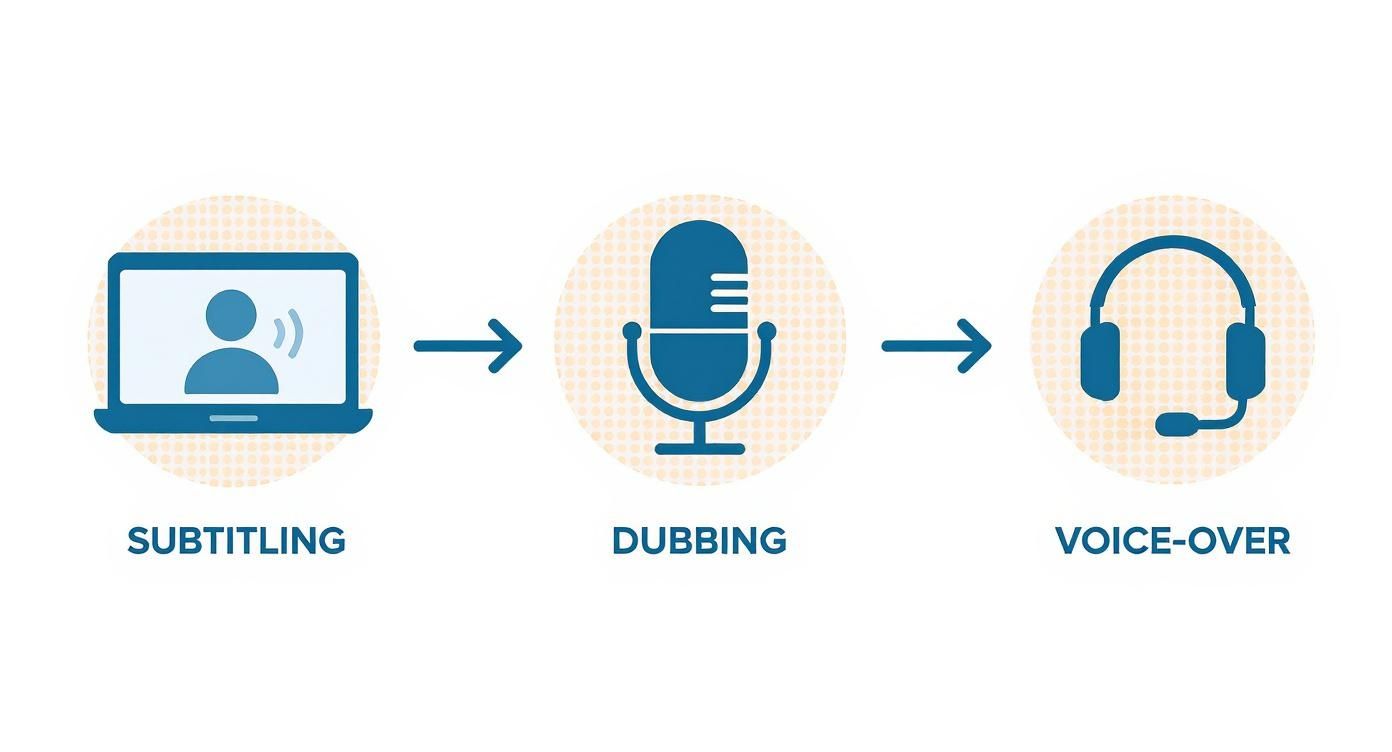
That graphic walks you through subtitling, dubbing, and voice-over in a neat, sequential loop.
Prepare The Script
Effective localization starts with a spotless source script.
You’ll match every line of translation to its corresponding timecode—no line slips through the cracks.
A glossary keeps terminology consistent and your brand voice intact across languages.
- Script adaptation respects idioms, cultural nuance, and reading speed.
- Time-coding frames each segment so text or audio lines up precisely.
- Glossary checks lock in uniform brand language and tone.
This foundation sets the stage for smooth recordings or crisp subtitle burn-ins.
Choose Talent And Tools
Next comes the talent hunt—human or AI-powered.
Freelancers, agencies, or in-house teams each bring different advantages in cost, turnaround, and quality.
- Freelancers offer flexibility and lower rates.
- Agencies deliver vetted teams and project management.
- In-house teams give you full control, but they tap internal bandwidth.
Your decision here shapes both pace and polish in the final cut.
Comparison of Video Translation Methods
Below is a comparison of four common video translation methods, highlighting their definitions, advantages, and trade-offs.
| Method | Definition | Pros | Cons |
|---|---|---|---|
| Subtitling | Adding translated text on screen aligned with spoken audio | Cost-effective; preserves original audio | Requires reading; can clutter the frame |
| Dubbing | Replacing original voice with a localized voice performance | Immersive; captures emotion | Lip-sync challenges; higher budget |
| Voice-Over | Overlaying a translated narrator track over the original audio | Maintains speaker’s tone underneath; faster turnaround | May overlap original dialogue; less immersive |
| Full Localization | Re-creating all audio, on-screen text, and sometimes visuals | Fully adapted to local culture; high engagement | Time-intensive; highest cost |
This overview will help you match your project’s goals with the method that best balances budget, audience experience, and timeline.
Below is a quick glance at typical costs, speeds, and quality levels for each method.
| Method | Cost (Per Minute) | Speed | Quality |
|---|---|---|---|
| Subtitling | $0.50–$2 | 24–48 hrs | High |
| Dubbing | $5–$15 | 1–2 weeks | Very High |
| Voice-Over | $2–$8 | 3–5 days | High |
Budget-minded projects often lean on subtitling, while narrative campaigns use dubbing to preserve emotional beats.
Quality checks at each step reduce errors and boost viewer satisfaction.
Finalize And Review
In the last stage, you sync new tracks with the visuals and run playback tests.
These checks catch any drift in timing, lip-sync hiccups, or format mismatches.
For advanced voice-over options, exploring AI-powered dubbing solutions like Dubverse AI can significantly streamline the localization process.
Final QA combines both linguistic review and technical testing.
Once your formats and codecs meet distribution specs, you’re ready to deliver a polished, localized gem.
Up next, we’ll dive into the unique benefits and real-world applications of each approach to guide your project strategy.
Benefits And Use Cases Of Video Translation Services
Video translation isn’t just swapping words—it’s about opening conversations across borders. You get three wins at once: a broader audience, more genuine interactions, and a trust mark that speaks their language.
- Wider Reach: Suddenly, new regions can tune in without language barriers.
- Deeper Engagement: Content that feels culturally familiar sticks in the mind.
- Stronger Credibility: Localized tone and nuance build real trust.
For instance, e-learning platforms that pace tutorials to match local teaching styles see learners grasp ideas faster. Similarly, marketers often report spikes in conversions when product demos speak directly to each customer’s dialect. These aren’t just numbers—they’re proof that translation sparks real connections.
Real World Examples
An online course provider saw a 45% Increase in student retention after adding multilingual subtitles and cultural annotations.
A product demo series enjoyed a 30% Uplift in click-through rates once it featured regional voice talent.
Streaming services recorded a 20% Jump in subscriptions after rolling out authentic dubbing focused on local dialects.
Authentic localization turns passive viewers into active fans across diverse markets.
On the industry side, North America held 36.4% Market Share in the global video translation services market in 2024. The U.S. segment was valued at USD 0.97 Billion and is projected to grow at a CAGR of 25.3%. Discover the full report on Market.us.
These figures underline a simple fact: whether you’re in education or entertainment, video translation fuels audience growth.
Boost SEO With Multilingual Subtitles
Subtitles do more than aid understanding—they create crawlable text that search engines index. When viewers linger to read in their native tongue, your watch time climbs—and so does your SEO ranking.
Key SEO Benefits:
- Enhanced Keyword Presence within subtitle files
- Improved Metadata from translated titles, descriptions, and tags
- Greater Dwell Time as viewers stay longer on pages they understand
Combine translated transcripts with region-specific thumbnails and watch your click rates soar.
| Use Case | Outcome |
|---|---|
| E-Learning Tutorials | 45% Jump In Comprehension |
| Product Demos | 30% Uplift In Conversions |
| Streaming Content | 20% Growth In Subscriptions |
Choosing between subtitling, dubbing, or voice-over really comes down to your goals and budget. The key is a strategic rollout that lets your brand speak globally with clarity and cultural respect.
Additional Use Cases And Tips
Video translation reaches far beyond marketing and training. HR teams speed up onboarding with localized modules. Legal departments distribute subtitled compliance videos in every office. Customer support hubs deploy voice-over walkthroughs to cut ticket volume.
Tips For Success:
- Align scripts with local idioms to keep messages authentic.
- Test translated cuts with focus groups before full launch.
- Build a glossary of brand terms for consistent terminology.
Consistent terminology increases brand recall and reduces revision cycles.
Try adding translated video snippets to email campaigns—you can see open rates climb by up to 12%. And by sharing on local social channels, you might even ignite organic, viral engagement.
Implement these insights to supercharge your global video strategy. Discover how LunaBloom AI simplifies translation and takes your content worldwide.
Select The Right Video Translation Service
Choosing a video translation service is a lot like planning a trip: you weigh cost, timing, and comfort before you set off. A clear decision framework keeps you from hitting unexpected tolls or detours.
Video translation pricing can follow different models:
- Fixed Rate Projects give you a set budget from start to finish.
- Per-Minute Pricing adjusts to your content length and complexity.
- Subscription Bundles work wonders when you have a steady flow of videos.
By matching the right pricing structure to your needs, you keep your project on track without surprises.
Compare Vendor Quality
Not all providers speak the same language when it comes to quality. Look for industry stamps of approval—like ISO 17100 or ATA accreditation—so you know they take linguistic accuracy and data security seriously.
Watch how quickly they deliver: short clips often return in 24–48 hours, while full-length productions can take up to 2 weeks. Line up sample reels and focus on:
- Lip-sync accuracy
- Regional accents
- Cultural relevance
Tracking metrics such as revision rounds and error rates helps you spot the most reliable partner.
“Evaluating sample work uncovers real-world service consistency,” notes a localization manager.
Consider these benchmarks:
- Custom SLA windows for tight deadlines
- Error rates under 2% as a quality threshold
- Client satisfaction scores over 90% among top providers
Balance In-House And Outsource
Should you keep translations under your own roof or trust an outside team? In-house efforts give you control but often stretch resources thin. Outsourcing, on the other hand, taps specialist talent and scales up or down on demand.
To negotiate a fair deal:
- Define revision limits and checkpoints in your contract.
- Set clear milestones for creative feedback and technical delivery.
- Include Service-Level Agreements (SLAs) that spell out response times.
Set Clear Expectations
A solid roadmap prevents scope creep and keeps everyone aligned.
- Draft a creative brief outlining tone, style, and brand guidelines.
- Nail down technical specs—resolution, file format, codec.
- Schedule brief check-ins to catch issues early.
The global translation services market is projected to hit USD 59.93 billion by 2025, growing at a CAGR of 9.17% thanks to booming streaming, e-commerce, and mobile commerce sectors. For an in-depth look, read the full report from Mordor Intelligence.
Best Practices For Video Translation
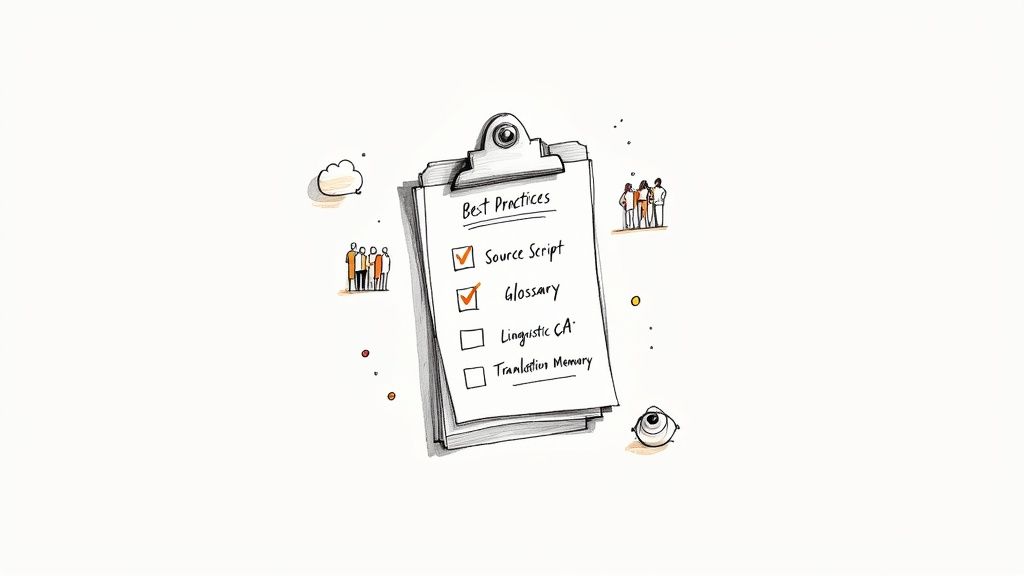
When you approach video translation, picture it as preparing a complex recipe for an international audience. A tight, well-annotated source script is your mise en place: every line measured so linguists know exactly what to use.
Defining tone and terminology up front—through glossaries and style guides—hands over the chef’s secret spice mix for your brand voice. No guesswork. No last-minute scrambles.
- Script Preparation Lays out context and reduces confusion.
- Glossary & Style Guides Lock in consistent phrasing.
- Translation Memory Stores repeats to save time and budget.
- Quality Assurance Catches mistakes before they reach viewers.
Follow this order and you’ll notice fewer revisions and cleaner handoffs.
Craft Source Scripts
A clear, polished script is your first line of defense against costly misinterpretations. It should include speaker cues, cultural notes, and any inside jokes you plan to keep.
When translators understand your intent from day one, you avoid extra review rounds and late-night edits.
"A clear script reduces QA cycles by up to 30%," notes a localization manager.
Foster Collaboration
Translation is a team sport. When project managers, linguists, and engineers share real-time updates, everyone stays in sync.
- Host scripts, assets, and comments in one central hub.
- Assign ownership for editing, translation, and QA.
- Hold brief stand-ups to unblock issues quickly.
Defined roles and regular touchpoints make each handoff seamless.
Use Translation Memory
Think of your translation memory as a growing library of past projects. It flags repeats so you don’t translate the same phrase twice.
- Import transcripts and earlier translations into your TM.
- Automate glossary checks at each translation stage.
- Update entries after QA to strengthen future projects.
Over time, this approach cuts costs and maintains consistency.
Conduct Linguistic QA Checks
Linguistic QA weaves language review with technical tests. Reviewers confirm subtitles, voice-over scripts, and on-screen text all sync correctly.
They blend creative precision with technical robustness.
| Step | Purpose |
|---|---|
| Initial Read-Through | Spot typos and tone inconsistencies |
| Timing Verification | Match text to audio and visuals |
| Cultural Review | Avoid awkward or insensitive wording |
Test With Target Audiences
Even the best internal checks can miss subtle issues. Run your localized videos by small focus groups in the target market before launch.
Watching real viewers interact often reveals issues that slip through internal reviews.
- Gather direct feedback on clarity and engagement.
- Use simple surveys to rate comprehension.
- Tweak scripts based on what resonates most.
This final check uncovers hidden cultural pitfalls and builds confidence.
When you tie these practices together, your team delivers polished, culturally tuned videos every time. Your process becomes more reliable and revisions become the exception, not the rule.
You’ll cut revisions by up to 40% and roll out global content with predictable results.
Take the next step: use LunaBloom AI’s collaboration and memory tools to keep your workflow on track and your translations sharp.
FAQ About Video Translation Services
What Is The Difference Between Subtitling And Dubbing?
Subtitling feels like reading along with the original performance—you see translated text at the bottom of the screen while the actors’ real voices and emotions shine through. On the flip side, dubbing swaps those voices out entirely, replacing them with new recordings that match lip movements and give viewers a fully localized experience.
How Long Does A Typical Video Translation Services Project Take?
Turnaround really depends on length and complexity. A simple subtitling job for a short clip often wraps up in 24–48 hours. That said, if you’re going full throttle with dubbing or cultural adaptation—from casting voice talent to recording sessions and meticulous quality checks—you’re looking at roughly 1–2 weeks.
Project Timeline And Milestones
- Script adaptation and timecoding
- Translation or recording
- Editing and sync testing
- Final QA and delivery
Can AI Really Improve Translation Quality?
AI can be your fast-track draft—catching repeated phrases and ensuring consistency across your video. However, it’s human editors who infuse local color, humor, and tone. Think of AI as the groundwork; the final polish always comes from expert linguists.
What Factors Drive Cost Variations?
Several elements play a role in pricing:
- Video length and format
- Complexity of the target language
- Urgency of the deadline
- Balance between human and AI post-editing
73% of users prefer videos in their native language, underscoring why investing in solid translation pays dividends.
Use this FAQ as a launchpad for selecting the right video translation partner. Explore our other guide sections for deeper insights and real-world examples.
Conclusion
Video translation services are more than a language swap—they’re a powerful strategy to engage audiences worldwide. By choosing the right method—whether subtitling, dubbing, voice-over, or full localization—you ensure every viewer experiences your content naturally and authentically.
Key takeaways:
- Subtitles offer quick, cost-effective clarity.
- Dubbing delivers immersive, emotion-driven performances.
- Voice-over balances speed with original atmosphere.
- Full localization tailors every detail for cultural precision.
Ready to streamline your global video strategy? Discover how LunaBloom AI accelerates workflows, enhances collaboration, and maintains consistency across every translation. Visit lunabloomai.com to get started.