Thinking about launching an online business? It’s a fantastic goal. But success isn’t just about a great idea. It’s about executing a smart plan that covers everything from validating your concept to finding your first customers.
This guide walks you through the essential steps. We’ll start with finding a profitable niche, then move through the legal setup, building your website, and creating a marketing plan that brings in sales and fuels your growth. Let’s get started.
Step 1: Find a Business Idea That Actually Works

Before you pick a domain name or design a logo, you need an idea with real market potential. Many entrepreneurs fail because they build something nobody actually wants to buy.
The best online businesses exist at the intersection of three things: genuine market demand, your personal passion, and your unique skills. You don’t need to invent something totally new. Instead, find an underserved niche where you can solve a specific problem for a specific group of people.
Identify Underserved Niches
Often, the best business ideas come from solving a problem you’ve personally experienced. Think about frustrations in your own life or gaps you’ve noticed in markets you already know well.
For example, maybe you’re a coffee enthusiast who could never find high-quality, ethically sourced decaf beans. That specific pain point could be the seed for a successful online store. Your personal experience provides an authentic story and an immediate connection with your target customer.
To start finding these opportunities, try these methods:
- Explore Online Communities: Dive into Reddit threads, Facebook groups, and niche forums related to your interests. What questions are people asking over and over? What are their common complaints? These are direct signals of unmet needs.
- Look for “Shoulder” Niches: Analyze popular, saturated markets and look for adjacent opportunities. The general fitness coaching space is crowded. But what about “fitness routines for new moms with limited time” or “ergonomic exercises for remote workers”? Specificity is your advantage.
- Use Keyword Research Tools: Tools like Google Keyword Planner or Ahrefs show you what people are searching for. Look for long-tail keywords—longer, specific phrases. High search volume with low competition can signal an audience with a problem that larger companies are ignoring.
The most powerful business ideas don’t reinvent the wheel. They simply offer a better, more focused, or more convenient solution to an existing problem that a specific group of people genuinely cares about.
Conduct Scrappy Competitor Analysis
Once you have an idea, it’s time to look at the competition. Don’t be discouraged if other businesses exist in your space—it’s a good sign! It proves there’s a market. Your goal is to find the gaps they haven’t filled.
This doesn’t need to be a formal report. A “scrappy” analysis is about finding actionable insights quickly. Choose three to five potential competitors and start investigating.
Here’s what to look for:
- Customer Reviews: Read their product reviews, social media comments, and Better Business Bureau ratings. What are customers consistently complaining about? “Slow shipping,” “confusing instructions,” or “poor customer service” are all opportunities for you to excel.
- Brand Positioning: How do they describe themselves? Are they the “cheapest,” “highest quality,” or “most sustainable”? Understanding their unique selling proposition (USP) will help you carve out your own distinct identity.
- Content and Social Media: What type of content are they creating? If they are focused on Instagram, perhaps there’s an opportunity on TikTok or YouTube. If their blog is generic, you can win by creating genuinely helpful, in-depth guides.
If you’re still on the fence, consider the scale of the opportunity. Launching an online business means tapping into a global ecommerce market projected to hit $7.4 trillion by 2025. That represents nearly 24% of all retail sales worldwide.
This is a significant increase from $5.7 trillion in 2023, driven by growing internet access, mobile shopping, and AI-powered personalization. With over 2.77 billion people expected to shop online in 2025, you have unprecedented access to customers. You can explore the digital commerce statistics to understand the full potential.
Business Idea Viability Checklist
Unsure if your idea has potential? Use this quick checklist. Score each factor from 1 (low) to 5 (high) to assess its viability.
| Viability Factor | Description | Scoring (1-5) |
|---|---|---|
| Market Demand | Is there a sizable group of people actively looking for a solution to this problem? | |
| Profit Potential | Can you price your product/service to cover costs and make a healthy profit? | |
| Personal Passion | Are you genuinely interested in this niche? Enough to stay motivated? | |
| Unique Skills | Do you have skills or experience that give you an edge over competitors? | |
| Competition Level | Is the market oversaturated, or is there room for a new player to stand out? | |
| Scalability | Can this business grow significantly without a proportional increase in effort? |
After scoring your idea, add up the points. A high score doesn’t guarantee success, but it indicates you’re on the right track. If your score is low, use the feedback to refine your idea or pivot to a stronger one.
Step 2: Handle the Legal and Financial Essentials
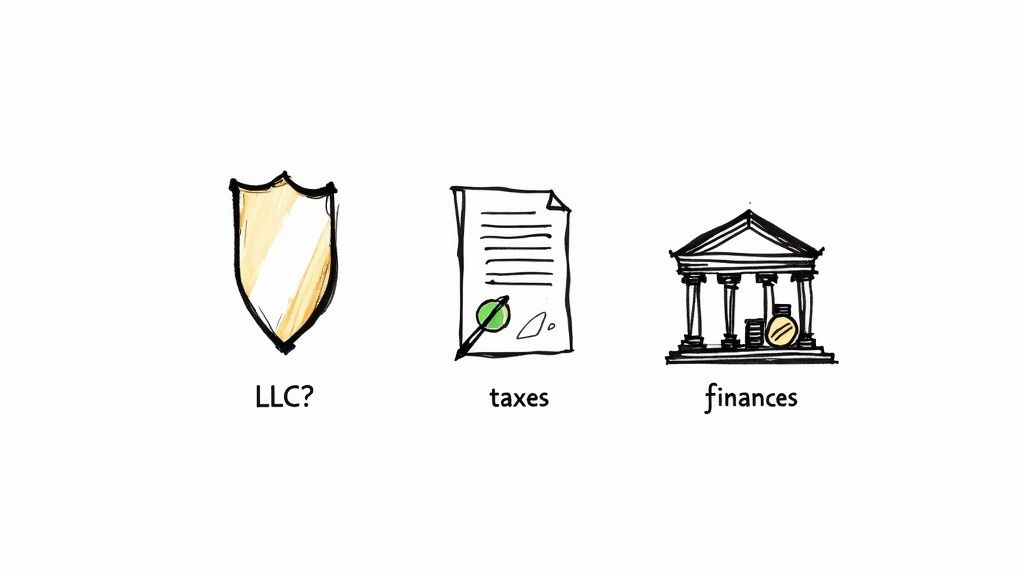
With a validated business idea, it’s time to build a solid legal and financial foundation. While this part can seem intimidating, getting it right from the start will save you from major headaches down the road.
Think of this step as creating a firewall between your personal and business affairs. It’s the essential framework that supports your venture as it grows.
Choose Your Business Structure
Your first major decision is choosing a legal structure for your business. This choice impacts your personal liability, how you file taxes, and how your business is perceived. For most new online entrepreneurs, it comes down to two main options.
Many people, like freelance designers or small Etsy shop owners, start as a Sole Proprietorship. It’s the simplest path forward. You and the business are legally the same entity, which means minimal paperwork.
However, this simplicity has a drawback. Your personal assets are not protected if the business incurs debt or faces legal issues. This is a risk you need to be comfortable with.
Protect Yourself with an LLC
As your business grows, consider forming a Limited Liability Company (LLC). An LLC creates a legal separation between you and your business. If your business is sued, your personal assets—like your home or car—are generally protected.
Setting up an LLC involves more paperwork and fees, but the peace of mind it provides is often worth the investment. It also signals to customers and partners that you are operating a serious, legitimate business.
The right business structure isn’t just a box to check; it’s a strategic move that reflects your risk tolerance and vision. An LLC provides a vital layer of protection that a Sole Proprietorship just can’t offer.
Make It Official and Stay Compliant
Once you’ve chosen a structure, it’s time to make it official. This involves a few key steps to solidify your business’s legal standing.
Here’s a checklist of what you’ll likely need to do:
- Register Your Business Name: If you’re not using your own legal name, you’ll probably need to file a “Doing Business As” (DBA) name. This informs your state or county who is behind the brand.
- Get a Federal Tax ID Number (EIN): An Employer Identification Number from the IRS acts as a Social Security number for your business. It’s free and necessary for opening a business bank account or hiring employees.
- Check for Licenses and Permits: Your industry and location may require specific local, state, or federal permits. For example, selling handmade food online has different regulations than running a digital marketing agency. Research this thoroughly.
Manage Your Business Finances
Keeping your finances organized from day one is non-negotiable. The most important step is to open a separate business bank account.
Mixing personal and business funds can create a bookkeeping nightmare and may compromise the legal protection of your LLC, putting your personal assets at risk. A dedicated account provides a clean financial record, simplifies tax preparation, and gives you a clear view of your business’s financial health.
Next, consider funding. Many founders bootstrap their ventures, using personal savings to cover initial costs. This approach keeps you in full control and avoids debt. Others might seek a small business loan or a line of credit to manage cash flow as the business gets started.
Step 3: Build Your Digital Storefront and Brand
With a validated idea and the legal work done, it’s time to build your online home. Your website is more than just a digital catalog; it’s your 24/7 salesperson, brand ambassador, and the core of your operation. A well-designed digital storefront converts casual visitors into loyal customers.
This is where your abstract ideas become a tangible experience for your customers. Let’s cover the practical steps of choosing the right tools and building a brand that connects with people.
Choose Your Ecommerce Platform
Your first big decision is selecting an ecommerce platform. This choice will affect your daily workflow, budget, and ability to scale. For most beginners, the decision comes down to two main options: Shopify and WooCommerce.
Shopify is a powerful, all-in-one solution. It’s designed for ease of use, allowing you to launch a professional store quickly, even with limited technical skills. Shopify handles security, hosting, and payment processing for you. If your goal is to start selling with minimal technical hassle, it’s an excellent choice.
WooCommerce is a flexible plugin that transforms a WordPress website into a robust ecommerce store. Its main advantage is customization. If you want complete control over your site’s design and features, WooCommerce offers that freedom. However, you’ll be responsible for your own hosting, security, and updates, which requires more technical confidence.
Platform Snapshot: Shopify vs. WooCommerce
| Feature | Shopify | WooCommerce |
|---|---|---|
| Ease of Use | Beginner-friendly, all-in-one setup | Requires some technical skill (WordPress) |
| Pricing Model | Monthly subscription fee + transaction fees | Free plugin, but you pay for hosting, themes |
| Customization | Good, but within the platform’s framework | Nearly limitless with plugins and code |
| Best For | Entrepreneurs who prioritize speed and simplicity | Business owners who want total control |
Focus on a Great User Experience
A beautiful website that is difficult to use will not generate sales. A poor user experience (UX) is a leading cause of shopping cart abandonment. Your primary focus should be making the customer’s journey from landing page to checkout as smooth as possible.
These are the non-negotiables:
- Mobile-First Design: A significant portion of online shopping occurs on mobile devices. Your site must function perfectly on a small screen. Test every aspect, from browsing to checkout, on a mobile device.
- Simple Navigation: Customers should be able to find what they’re looking for in a few clicks. Use clear categories, a visible search bar, and a logical menu structure.
- Frictionless Checkout: The checkout process must be simple. Minimize the number of steps, allow guest checkout, and display all shipping costs upfront. Surprise fees are a major conversion killer.
The ecommerce landscape has grown significantly. By 2025, there will be over 28 million ecommerce stores worldwide, with sales projected to exceed $6.8 trillion. This growth is built on trust, with 96% of Americans having made an online purchase. A great user experience is your key to capturing a piece of this market.
Craft a Memorable Brand Identity
Your brand is your business’s personality—it’s the feeling customers get when they interact with you. A strong brand identity helps you stand out from competitors and build a loyal following.
Start with your visuals. Your logo should be simple, memorable, and recognizable even at small sizes. Your color palette does more than just look good; it sets a mood. Blue often conveys trust, while yellow can feel energetic.
Your brand voice is the consistent tone you use everywhere, from your website copy to your Instagram captions. Are you witty and informal? Or are you more authoritative and polished? Finding the right voice makes your brand feel human and relatable.
Creating brand guidelines is crucial for consistency. It ensures everyone on your team uses the same colors, fonts, and tone. Learning how to create strong brand guidelines is a smart investment that keeps your messaging consistent as you grow, building trust and recognition.
Step 4: Create a Marketing Plan That Gets Customers
A brilliant product that nobody knows about is just a hobby. This section is about getting noticed. It’s your game plan for securing your first sales and building a marketing engine that drives sustainable growth.
Your marketing should start long before you launch. Building momentum early creates an audience that is excited for what you’ve built.
Build Pre-Launch Hype
The pre-launch phase is like a movie trailer for your business. The goal is to generate curiosity and give people a reason to care before they can make a purchase.
A simple yet effective strategy is to create a “coming soon” landing page. This page should introduce your brand, hint at the problem you solve, and feature a prominent email sign-up form. Capturing these early email addresses gives you a direct line to your most interested potential customers.
Once the page is live, start teasing your launch on social media. Share behind-the-scenes content, talk about your mission, and ask for feedback. The goal is to build a community, not just collect followers.
This infographic outlines the key steps, from choosing a platform to creating a brand identity, which are all prerequisites for a successful launch.
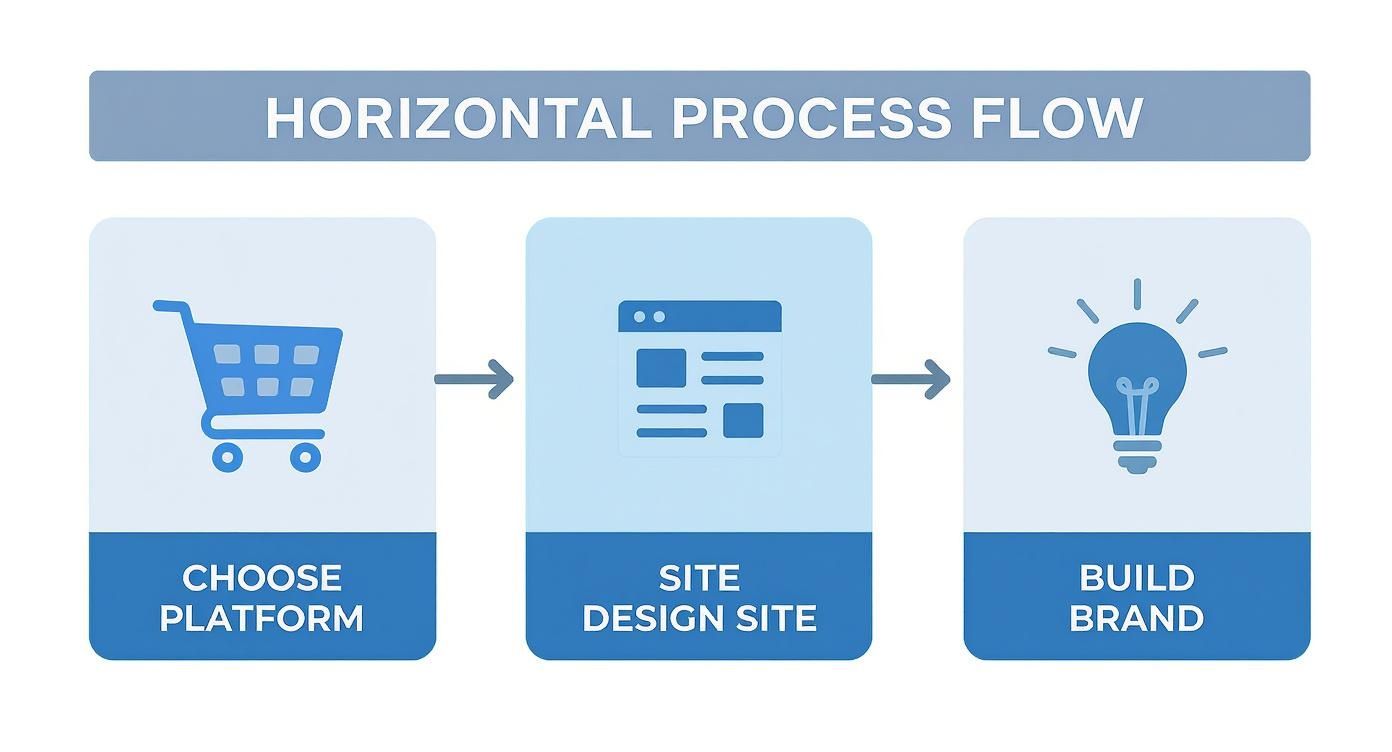
As you can see, a solid technical foundation and a clear brand are the launchpad for any effective marketing push.
The Power of Content Marketing
Once you’re live, the focus shifts to sustainable growth. Content marketing is the engine for this growth. It involves creating and sharing valuable content—like blog posts, how-to videos, or in-depth guides—that attracts the right audience and converts them into customers.
Instead of interrupting people with ads, you’re offering solutions. If you sell eco-friendly cleaning supplies, a blog post on “5 Non-Toxic Ways to Clean Your Kitchen” will attract your ideal audience through Google searches. This approach builds trust and establishes you as an expert.
The big idea behind content marketing is pretty straightforward: If you consistently give buyers valuable information, they’ll eventually reward you with their business and stick around for the long haul.
This is a long-term strategy that builds a durable asset for your business. Every piece of content you publish becomes another way for customers to find you.
Master Search Engine Optimization
Search Engine Optimization (SEO) helps your website appear on Google when someone is searching for what you sell. It’s one of the most powerful ways to get consistent, “free” traffic over time.
For a new business, the key is to target long-tail keywords. These are longer, more specific phrases that have less competition and indicate high purchase intent. Instead of trying to rank for a broad term like “coffee,” target something more specific like “low-acid organic decaf coffee beans.”
Here’s a quick SEO checklist to get started:
- Keyword Research: Use a free tool like Google Keyword Planner to find the long-tail keywords your customers are using.
- On-Page SEO: Integrate your target keyword naturally into your page title, headers, and content. Avoid keyword stuffing; make it sound natural.
- Quality Content: Create content that genuinely helps the reader and completely answers their question. Google rewards depth and quality.
Nurture Customers with Email Marketing
Acquiring a customer is hard work; retaining them should be easier. Email marketing is your best tool for turning one-time buyers into repeat customers and brand advocates. The data supports this: for every $1 spent on email marketing, businesses see an average return of around $45.
Start by setting up a simple welcome email series for new subscribers. Use it to share your brand story, offer a small discount, and showcase your best-selling products.
After that, you can send regular newsletters with content like:
- New product announcements
- Exclusive subscriber-only deals
- Helpful tips related to your products
- Company news and behind-the-scenes stories
This direct line to your customers is invaluable. Unlike social media, you own your email list and aren’t subject to algorithm changes.
Use Paid Ads for a Quick Boost
While content and SEO are long-term strategies, sometimes you need immediate traffic. Paid advertising on platforms like Meta (Facebook and Instagram) or Google Ads can provide that boost.
Paid ads allow you to target your ideal customer with precision based on their demographics, interests, and online behavior. For a new business, this is a great way to test product-market fit, drive initial sales, and get fast feedback on your messaging.
Start with a small budget. Run a few small-scale campaigns, analyze the results, and invest more in the ads that are performing well. To create professional-looking video ads without the high cost of production, tools like the AI video generator from LunaBloom AI can help you create high-quality assets in minutes.
Marketing Channel Comparison for New Businesses
Choosing where to invest your limited time and money is a major challenge for new businesses. This table breaks down common marketing channels to help you prioritize your efforts.
| Marketing Channel | Typical Cost | Time to See Results | Best For |
|---|---|---|---|
| Content Marketing/SEO | Low (Time-intensive) | 3-6+ months | Building long-term authority and generating “free” organic traffic. |
| Email Marketing | Low to Medium | Immediate to Weeks | Nurturing leads, driving repeat purchases, and building customer loyalty. |
| Social Media (Organic) | Low (Time-intensive) | 1-3 months | Building community, engaging with customers, and brand awareness. |
| Paid Social Ads (Meta) | Medium to High | Days to Weeks | Driving targeted traffic quickly, testing offers, and retargeting visitors. |
| Google Ads | Medium to High | Days | Capturing high-intent search traffic and generating immediate leads/sales. |
The best approach is usually a mix. Start with one or two channels you can manage effectively—like content and email—and then add others like paid ads once you have some traction and data. Avoid trying to do everything at once.
Step 5: Manage Operations and Scale for Growth
Once sales start coming in, your role shifts from founder to operator. This is where you build a lasting business by focusing on the backend systems that keep customers happy and returning.
A smooth operational flow is what separates a short-lived success from a brand with staying power. It’s about ensuring a seamless customer journey from payment to unboxing.
Nail the Fulfillment Process
The customer’s experience begins the moment they click “buy.” Your ability to deliver the right product quickly and reliably is crucial.
First, you need a secure way to accept payments. Major providers like Stripe and PayPal are industry standards because they are secure, trusted by customers, and integrate easily with most ecommerce platforms.
Next, establish a simple system for inventory management. Even a basic spreadsheet is better than nothing. You must track what you have in stock to avoid overselling, which leads to angry customers and logistical problems.
Finally, choose your shipping partners.
- For small, light items: USPS often offers the best rates.
- For larger or heavier goods: Carriers like UPS or FedEx provide robust tracking and insurance.
- For international shipping: DHL is a strong option.
Compare rates, reliability, and platform integrations to find a partner who will meet your customers’ expectations.
Turn Customer Service into a Superpower
View customer service as a powerful marketing tool, not a cost center. Every interaction is an opportunity to build loyalty.
When you receive a question or complaint, see it as a chance to create a positive experience. A quick, empathetic, and helpful response can turn a frustrated customer into a brand advocate. Set up a dedicated support email and aim to respond within 24 hours to build trust.
An unhappy customer whose problem you solve is often more loyal than a customer who never had a problem in the first place. Excellent service is your secret weapon against bigger competitors.
Use Data to Drive Smart Decisions
As your business grows, you need to rely on data, not just intuition. Tracking a few key metrics will provide the clarity needed to make smart decisions and scale effectively.
Focus on these three to start:
- Conversion Rate: What percentage of website visitors make a purchase? A low rate could indicate issues with pricing, product images, or the checkout process.
- Average Order Value (AOV): How much does the average customer spend per transaction? You can increase this by offering product bundles or a free shipping threshold.
- Customer Lifetime Value (CLV): How much revenue does a single customer generate over their entire relationship with your brand? A high CLV indicates strong customer satisfaction and loyalty.
This data is your roadmap for growth, showing you what’s working and where to invest your time and money.
Plan Your Next Move
Scaling is about making strategic moves to expand your reach and revenue. With operational data, you can explore smart growth opportunities.
This could mean adding complementary products, expanding into new markets or sales channels like Amazon or Etsy, or automating repetitive tasks like welcome emails and social media posting. Automation frees you up to focus on high-level strategy.
The potential for online businesses is immense. By 2025, the number of global online shoppers is expected to reach 2.77 billion—more than a third of the world’s population. This demand is projected to drive ecommerce sales to between $6.42 trillion and $8.3 trillion. You can find more details in these online shopping statistics on SpeedCommerce.com.
Common Questions About Starting an Online Business
Even with a solid plan, starting a business comes with questions. Let’s address some of the most common concerns to help you move forward with confidence.
How Much Money Do I Need to Start an Online Business?
The amount of money you need to start an online business varies widely. The good news is that you don’t need a massive investment to get started.
You can launch a service-based or dropshipping business for under $500. This typically covers essentials like your domain name, website hosting, and a few key software tools. It’s a lean approach that lets you test your idea without significant financial risk.
If you’re buying inventory upfront or planning a large marketing campaign, startup costs can quickly run into the thousands. The key is to start small. Build a Minimum Viable Product (MVP) to validate that people will buy what you’re selling, then reinvest the profits to grow the business.
The smartest founders minimize their initial investment. Get the concept proven and money coming in first, then scale up your spending. This keeps your cash flow healthy and the pressure off.
What Is the Easiest Online Business to Start?
The “easiest” business is one that leverages your existing skills. Trying to learn a new industry while also learning how to run a business can lead to burnout.
For most beginners, business models with a low barrier to entry are the easiest to start. Consider one of these options:
- Dropshipping: You sell products without handling inventory. When a customer makes a purchase, your supplier ships it directly to them. To learn more, check out this guide on how to start an e-commerce business on Shopify.
- Affiliate Marketing: You earn a commission by promoting other companies’ products.
- Selling Digital Goods: Create an ebook, design template, or online course once and sell it an infinite number of times with no additional overhead.
- Freelancing: If you have skills like writing, graphic design, or web development, you can start making money with minimal startup costs.
How Do I Get My First Customers Online?
Your first customers won’t find you by accident. You have to be proactive.
Start with your personal network. Friends, family, and former colleagues can be a great source for your first few sales and, more importantly, honest feedback.
Next, go where your ideal customers spend their time online. Join niche Facebook groups, relevant subreddits, or industry forums. Become a helpful member of the community by providing value long before you promote your product. A special introductory offer can also be an effective way to generate initial sales.
Can I Start an Online Business While Working a Full-Time Job?
Yes, and it’s often the smartest approach.
Keeping your day job provides a financial safety net, reducing the pressure for your new business to be profitable immediately. It allows you to build your business without desperation.
The key is effective time management. Dedicate specific hours each week—early mornings, evenings, or weekends—to your business and treat them as unbreakable appointments. Start with a business model that is manageable around a 9-to-5 schedule, such as selling digital products or offering a service with flexible deadlines. Use automation tools for tasks like social media scheduling to work smarter, not harder.
Ready to turn your vision into compelling video content? LunaBloom AI empowers you to create stunning, professional-quality videos from simple text in minutes, complete with AI avatars and voice cloning. Start creating for free and bring your brand’s story to life at https://lunabloomai.com.