A video translation company is your expert partner for taking content global. It’s not just about swapping words; it’s about cultural translation. These specialists use services like subtitling and dubbing to ensure your message, humor, and brand identity resonate in new markets, making your content feel local, everywhere.
What Does a Video Translation Company Actually Do?
Ever watch a foreign film where the jokes fall flat or the dialogue feels awkward? That’s what happens with a literal, word-for-word translation. A professional video translation company prevents that. Think of them less as a dictionary and more as a local director adapting your content for a new culture.
Their primary goal is to preserve the intent of your message. They go beyond asking, “What does this word mean?” to ask, “How should this video make the audience feel?” Answering that question requires a deep understanding of cultural nuances, local idioms, and even visual cues that might have different meanings across borders.
It’s More Than Just Subtitles
While accurate subtitles are crucial, a full-service agency offers a much broader toolkit. Their work focuses on creating a seamless and immersive viewing experience, which often requires more than just on-screen text.
Key services from a leading video translation company typically include:
- Professional Dubbing and Voice-Overs: This involves replacing the original audio with a new track recorded by native-speaking voice actors who match the original tone, emotion, and performance.
- Cultural Adaptation: This service goes beyond language to modify on-screen text, graphics, or even scenes to ensure they are culturally appropriate and relevant for the target audience.
- Localization Strategy: The best partners also act as consultants. They help you identify promising markets and advise on how to adapt your content to meet local viewer expectations.
Why the Demand is Skyrocketing
This comprehensive approach is why the need for video translation services is exploding. Businesses now understand that connecting with global customers requires genuine, authentic communication—something a simple translation tool can’t provide.
A professional video translation company acts as your brand’s guardian in foreign markets. They prevent the embarrassing and costly cultural missteps that can damage a reputation and alienate potential customers.
This growing need for global connection is reflected in the market data. The Video Translation Service Market, valued at $1.7 billion, is projected to soar to $4.5 billion by 2033. This massive growth highlights how essential these companies have become in today’s global economy. You can explore more about these market projections to understand the forces driving this trend.
Ultimately, choosing the right agency is an investment in your brand’s global reputation. It ensures your story is heard and understood exactly as you intended, no matter who is watching.
Exploring Core Video Translation Services
When you partner with a professional video translation company, you gain access to a suite of services designed to make your content feel native to any market. These services are the essential tools that break down language barriers and ensure your message connects authentically.
The process almost always starts with transcription. This is the foundational step of converting all spoken audio into a written script. This text document becomes the blueprint for all subsequent translation and localization work.
From Translation to True Localization
With a clean transcript, the real creative work begins. This is where the process splits into two distinct but related paths: translation and localization.
Translation is the direct conversion of words from the source language to the target language. Its focus is on literal accuracy.
Localization, however, is the art. It adapts your entire message—including cultural references, idioms, humor, and on-screen visuals—to feel as if it were created locally. It’s the difference between a video that is simply understood and one that truly resonates with an audience.
This infographic provides a clear overview of the main service categories.
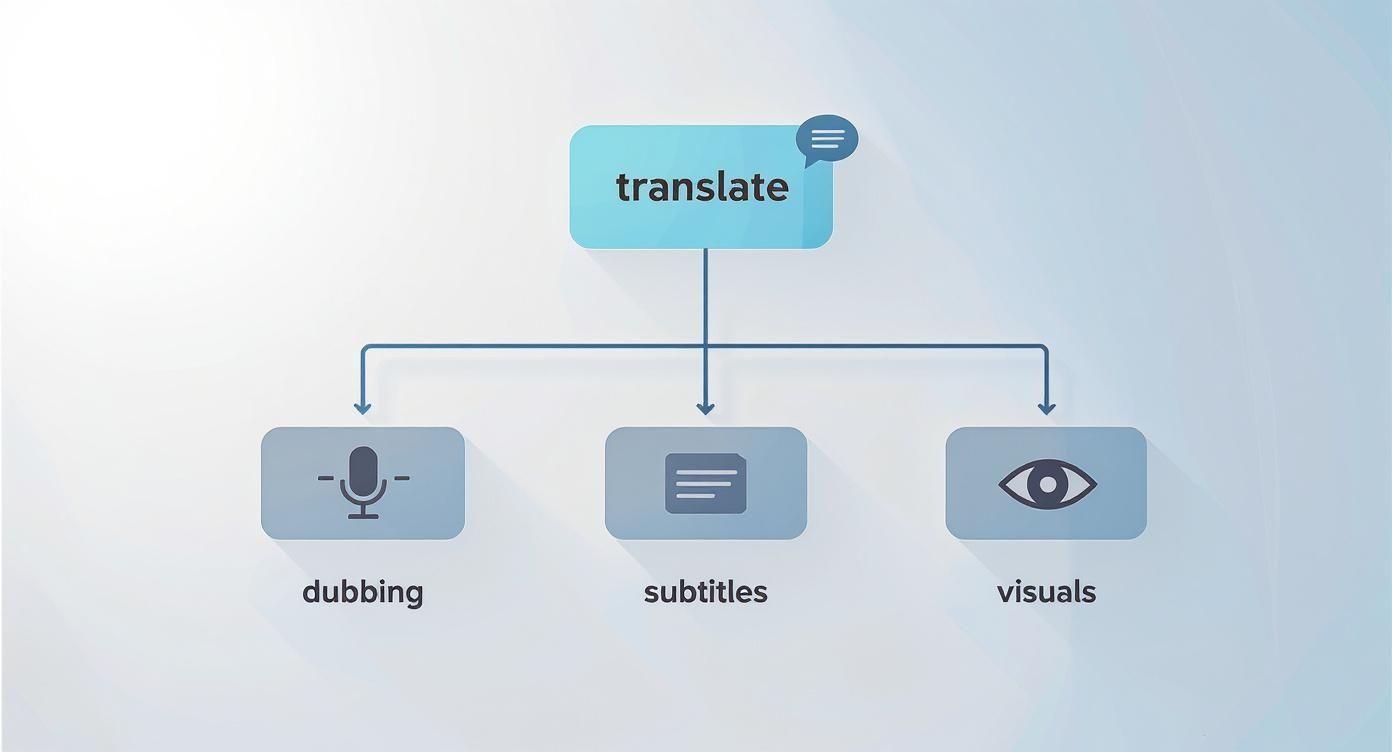
As you can see, an effective strategy integrates text, audio, and visuals to craft a completely natural viewer experience.
Making Content Accessible and Immersive
Once the script is localized, a video translation company can deliver the final product in several ways, each with unique benefits. High-quality video transcription and subtitling services are fundamental for any brand serious about global reach and accessibility.
Here’s a quick breakdown of the most common delivery methods:
- Subtitles and Closed Captions: Subtitles provide a text translation of dialogue, ideal for viewers who don’t speak the original language. Closed captions (CC) go further by describing important sounds, like “(door creaks)” or “(suspenseful music),” making content fully accessible to deaf and hard-of-hearing audiences.
- Voice-Over: This technique layers a translated audio track over the original, which is often still faintly audible in the background. It’s a popular choice for documentaries and corporate training, where preserving the original speaker’s voice is desired.
- Dubbing: For the highest level of immersion, dubbing is the gold standard. It completely replaces the original audio with a new language track. Professional dubbing is an art, requiring skilled voice actors to sync their performance with the on-screen characters’ lip movements and emotions.
Not sure which service is right for you? This table highlights the key differences.
Comparing Video Translation Services
| Service | Best For | Audience Immersion | Relative Cost |
|---|---|---|---|
| Subtitles/Captions | SEO, social media, accessibility, and reaching the widest possible audience quickly. | Low | $ |
| Voice-Over | Documentaries, e-learning, corporate training, and news reports. | Medium | $$ |
| Dubbing | Feature films, TV series, high-budget marketing, and children’s content. | High | $$$ |
Ultimately, the best service depends on your goals and target audience. Subtitles offer excellent accessibility and SEO benefits, but for maximum emotional impact, nothing beats full dubbing.
A great video translation company will guide you through these options, helping you select the right mix of services to match your content, budget, and global strategy.
How AI Is Changing Video Translation
Artificial intelligence is no longer a futuristic concept; it’s a transformative force in the video translation industry. Any modern video translation company now leverages AI to deliver projects faster, more affordably, and at a scale previously unimaginable. It acts as a powerful assistant to human language experts.

In practice, the workflow often starts with Automated Speech Recognition (ASR), which generates a complete text transcript in minutes. This text is then processed by Machine Translation (MT) engines to produce a solid first-draft translation. This gives human linguists a significant head start, accelerating the entire process.
AI’s Impact Beyond Text
AI’s influence extends far beyond text translation. The most exciting advancements are happening in audio and visuals, making the final product more natural and immersive.
Key AI tools making a difference include:
- AI Voice Cloning: This technology can replicate a person’s voice in another language while preserving the original tone and emotion, ensuring brand voice consistency across markets.
- Automated Lip-Syncing: Advanced AI can adjust on-screen lip movements to match newly dubbed dialogue, eliminating the distracting “bad dubbing” effect and creating a seamless viewing experience.
These tools solve real-world challenges, making high-quality dubbing accessible for projects with tight budgets and deadlines. This innovation is a key reason the AI Video Translation market is forecast to grow from $2.68 billion to an astounding $33.4 billion by 2034.
The Hybrid Model: Blending AI and Human Expertise
It’s crucial to understand that AI is not replacing human experts. The best video translation agencies use a hybrid model that combines the speed of technology with the irreplaceable nuance of human insight.
AI handles the initial heavy lifting—transcription and translation—while human editors provide the essential final polish. They catch subtle cultural references, refine awkward phrasing, and ensure the message connects with the target audience.
This balanced approach delivers a final product that is both efficiently produced and culturally authentic. You get the benefits of speed without sacrificing quality. To learn more, you can read about the impact of AI in different sectors.
The smartest companies see AI as a collaborator. Platforms like LunaBloom AI exemplify how these tools empower creators. This “human-in-the-loop” system represents the perfect fusion of machine power and the human touch.
Why Partnering with an Agency Pays Off
With so many free online translation tools available, you might wonder if hiring a professional agency is still necessary. The answer is a resounding yes. Choosing a dedicated video translation company is an investment in your brand’s integrity and long-term global success.
Think of an agency as your brand’s guardian in new markets. They prevent the cultural blunders and awkward phrasing that automated tools inevitably miss. A single poor word choice or culturally inappropriate image can do more than cause confusion—it can damage your reputation and alienate the very audience you want to reach.
Mastering Technical and Brand Details
Beyond cultural accuracy, a professional partner handles all the technical details that create a flawless final product. This includes everything from ensuring consistent audio levels in dubbing to embedding perfectly timed subtitles that are easy to read on any device. This level of quality control distinguishes professional content from amateur efforts.
A frequently overlooked benefit is global SEO. An agency doesn’t just translate words; they localize the metadata that helps people discover your video.
This includes optimizing:
- Video Titles: Using keywords and phrases that local audiences actually search for.
- Descriptions: Writing descriptions tailored for regional search engine algorithms.
- Tags and Keywords: Researching and implementing relevant local search terms.
This strategic approach turns your video from a passive asset into a powerful tool that actively attracts new international viewers.
Ensuring a Consistent Global Voice
Perhaps the most vital role a video translation company plays is maintaining a consistent brand voice across all languages and cultures. They invest time to understand your brand’s personality—its tone, style, and core message—and then find the perfect way to express it in a new cultural context.
Partnering with an agency is an investment in consistency. They ensure that a customer watching your video in Tokyo, Berlin, or São Paulo receives the same core brand experience you worked so hard to build.
It’s about more than finding equivalent words; it’s about evoking the same emotions and building the same level of trust. That is the brand stewardship that protects your reputation and helps you build a truly global community.
How to Choose the Right Translation Partner
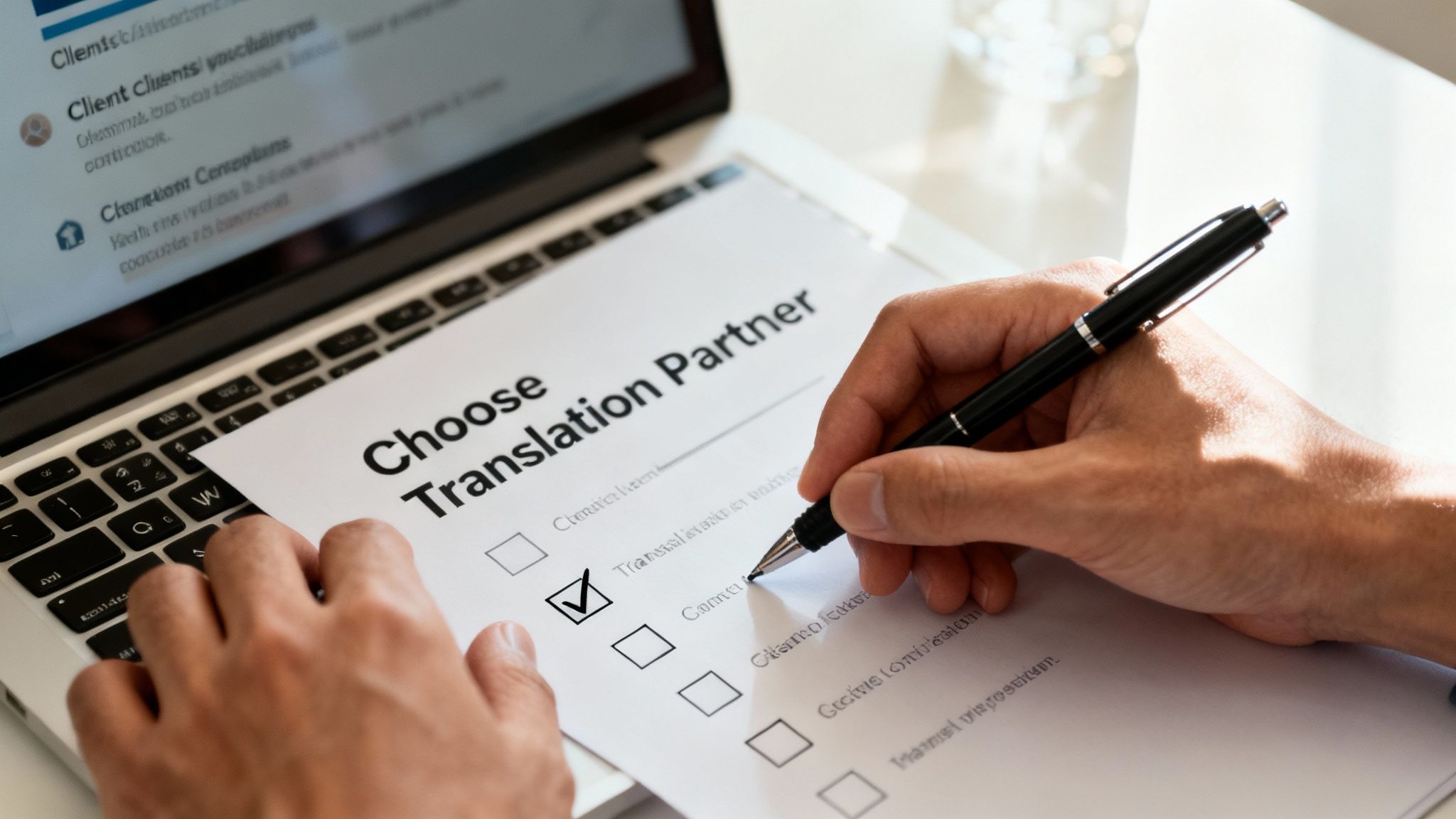
Selecting the right video translation company can seem daunting, but a structured approach makes it manageable. Focus on key areas that reveal a partner’s true capabilities rather than getting swayed by flashy marketing. The best agencies become an extension of your team, dedicated to your brand’s standards and global vision.
Start by confirming their expertise in your specific industry. Translating a technical medical tutorial is vastly different from localizing a fast-paced video game trailer. A company fluent in your niche will already understand the terminology, regulations, and audience expectations.
Assess Their Quality Assurance Process
A top-tier video translation company will have a robust quality assurance (QA) process. This is a critical differentiator. Don’t hesitate to ask for specific details about how they ensure accuracy and cultural appropriateness. Vague answers are a major red flag.
A strong QA workflow involves multiple stages and experts:
- Initial Translation: A native-speaking linguist with subject-matter expertise handles the first draft.
- Editing and Review: A second native speaker reviews the translation for accuracy, tone, and style.
- Proofreading: A final check catches any remaining typos, grammar errors, or formatting issues.
- Cultural Consultation: An in-country expert provides the final approval, ensuring all idioms, references, and visuals will resonate with the local audience.
This multi-layered approach is essential for protecting your brand from embarrassing and costly mistakes.
Understand Their Technology and Human Balance
Next, discuss their technology. Ask how they combine AI-powered tools with human translators. The leading agencies have perfected a hybrid model, using AI for speed on initial drafts and relying on human experts for critical thinking, creativity, and cultural sensitivity.
An effective video translation company leverages technology to enhance human skill, not replace it. This results in a final product that is both efficient and authentic.
Ensure they also have the technical expertise to handle your specific video formats and platforms. Can they work with complex files? Can they deliver perfectly synced audio and properly embedded subtitles? Technical competence is key to a smooth, hassle-free process.
The demand for this blend of skills is surging. The global Video Translation Software market is expected to reach approximately $4.5 billion by 2025, with a Compound Annual Growth Rate of around 20% through 2033. This growth underscores the importance of finding a partner who excels at both the linguistic and technical aspects of the job. You can discover more insights about these market trends to see where the industry is heading.
Evaluate Past Work and Client Feedback
Finally, ask for proof. Look beyond homepage testimonials and request case studies or project samples from clients in your industry. When reviewing their portfolio, don’t just be impressed by big-name logos.
Instead, ask yourself these key questions:
- Is the quality consistent across projects?
- Does the translated tone match the original brand’s voice?
- Do they showcase measurable results, like increased engagement or successful market entry?
By following this checklist, you can cut through the noise and confidently choose a video translation company that will be a true partner in your global expansion.
Of course, you might still have some practical questions. Let’s answer a few of the most common ones to help you move forward.
My goal is to give you the direct answers you need to make an informed decision.
How Much Does Video Translation Cost?
The honest answer is: it depends. There is no one-size-fits-all price, as every project is unique. A short social media clip with AI-generated subtitles will be far less expensive than a feature film requiring full lip-sync dubbing by professional voice actors.
The main factors that influence cost are:
- Service Type: Subtitling is the most budget-friendly option. Voice-over is a mid-range service, while high-quality dubbing is the most premium.
- Language Pair: Common language pairs like English to Spanish are generally less expensive than less common pairs like English to Icelandic due to the availability of expert linguists.
- Content Complexity: Videos with technical, medical, or legal jargon require specialized translators, which adds to the cost.
- Video Length: Most companies charge on a per-minute basis, so longer videos cost more.
- Turnaround Time: Rush jobs that require translators to work overtime will incur a premium fee.
A reputable video translation company will always provide a detailed, itemized quote so you know exactly what you’re paying for.
What Are Typical Turnaround Times?
Like cost, turnaround times vary widely. A 2-minute social media video needing simple subtitles could be completed in a few hours with an AI-assisted workflow. In contrast, a 60-minute e-learning course requiring dubbing into five languages could take several weeks.
The primary factors are video length and project complexity. Dubbing is a multi-step process involving translation, voice actor casting, recording, and audio mixing, each adding to the timeline.
A professional agency will provide a clear project timeline upfront. This is essential for managing expectations and ensuring everyone is aligned on deadlines.
If you have a tight deadline, communicate it early. Many agencies can expedite projects, but it’s important to confirm that speed won’t compromise quality.
How Do You Ensure Translation Quality?
This is the key difference between a professional video translation company and a free online tool. Quality assurance is integrated into every step of the process. The best agencies use a multi-layered review system to guarantee both linguistic accuracy and cultural nuance.
A typical quality assurance process includes:
- Native Speaker Translation: The initial translation is done by a linguist who is a native speaker of the target language.
- Independent Editing: A second linguist reviews the translation for accuracy, tone, and style.
- Final Proofreading: A final pass is conducted to catch any remaining grammatical errors or typos.
- In-Country Review (Optional): For high-stakes projects, an expert in the target country may perform a final review to ensure everything feels natural and culturally appropriate.
This rigorous, human-driven process is the only way to ensure your message connects authentically and protects your brand’s reputation in new markets.
Ready to take your videos global? LunaBloom AI provides powerful tools to translate and adapt your content for audiences worldwide, blending AI efficiency with high-quality results. Create your first translated video with LunaBloom AI today!