A typical Google Search ad averages around 3.17% CTR, and disciplined matching of message to intent, not clever wording, is the single biggest lever for click-through rate improvement. Strong results come from aligning the query, audience, placement, promise, and next action before polishing the headline.
That distinction matters because CTR is easy to celebrate and easy to misunderstand. A higher click rate can mean better relevance, but it can also reflect a cheaper audience, a changed SERP layout, accidental clickbait, or a test that attracts traffic without producing qualified conversions.
In practice, click-through rate improvement is a measurement and experimentation problem across channels. Search ads, organic listings, display placements, email campaigns, paid social, and on-site modules each have different denominators, intent levels, and competitive environments. Treating them as one interchangeable metric leads to bad decisions.
What Click-Through Rate Improvement Really Means in 2026
CTR is a ratio, not a universal quality score. In paid search, it usually means clicks divided by impressions. In email, it means clicks divided by delivered messages. In organic search, it shows how often a listing earns a click after appearing on a results page whose layout can change by query and device.
The denominator and intent determine what the number means. A 3.17% Google Search ad CTR and a 0.46% Display Network CTR are different operating targets because the placements serve different jobs and capture different levels of intent, as documented in industry CTR benchmarks by channel. A research query needs an explanatory result; a branded query needs a direct route to the destination.
The SERP is no longer a simple ranking list
Organic click distribution has shifted as search pages add AI answers, rich results, shopping modules, sitelinks, and zero-click answer boxes. One 2026 benchmark reported that top-of-page organic CTR for positions 1 through 5 fell 17.92% year over year. Position 1 moved from about 28% to about 19%, while position 2 declined by 39%. Positions 6 through 10 rose 30.63%, which shows why rank alone cannot explain performance. The reported changes appear in this 2026 organic CTR benchmark by position.
A lower position is not automatically better. A listing can gain or lose clicks through snippet ownership, schema, answer competition, device layout, and SERP crowding, even when its numerical rank stays the same.
Before rewriting a headline, inspect the impression environment:
- Query intent: Is the searcher learning, comparing, buying, or finding a specific brand?
- Device mix: Does the result remain visible and persuasive on smaller screens?
- Ad rank and assets: Are competitors taking more visual space or presenting stronger extensions?
- Snippet ownership: Has an answer box or AI summary absorbed demand before the organic listing?
- Historical bands: Is the current CTR outside the campaign's normal range?
- Quality signals: Did relevance, landing-page experience, load performance, or engagement quality change?
A headline rewrite cannot fix a query mismatch, a crowded SERP, or weak page quality.
Practical rule: Diagnose the impression environment first. Copy is often the last problem, not the first.
A benchmark is a starting diagnostic
| Channel / Placement | Average CTR | Top Quartile CTR | Diagnostic Note |
|---|---|---|---|
| Google Search ads | About 3.17% | Not provided | Compare branded and non-branded traffic separately |
| Display Network ads | About 0.46% | Not provided | Lower-intent placement, do not compare directly with Search |
| Google and Microsoft Ads, all industries | 6.64% | Not provided | Broad benchmark spanning different campaign mixes |
| Organic positions 1 to 5 | About -17.92% YoY (positions 1 to 5) | Not provided | SERP features and AI answers alter click distribution |
| Organic positions 6 to 10 | 30.63% year-over-year rise reported | Not provided | Evaluate layout and snippet visibility, not rank alone |
The wider advertising benchmark reported that Google and Microsoft Ads averaged 6.64% across industries. Education and Instruction rose 31.71%, Beauty and Personal Care rose 18.21%, and Finance and Insurance rose 18.01% year over year. Treat these figures as market context, not quotas for an individual account. For CTR benchmarks across marketing channels, separate the channel, campaign objective, audience, and placement before drawing conclusions.
Teams using LunaBloom AI to create video ads or social assets should apply the same diagnostic discipline. A stronger thumbnail or opening hook can increase clicks, but only when the creative answers the audience's actual question, fits the placement, and makes the next action logical. Then judge the change against qualified engagement or conversion quality, not CTR alone.
Writing Headlines and Subject Lines That Earn the Click
A headline should make the next step obvious to the person who sees it. The most reliable pattern isn't a clever formula. It's intent matching, with enough specificity to confirm that the message belongs to the searcher.
For informational queries, specificity and proof usually beat broad promises. “How X works in 7 steps” is more useful than “Everything you need to know.” Commercial searches need comparison, category, and freshness signals. Transactional searches respond to cues such as price, speed, availability, or a guarantee when those details are directly supported. Navigational searches usually need the exact brand name plus a useful differentiator.
Match the wording to the job
For email, the same principle applies, but the audience relationship changes. B2C subject lines can benefit from curiosity, emoji, and relevant personalization. B2B recipients generally need role specificity and a clear business outcome. A subject line for a finance lead shouldn't sound like one for a first-time shopper.
A large benchmark covering 32M sends and 4,200 A/B tests found that subject lines tied to known behavior or product interest produced +21% CTR, 41 to 60 character lines produced +14%, numeric specificity produced +11%, and preview-text alignment produced +6%. Those findings are summarized in this email subject-line benchmark analysis. Test one variable at a time, and make sure the email body fulfills the subject's promise.
| Channel | Weak Version | Intent-Matched Rewrite | Why It Works |
|---|---|---|---|
| Search ad | “Solutions for Your Business” | “Compare CRM Pricing for Small Teams” | Names the category, audience, and commercial task |
| B2C email | “You Won't Believe This” | “Your Running Shoes Are Back in Stock” | Uses a concrete behavioral trigger instead of vague curiosity |
| B2B email | “Improve Your Marketing” | “Reduce Reporting Time for Paid Media Teams” | Names the role-relevant outcome |
The trade-off is important. Clickbait can lift an initial open or click while damaging downstream conversion because the landing page can't satisfy the exaggerated promise. A subject line that earns a click from the wrong person isn't a successful test. It just moves the mismatch further down the funnel.
For additional ideas, proven headline psychology hooks can help generate variants. Use them as starting points, then filter every option through the query, audience, offer, and landing-page experience.
Your final check should be simple:
- Informational: Does the headline answer what the person wants to understand?
- Commercial: Does it help the person compare or evaluate?
- Transactional: Does it clarify the action and its value?
- Navigational: Does it identify the intended destination immediately?
For teams building and testing creative variants in LunaBloom AI's starter app, keep the hook, title, and call to action aligned. More variation isn't automatically better. Relevance is what makes variation useful.
Calls to Action and Ad Copy That Match Searcher Intent
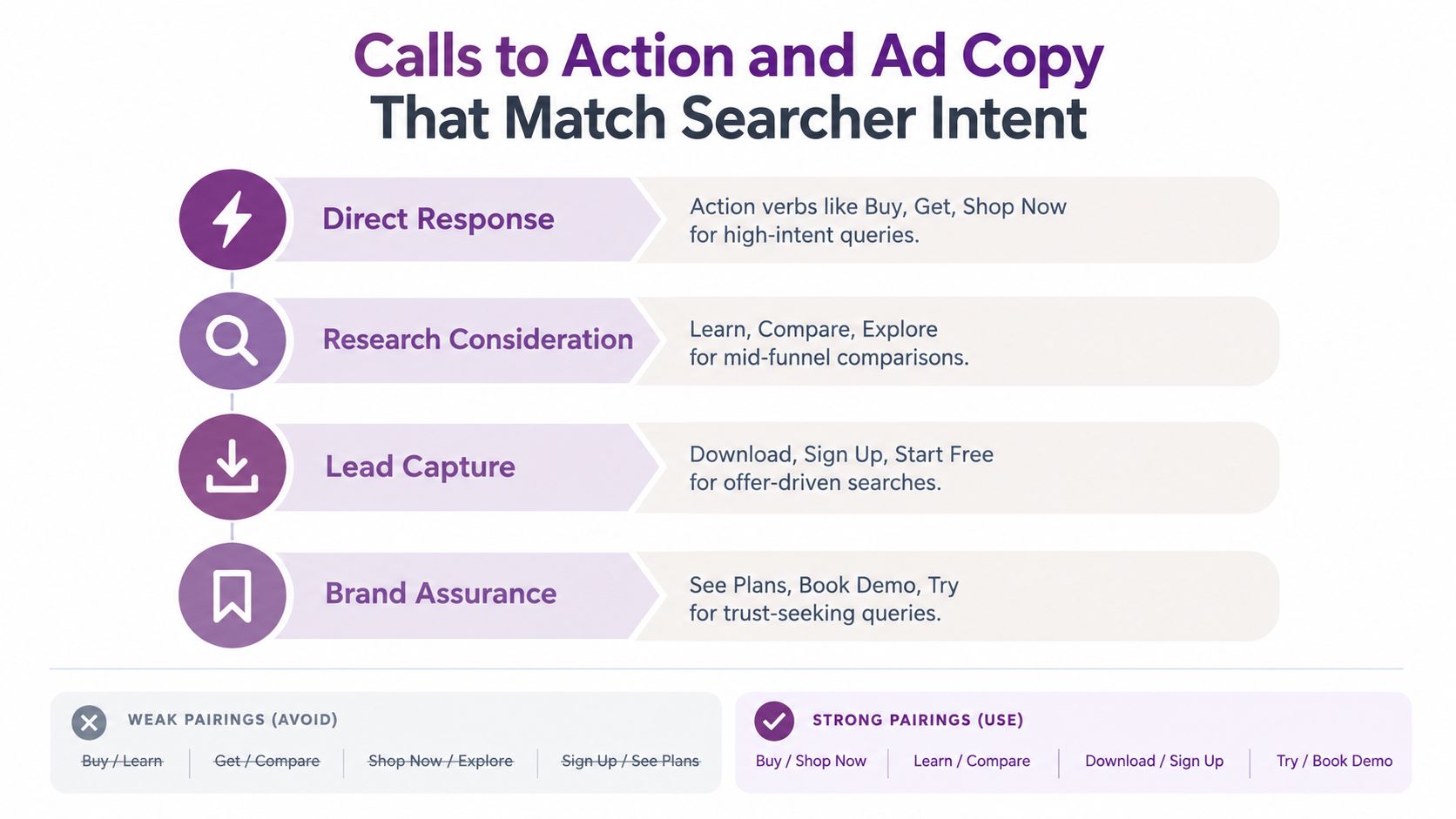
A CTA describes the job the click will perform. “Buy” and “Order” suit direct-response queries. “Get a Quote,” “See Pricing,” and “Start a Trial” suit lead-generation journeys. “Read the Report,” “Compare Options,” and “See Benchmarks” fit research intent. “Visit,” “View,” and “See More” work when the user already knows the destination and needs navigation.
Google Ads recommends making ad text more compelling while matching the keyword's intent, then keeping the landing page consistent with that message in its guidance on improving CTR. Its examples of specific action language include Buy, Sell, Order, Browse, Find, Sign up, Try, and Get a Quote, as explained in the Google Ads CTA recommendations.
Audit the action before the adjectives
A strong headline can still underperform when the CTA asks for the wrong commitment. “Download the Guide” is a poor fit for someone ready to buy, while “Buy Now” can feel premature for a comparison query.
Use this audit:
- Name the intent bucket. Research, consideration, transaction, or navigation.
- Write the desired next action. Don't start with the verb. Start with what the user needs to accomplish.
- Choose the narrowest accurate CTA. “See Pricing” is clearer than “Learn More” when cost is the question.
- Check the landing page. The first visible section should reinforce the same action.
For one responsive search ad, build a balanced asset set:
- Keyword-rich headline: Reflect the search language.
- Benefit headline: Explain the practical value.
- Proof headline: Add a supported trust signal, qualification, or product detail.
- CTA headline: Use an action verb that matches the job to be done.
Pinning can help preserve an essential message, but over-pinning can restrict combinations and reduce learning. Asset reporting should show which combinations earn clicks, while conversion data determines whether those clicks are useful.
Test the CTA independently of the headline whenever possible. If both change together, you won't know whether the wording, action, or interaction between them caused the result. For email closings that support a clear next step, these outbound email closing lines provide useful examples without replacing the need for offer-to-action alignment.
A/B Testing Without Lying to Yourself
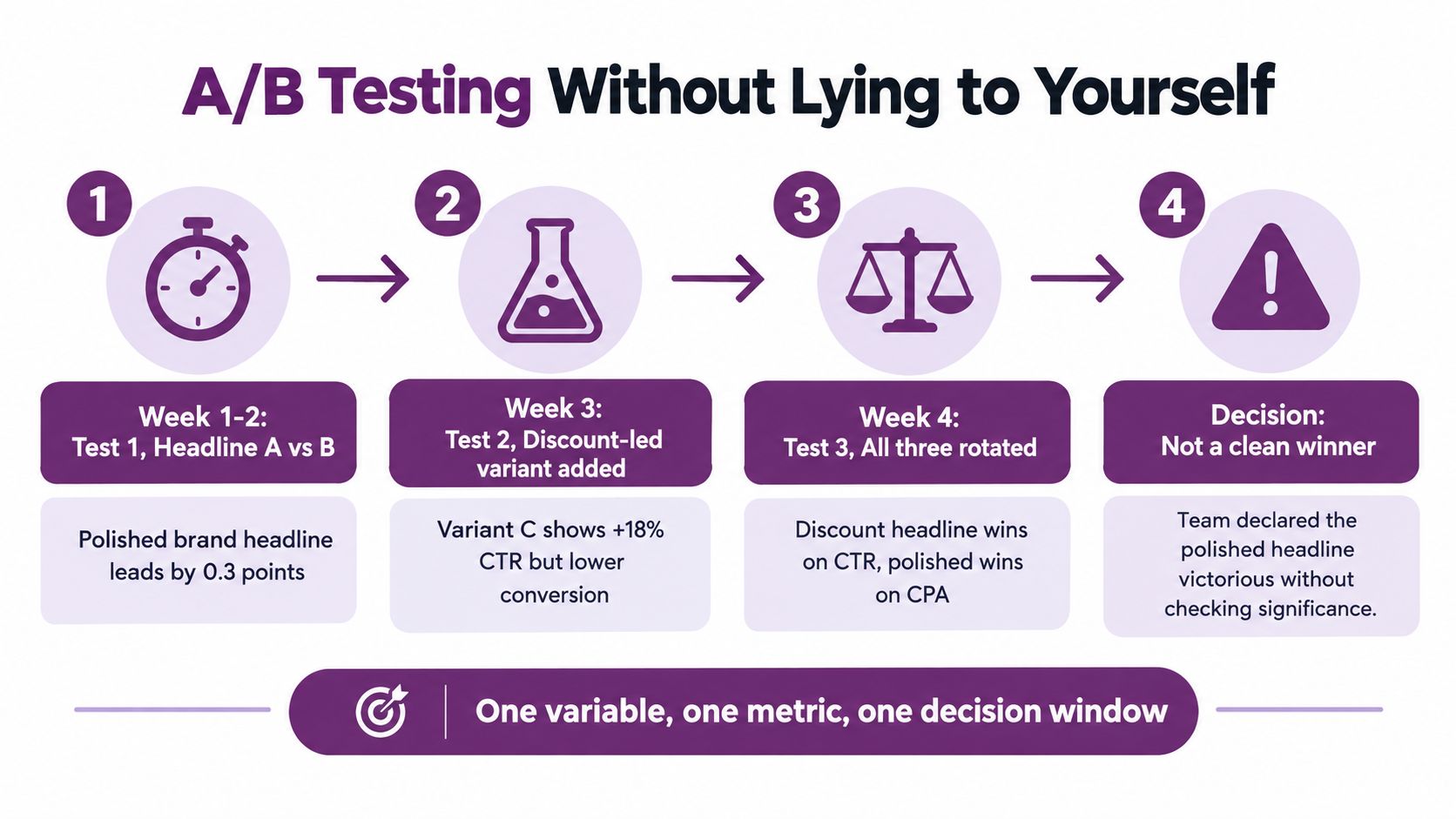
A paid search team once ran three headline tests across four weeks. The polished brand headline appeared to win the first comparison by a narrow margin, so the team prepared to roll it out. Then someone checked the weekly breakdown and found that a discount-led variant had pulled clicks during the second week.
The final view was more complicated. The discount headline won on CTR, while the polished version won on CPA. Declaring the polished headline the winner based on the first read would have confused a business outcome with a surface metric.
Control the experiment
A clean paid-search test changes one meaningful variable. Keep the description lines, display path, landing page, bid approach, audience, and targeting constant while testing the headline. Google recommends at least 100 impressions per cell in a single auction as a practical starting point for ad testing, so don't treat a handful of impressions as evidence of a durable winner.
The scenario becomes clear when written as a test log:
| Period | Test | Observed result | Correct interpretation |
|---|---|---|---|
| Week 1 to 2 | Polished brand headline versus headline B | Polished headline leads by 0.3 points | Early directional signal only |
| Week 3 | Discount-led variant added | Variant C shows +18% CTR but lower conversion | CTR and conversion disagree |
| Week 4 | All three rotated | Discount wins CTR, polished wins CPA | No single winner for every objective |
| Decision | Team reviews only the first result | Polished headline declared victorious | Analytical error |
The +18% CTR scenario above is illustrative, not a general benchmark. Its lesson is that a test can produce a click-rate winner and a business-result winner at the same time.
One variable, one metric, one decision window.
For email and paid social, minimum sample size depends on baseline CTR, desired detectable change, traffic allocation, and the confidence threshold you choose. Don't invent a universal recipient count. Calculate the required sample before launch, then record the primary metric, minimum detectable effect, and stop date in the test plan.
Segmented results can hide the signal. New subscribers may respond differently from returning subscribers, and a blended result can make a strong segment look average. Review segments after the primary decision, not by repeatedly slicing data until a favorable day appears.
A testing workspace such as LunaBloom AI's app can support creative production, but the platform doesn't replace experimental discipline. Rotate variants consistently, preserve the landing experience, and log the decision with its evidence.
Measuring CTR the Right Way Across Channels
CTR only becomes useful when its denominator and context are clear. Compare like with like: search CTR reflects query intent and auction visibility, display CTR reflects interruption and placement, email CTR depends on delivery, audience, offer, and message design, while organic CTR is shaped by the result page, competing features, and snippet appearance.
Build each channel baseline around campaign type, audience, device, placement, brand status, and intent bucket. A hypothetical email rate beside a hypothetical Google Ads rate creates a comparison, not an insight. Record impressions, delivered messages, clicks, and the conversion action consistently so a reporting change does not masquerade as performance change.
Use Quality Score as a diagnostic
Google Ads measures Quality Score at keyword level on a scale from 1 to 10. Its components are expected CTR, ad relevance, and landing page experience, according to Google's Quality Score documentation.
Expected CTR estimates the likelihood of a click when the ad appears. It does not judge copy in isolation. A below-average signal can indicate weak alignment among query, keyword, audience, and ad. A below-average ad relevance signal points more directly to wording that fails to reflect the searcher's language.
| Channel | Typical CTR Baseline | Primary Diagnostic Signal | Watch Out For |
|---|---|---|---|
| Google Search ads | About 3.17% | Query-to-ad match and expected CTR | Mixing branded and non-branded campaigns |
| Display Network ads | About 0.46% | Placement, audience, and creative context | Comparing interruption traffic with Search |
| Google and Microsoft Ads | 6.64% across industries | Campaign objective and audience mix | Treating a broad benchmark as a target |
| Facebook lead generation | 2.59% | Offer and objective alignment | Comparing with Facebook traffic campaigns at 1.71% |
The paid-social benchmark reported that Facebook lead-generation campaigns reached 2.59% CTR, about 52% higher than traffic campaigns at 1.71%, showing why campaign objective belongs in the baseline. Review cross-channel benchmark figures before combining reports, and label each figure by source, objective, and audience.
Follow a fixed drop diagnosis
When CTR falls, use this sequence:
- Confirm the change. Compare it with the baseline, then assess sample size and significance.
- Segment the result. Break performance down by query, device, audience, placement, and brand status.
- Inspect the environment. Check SERP layout changes, new competitors, altered assets, and delivery shifts.
- Test one variable. Change the most plausible cause while keeping the rest stable.
Reporting software can organize channel-level diagnostics. A Raven Tools alternative may help teams keep those comparisons in one workflow. Apply the same care to governance: document access, retention, and permitted use, and review LunaBloom AI's privacy policy when handling related platform data.
When Better Targeting Beats Better Wording
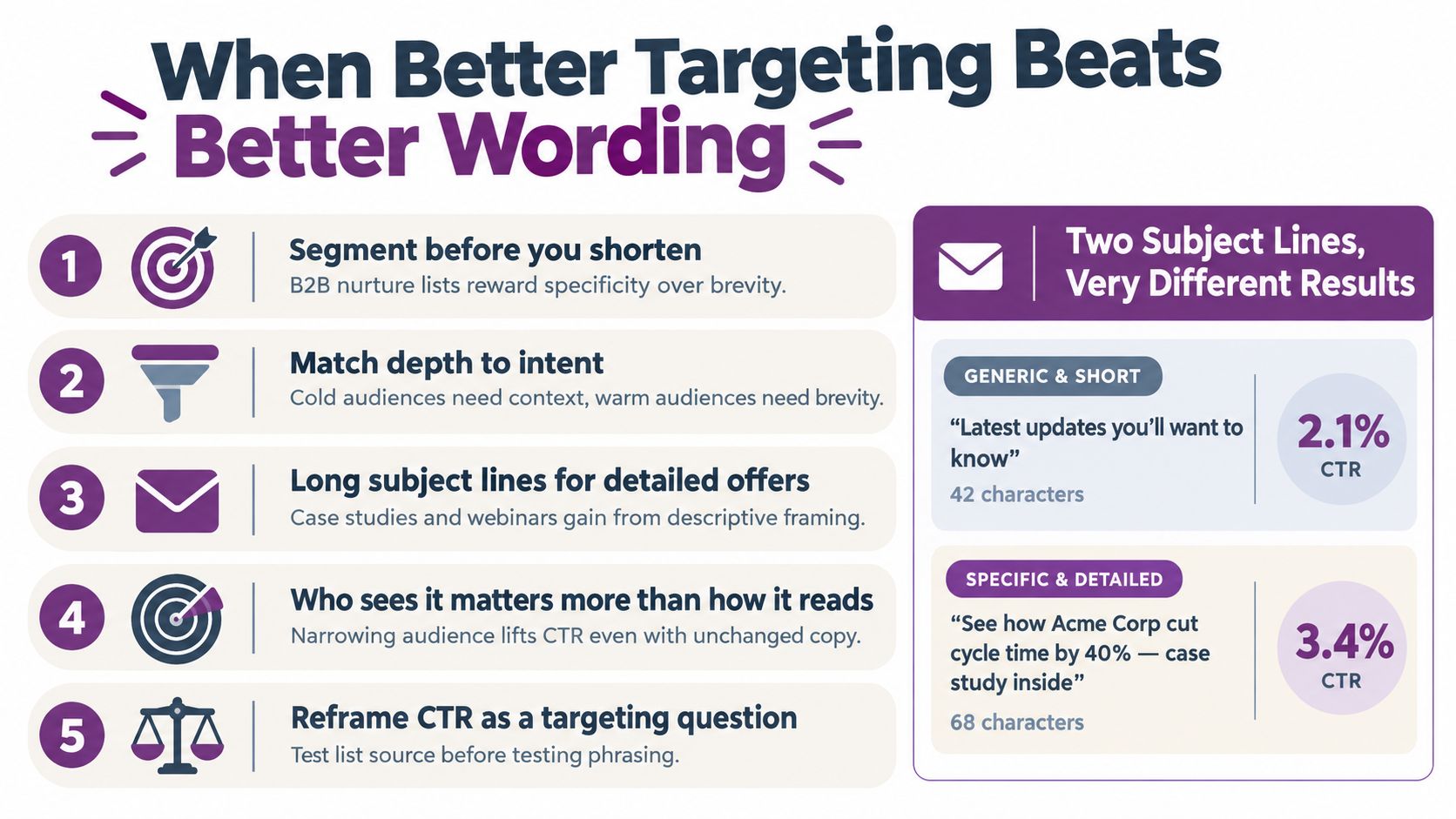
Shorter subject lines don't always win because brevity isn't the outcome. The outcome is a qualified click from a person who understands the offer and has a reason to act.
Benchmark coverage is inconsistent. One analysis favors 20 to 40 characters for opens, another B2B dataset favors 2 to 4-word subject lines and questions for opens, while another benchmark reports the strongest CTR at 41 to 50 characters, with 17.57% CTR. Those differences are documented in email subject-line best-practice coverage. The practical conclusion is not to choose one universal length. Test length against the audience, device, message complexity, and intended outcome.
Three targeting moves to test first
In paid search, layer relevant in-market or firmographic audiences where the campaign supports them. The purpose isn't to make the audience larger. It's to qualify impression opportunities and separate high-intent behavior from broad research traffic.
In email, use exclusion audiences to prevent fatigue. Suppress recent purchasers from acquisition offers, remove people who already completed the advertised action, and separate dormant subscribers from active ones. A generic subject line sent to a tightly defined audience can outperform polished wording sent to everyone.
In search strategy, label queries by intent. Route research queries toward educational pages, comparison queries toward evaluation content, and buyer queries toward pricing or action pages. This prevents one headline from carrying incompatible promises.
Targeting is probably the smarter lever when:
- CTR is weak across several copy variants.
- High impressions come from low-intent queries.
- New and returning audiences behave very differently.
- The offer is relevant to only one product, role, region, or lifecycle stage.
- Expected CTR and ad relevance remain weak after reasonable copy alignment.
Improved targeting can also strengthen paid-search quality signals because the ad appears in a more relevant context. The important distinction is that targeting doesn't make weak copy irrelevant. It gives the copy a better chance to reach people for whom the promise matters.
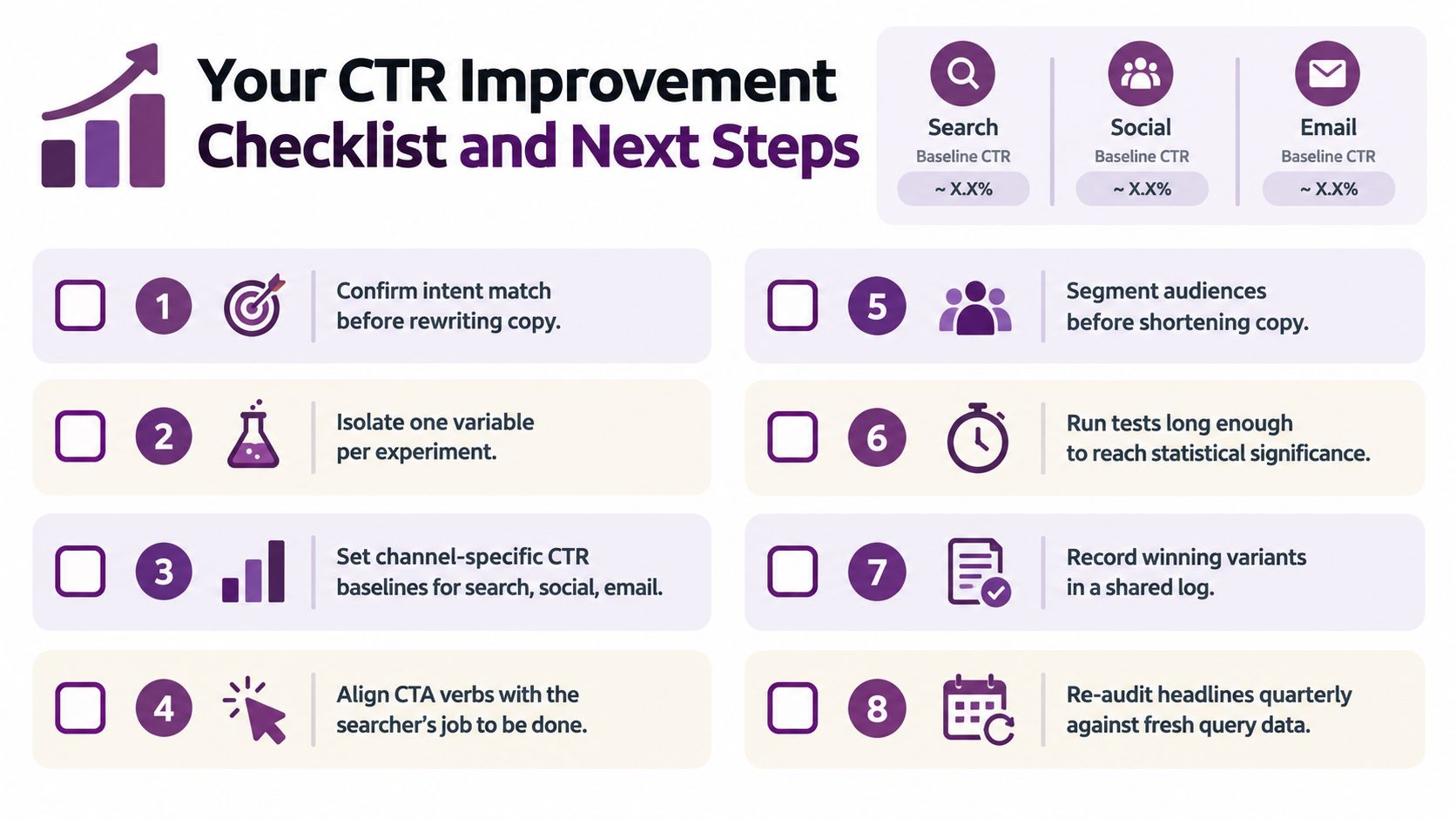
Your CTR Improvement Checklist and Next Steps
Review CTR as a measurement and experimentation problem, not only a copy task. Keep the evidence beside every decision so a promising headline does not receive credit for a stronger audience, better placement, or an easier SERP.
Before launch
- Confirm intent match: Map each ad, email, result, and landing page to the audience's immediate task. Check whether the SERP layout supports the click or gives users enough information without one.
- Set separate baselines: Record channel, placement, audience, device, brand status, query intent, and quality signals.
- Align CTA verbs: Use Buy, Order, See Pricing, Compare, Read, Visit, or another action the destination supports.
- Choose the primary metric: Decide whether the test optimizes CTR, qualified clicks, CPA, or another business result.
- Define the detectable effect: Calculate the sample needed before traffic starts.
During the test
- Isolate one variable: Keep the headline, CTA, offer, and landing page stable when testing one of them.
- Protect the audience split: Keep allocation and eligibility consistent.
- Watch quality signals: Review expected CTR, ad relevance, placement, query mix, delivery, and landing-page quality.
- Check segments: Separate new and returning subscribers, branded and non-branded queries, devices, and audiences.
- Respect the decision window: Do not stop because one day looks favorable.
After the test
- Record the result: Log the variant, audience, dates, baseline, primary metric, and decision.
- Check downstream quality: Confirm that higher CTR did not reduce conversion quality.
- Promote carefully: Apply the winner only to matching intent and audience, not every campaign.
- Re-audit regularly: Refresh headlines against current query data and SERP layouts.
- Revisit targeting: If wording plateaus, narrow or restructure the audience before producing more variants.
Start with three actions. Audit ad groups and email journeys for intent alignment, then inspect query mix, SERP features, devices, placements, and quality signals before rewriting copy. Queue two A/B tests with a predefined primary metric and minimum detectable effect. Schedule a 30-day CTR diagnostic using channel-specific baselines and downstream conversion quality.
If you need controlled creative variants, LunaBloom AI can turn scripts, prompts, and images into edited videos with voiceovers, captions, localized versions, and social-ready exports. If you want help scoping your first tests, reach out through the LunaBloom contact page and review your campaign baselines together.