Imagine creating professional-quality videos without ever touching a camera or hiring a film crew. That’s the power of full body avatars. Unlike the simple head-and-shoulders avatars you might know, these are complete digital characters that move, gesture, and interact just like a real person, bringing an authentic human touch to your content.
This guide breaks down exactly what they are, how they're made, and how you can use them to create incredible videos.
What Are Full Body Avatars and Why They Matter Now
A full body avatar is more than just a digital puppet; it's a complete virtual stand-in for a person, capable of communicating complex ideas and emotions through body language. To get a feel for the technology, you can explore the foundational features of AI Avatars.
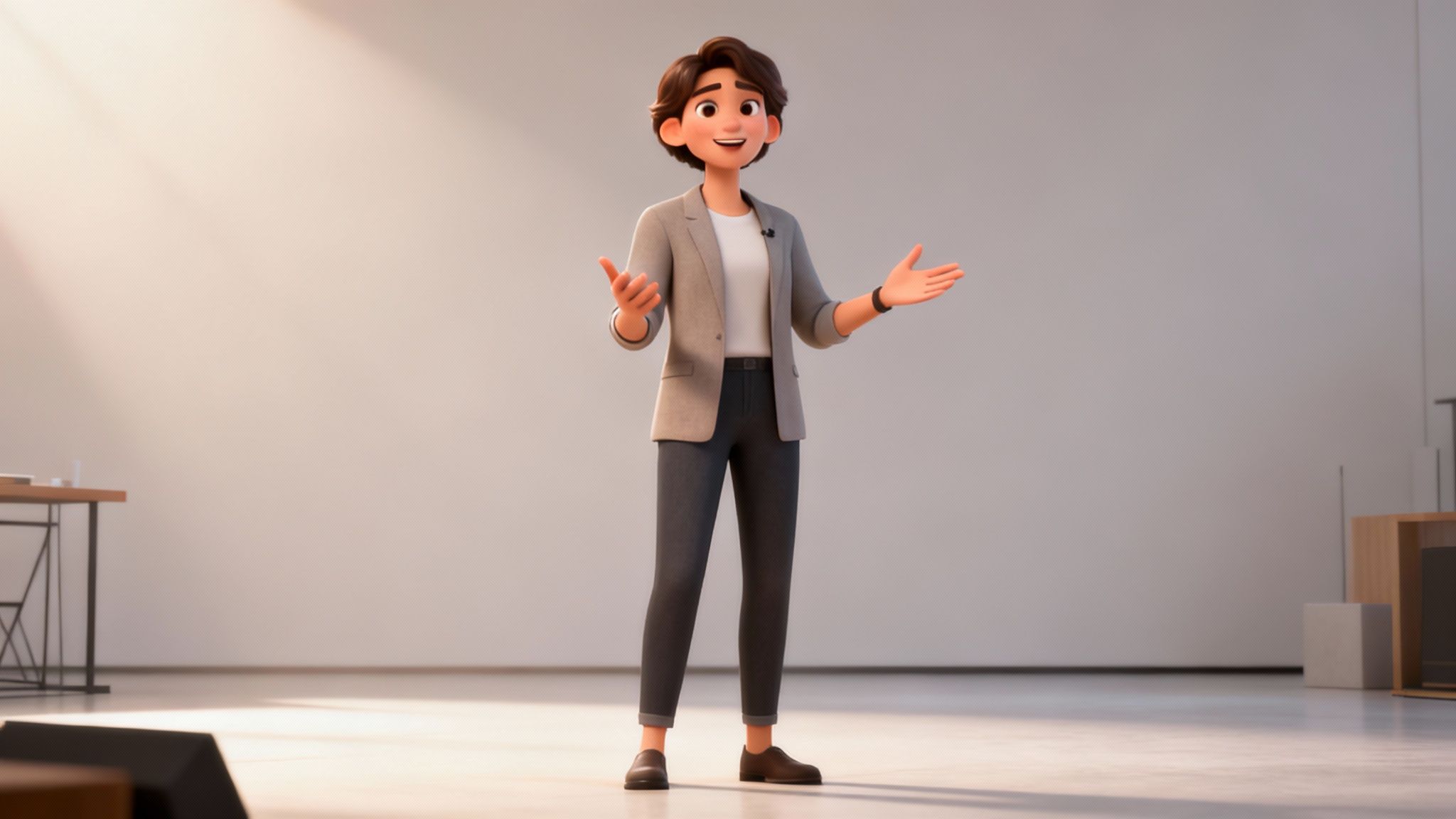
Think about the difference between a static profile picture and a captivating presenter on stage. A traditional avatar, showing only a face, is limited to facial expressions and voice. A full body avatar, however, uses its entire form to tell a story, making the experience far more dynamic and engaging for your audience.
The Power of Non-Verbal Communication
Much of how we communicate isn’t about words—it’s our gestures, posture, and subtle movements that add meaning. This is where full body avatars truly shine.
By bringing the entire body into the picture, these digital characters can:
- Build Stronger Connections: Realistic body language makes an avatar feel more human and trustworthy, helping you build genuine rapport with your audience.
- Enhance Storytelling: An avatar can walk across a virtual stage, point to a chart, or interact with digital objects, making your explanations clearer and more memorable.
- Improve Learning and Retention: For training or educational videos, physical demonstrations can break down complex topics more effectively than a talking head ever could.
This technology isn't just a novelty; it's a massive leap forward that opens up a world of new possibilities for content creators.
A Rapidly Growing Market
The industry numbers tell a clear story. The global digital avatar market, which includes full body avatars for everything from virtual reality to video creation, was valued at an estimated USD 18.19 billion in 2023. Projections show it skyrocketing to USD 270.61 billion by 2030, growing at a staggering compound annual growth rate (CAGR) of 49.8% from 2024.
This isn't just about creating cool cartoons. It's about building accessible, scalable tools that empower anyone to produce high-quality video that connects with people, without the traditional hurdles of cost, equipment, and time.
What was once reserved for big-budget animation studios is now in the hands of marketers, trainers, and creators of all kinds. The ability to generate a lifelike, expressive digital presenter is completely changing how we think about video production, making it faster, cheaper, and incredibly versatile.
How Full Body Avatars Are Brought to Life
Creating a digital person from scratch once felt like science fiction, but today it's a fascinating blend of art and technology. The process for building full body avatars has evolved from slow, manual work to much faster, AI-driven methods.
Peeking behind the curtain reveals the magic that makes their movements and expressions feel so real. Getting from a basic idea to a believable digital human involves a few key steps, each one adding another layer of realism.
Traditional 3D Modeling: The Digital Sculptor
The classic way to create a full body avatar is with 3D modeling. Think of it as digital sculpting. An artist uses software like Blender or Maya and starts building a character from a simple geometric shape, often called a "mesh."
Like a sculptor working with clay, the artist painstakingly shapes this mesh, adding every detail by hand—facial features, muscle definition, even the wrinkles in their clothing. It's a craft that demands serious skill, a ton of time, and a solid grasp of anatomy to achieve a lifelike result.
Advanced Creation Techniques
Beyond sculpting by hand, other technologies emerged to capture reality with incredible detail. These are the methods used in big-budget video games and blockbuster films to create digital doubles that are almost indistinguishable from real people.
- Photogrammetry: This technique involves taking hundreds of high-resolution photos of a person from every angle. Specialized software then stitches these images together to build an incredibly detailed and textured 3D model.
- Motion Capture (MoCap): You’ve likely seen this in behind-the-scenes movie clips. Actors wear suits with sensors that track their every move. That data is then mapped onto a digital character, allowing it to mimic the actor's performance with uncanny accuracy.
These techniques deliver jaw-dropping results, but they have always been limited by expensive gear and the need for technical experts. For most creators, they were simply out of reach—until AI changed everything.
The AI Revolution: Text-to-Avatar Generation
The biggest shift in avatar creation is happening right now, thanks to artificial intelligence. AI models can now generate and customize unique avatars from a simple text description.
Instead of needing years of 3D art experience, you can type a prompt like, "a professional woman in a business suit with brown hair and glasses," and the AI creates a 3D model to match. This democratizes the creation process, allowing anyone to design a custom digital character in minutes, not weeks. This exact technology fuels platforms like LunaBloom AI, putting powerful creative tools in the hands of everyday users.
Rigging: The Unseen Skeleton
No matter how an avatar is created, it needs a way to move. That’s where rigging comes in. Rigging is the process of building a digital skeleton inside the 3D model.
Think of the 3D model as the avatar's skin and the rig as its bones and joints. This internal framework dictates how the character can bend its knees, wave its hands, or show emotion.
A solid rig is what separates a believable character from a stiff, lifeless mannequin. It sets the rules for movement—an elbow only bends one way, after all—and gives animators (or an AI) the controls needed to bring the avatar's body to life.
Putting Your Avatar to Work with AI Tools
Creating a great full body avatar is just the starting point. The real magic happens when you bring it to life—making it speak, move, and connect with your audience in a believable way. Modern AI tools, like those found on platforms such as LunaBloom AI, make this animation process surprisingly simple.
Forget wrestling with complex animation software. Today's workflow is intuitive. You can either upload your own custom avatar or choose one from a library to get started. From there, you can tweak its appearance, changing everything from clothing to accessories to ensure it perfectly matches your brand and message.
This process connects the dots between character creation and final animation, as illustrated here.
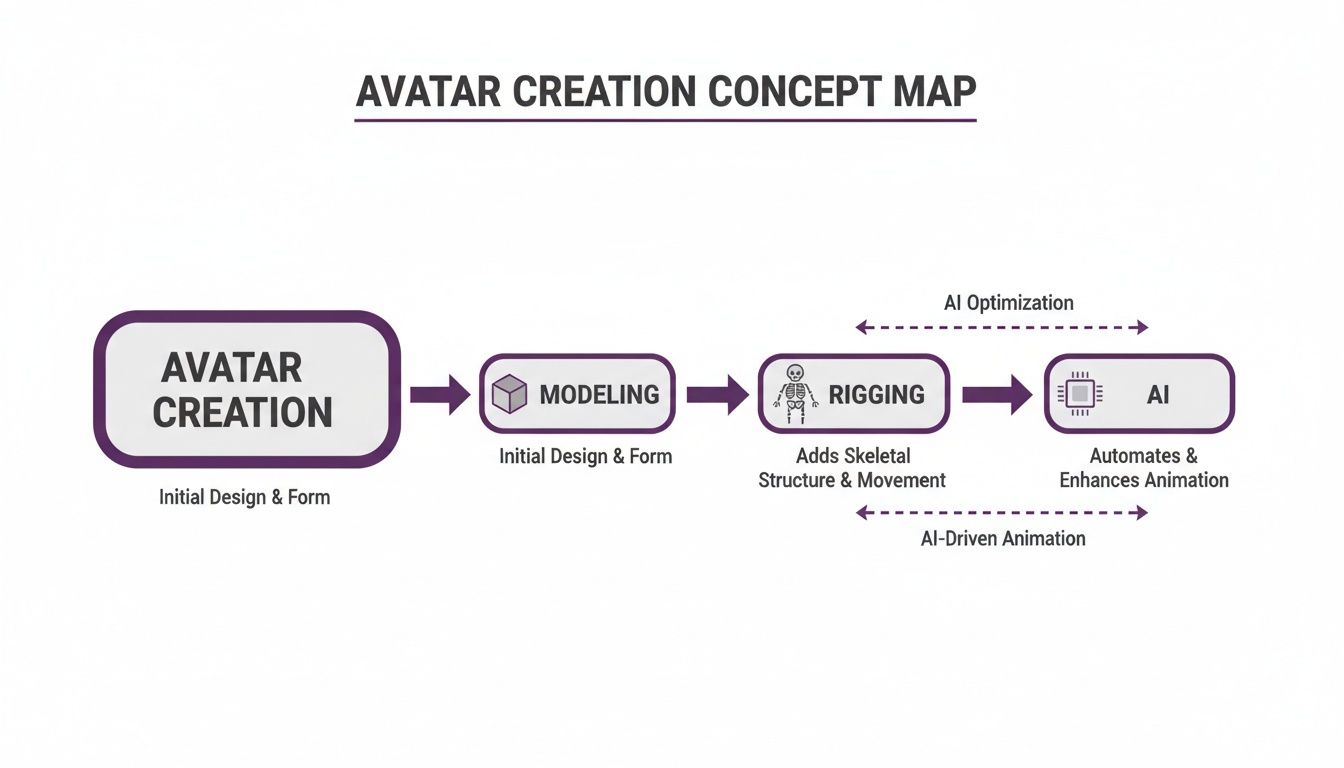
This map shows how foundational steps like 3D modeling and rigging now feed directly into an AI-driven process, smoothing the entire path to a final, animated character.
Breathing Life into Your Digital Character
Once your avatar looks the part, the next step is giving it a voice and personality. This is where AI features shine, automating tasks that once required a team of specialists and countless hours.
One of the most impressive features is AI-powered voice cloning. You can upload a short audio clip of any voice—yours, a voice actor's, or a licensed AI voice—and the platform can make your avatar say anything you write in that exact voice. It’s perfect for maintaining brand consistency or localizing content for different countries with authentic-sounding narration.
Alongside voice cloning, the system automatically handles the lip-syncing.
The AI analyzes the audio track and perfectly matches the avatar’s mouth movements to every word. This eliminates the painstaking, frame-by-frame animation work of the past, delivering a polished, natural result every time.
Automating the Finer Details
Great communication isn't just about what's said; it's how it's said. We’re talking about gestures, expressions, and accessibility. AI can handle all of that, too.
Platforms like LunaBloom AI integrate features that add these crucial layers of realism and professionalism.
- Automated Gesture Generation: To prevent your avatar from looking stiff, the AI generates subtle, natural-looking hand and body movements that match the script's tone, adding a dynamic feel to the performance.
- Automatic Subtitle Creation: To make your content accessible and boost engagement on social media, the platform can transcribe your audio and generate accurate subtitles automatically.
The entire process is designed to be seamless, as you can see in this overview of the LunaBloom AI platform.
You can see how essential tools—from choosing an avatar to generating a voice and adding subtitles—are integrated into one straightforward workflow. This kind of user-friendly integration is fueling the massive growth in this space.
In fact, the AI avatar market, driven by full body avatars, was valued at USD 0.62 billion in 2024 and is projected to hit USD 5.93 billion by 2032. This incredible expansion is happening because AI is making these characters more interactive and easier to create, giving anyone the power to produce professional-grade videos.
How Businesses Are Using Full Body Avatars
The tech behind full body avatars is fascinating, but their real value lies in solving business problems. Companies are using these digital characters to communicate more effectively, save money, and scale their messaging in ways that were previously impossible.
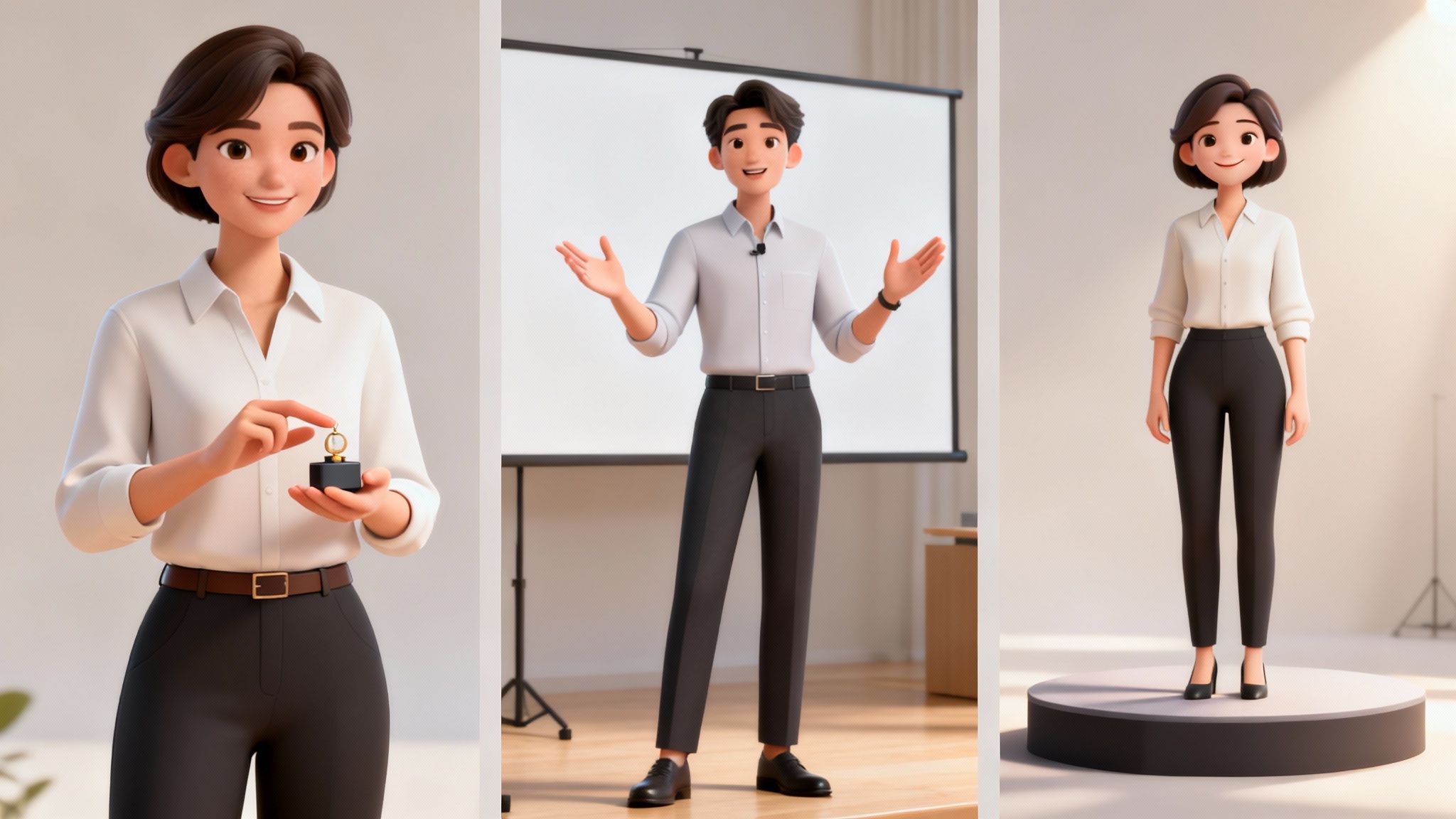
This isn’t about replacing people—it’s about amplifying their reach. An avatar can be a tireless brand ambassador, a patient trainer, or a dynamic presenter working 24/7, delivering a perfectly consistent message every time.
Shaking Up Marketing and Sales
In marketing, cutting through the noise is a constant challenge. Full body avatars are becoming a powerful tool for this, giving brands a consistent and recognizable digital persona across multiple channels.
An avatar can star in everything from social media campaigns and product tutorials to promo videos. And because they're digital, they offer incredible flexibility. You can take a single video and localize it into dozens of languages in minutes by simply swapping the script and cloning a new voice, tapping into global markets without the high cost of reshooting.
The e-commerce world is also getting creative. Many retailers use virtual dressing room technology that lets customers try on clothes online, often relying on personalized full body avatars to make the experience seamless.
A New Era for Corporate Training and Onboarding
For HR and learning departments, consistency and engagement are key. Creating training modules with live actors is expensive, slow, and difficult to update.
Full body avatars solve this problem. Companies can build an entire library of training content led by a friendly, professional digital instructor, guaranteeing every new hire receives the same high-quality information.
Research shows that using animated, expressive characters in training can improve information retention. When learners are engaged, they are far more likely to remember key concepts, leading to a better-trained workforce.
This approach not only cuts production costs but also makes the content more interesting than a boring slideshow.
Expanding Into New Communication Frontiers
Businesses are finding all sorts of innovative uses for these digital ambassadors. Here's a quick look at where these avatars are making an impact.
Full Body Avatar Applications and Benefits
This table breaks down common applications and their direct business benefits.
| Use Case | Primary Audience | Key Benefit |
|---|---|---|
| Marketing & Social Media | Potential Customers | Increased Brand Recognition & Engagement |
| Corporate Training | Employees | Consistent, Scalable & Cost-Effective Learning |
| Virtual Event Hosting | Event Attendees | Professional & Engaging User Experience |
| AI-Powered Customer Support | Customers | More Personal & Human-Like Interactions |
| Internal Communications | Employees | Efficient, Scalable & Personalized Messaging |
Each use case highlights a simple truth: avatars save significant time and money on video production while boosting audience engagement and message consistency.
This forward-thinking approach is why the market is growing so rapidly. In the U.S. alone, the digital avatar sector reached USD 5.82 billion in 2025 and is projected to hit USD 22.47 billion by 2030. Much of that growth comes from 3D full body avatars, which captured a 51.32% market share in 2024 due to their effectiveness in virtual worlds.
Other clever applications include:
- Virtual Event Hosts: Avatars can act as emcees for online conferences, adding a professional presence.
- AI-Powered Customer Support: A friendly avatar can be the face of a chatbot, making customer service feel more personal.
- Internal Communications: CEOs can use their digital twins to deliver company-wide announcements, saving time while maintaining a personal touch.
Best Practices for Engaging Avatar Videos
Creating a great video with a full body avatar is more than just a tech trick; it's an art. To connect with your audience, your avatar must feel real, trustworthy, and interesting. It's not just about looking sharp—it's about making a genuine connection.
The goal is to move past the novelty and deliver content that truly helps people. By following a few key practices, you can ensure your avatar videos not only look professional but also leave a lasting impact.
Write for a Human Voice, Not a Machine
The most common mistake in AI-generated video is a script that sounds robotic. Your avatar can look incredibly human, but if it speaks like an old text-to-speech app, the illusion is broken. Your script is everything.
Always write as if you're speaking to another person. A great trick is to read your script out loud; you'll immediately catch any awkward phrasing or jargon. Aim for a conversational tone, as if you're explaining something to a friend.
"Authenticity is the cornerstone of engagement. An avatar that speaks with a natural, conversational flow builds trust and makes the message more relatable and memorable for the viewer."
Achieving a natural feel is easier than you think. Just follow these simple rules:
- Keep It Simple: Ditch the corporate-speak. Clear, direct language always wins.
- Vary Your Sentences: Mix short, punchy sentences with longer, more explanatory ones to create a natural rhythm.
- Use Contractions: Saying "it's," "you'll," and "can't" instantly makes your script sound more human.
This simple shift in your writing can completely transform how your avatar is perceived, turning it from a digital puppet into a credible guide.
Match the Environment to the Message
Your avatar needs a background, and that environment does a lot of heavy lifting. It sets the tone and reinforces your message. The wrong background can be a major distraction that undermines your credibility.
Think about it: a financial update delivered from a cartoon beach scene just feels off. A clean, professional office works for most business topics, while a minimalist background is great when you want the focus to be on a creative idea. Be deliberate with your choice.
Use Gestures for Emphasis
One of the biggest advantages of full body avatars is their ability to use body language. Gestures are golden for adding emphasis, pointing things out, and keeping your viewers engaged. An avatar that just stands there is a missed opportunity.
Program gestures that align with your script. For example:
- Counting on Fingers: Perfect for listing out steps or key points.
- Pointing: A great way to direct your audience's attention to text or a graphic on screen.
- Open Hand Gestures: This classic gesture signals honesty and openness, which helps build trust.
Even small movements, like a slight head nod or a subtle shift in weight, add a ton of realism. These non-verbal cues make the avatar feel more alive and help hold your audience's attention.
The Future of Digital Identity and Communication
Looking ahead, full body avatars are set to become more than just a presentation tool; they're on track to be a fundamental part of our digital lives. We are on the verge of an era where hyper-realistic avatars, nearly indistinguishable from real people, will represent us in virtual meetings, online stores, and the metaverse.
This is about more than a graphics upgrade. We're talking about building persistent digital identities. Soon, your avatar will be your digital twin—a consistent, authentic version of you that can move seamlessly between different virtual worlds.
From Tools to Digital Twins
Right now, we use an avatar for a specific task. In the future, they will be our constant companions in the digital world. Imagine logging into a virtual conference, and your avatar is already there, ready to network and interact on your behalf.
This shift will reshape what it means to be "present" online. Instead of a flat profile picture, your digital twin will communicate your personality through subtle body language, leading to richer and more genuine online interactions.
Get Ahead of the Curve
This isn't a distant sci-fi dream; the foundation is being built today. The technology driving full body avatars is advancing at a dizzying pace, making them more realistic, accessible, and integrated every day. Embracing these tools now puts you at the forefront of a major shift in digital communication.
By learning to create and use full body avatars today, you’re not just acquiring a new skill. You're preparing for the next wave of digital interaction and positioning yourself as a leader in video content and digital identity.
Getting started now gives you a significant head start. You’ll be ready to captivate audiences in the immersive spaces of the future, building connections and telling stories in ways that are about to become the new standard.
Common Questions About Full Body Avatars
As you prepare to dive into the world of full body avatars, it's natural to have questions. This technology is moving fast, and understanding the practicalities will help you make the best decisions for your projects. Here are answers to the most common questions.
We'll cover everything from the technical skills you need (or don't) to the time it takes to build a custom character, giving you the straightforward answers needed to get started.
What Technical Skills Do I Need to Create an Avatar Video?
This is one of the biggest myths out there. While traditional 3D modeling requires years of training, modern AI platforms have made the process incredibly simple. The short answer? For most users, no technical skills are required.
Platforms like LunaBloom AI are designed to be user-friendly. If you can write a script and click a few buttons to customize an avatar’s appearance, you're ready to go. The AI handles all the complex background tasks, such as:
- Lip-Syncing: Automatically matching mouth movements to your audio.
- Gesture Generation: Adding natural body language to bring the avatar to life.
- Voice Cloning: Creating a realistic digital voice from a short audio sample.
Essentially, the AI does the heavy lifting, allowing you to focus on your message and creative vision.
Can I Use My Own Custom Full Body Avatar?
Absolutely. While many platforms offer a library of pre-made avatars, using a custom character is a smart way to align the video with your brand. It lets you create a unique digital personality that your audience will instantly recognize.
Using a custom full body avatar ensures your brand's digital persona is unique and consistent across all your video content, strengthening brand recall and trust with your viewers.
Most AI video creation tools, including LunaBloom AI, allow you to upload your own 3D model. Just be sure to check the required file formats. You'll commonly see formats like .FBX and .GLB, as they package all the essential data—the 3D mesh, textures, and the "rig" (or digital skeleton) that enables animation.
How Much Does a Full Body Avatar Cost?
The cost can vary dramatically depending on your approach. A fully custom, hyper-realistic avatar built from scratch by a professional 3D artist can cost anywhere from $5,000 to $50,000 or more.
The good news is that AI-powered platforms make this far more affordable. Most of these platforms operate on a subscription model, where access to avatar tools and video generation is bundled into a monthly or yearly fee. This approach eliminates the massive upfront investment, making professional-looking avatar videos accessible to small businesses and individual creators.
Ready to create stunning videos with your own digital presenter? With LunaBloom AI, you can generate and animate full body avatars in minutes, transforming your ideas into engaging video content without any technical hurdles. Start your video creation journey at https://lunabloomai.com.